wayground logo

Free Printable Worksheets

Font size

S
M
L
XL
Worksheets

Semester 2 Final Review

Total questions: 165

Worksheet time: 3hrs 17mins

Name
Class
Date
1.
How many molecules of sugar (C6H12O6) are in a mole?
a)
24 molecules
b)
180 molecules
c)
180 g
d)
6.02 x 10²³ molecules
2.
What methods can you use to measure the pH of a solution?
a)
Observing color or clarity
b)
Measuring mass or volume
c)
Measuring density or electrical conductivity
d)
Using acid base-indicators or pH meters
3.
Which changes of state are exothermic changes?
a)
condensation and freezing
b)
melting and evaporation
4.
An exothermic reaction:
a)
Produces heat when the reaction occurs
b)
Absorbs heat when a reaction occurs
5.
An endothermic reaction
a)
Produces heat when a reaction occurs
b)
Absorbs heat when a reaction occurs
6.

Which sample has hydrogen bonding?

a)

H2S

b)

CH4

c)

NH3

d)

HI

7.

Water has an unusually high boiling point for a molecular compound because it has

a)

hydrogen bonding

b)

ion-ion attractions

c)

a high density

d)

a large gram formula mass

8.

Which substance has the weakest intermolecular forces?

a)

Substance A, boiling point of 75 °C

b)

Substance B, boiling point of 105 °C

c)

Substance C, boiling point of 25 °C

d)

Substance d, boiling point of 45 °C

9.

The weaker the intermolecular forces of a substance the _____________ the boiling point

a)

higher

b)

lower

10.

________________________ have the strongest intermolecular forces of attraction.

a)

Dipole- Dipole

b)

Dispersion

c)

Hydrogen Bonds

11.
Hydrogen bonding occurs when hydrogen is bonded to N, O, or F.  Which of the following has hydrogen bonding?
a)
CBr4
b)
NO2
c)
H2S
d)
NH3
12.

Which of these has dispersion forces?

a)

I2

b)

NH3

c)

OCl2

d)

SH2

13.

Intermolecular forces for: NH3

a)

Dispersion Force

b)

Dipole dipole

c)

Hydrogen bonding

14.
Thermal energy ALWAYS moves from _____ to _____.
a)
solid to liquid
b)
ice to water
c)
hot to cold
d)
solid to gas
15.
Which of the following terms identifies the change from a liquid to gas?
a)
Evaporation
b)
Condensation
c)
Melting
d)
Freezing
16.
Which of the following terms identifies the change from a liquid to solid?
a)
Melting
b)
Condensation
c)
Evaporation
d)
Freezing
17.
When the temperature of matter increases the particles...
a)
speed up and move closer
b)
speed up and move farther apart
c)
slow down and move closer together
d)
slow down and move farther apart
18.
When the temperature of matter decreases the particles ...
a)
speed up and move farther apart
b)
speed up and move closer together
c)
slow down and move farther apart
d)
slow down and move closer together
19.
Phase change from a gas to a liquid.
a)
condensation
b)
evaporation
c)
melting
d)
freezing
20.
The phase change from water vapor to liquid water is known as...
a)
evaporation
b)
precipitation
c)
condensation
d)
sublimation
21.
What is it called when a solid turns directly into a gas?
a)
Sublimation
b)
Condensation
c)
Liquid
22.
Change from liquid to solid is call......
a)
fusion
b)
Freezing
c)
sublimation
d)
evaporation
23.
All changes in the state of matter of a substance requires...
a)
vibration
b)
water
c)
permission
d)
energy
24.
When a puddle of water dries up this process is called...
a)
Condensation
b)
Evaporation
c)
Melting
d)
Boiling
25.
Which two phases changes takes away energy?
a)
Freezing, Melting
b)
Condensation, Evaporation
c)
Freezing, Condensation
d)
Melting, Evaporation
26.
What happens to particle movement/speed when energy is added to a phase?
a)
Particles slow down
b)
Particles go faster
c)
Particles don't move
d)
Particles stay the same speed
27.
Gas pressure is caused by
a)
gas molecules colliding with surfaces
b)
gas molecules condensing to a liquid
c)
gas molecules hitting other gas molecule
d)
barometers
28.
a)
Flask 1 contain the most molecules
b)
Flask 2 contain the most molecules
c)
Flask 3 contain the most molecules
d)
Flask 4 contain the most molecules
29.
a)
Flask 1 contain the least pressure
b)
Flask 2 contain the least pressure
c)
Flask 3 contain the least pressure
d)
Flask 4 contain the least pressure
30.
a)
Since all flask have same amount of gas, flask 1 has the least pressure
b)
Since all flask have same amount of gas, flask 2 has the least pressure
c)
Since all flask have same amount of gas, flask 3 has the least pressure
d)
Since all flask have same amount of gas, flask 4 has the least pressure
31.
a)
Gas particles are elastic and do not attract each other.
b)
The kinetic energy of gas is dependent on temperature 
c)
Energy is not lost when gas particles collide with each other or with the walls of the container.
d)
All of the above
32.
Which among the following is not a property of gases?
a)
high compressible
b)
thermally expandable
c)
infinitely miscible
d)
high density
33.
Movement of gas through a tiny opening
a)
Diffusion
b)
Effusion
34.
What is the lightest gas in the Periodic Table of Elements?
a)
Helium
b)
Oxygen
c)
Hydrogen
d)
Neon
35.
Which of the following changes to a system WILL NOT result in an increase in pressure?
a)
Increasing the volume of the container
b)
Decreasing the volume of the container
c)
Adding more gas molecules
d)
Raising the temperature
36.
One assumption in KMT is that particles move in random straight line motion.
a)
True
b)
False
37.
What is the range of pH values in an acidic solution?
a)
0-7
b)
7-14
c)
15-239058204958
d)
pH = 7
38.
Which of the following is most likely to be basic:
a)
Lemon juice
b)
Vinegar
c)
Laundry detergent
d)
Coke
39.
A solution with a pH of 7 is________
a)
increasing
b)
neutral
c)
decreasing
d)
apple juice
40.
is this object acidic or base
a)
Acidic
b)
Base
c)
neither
d)
neutral 
41.
Tastes Sour
a)
Acids
b)
Bases
c)
Salts
d)
All
42.
Which of the following word pairs correctly completes the sentence below?
_______ are corrosive substances characterized as having a strong smell, a sour taste, and a _______.
a)
Acids; pH less than 7
b)
Acids; pH greater than 7
c)
Bases; pH greater than 7
d)
Bases; pH less than 7
43.
If an acid is combined with a base of equal strength, the result will most likely be
a)
a neutral solution.
b)
a stronger acid.
c)
impossible to tell without testing the pH.
d)
a stronger base
44.

Holly has an unknown substance in a beaker. She wants to determine the relative pH of the unknown substance. She places a piece of blue litmus paper into the substance, and the litmus paper stays blue.

The substance in the beaker

a)

is a base.

b)

has a neutral pH.

c)

is an acid.

d)

does not have a pH.

e)

Is a base or Neutral Solution

45.
Which of the following is a base?
a)
orange juice
b)
water
c)
vinegar
d)
dishwashing detergent
46.
Litmus paper can be used to determine the _______ of a substance.
a)
relative volume
b)
temperature
c)
relative pH
d)
chemical formula
47.
Which of the following statements is correct?
a)
Blue litmus paper turns red when placed in a base.
b)
Red litmus paper turns blue when placed in a base.
c)
Blue litmus paper stays blue when placed in an acid.
d)
Red litmus paper stays red when placed in a base.
48.
Carrie's teacher hands out test tubes filled with different chemicals and tells the students to identify their liquid as an acid, base, or neutral chemical. Carrie's test tube contains a clear chemical. She adds phenolpthalein to her test tube and gently moves the tube from side to side. A few moments later, the chemical in the test tube turns bright pink.
What type of chemical does Carrie have?
a)
Carrie has a neutral chemical.
b)
Carrie has an acidic chemical.
c)
Carrie has a basic chemical.
d)
The type of chemical Carrie has cannot be determined.
49.
 Which of the following is an acid?
a)
shampoo
b)
baking soda
c)
orange juice
d)
water
50.
When using pH paper, the pH of a solution can be determined by looking at the _______ of the paper.
a)
texture
b)
color
c)
length
d)
mass
51.
What would be considered the weakest base? 
a)
8
b)
14
c)
7.8
d)
11.6
52.
What is the molarity of 4 g of NaCl (MM=58.45) in 3,800 mL of solution?
a)
0.018 M
b)
0.0011 M
c)
1.052 M
d)
0.062 M
53.
Tastes bitter.
a)
Acids
b)
Bases
c)
Salts
d)
All
54.
How many grams of solute are dissolved in 125.0 mL of 5.00 M NaCl (MM = 58.45)?
a)
0.625 g NaCl
b)
625 g NaCl
c)
36.5 g NaCl
d)
0.04 mol NaCl
55.
Find the molarity of 186.55 g of sucrose, C12H22O11 (MM = 342) in 250 mL of water.
a)
2.18 M
b)
0.746 M
c)
1.18 M
d)
0.545 M
56.
True or False? The higher the concentration of a solution the less solutes it has in it.
a)
True
b)
False
57.
Calculate the molarity of the following solution:  1.0 mole of KCl in 750.0 mL of solution.
a)
0.750 M
b)
99 M
c)
1.3 M
d)
2.0 M
58.
What is the molarity of a solution made by adding 1.565 moles of PbNO3 to 500 mL?
a)
300. M
b)
31.3 M
c)
3.13 M
d)
1.56 M
59.
a)
Substance A because HCl is a strong acid, therefore, a strong electrolyte
b)
Substance A because HCl is a weak acid, therefore, a nonelectrolyte
c)
Substance B because HCl is a strong acid, therefore a nonelectrolyte
d)
Substance B because HCl is a weak acid, therefore a strong electrolyte
60.
Which of the following is the solute of a 0.5M NaOH solution?
a)
water
b)
Na
c)
OH
d)
NaOH
61.
In a sample of salt water, water would be considered the ______.
a)
Solute
b)
Solution
c)
Solvent
d)
Solvation
62.
If we are making Kool-aid with sugar, Kool-aid powder, and water, which part is the solvent?
a)
water
b)
powder
c)
sugar
d)
powder and sugar
63.
How many elements are in C6H12O6?
a)
1
b)
2
c)
3
d)
4
64.
How many atoms of carbon (C) are in C6H12O6?
a)
3
b)
6
c)
12
d)
24
65.
The red numbers in the image below represent ________
a)
subscripts
b)
coefficients
c)
I don't know, and don't want to try
d)
None of the answers are correct
66.
The blue numbers in the image below represent ________
a)
I don't know, and don't want to try
b)
coefficients
c)
subscripts
d)
none of the answers are correct
67.
In the equation,          2Mg + O2 ---> 2MgO, which are the reactants?
a)
Mg and O
b)
MgO
c)
Mg and MgO
d)
O and MgO
68.
How many atoms of aluminum are on each side of the following equation: 4Al + 3O--> 2AlO3
a)
2
b)
6
c)
1
d)
4
69.
Is the following equation balanced or unbalanced?
Fe + S --> FeS
a)
balanced
b)
unbalanced
70.
How many Sodium (Na) are in 6NaCl?
a)
1
b)
12
c)
6
71.
Decomposition occurs when...
a)
Two formulas combine.
b)
A formula breaks apart.
c)
An atom is replaced during a reaction.
72.
A synthesis occurs when...
a)
Two formulas combine.
b)
A formula breaks apart.
c)
An atom is replaced during a reaction.
73.
Is the equation balanced?: 2H2O + O2 --> 4MgO + 3Fe
a)
Yes
b)
No
74.
Which of the Following Correctly Balances this Equation? 
_H2+_Cl2 --> _HCl
a)
2H+ Cl2 --> 4HCl
b)
H2+Cl2 --> 2HCl
c)
3H+ 3Cl--> HCl
d)
H + Cl --> HCl
75.
What is the part of the chemical equation in green called? 
Fe + S --> FeS
a)
products
b)
reactants
c)
yield
d)
chemical formula
76.
At the end of chemical reactions, what is the total mass of the reactants compared to the total mass of the products?
a)
the product is doubled
b)
the product is half the mass of the reactants
c)
the mass is the same
d)
the mass changes depending on the reaction
77.
What does the Law of Conservation of Mass state?
a)
Matter cannot be gained or lost in a chemical reaction.
b)
Matter can only be lost in a chemical reaction.
c)
Matter can only be gained in a chemical reaction.
d)
Matter can be gained and lost in a chemical reaction. 
78.
What is the little number after an element in a chemical equation called.
Example: H2
a)
Coefficient 
b)
Subscript
c)
Atom
d)
Equation
79.
KNO3 --> KNO2 + O2
What coefficients are needed to balance the reaction?
a)
2, 2, 1
b)
2, 3, 2
c)
1, 2, 2
d)
1, 3, 1
80.
O2 + CS2 --> CO2 + SO2
What coefficient would go in front of the O2?
a)
1
b)
2
c)
3
d)
4
81.
BaF2 + K3PO4 --> Ba3(PO4)2 + KF
What coefficient goes in front of K3PO4?
a)
1
b)
2
c)
3
d)
4
82.
C2H6 + O2 --> CO2 + H2O
What coefficient would go in front of C2H6?
a)
1
b)
2
c)
3
d)
4
83.
Al + H2SO4 --> Al2(SO4)3 + H2
What coefficient goes in front of H2?
a)
1
b)
2
c)
3
d)
4
84.
Classify
CH4 + O2 → CO2 + H2
a)
single replacement
b)
double replacement
c)
synthesis
d)
combustion
85.
Classify
FeS + HCl → H
2S + FeCl2
a)
synthesis
b)
combustion
c)
single replacement
d)
double replacement
86.
Classify
Fe + O
2 → Fe2O3
a)
synthesis
b)
decomposition
c)
double replacement 
d)
single replacement
87.
AB + X --> XB + A
a)
synthesis
b)
decomposition
c)
single replacement
d)
double replacement
88.
XY --> X + Y
a)
synthesis
b)
decomposition
c)
single replacement
d)
double replacement
89.
Pb(NO3)2 + KI --> KNO3 + PbI2
a)
synthesis
b)
combustion
c)
single replacement
d)
double replacement
90.
C12H22O11 + O2 --> CO2 + H20
a)
synthesis
b)
acid base
c)
combustion
d)
acid base
91.
Mg + HCl --> MgCl2 + H2
a)
combustion
b)
synthesis
c)
decomposition
d)
single replacement
92.
Fe + O2 --> Fe2O3
a)
synthesis
b)
decomposition
c)
combustion
d)
acid base
93.
What coefficient should be used to make the following equation balanced?
N2+O2--> _NO 
a)
1
b)
2
c)
3
d)
4
94.
According to the activity series, which of the following single replacement reactions can occur?
a)
Ca + Al2(SO4)3
b)
Fe + NaOH
c)
Ni + MgSO4
d)
Al + KOH
95.
Which of the following equations represents the balanced synthesis reaction of iron (III) and oxygen?
a)
Fe + 3 O2 → Fe2O3
b)
3 Fe + 3 O2 → 2 Fe2O3
c)
2 Fe + O2 → Fe2O3
d)
4 Fe + 3 O2 → 2 Fe2O3
96.
What are the correct formulas and coefficients for the products of the following double-replacement reaction?
RbOH + H3PO4
a)
Rb3PO4 + 3 H2O
b)
Rb(PO4)3 + H2O
c)
H3Rb + PO4OH
d)
RbPO4 + 2 H2O
97.
Which of the following may indicate that a chemical reaction has occurred?
a)
release of energy as light
b)
gas bubble formation
c)
a color change
d)
all of these
98.
Which of the following would create a precipitate according to the solubility table?
a)
Ba(NO3)2
b)
K3PO4
c)
Cu(OH)2
d)
NH4Cl
99.
What is the molar mass of C6H12O6?
a)
180.18
b)
180.12
c)
180.24
d)
180.06
100.
Using the following equation:
Fe2O3(s) + 3H2(g) → 2Fe(s) + 3H2O(l)
How many moles of iron can be made from  6 moles H2
a)
4 moles Fe
b)
6 moles Fe
c)
9 moles Fe
d)
2 moles Fe
101.
N2 +  3H2 → 2NH3 
How many moles of hydrogen are needed to react with 2 moles of nitrogen?
a)
6
b)
2
c)
3
d)
1
102.
2H2   +   O2  →  2H2O
How many moles of water can be produced if 8 moles H2 are used?
a)
4 moles
b)
8 moles
c)
16 moles
d)
2 moles
103.
2 NaClO3 (s) --> 2NaCl (s) +3 O2 (g)  
12.00 moles of NaClO3 will produce how many grams of O2?
a)
256 g of O2
b)
576 g of O2
c)
288 g O2
104.
Balance the following reaction :
 
CaC₂(s)   +   H₂O(l)   -->   C₂H₂(g)   +   Ca(OH)₂(aq)
a)
1,2,2,2
b)
1,2,1,1
c)
2,1,1,1
d)
2,1,2,1
105.
For the Balanced Reaction: 3 Mg + 1 Fe2O3 → 3 MgO + 2 Fe; What is the Ratio of moles of Mg to moles Fe?
a)
3mol Mg / 2 mol Fe
b)
2 mol Mg/ 3 mol Fe
c)
1 mol Fe/ 2 mol Fe
d)
3 mol MgO / 2 mol Fe
106.
In the reaction 2 H2 + O2 → 2 H2O what is the mole ratio of oxygen to water
a)
1:2
b)
2:1
c)
3:4
d)
4:3
107.
How many grams are in 7.8 moles of NaCl?
a)
476grams
b)
460 grams
c)
452 grams
d)
462 grams
108.
Which process changes a gas to a solid?
a)
solidification
b)
deposition
c)
sublimation
d)
freezing
109.
Particles that make up a solid have the _____________ attraction toward each other. 
a)
strongest
b)
weakest
110.
Gases are described as having a 
a)
definite shape and indefinite volume
b)
indefinite shape and indefinite volume
c)
definite shape and definite volume
d)
indefinite shape and definite volume
111.
Solids are described as having a 
a)
definite shape and indefinite volume
b)
indefinite shape and indefinite volume
c)
definite shape and definite volume
d)
indefinite shape and definite volume
112.
When a liquid changes its phase and turns into a solid it is known as
a)
condensation.
b)
sublimation.
c)
vaporization.
d)
freezing.
113.
When a gas changes its phase and turns into a liquid it is known as
a)
condensation.
b)
sublimation.
c)
vaporization.
d)
freezing.
114.
In a solid, the particles
a)
vibrate in place
b)
slide past one another
c)
overcome the strong attraction
115.
The drops of water that appear on the outside of a glass of cold juice on a warm day are an example of?
a)
sublimation
b)
condensation
c)
evaporation
116.
A gas
a)
has a definite shape but no definite volume
b)
has a definite volume but no definite shape
c)
has fast-moving particles
117.
At higher temperatures
a)
particles in an object have less energy
b)
particles in an object move faster
c)
a gas contracts
118.
If you place a balloon in a freezer what happens to the size of the balloon?
a)
Doubles
b)
increases
c)
decreases
d)
stays still
119.
The temperature at which all molecular motion stops is
a)
-460 .C
b)
-273K
c)
0K
d)
0.C
120.
The energy of an object as it is in motion is defined as
a)
Kinetic Theory
b)
Kinetic energy
c)
Potential energy
d)
Electric energy
121.
The random molecular motion of a substance is greatest when the substance is
a)
condensed
b)
frozen
c)
gas
d)
a liquid
122.
What happens to the average kinetic energy of matter when it is heated?
a)
It increases
b)
It decreases 
c)
It doesn't change
d)
It cannot be determined
123.
In order to convert to Kelvin, you add ______ to the Celsius measurement.
a)
372
b)
273
c)
237
d)
732
124.
A gas
a)
has a definite shape but no definite volume
b)
has a definite volume but no definite shape
c)
has fast-moving particles
125.
What is the measure of the average kinetic energy of the particles in an object?
a)
Motion
b)
Temperature
c)
Thermal Energy
d)
Heat
126.
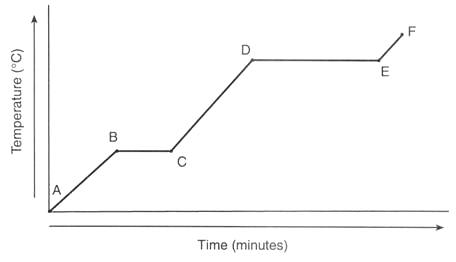
What letter represents the liquid phase?
a)
A
b)
C
c)
G
d)
H
127.
What letter represents boiling?
a)
E
b)
D
c)
B
d)
F
128.
What letter represents melting?
a)
E
b)
D
c)
B
d)
F
129.
What is point B called?
a)
critical point
b)
triple point
c)
normal melting point
d)
normal boiling point
130.
What is point D called?
a)
critical point
b)
triple point
c)
normal melting point
d)
normal boiling point
131.
Type of intermolecular force present in HF.
a)
dipole dipole
b)
dispersion
c)
H-bond
d)
ionic
132.
Intermolecular forces are the forces
a)
within molecules
b)
between molecules
133.
Which is the strongest intermolecular force below?
a)
Dipole Force
b)
London Dispersion
c)
Hydrogen Bonding
134.
Does CH4 have hydrogen bonding?
a)
yes
b)
no
135.
Does H2O have hydrogen bonding?
a)
yes
b)
no
136.
What happens to the temperature of a liquid as it evaporates?
a)
Stays the same
b)
Increases
c)
Decreases
137.
What will be the state of the following molecule?
a)
gas
b)
liquid
c)
solid
138.
How will the following molecule bond with itself?
a)
Dispersion
b)
Dipole
c)
Hydrogen bond
139.
Intermolecular force present in Cl2?
a)
dipole dipole
b)
H-bond
c)
dispersion
d)
metallic
140.
Type of intermolecular force present in HF.
a)
dipole dipole
b)
dispersion
c)
H-bond
d)
ionic
141.
Type of intermolecular force present in I2, Br2, and Cl2.
a)
dipole dipole
b)
H-bond
c)
dispersion
d)
metallic
142.
H2S has what kind of intermolecular force?
a)
dipole dipole
b)
dispersion
c)
H-bond
d)
ionic
143.
Evaporation is said to be a cooling process because
a)
evaporating molecules are more attracted to one another
b)
evaporating molecules absorb heat when they evaporate
c)
evaporating molecules give off heat when they evaporate
d)
evaporating molecules escape from the surface of a nonboiling liquid
144.
In which state are the particles least able to move?  (Which is the solid?)
a)
State A
b)
State B
c)
State C
d)
None
145.
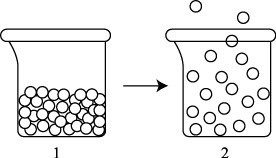
Which statement describes the process occurring from beaker 1 to beaker 2?
a)
Solid ice is changing into a gas.
b)
Liquid water is changing to gas.
c)
Solid ice is melting to liquid water.
d)
Gaseous steam is condensing to solid ice.
146.
What effect does soap have on the surface tension of water?
a)
it increases the surface tension of water
b)
it decreases the surface tension of water
c)
it has no effect on the surface tension of the water
d)
surface tension cannot be altered
147.
Why do hot liquids diffuse faster than cold liquids?
a)
the particles in a hot liquid experience greater intermolecular forces
b)
the particles in a hot liquid are relatively incompressible
c)
the particles in a hot liquid have a greater surface tension
d)
the particles in a hot liquid move faster
148.
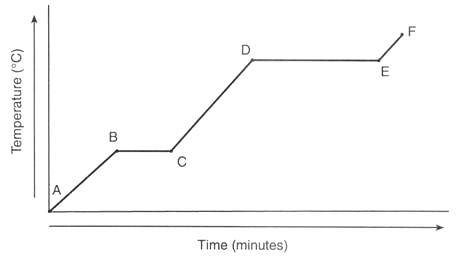
Describe the substance between letters A and B. 
a)
Solid
b)
Liquid
c)
Melting
d)
Evaporating
149.
Describe the substance between letters B and C. 
a)
Solid
b)
Liquid
c)
Melting
d)
Evaporating
150.
Describe the substance between letters C and D. 
a)
Gas
b)
Liquid
c)
Melting
d)
Evaporating
151.
Describe the substance between letters D and E. 
a)
Gas
b)
Liquid
c)
Melting
d)
Evaporating
152.
Describe the substance between letters E and F. 
a)
Gas
b)
Liquid
c)
Melting
d)
Evaporating
153.
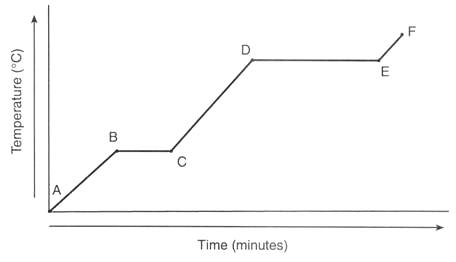
Between which points is the temperature of the substance increasing?
a)
A-B only. 
b)
A-B, C-D, E-F
c)
B-C only. 
d)
B-C, D-E
154.
Between which points is the temperature of the substance remaining constant?
a)
A-B only. 
b)
A-B, C-D, E-F
c)
B-C only. 
d)
B-C, D-E
155.
Between which points is heat not being added to the substance?
a)
Heat is always added
b)
A-B, C-D, E-F
c)
B-C only. 
d)
B-C, D-E
156.
Between which points is the substance changing its state of matter?
a)
A-B only. 
b)
A-B, C-D, E-F
c)
B-C only. 
d)
B-C, D-E
157.
How many states of matter are present during line segment AB?
a)
One
b)
Two
c)
Three
d)
Depends on the temperature
158.
How many states of matter are present during line segment BC?
a)
One
b)
Two
c)
Three
d)
Depends on the temperature
159.
How many states of matter are present during line segment CD?
a)
One
b)
Two
c)
Three
d)
Depends on the temperature
160.
How many states of matter are present during line segment DE?
a)
One
b)
Two
c)
Three
d)
Depends on the temperature
161.
Which process takes the longest to occur?
a)
melting
b)
boiling
c)
freezing
d)
heating the solid
162.
What state(s) of matter are present at D-E?
a)
Solid-liquid
b)
Liquid
c)
Liquid-gas
d)
Gas-Solid
163.
True or false: melting and freezing occur at the same temperature.
a)
True
b)
False
164.
Which segment represents the heat of vaporization?
a)
E-F
b)
B-C
c)
C-D
d)
D-E
165.
Looking at the heating curve above, What is occurring at letter B?
a)
Ice is melting to form liquid water.
b)
Liquid water is becoming warmer.
c)
Liquid water is boiling to form steam.
d)
Steam is becoming warmer