Wayground logo

Free Printable Worksheets

Font size

S
M
L
XL
Worksheets

Chem Midterm Review

Total questions: 117

Worksheet time: 5hrs 15mins
Name
Class
Date
1.
The amount of energy required to raise the temperature 1ºC for every kilogram is called____?
a)
Thermal Energy
b)
Specific Heat
c)
Temperature
d)
Kinetic Energy
2.
What is the symbol for Thermal Energy?
a)
Q
b)
t
c)
m
d)
C
3.
What unit do you use to measure Thermal Energy?
a)
J/Kg ºC
b)
Kg
c)
ºC
d)
J
4.
What is the symbol for Specific Heat
a)
Q
b)
t
c)
m
d)
C
5.
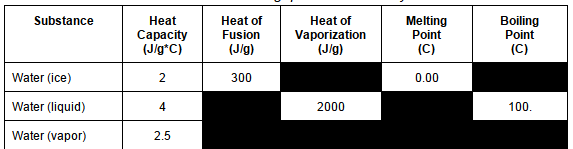
How many Joules of energy are required to change 10 gram of ice at -2 C to water at 20 C?
a)
440 J
b)
880 J
c)
10,140 J
d)
66,000 J
6.
How many Joules of energy are required to change 10 gram of water from 20 C to 90 C?
a)
1400 J
b)
2800 J
c)
210,000 J
d)
1,400,000 J
7.
How many Joules of energy are required to make 100 grams of ice at 0 C completely melt?
a)
200 J
b)
400 J
c)
30,000 J
d)
2,000,000 J
8.
How much liquid water can you change 20 C if you apply 20,000 J?
a)
500 g
b)
100,000 g
c)
250 g
d)
350 g
9.
How many Joules of energy are required to make 100 grams of ice at 0 C completely melt?
a)
200 J
b)
400 J
c)
30,000 J
d)
2,000,000 J
10.
The specific heat(c) of copper is 0.39 J/g °C. What is the temperature change(∆t) when 100 Joules of heat(Q) is added to 20 grams of copper?
a)
12.82 °C
b)
24.12°C
c)
351 °C
11.
20 g of water. specific heat of water is 4.18 J/g°C.  temperature changes from 25° C to 20° C, how much heat energy (Q) moves from the water to the surroundings?
a)
418 Joules
b)
209 J
c)
83 J
d)
4.18 J
12.
If 200 grams of water is to be heated from 24.0° C to  100.0° C to make a cup of tea, what is the mass and what is the change in temperature?
a)
m=100g,  ∆t= 224 C
b)
m=200g,  ∆t=124 C
c)
m=100g,  ∆t=24 C
d)
m=200g,  ∆t=76 C
13.
The specific heat of aluminum is 0.21 cal/g°C.  How much heat(Q) is released when a 10 g piece of aluminum foil is taken out of the oven and cools from 100° to 50°?
a)
105 J
b)
10.5 J
c)
1.05 J
d)
50 J
14.

How many Joules of energy are required to make 100 grams of ice at 0 οC completely melt? The specific latent heat of fusion of ice is 334 J/g

a)

200 J

b)

400 J

c)

33,400 J

d)

2,000,000 J

15.

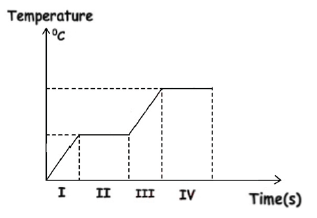
Consider the following temperature-time graph when a solid is heated. which part of the graph involves latent heat of vaporization?

a)

Part I

b)

Part II

c)

Part III

d)

Part IV

16.
Exothermic reactions...
a)
Absorb energy
b)
Release energy
c)
Release Color
d)
Absorb Color
17.
In an endothermic reaction, heat is ,,,
a)
taken in
b)
given out
18.
How much energy is required to completely boil away 150g of 10o C water? Use C = 4.184 J/goC for water, and Hv = 2260 J/g.
a)
56,484 J
b)
339,000 J
c)
395,484 J
d)
385,484 J
19.

If a 8.50g ice cube at -10o C sits out on the counter, completely melts, and then warms to room temperature (25o C) how much energy did the ice cube absorb? Use Cice=2.11J/goC, Cwater=4.18J/goC, Csteam=2.00J/g°C, Hfus=334J/g, Hvap=2260J/g

a)

179 J

b)

2839 J

c)

889 J

d)

3907 J

20.

The particles of this state of matter are close together

a)

Solid

b)

liquid

c)

Gas

21.
What is the formula for density?
a)
density = mass x volume
b)
density = mass / volume
c)
density = mass + volume
d)
density = mass - volume
22.
Frank has an eraser. It has a mass of 4g, and a volume of 2cm3. What is its density?
a)
8 g/cm3
b)
2 g/cm3
c)
1/2 g/cm3
d)
24 g/cm3
23.

Which type of energy has to do with objects in motion?

a)

Potential

b)

Kinetic

24.

Which condition is necessary for most gases to behave nearly ideally?

a)

high pressure

b)

high temperature

c)

low compressibility

d)

low expansion

25.

Which of the following is not a physical property of gases?

a)

absence of definite volume

b)

large density

c)

high compressibility

d)

fluidity

26.

For a fixed amount of gas at a constant temperature, the volume increases as the pressure...

a)

remains steady.

b)

increases.

c)

decreases.

d)

fluctuates.

27.

When Temperature of a gas increases, the Volume will ____________________

a)

Increase

b)

Decrease

c)

Stay the Same

28.

When Temperature of a gas increases, the Pressure will ____________________

a)

Increase

b)

Decrease

c)

Stay the Same

29.

When Volume of a gas increases, the Pressure will ______________

a)

Increase

b)

Decrease

c)

Stay the Same

30.

What is the Standard for Temperature and Pressure?

a)

273 K and 1 atm

b)

273 C and 1 kPa

c)

273 F and 1 mmHg

d)

273 K and 1 Torr

31.

Which of the following set of conditions would allow a gas to behave ideally?

(HINT: Remember that gases like to spread far apart! Which conditions would allow the molecules to easily spread apart?)

a)

High Temperature, Low Pressure

b)

High Temperature, High Pressure

c)

Low Temperature, High Pressure

d)

Low Temperature, Low Pressure

32.
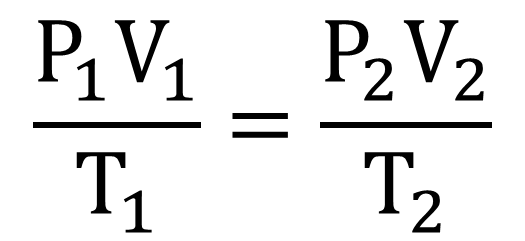
A gas is heated from 263K to 298K. The volume is increased from 24.0L to 35.0L. If the original pressure was 1.00 atm, what is the new pressure?
a)
0.78 atm
b)
1.65 atm
c)
1.28 atm
d)
0.61 atm
33.

A weather balloon has a volume of 105L at 0.97 atm when the temperature is 318K. What is the volume at 293K and 1.05 atm?

a)

89.4 L

b)

0.32 L

c)

93.8 L

d)

3.13 L

34.
A sample of gas with a volume of 30.0 mL at 25.0oC is heated to 50.0oC.  What is the new volume of the gas?
a)
60.0 mL
b)
15.0 mL
c)
27.5 mL
d)
32.5 mL
35.
A sample of oxygen at 28.0°C has 340.0 kPa. What will its temperature be at 150.0 kPa?
a)
132.8 K
b)
132.8 °C
c)
682.2 K
d)
12.35 K
36.
A sample of a gas has a volume of 852 mL at 298 K. What temperature is necessary for the gas to have a volume of 945 mL?
a)
57.5 °C
b)
57.5 °K
c)
330.5 K
d)
330.5°C
37.

A water bottle at STP is cooled to -155°C. What is the new pressure?

a)

3.2 atm

b)

0.43 atm

c)

1.8 atm

d)

0.27 atm

38.

The pressure of a 6.5 L sample of oxygen gas is measured to be 3.8 atm. If the gas is transferred into a 12 L tank, what is the new pressure?

a)

6.6 atm

b)

3.9 atm

c)

4.5 atm

d)

2.1 atm

39.

who discovered the electron

a)

Dalton

b)

J.J Thomson

c)

Lavoisier

d)

Rutherford

40.

What is the charge of a proton?

a)

Negative

b)

Positive

c)

Neutral

41.

What is the charge of a neutron?

a)

Negative

b)

Positive

c)

Neutral

42.
These will determine what element an atom is. 
a)
number of neutrons
b)
number of electrons
c)
number of atoms 
d)
number of protons 
43.

Subatomic particles with a negative charge

a)

Electrons

b)

Neutrons

c)

Protons

d)

Quarks

44.
Subatomic particles with a positive charge
a)
neutrons
b)
atomic mass
c)
protons
d)
isotopes
45.

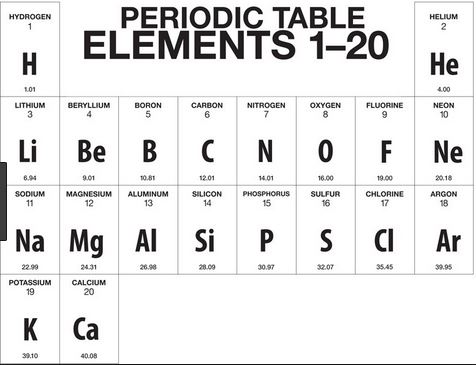
The number 16 for the atomic element sulfur is the

a)

ionic number

b)

isotope

c)

atomic mass

d)

atomic number

46.

How many protons does sulfur have?

a)

32

b)

16

c)

48

d)

12

47.

How many electrons does sulfur have

a)

16

b)

32

c)

48

d)

12

48.
What is the atomic mass of "F"
a)
9
b)
18
c)
17
d)
19
49.
An atom of the element with atomic number 6 always has _____.
a)
six protons in its nucleus
b)
an atomic mass of six
c)
more than six neutrons
d)
six electron clouds
50.
What are subatomic particles? 
a)
the nucleus 
b)
electron cloud
c)
positive charge
d)
electrons, protons, and neutrons
51.
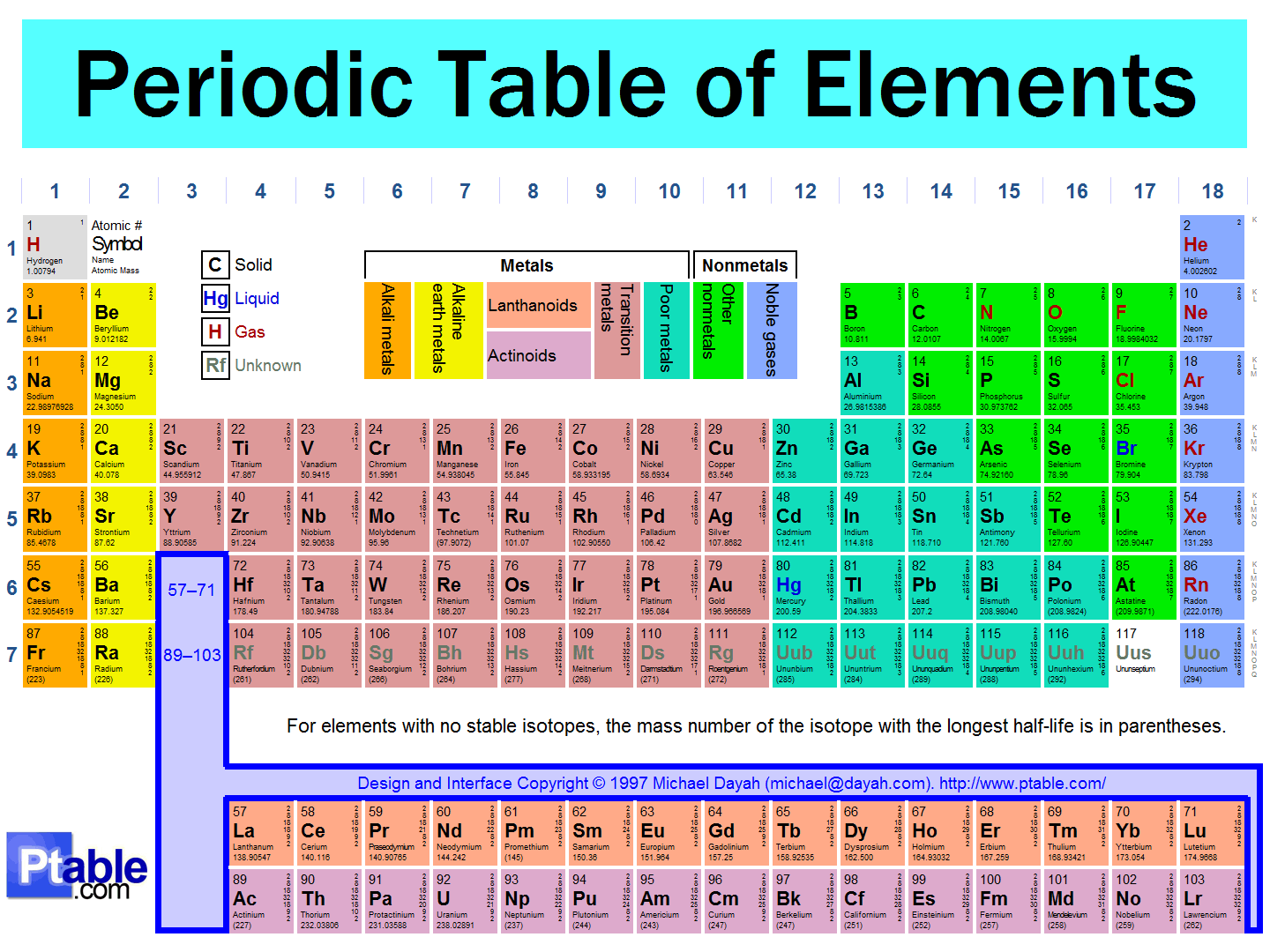
How many electrons does potassium K contain? (click to see image)
a)
19
b)
39
c)
20
d)
40
52.

How many neutrons does a Hydrogen atom have?

a)

1

b)

2

c)

3

d)

0

53.

What atom matches this electron configuration?
2-8-2

a)
Neon
b)
Magnesium
c)
Aluminum
d)
Potassium
54.
Which is the electron configuration for an oxygen atom?
a)

2-3

b)

2-6

c)

2-8-6

d)

2-8

55.
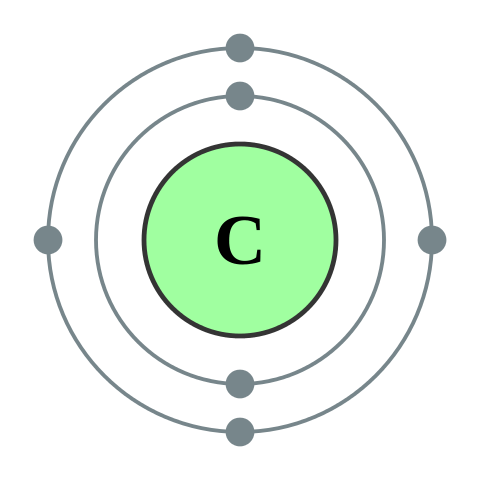
How many valence electrons are represented here?
a)
7
b)
5
c)
2
d)
8
56.

What is this element? 
2-8-18-8

a)
Argon
b)
Krypton
c)
Selenium
d)
Bromide
57.
How many electrons can the first energy level hold?
a)
1
b)
2
c)
8
d)
0
58.
How many valence electrons does Chlorine have?
a)
5
b)
2
c)
7
d)
5
59.

The bright-line spectra produced by four elements are represented in the diagram below.

a)

A and X

b)

A and Z

c)

D and X

d)

D and Z

60.

Which elements are present in the mixture

a)

G and J

b)

G and L

c)

M, J, and G

d)

M, J, and L

61.

Metal atoms are most likely to form...

a)

positively charged cations.

b)

negatively charged anions.

c)

neutral molecules.

d)

bations.

62.

Non-Metal atoms are most likely to form...

a)

positively charged cations.

b)

negatively charged anions.

c)

neutral molecules.

d)

bations.

63.
An atom that has gained or lost electrons is called ...
a)
a winner
b)
an isotope
c)
an ion
d)
a loser
64.
Atoms that gain electrons become...
a)
negatively charged
b)
positively charged
c)
remain neutrally charged
d)
21
65.
If an aluminum atom has 13 protons (+) and 10 electrons (-), what is it's charge?
a)
Al3+
b)
Al13+
c)
Al10+
d)
Al10-
66.
If an oxygen atom has 8 protons (+) and 10 electrons (-), what is it's charge?
a)
O10-
b)
O8+
c)
O2-
d)
O10+
67.
An ionic bond is the attraction between:
a)
oppositely charged ions
b)
similarly charged ions
c)
neutral ions
d)
neutral atoms
68.

The vertical (up and down) columns in the Periodic Table are called

a)

groups

b)

towers

c)

periods

d)

atomic numbers

69.
The Modern Periodic Table of Elements is arranged by
a)
atomic mass
b)
atomic number
c)
valence electrons
d)
number of isotopes
70.
Which group of the periodic table is composed of inert (not reactive)  gases?
a)
alkali metals
b)
alkaline earth metals
c)
halogens
d)
noble gases
71.
The atoms along the staircase are called 
a)
metals
b)
nonmetals
c)
metalloids
d)
noble gases
72.
Which is a halogen?
a)
Helium
b)
Chlorine
c)
Oxygen
d)
Neptune
73.
Elements in a ..................have similar chemical properties.  
a)
period
b)
group
c)
row
74.
As you move down a group, atomic radius increases because - 
a)
you add more and more neutrons
b)
you add more and more protons
c)
you add more and more shells (energy levels)
d)
you add more atomic mass
75.
Electronegativity is...
a)
the ability of an atom to attract/ accept electrons
b)
the ability of an atom to lose electrons
c)
the energy required to remove an electron from a specific atom
d)
how easy it is to make friends. 
76.
Which has the greater Electronegativity: 
N or C?
a)
C
b)
N
77.
As atoms of elements in group 16 are considered in order from top to bottom, the electronegativity of each successive element....
a)
decreases
b)
increases
c)
remains the same
d)
none of the above
78.
Elements in the same column of the periodic table always have the same # of _______ as one another.
a)
Protons
b)
Neutrons
c)
Electrons
d)
Valence Electrons
79.
How many valence electrons are in an atom of K?
a)
3
b)
8
c)
4
d)
1
80.
How many valence electrons are in an atom of Ar?
a)
2
b)
8
c)
4
d)
1
81.
Which of the following is the correct LD Diagram for Hydrogen Cyanide? HCN?
a)
A
b)
B
c)
C
d)
D
82.
How many bonds form around Hydrogen and all of the Halogens. 
a)
1
b)
2
c)
3
d)
4
83.
How many Valance electrons does Iodine Have?
a)
6
b)
16
c)
7
d)
17
84.

This is a correct dot diagram for neon (Ne)

a)

True

b)

False

85.

By replacing the element symbol, this could be the dot diagram of

a)

Mg

b)

Cl

c)

C

d)

O

86.

This is a correct dot diagram for nitrogen (N)

a)

true

b)

false

87.

How many valence electrons does carbon have?

a)

4

b)

5

c)

6

d)

7

88.

How many valence electrons does Aluminum Have?

a)

1 Valence electron

b)

2 Valence electron

c)

3 Valence electron

d)

4 Valence electron

e)

5 Valence electron

89.

Which is the correct molecular structure for carbon dioxide?

a)
b)
c)
d)
90.

This is a correct dot diagram for fluorine (F)

a)

true

b)

false

91.

This is a correct dot diagram for oxygen (O)

a)

true

b)

false

92.

According to the Octet Rule, atoms of elements react with each other in order to attain ____ electrons in their outermost energy level or shell.

a)

2

b)

4

c)

6

d)

8

e)

10

93.

Which of the following elements LOSES 1 electron in order to attain an octet?

a)

potassium

b)

calcium

c)

helium

d)

boron

e)

fluorine

94.

Which of the following elements GAINS 1 electron in order to attain an octet?

a)

sodium

b)

calcium

c)

helium

d)

boron

e)

chlorine

95.

What are chemical bonds?

a)

forces that hold atoms together

b)

electrons that are glued together

c)

areas between protons

d)

the force of gravity on an atom

96.

The chemical bond that forms when electrons are transferred is called:

a)

Ionic

b)

hydrogen

c)

covalent

97.

The chemical bond that forms when electrons are shared is called:

a)

Ionic

b)

hydrogen

c)

covalent

98.
What type of bond is illustrated above?
a)
Metallic
b)
Ionic
c)
Covalent
d)
Wiggly
99.
A solid substance is an excellent conductor of electricity. The chemical bonds in this substance are most likely?
a)
ionic, because the valence electrons are shared between atoms
b)
covalent, because the valence electrons are mobile
c)
metallic, because the valence electrons are stationary
d)
metallic, because the valence electrons are mobile
100.

A compound is made of two nonmetals. It is

a)

ionic

b)

metallic

c)

covalent

101.

A compound forms between a metal and a nonmetal. It is

a)

ionic

b)

metallic

c)

covalent

102.
Ions have unequal numbers of 
a)
neutrons and protons.
b)
protons and electrons.
c)
electrons and neutrons.
103.
Why do some elements form ions?
a)
to be stable
b)
to be happy
c)
to have more energy
d)
to create mass
104.
When is an atom stable?
a)
when it has plenty of friends and family that love it
b)
when it has a full valence electron shell
c)
when it has an empty valence electron shell
d)
when its protons equal its neutrons
105.
When atoms form ions they obtain an electron configuration similar to a __________.
a)
metal
b)
halogen
c)
alkali metal
d)
noble gas
106.
Ionic bonds occur between __________ atoms.
a)
two metal
b)
two nonmetal
c)
metal and nonmetal
d)
two noble gas
107.
_____ tend to form negative anions.
a)
metals
b)
nonmetals
108.
_____ tend to form positive cations.
a)
metals
b)
nonmetals
109.
As an ion, nitrogen has a ____ charge.
a)
5+
b)
5-
c)
3+
d)
3-
110.
As an ion, bromine has a ____ charge.
a)
1+
b)
1-
c)
2+
d)
2-
111.
As an ion, potassium has a ____ charge.
a)
1+
b)
1-
c)
2+
d)
2-
112.
What explains the very high melting and boiling point of water
a)
Strong dipole-dipole bonds between water molecules
b)
Strong hydrogen bonds between water molecules
c)
Dispersion forces which are present in all molecules
d)
Asymmetrical shape of the polar bonds.
113.
Does HCl have hydrogen bonding?
a)
yes
b)
no
114.

Intermolecular forces for: NH3

a)

Dispersion Force

b)

Dipole dipole

c)

Hydrogen bonding

115.
Rank these in order of strength:
covalent bond
London forces
hydrogen bond
dipole-dipole attraction
a)
dipole-dipole>covalent bond>hydrogen bond>London
b)
London>dipole-diple>hydrogen bond>covalent bond
c)
covalent bond>hydrogen bond>dipole-dipole>London
d)
hydrogen bond>dipole-dipole>London>covalent bond
116.

Which is not a bond, but is an intermolecular force?

a)

Covalent Bond

b)

Ionic Bond

c)

Hydrogen Bond

d)

These are all bonds

117.

Water's polarity is primarily due to:

a)

Unequal sharing of electrons between hydrogen and oxygen

b)

Equal sharing of electrons between hydrogen and oxygen

c)

The presence of only oxygen atoms in the water molecule

d)

The absence of hydrogen atoms in the water molecule