
 Worksheets
Quarter 3 Review
Total questions: 115
Worksheet time: 3hrs 37mins

Element
Compound
Homogeneous Mixture
Heterogeneous Mixture


Which particle diagram represents one substance in the gas phase?


Diamond and Graphite have different properties because diamond has
carbons joined by fewer covalent bonds
carbon atoms with more dense nuclei than graphite
carbon atoms with more protons than carbon atoms in graphite
molecules with a different structure than graphite
0.00345
24.28 + 12.5
(12.470)(271)
3400
3379.37
3379
3380

Which letter indicates where water is in both the solid and liquid phase at the same time?
A
B
C
D
E

The melting point of the sample is
-60 ºC
20 ºC
60 ºC
100 ºC
A measure of the average kinetic energy of the particles in an object is called
Heat
Temperature
Kinetic energy
Enthalpy
If the specific heat of water is 4.18 J/g∙°C, how much heat is required to increase the temperature of 1,200 g of water from 23 °C to 39 °C?
-80,256 J
80.256 J
80,256 J
-80.256 J
How much heat is needed to change 12 grams of ice at 0 ºC to 12 grams of water at 0ºC?
Q = 12 x 4.18 x 0
Q = 12 x 334
Q = 12000 x 334
Subatomic particles with a negative charge
Electrons
Neutrons
Protons
Quarks

What is the atomic mass of Neon?
10
20
30

How many neutrons does calcium have?
20
40
60
0
What is the net charge of an ion which has 11 protons, 10 electrons and 12 neutrons
-1
0
+1
+2
What is the state when electrons move to a higher energy level upon absorption of energy?
active state
inactive state
excited state
ground state
What form of energy is emitted when an excited electron returns to the ground state?
Photon (light)
Heat
Kinetic
Potential

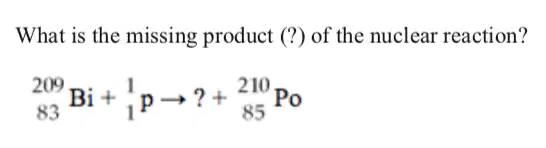
What is the missing product (?)
a neutron
an alpha particle
a beta particle
a positron

Which element has a higher electronegativity value?
Niobium
Tin
Cadmium
Iodine
Electronegativity (a) as you go down a group.
What is the number of electrons shared between the atoms in a molecule of N2?
3
6
4
2
In metallic bonds electrons are:
shared
move around the nuclei randomly
transferred
What could be a charge on aluminum?
1+
2+
3+
4+
H-H is...
polar
nonpolar
MgO is...
ionic
metallic
covalent

CO2 is...
polar
nonpolar

Water is...
polar
nonpolar

NH3 is...
polar
nonpolar
How many moles of hydrogen are needed to react with 2 moles of nitrogen?
How many moles of water can be produced if 8 moles H2 are used?
48.86 g of cobalt is equal to how many moles of cobalt?
2879 moles
8.291 moles
.8291 moles
.829 moles
How many moles of sodium chloride are in a 321.8 g sample?
18810 moles
3.315 x 1024 moles
5.507 moles
4.767 moles
N2+O2--> _NO
Mg + __HCl ---> MgCl2 + H2
Balance this equation
_Al +_HCl --> _H2 +_AlCl3
2,6,3,2
it's already balanced
4,12,3,4
2,1,4,5
The energy of movement is ___.
potential energy
kinetic energy
mechanical energy
The more energy that particles have, the ___ they move.
slower
faster
The force of attraction between molecules is ___.
intermolecular forces
bridge forces
chemical bonds
Which one of these is NOT an Ideal Gas Assumption?
Gas particles are hard, round spheres.
Gas particles are strongly attracted to one another.
Gas particles do not take up space.
Gas particles collide perfectly elastically.

Ideal gas particles _____. CLICK ALL CORRECT ANSWERS.
move randomly
have no kinetic energy
repel each other
have no mass or volume
have mass and volume
Which statement describes a Real gas?
no attractive forces between particles
particles have volume
volume of particles is not significant
At STP, which gas sample has the same number of molecules as 7.0 L of CO2 (g) at STP?
7.0 M of NH3 (g)
7.0 g of NH3 (g)
7.0 mol of NH3 (g)
7.0 L of NH3 (g)
A student measures the pressure and volume of an empty water bottle to be 1.4 atm and 2.3 L. She then decreases the pressure to 0.65 atm. What is the new volume?
2.1 L
5.0 L
8.2 L
3.9 L
A student inflates a balloon with helium then places it in the freezer. The student should expect
the balloon's volume to increase
the balloon's volume to decrease
the balloon's moles to increase
the balloon's moles to decrease
If a hairspray can is heated, what can be expected of the pressure of the gas inside the can?
The pressure will increase
The pressure will decrease
The pressure will remain constant
The pressure will equalize
Pressure is
defined as the mass that an object exerts when at rest.
not a measurable in gases.
defined as the number of moles of substance divided by the mass of the substance.
created by the force of the gas particles impacting the walls of the container.
The weaker the intermolecular forces of a substance the _____________ the boiling point
higher
lower
Which substance has the weakest intermolecular forces?
Substance A, boiling point of 75 °C
Substance B, boiling point of 105 °C
Substance C, boiling point of 25 °C
Substance d, boiling point of 45 °C

According to the reference table, what is the boiling point of ethanoic acid at 80 kPa?
28 oC
100oC
111oC
125oC

Which liquid has the highest vapor pressure at 75oC?
ethanoic acid
ethanol
propanone
water

At which temperature is the vapor pressure of ethanol equal to the vapor pressure of propanone at 35oC?
35oC
60oC
82oC
95oC

Water is the univeral ____.
solute
solvent
solution
solute + solvent =
solution
equation
A solution contains 35 grams of KNO3 dissolved in 100 grams of water at 40°C. How much more KNO3 would have to be added to make it a saturated solution?
29 g
24 g
12 g
4 g
According to Table F, which of these salts is least soluble in water?
LiCl
RbCl
FeCl2
PbCl2
According to your Reference Tables, which of these compounds is the least soluble in water?
K2CO3
KC2H3O2
Ca3(PO4)2
Ca(NO3)2
According to Reference Table F, which substance is most soluble?
AgI
CaSO4
PbCl2
K2CO3
According to Reference Table F, which compound is most soluble in water?
ZnCO3
ZnSO4
BaSO4
BaCO3
A 2400.-gram sample of an aqueous solution contains 0.012 gram of NH3. What is the concentration of NH3 in the solution, expressed as parts per million?
5.0 ppm
15 ppm
20. ppm
50. ppm
What is the concentration of a solution in parts per million if 0.02 grams of NaCl is dissolved in 1000 grams of solution?
2 ppm
20 ppm
200 pm
0.2 ppm
If you have 34 mL of a 0.5 M NaBr solution, what will the concentration be if the new solution volume is 100 mL?
.188 M
3.78 M
.389 M
1.76 M
What is the molarity of a 0.5L sample of a solution that contains 60.0 g of sodium hydroxide (NaOH)
0.8 M
1.5M
3.0M
6.0M
If the temperature is reduced, a reaction rate will ______
increase
decrease
stay the same
If the concentration of a reactant is increased, the reaction rate will ___________.
increase
decrease
stay the same

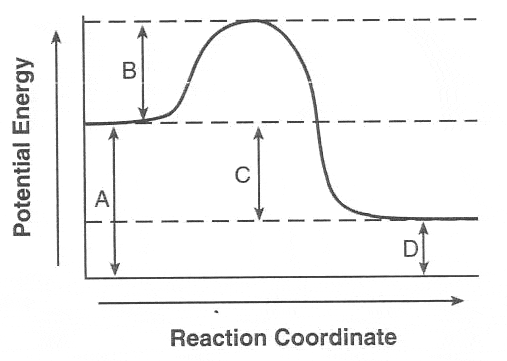
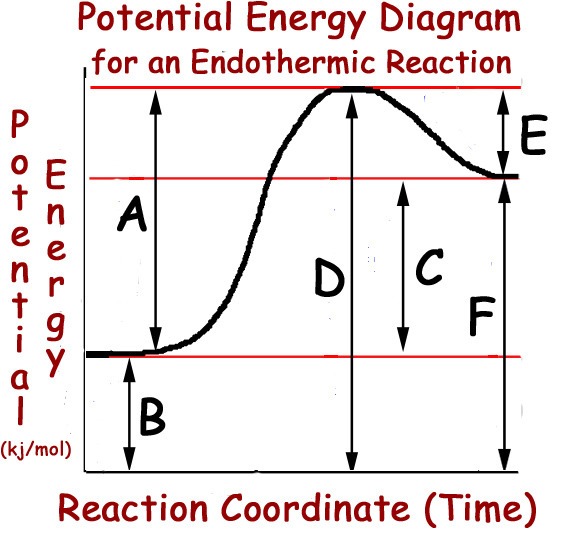
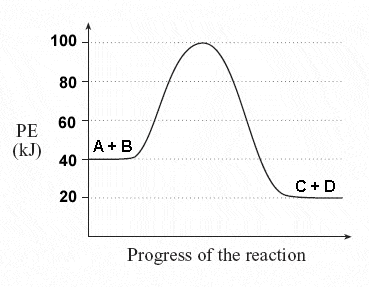
What is the change of the heat of the reaction (ΔH)?
-40 kJ
-20 kJ
100 kJ
60 kJ

What is the change of the heat of the reaction (ΔH)?
100 kJ
-175 kJ
-50 kJ
75 kJ

How much energy is produced in the reaction between aluminum and oxygen as written on Table I
-3351 kj
-890.4 kj
-6072 kj
-2219.2 kj

How much energy is produced in the combustion reaction of 2 mol CH3OH with O2 on Table I?
-1452 kj
-2904 kj
-726 kJ
-890.4 kj

How much energy is produced in the reaction between 4C + 2H2 --> 2C2H2 on Table I?
+227.4 kj
-227.4 kJ
+454.8 kj
-454.8 kj
How much energy is produced in the reaction 2NH3 --> N2 + 3H2 on Table I?
+91.8 kj
+66.4 kJ
-91.8 kj
-66.4
The following equation shows the reaction between Ag+ and Cl− ions.
Ag+ + Cl− -> AgCl Δ H= -65 kJmol−1
Which of the following is true about the above equation?
Exothermic reaction occurs
Heat is absorbed from the surrounding
The energy content of the reactants is less than the products
65 kJ of heat is absorbed when 1 mole of silver chloride is formed
At 101.3 kPa and 298 K, a 1.0-mole sample of which compound ABSORBS the greatest amount of heat as the entire sample dissolves in water?
LiBr
NaCl
NaOH
NH4Cl
At 101.3 kPa and 298 K, a 1.0-mole sample of which compound ABSORBS the greatest amount of heat as the entire sample dissolves in water?
LiBr
NaCl
NaOH
NH4Cl
Based on Table I, which compound dissolves in water by an exothermic process?
NaCl
NaOH
NH4Cl
NH4NO3
Which of the following will lower the rate
of reaction?
adding an enzyme to the reaction
decreasing the temperature from 40°C to
10°C
breaking a chunk of calcium up into
smaller pieces
increasing the amount of solute
dissolved in a solution
Which factors affect the rate of a reaction? (select all that apply)
temperature
concentration
surface area
pressure
catalyst

Which letter represents the activation energy for the reverse reaction?
A
B
C
D
E

What is the activation energy of the forward reaction?
20 kJ
40 kJ
60 kJ
80 kJ
100 kJ
What is the activation energy of the reverse reaction?
20 kJ
40 kJ
60 kJ
80 kJ
100 kJ

