Wayground logo

Free Printable Worksheets

Font size

S
M
L
XL
Worksheets

Semester 1 Review 2023-2024

Total questions: 105

Worksheet time: 2hrs 35mins

Name
Class
Date
1.

Matter is anything that.....

a)

Has mass and takes up space

b)

Has mass and is visible

c)

Takes up space and has energy

d)

Has energy and is visible

2.

What particle view below is a mixture?

a)

b)

c)

d)

3.

What is the best classification for this substance?

a)

An element

b)

A compound

c)

A mixture

4.

Is this a pure substance?

a)

Yes

b)

No

5.

What is the best classification of this substance?

a)

An element

b)

A compound

c)

A mixture of 2 elements

d)

A mixture of 2 compounds

6.

What is an example of a physical property?

a)

Silver is shiny

b)

Alcohols are flammable

c)

Alkali metals are reactive with water

d)

Acids are sometimes corrosive

7.

What is an example of a chemical change?

a)

Tearing paper

b)

Dissolving salt in water

c)

Melting ice

d)

Burning wood

8.

Is this image showing a homogeneous or a heterogeneous mixture? Image: Cesar salad

a)

homogeneous

b)

heterogeneous

9.

Is this image showing a homogeneous or a heterogeneous mixture? Image: Milk

a)

homogeneous

b)

heterogeneous

10.

Does this image represent a chemical or a physical change?

a)

Chemical change

b)

Physical change

11.

Does this image represent a chemical or physical change?

a)

Chemical change

b)

Physical change

12.
Subatomic particle with a charge of 0
a)
neutron
b)
proton
c)
electron
d)
quark
13.

Subatomic particles with a negative charge

a)

Electrons

b)

Neutrons

c)

Protons

d)

Quarks

14.
Subatomic particles with a positive charge
a)
neutrons
b)
atomic mass
c)
protons
d)
isotopes
15.
These will determine what element an atom is. 
a)
number of neutrons
b)
number of electrons
c)
number of atoms 
d)
number of protons 
16.

The number 16 for the atomic element sulfur is the

a)

ionic number

b)

isotope

c)

atomic mass

d)

atomic number

17.

How many electrons does sulfur have

a)

16

b)

32

c)

48

d)

12

18.
What is the atomic mass of "F"
a)
9
b)
18
c)
17
d)
19
19.
An atom of the element with atomic number 6 always has _____.
a)
six protons in its nucleus
b)
an atomic mass of six
c)
more than six neutrons
d)
six electron clouds
20.
How many electrons does potassium K contain? (click to see image)
a)
19
b)
39
c)
20
d)
40
21.

How many neutrons does a Hydrogen atom have?

a)

1

b)

2

c)

3

d)

0

22.

What is the mass number?

a)

the number of protons in the nucleus

b)

the number of protons and neutrons in the nucleus

c)

the number of neutrons in the nucleus

d)

the number of protons and electrons in the atom

23.

What is the atomic number?

a)

the number of protons in the nucleus

b)

the number of protons and neutrons in the nucleus

c)

the number of neutrons in the nucleus

d)

the number of protons in the energy levels
24.

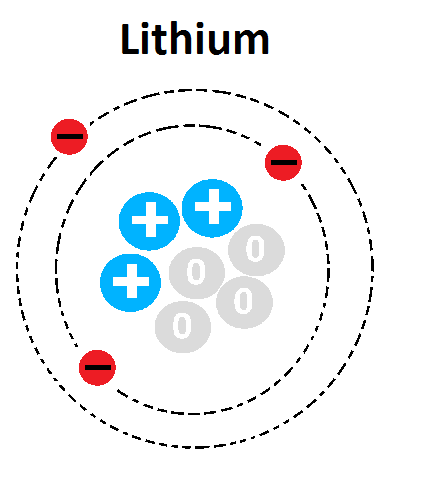
What is the atomic number of this atom?

a)

1

b)

3

c)

4

d)

7

25.

What is the mass number of this atom?

a)

1

b)

3

c)

4

d)

7

26.
How is the number of neutrons in the nucleus of an atom calculated?
a)
Add the number of e- and p+ together
b)
Subtract the number of e- from p+
c)
Subtract the number of p+ from the mass number
d)
Add the mass number to the number of e-
27.

An atom has 10 protons, 15 neutrons and 10 electrons what is its mass number.

a)

20

b)

10

c)

35

d)

25

28.
An element with a mass number of 11 and an atomic number of 5 has how many neutrons?
a)
11
b)
5
c)
6
d)
16
29.

Isotopes of an element have a different number of...

a)

Protons

b)

Neutrons

c)

Electrons

d)

Mass

30.
How many neutrons does an atom of the isotope Neon-22 have?
a)
12
b)
10
c)
22
d)
20
31.
How many neutrons does a Sodium 24 isotope have?
a)
12
b)
13
c)
14
d)
15
32.

76 protons and 114 neutrons

a)

Osmium-114

b)

Osmium-76

c)

Osmium-190

d)

Osmium-190.23

33.
In a correctly written symbol what would be located in the "A" position?
a)
number of neutrons
b)
atomic number
c)
number of electrons 
d)
mass number
34.
What is the name of the pictured isotope?
a)
Copper-29
b)
Copper-63
c)
Copper-34
d)
CopperWopperHopperBopper
35.
Four isotopes of lead include lead-204, lead-206, lead-207, and lead-208.  The average atomic mass of lead is 207.2.  Which isotope of lead is likely to be the most abundant.
a)
204
b)
206
c)
207
d)
208
36.
If X is the symbol for an element, which of the following two symbols represent    isotopes of the same element?     I. 7735X  II. 7733X  III. 8137X  IV. 8135 X
a)
I and II
b)
III and IV
c)
I and IV
d)
I and III
37.
How many neutrons does the isotope below have?     89 36Kr
a)
53
b)
36
c)
89
d)
125
38.

Which elements are to the right of the zig zag?

a)

metals

b)

nonmetals

c)

metalloids

39.

Sulfur is considered:

a)

malleable

b)

brittle

c)

ductile

d)

a good conductor

40.

ductile means...

a)

can be made into wire

b)

can be bent or hammered

c)

can light up a light bulb

d)

it's shiny

41.

Which elements are to the LEFT of the zigzag?

a)

metals

b)

nonmetals

c)

metalloids

42.

Vanadium (V) is a good conductor, malleable and ductile. What type of element is vanadium?

a)

Metal

b)

Nonmetal

c)

Metalloid

d)

Superconductor

43.

Silicon is a semiconductor and has properties of both metals and nonmetals. What type of element is Silicon?

a)

Metal

b)

Nonmetal

c)

Metalloid

d)

Superconductor

44.
All of these properties describe metals except...
a)
malleable
b)
conductors
c)
brittle 
d)
shiny
45.

Which elements are found along the zig-zag line?

a)

metals

b)

nonmetals

c)

metalloids

d)

superconductors

46.
Which element is least likely to conduct heat and electricity? 
a)
O
b)
Si
c)
Po
d)
Ca
47.
Evidence of a chemical reactions is anything that shows - 
a)
a new substance has formed
b)
a solid dissolved in a liquid
c)
interaction between 2 gases
d)
a change in the state of matter
48.
One of the signs of a chemical reaction taking place is:
a)
Bubbles are produced 
b)
Reactants are not combining
c)
Products are not forming
d)
Color is not changing
49.
Which of the following describes a precipitate?
a)
a liquid forms when a block of metal is heated
b)
a solid forms when one liquid is poured into another
c)
a gas forms when a solid is placed in a liquid
d)
bubbles form when an acid is poured on a rock
50.
Which is NOT an indication of a chemical change?
a)
temperature change
b)
formation of a precipitate
c)
shape change
d)
production of light
51.
A clear liquid from a flask is poured into another clear liquid in a beaker. Which of the following results of this procedure would indicate a new substance was formed?
a)
The level of the substance in the beaker is higher after the other liquid is added.
b)
A yellow solid forms and then settles to the bottom of the beaker.
c)
Small white crystals are left behind in the flask that held the first liquid.
d)
The mass of the combined liquids is greater than either original liquid.
52.
Which of the following is an example that includes evidence of a chemical reaction?
a)
A sample of zinc is placed in water and it settles to the bottom
b)
A solid block of ice is heated and it completely melts into a liquid. 
c)
Sugar that is burned gives off an odor and turns brown and then black.
d)
A tomato is placed into a blender and chopped up into smaller pieces.
53.

The Metric System is based on powers of:

a)

5's

b)

10's

c)

20's

d)

50's

54.

How many milligrams are in 100 grams? Convert 100 grams (g) to milligrams (mg).

a)

10 mg

b)

1,000 mg

c)

100,000 mg

d)

1,000,000 mg

55.

There are ___ millimeters (mm) in 2.7 centimeters (cm)

a)

270 mm

b)

0.27 mm

c)

27 mm

d)

.027 mm

56.
To go from kilograms to grams, move the decimal point to the .....
a)
left
b)
right
57.
To go from milliliters to liters, move the decimal point to the ....
a)
left
b)
right
58.

He claimed that matter was made of small, hard particles that he called “atomos.”

a)

Democritis

b)

Dalton

c)

Moseley

d)

Einstein

59.

What is the Law of Definite Proportions?

a)

The Law of Definite Proportions states that the mass of a compound is always equal to the sum of the masses of its elements.

b)

A chemical compound always contains the same elements in the same proportions by mass.

c)

The Law of Definite Proportions only applies to organic compounds.

d)

A chemical compound contains different elements in different proportions by mass.

60.
Matter can not be created nor destroyed: it can only be
a)
Destroyed a little bit
b)
Invisible
c)
Transformed, changed
d)
None of the above
61.
If reaction starts with 20g of reactants it should produce 
a)
a total of 40g of products
b)
a total of 10g of products
c)
a total of 80 g of products
d)
a total of 20g of products
62.
In a reaction A + B ----> C,  reactant A has 5g and product  C has 9g. How many grams does reactant B should have? 
a)
4g
b)
5g
c)
9g
d)
14g
63.
What is the Law of Conservation of mass?
a)
Mass is created in a chemical reaction
b)
Mass is created in a physical change
c)
New chemicals formed from a chemical reaction have a larger overall mass than the original reactants
d)
Mass is never created or destroyed
64.
Bob puts 200 grams of ice into a pitcher with 900 grams of water. He gets distracted and comes back later to find that the ice has melted in the water. How many grams of water does Bob now have in the pitcher?
a)
200 g
b)
700 g
c)
1,100 g
65.
24 g of magnesium reacts with 38 g of fluorine to produce _____ g magnesium fluoride
a)
62 
b)
38
c)
24
d)
14
66.

Has the "Plum Pudding" model of the atom

a)

Dalton

b)

Thomson

c)

Rutherford

d)

Bohr

67.

Discovered energy levels and explained why electrons didn't fall to the center of the atom

a)

Dalton

b)

Thomson

c)

Rutherford

d)

Bohr

68.

Discovered the positively charged nucleus

a)

Dalton

b)

Thomson

c)

Rutherford

d)

Bohr

69.

Discovered the electron

a)

Dalton

b)

Thomson

c)

Rutherford

d)

Bohr

70.

Which law states that a chemical compound contains the same elements in exactly the same proportion regardless of the size of the sample

a)

Law of Conservation of Mass

b)

Law of Definite Proportions

c)

Law of Multiple Proportions

71.
What does it mean if a mixture is heterogeneous?
a)
you can see the different parts
b)
cannot tell one part from another
c)
very well blended
d)
made of elements
72.
What does it mean if a mixture is homogeneous?
a)
you can see the different parts
b)
cannot tell one part from another
c)
chunks of particles
d)
made of elements
73.
Two classifications of a pure substance are
a)
homogeneous and heterogeneous
b)
atoms and elements
c)
elements and compounds
d)
solutions and colloids
74.
What is the name of this element?
a)
Helium
b)
Hydrogen
c)
Argon
d)
Silver
75.
How are electrons arranged in an atom?
a)
In groups of five
b)
In energy levels
c)
By color
d)
By shape
76.

How many electrons can fit on the 1st energy level (orbital) for any Bohr Model?

a)

2

b)

6

c)

8

d)

10

77.

What is the mass number of this atom of Chlorine?

a)

17

b)

18

c)

35

d)

35.453

78.
A nuclear reaction where a nucleus splits into two smaller nuclei is... 
a)
Fission
b)
Fusion
c)
Gamma decay
d)
Beta decay
79.
What happens when the number of protons in an atom changes? 
a)
The number of electrons changes too 
b)
Usually nothing happens, unless the atom is radioactive 
c)
The atomic nucleus explodes
d)
It becomes a completely different atom, with different properties 
80.
What element is the ?
a)
Ag-115
b)
Cd-115
c)
Pd-115
d)
Not Listed
81.
Which type of nuclear radiation is being emitted here?
a)
alpha
b)
beta
c)
gamma
d)
none
82.
Which type of nuclear radiation is being emitted here?
a)
Alpha
b)
beta
c)
gamma 
d)
none
83.
Balance the following equation:
146C --> 0-1e + ________
a)
145B
b)
146C
c)
147N
d)
42He
84.
Two or more nuclei combine to form one larger nucleus in the process of nuclear _____.
a)
Fusion
b)
Fission
c)
Tracing
d)
Decay
85.
The time needed for half of a radioactive sample to decay is called its __________.
a)
decay period
b)
period
c)
transmutation time
d)
half-life
86.

When the isotope 5024X releases an alpha particle we get another element Y that looks like

a)

5022Y

b)

4622Y

c)

4820Y

d)

5426Y

87.

When the isotope 5024X releases a beta particle we get another element, Y, that looks like

a)

5023Y

b)

4622Y

c)

5025Y

d)

5024Y

88.

What is meant by the statement that 3215P has a half life of 14 days

a)

It takes 7 days to go down to 50% radioactivity each time

b)

It takes 14 days to go down to 50% radioactivity each time

c)

After 14 days it starts to become less radioactive

d)

It takes 14 days to go up by 50% radioactivity each time
89.

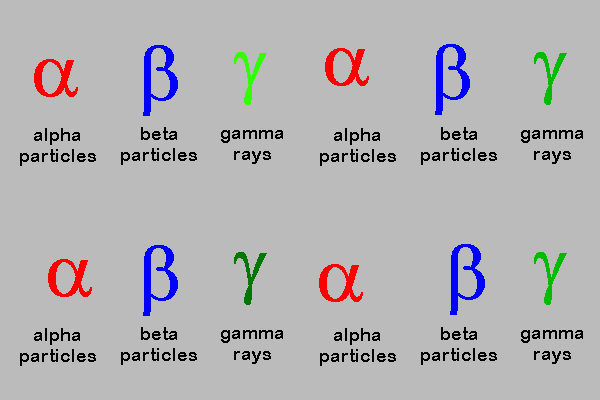
In order of most to least penetrating radiation we have

a)

Alpha , Beta, Gamma

b)

Beta , Gamma , Alpha

c)

Gamma, Beta, Alpha

d)

Gamma, Alpha, Beta

90.
The half life of Thorium-234 is 24 days. What fraction of the element remains after 96 days
a)
1/2
b)
1/4
c)
1/8
d)
1/16
91.
The technetium-99 isotope has a half-life of 6.0 hours. If 100.0 mg were injected into a patient how much remains after 18 hours?
a)
33.0 mg
b)
12.5 mg
c)
.33 mg
d)
15.8 mg
92.
Which element is pictured?
a)
neon
b)
fluorine
c)
magnesium
d)
argon
93.
Which element is depicted from this orbital diagram
a)
Fluorine
b)
Neon
c)
Chlorine
d)
Argon
94.
This orbital diagram represents:  
a)
C
b)
B
c)
N
d)
O
95.
What is incorrect about this orbital diagram?
a)
Both arrows in the 2p box should be pointing up
b)
There is nothing incorrect with this diagram
c)
In the 2p box there should only be 1 electron in the first 2p box and one in the 2nd 2p box
d)
All the arrows should be pointing up.
96.
Which orbital shows a violation of Hund's Rule?
a)
A
b)
B
c)
C
d)
D
97.
What electron configuration matches an oxygen atom?
a)
1s22s22p63s2, 3p64s23d104p5
b)
1s22s22p4
c)
1s22s22p6
d)
1s22s22p63s23p64s23d1
98.
What do you start electron configuration with?
a)
1s2
b)
1d10
c)
1f14
d)
1p6
99.

What atom matches this electron configuration?

1s22s22p63s23p64s23d10

a)

zinc

b)

copper

c)

nickel

d)

germanium

100.

What is the short-hand electron configuration for sulfur?

a)

[Ar] 3p4

b)

[He] 3s2 3p4

c)

[Ne] 3s2 3p4

d)

[Na] 3s2 3p4

101.

What is the short hand configuration for silicon?

a)

[Ar]2s22p2

b)

[Ne]2s22p2

c)

[Ne]3s23p2

d)

[Ne]3s23p4

102.
Which electron configuration belongs to Chlorine (Cl)?
a)
1s2 2s2 2p6 3s2 3p5
b)
1s2 2s2 2p6 3s2 3p6
c)
1s2 2s2 2p6 3s2 3p7
103.
Which atom is it who has 3 energy levels and 4 valence electrons? 
a)
Carbon
b)
Lithium
c)
Silicon
d)
Aluminum
104.
What is the number of valence electrons for Carbon?
a)
12
b)
6
c)
5
d)
4
105.
How many valence electrons does Calcium have? How many energy levels does Calcium have?
a)
2 valence: 4 energy levels 
b)
20 valence:  4 energy levels 
c)
4 valence: 2 energy levels 
d)
2 valence: 3 energy levels