
 Worksheets
States and Gas Laws
Total questions: 76
Worksheet time: 2hrs 25mins
A solid is a state of matter that has a(n)
indefinite volume and indefinite shape
definite volume and a definite shape
definite volume and an indefinite shape
indefinite volume and a definite shape
The freezing point of water is the same as its
melting point
boiling point
sublimation point
evaporation point
An uncovered pot of soup is simmering on a stove, and there are water droplets on the wall above the back of the stove. What sequence can you infer has occurred?
melting, then boiling
freezing, then thawing
vaporization, then condensation
condensation, then vaporization
In a(n) (a) , the particles are packed closely together, but they can move past each other freely.
The common state of matter that does not have a definite shape or a definite volume is a(n) (a) .
The characteristic temperature at which a pure solid changes to a liquid is its (a) point.
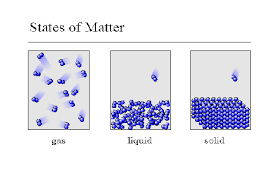
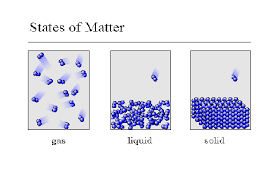
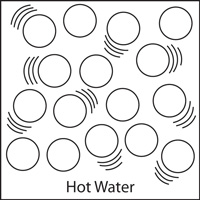
The slower the particles in a substance move (click all that are correct!)


In CHARLES'S LAW, volume and temperature have a ______ proportionality.
direct
inverse
linear
exponential
In BOYLE'S LAW, what type of relationship do pressure and volume have?
Direct
Inverse
No relationship
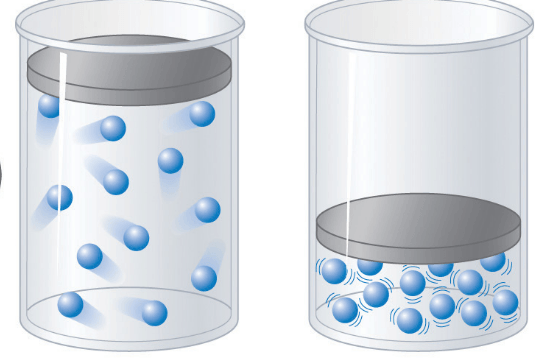
Which container will have a lower pressure?
left
right
they both have the same pressure

What type of relationship is Charles' Law?
Inverse
Direct
Not enough information
#goals
In CHARLES' LAW, at constant pressure, what happens to temperature of a gas when the volume doubles?
The temperature also doubles.
The temperature decreases to half of its original volume.
The temperature doesn't change.
The temperature quadruples.

The reason gases can be compressed is because:
The particles are very close together.
The particles are merely vibrating.
The particles are unable to move.
The particles are very far apart.

Pressure in gases is a measure of:
the number of collisions per second of the particles with the side of the container.
the force of the collisions of the particles with the side of the container.
the amount of space taken up by the particles in the container.
None of the above
In CHARLES' LAW, at constant pressure, what happens to temperature of a gas when the volume doubles?
The temperature also doubles.
The temperature decreases to half of its original volume.
The temperature doesn't change.
The temperature quadruples.
In BOYLE'S LAW, when Pressure increases then the Volume must...
Increase
Decrease
In BOYLE'S LAW, when Volume increases then Pressure must...
Increase
Decrease
Which container will have a lower pressure?
left
right
they both have the same pressure
What causes pressure?
The walls of the container
The vacuum in the container
The collisions of the particles
Atmospheric pressure acting on the outside walls
If the temperature of a gas increase, the pressure... (volume is constant)
decreases
increases
does not change
If a balloon is cooled what will happen to the volume?
Volume will increase
Volume will decrease
Volume will not change
A student inflates a balloon with helium then places it in the freezer. The student should expect
The balloon's volume to increase
The balloons volume to decrease
If a hairspray can is heated, what can be expected of the pressure of the gas inside the can?
The pressure will increase
The pressure will decrease
The pressure will remain constant
The pressure will equalize
Edelman and Gronkowski want to play a game of beach volleyball. If the beach ball has a volume of 400 L at a temperature of 500 K, what will the temperature of the balloon be if the volume decreases to 176 L?
176 L
500 K
400 L
220 K
(Don’t forget about what must be done to temperatures!)
As you go higher in the atmosphere, the amount oxygen available:
stays the same
decreases
increases

