
 Worksheets
Atoms
Total questions: 45
Worksheet time: 23mins
What is the chemical symbol for the element with atomic number 1?
He
H
Li
Be
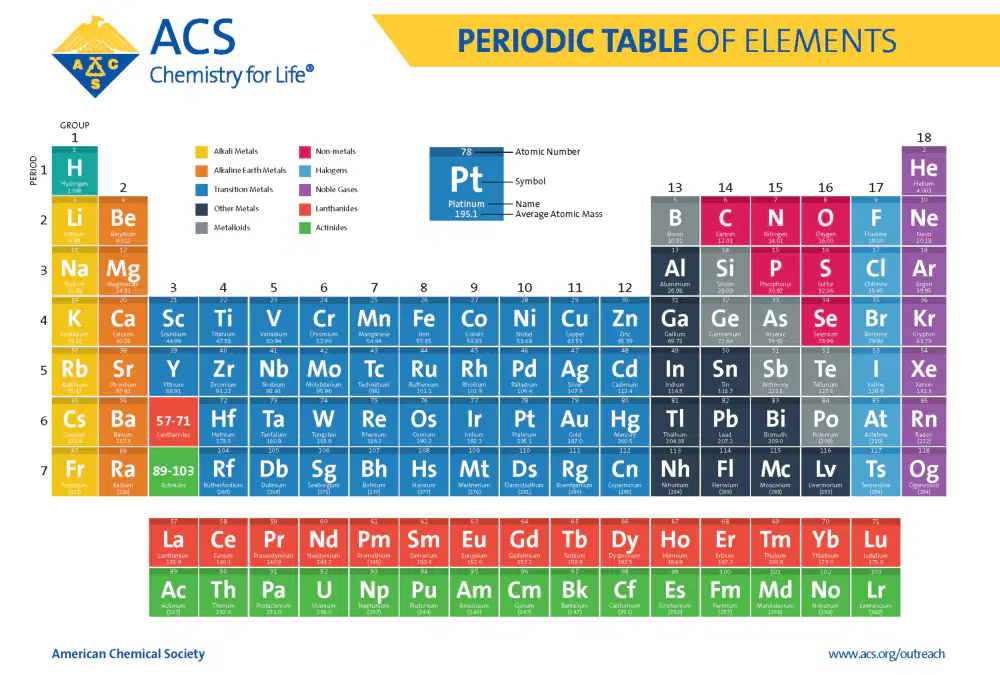
What color is used to represent metalloids in the periodic table provided in the image?
Green
Grey
Purple
Blue
What is an atom?
The largest particle of an element
The smallest particle of an element that still has the properties of that element
A combination of elements
A molecule
What is the simplest form of matter?
A compound
A molecule
An atom
An element
How many atoms of hydrogen are there in a water molecule (H₂O)?
1
2
3
4
Who was the first person to name the atom?
John Dalton
Dmitri Mendeleev
Democritus
Isaac Newton
What does the word 'atomus' mean in Greek, as used by Democritus?
Small particle
Basic unit
Indivisible
Invisible
What was John Dalton's model of the atom known as?
Electron Cloud model
Solid Sphere model
Nuclear model
Planetary model
According to John Dalton's Solid Sphere model, what are compounds?
Atoms of the same element combined
Atoms of different elements combined
Molecules that can't get any smaller
Elements that are indivisible
Who developed the first periodic table of elements organized by atomic mass?
Albert Einstein
Niels Bohr
Dmitri Mendeleev
Ernest Rutherford
What year was the Plum Pudding Model proposed by J.J. Thomson?
1897
1904
1911
1920
According to the Plum Pudding Model, what is the charge of the sphere in which the negative particles are embedded?
Negatively charged
Positively charged
Neutral
No charge
What was the main discovery of Ernest Rutherford's Gold Foil Experiment?
The atom is indivisible
Electrons orbit the nucleus in fixed paths
The atom consists of a nucleus with a surrounding electron cloud
The mass of the atom and its positively charged particles are in the nucleus
Which model of the atom is associated with the Gold Foil Experiment?
Dalton's Model
Thomson's Plum Pudding Model
Rutherford's Nuclear Model
Bohr's Model
Who discovered the number of protons is unique to each element (atomic number) in 1913?
Niels Bohr
Schrodinger and Heisenberg
Henry Moseley
John Dalton
What did Niels Bohr propose in his model of the atom in 1913?
Electrons are positive particles that travel in fixed orbits.
Electrons travel in random paths around the nucleus.
Electrons are negative particles that travel in fixed orbits around the positively charged nucleus.
The nucleus is surrounded by an electron cloud divided into shells.
What is the key feature of the Electron Cloud model proposed by Schrodinger and Heisenberg in 1926?
Electrons travel in fixed orbits around the nucleus.
The nucleus is surrounded by an electron cloud that is not divided into shells.
Electrons do not travel in fixed orbits but exist in electron clouds.
Protons are surrounded by a cloud of electrons.
Who proposed the idea that all materials were made up of earth, fire, water, and air?
John Dalton
Democritus
Aristotle
Niels Bohr
Which scientist is associated with the discovery of the electron cloud?
J.J. Thomson
Ernest Rutherford
Niels Bohr
Erwin Schrödinger and Werner Heisenberg
Who is credited with the plum-pudding model where electrons are mixed throughout the atom?
J.J. Thomson
John Dalton
Niels Bohr
Ernest Rutherford
Which scientist proposed that electrons can jump from one energy level to another?
Ernest Rutherford
John Dalton
Niels Bohr
Democritus
Who discovered the nucleus of the atom?
J.J. Thomson
Niels Bohr
John Dalton
Ernest Rutherford
What are the two main parts of an atom?
Proton and Electron
Nucleus and Electron Cloud
Neutron and Proton
Electron and Neutron
What is the nucleus of an atom made of?
Electrons and Protons
Protons and Neutrons
Neutrons and Electrons
Protons and Electron Cloud
Which part of the atom is positively charged?
Electron Cloud
Neutron
Nucleus
Electron
Where is the mass of the atom primarily located?
In the Electron Cloud
In the Neutrons
In the Nucleus
In the Valence Electrons
What term is used to describe the regions of space around the nucleus where electrons are likely to be found?
Orbitals
Valence Shells
Energy Levels
Electron Clouds
Electrons in the outermost energy level of an atom are called what?
Core Electrons
Neutron Electrons
Valence Electrons
Nucleus Electrons
What is the charge of the electron cloud?
Positively charged
Neutrally charged
Negatively charged
Not charged
Where is the volume of the atom primarily located?
In the Nucleus
In the Neutrons
In the Electron Cloud
In the Protons
Which subatomic particle has a positive charge?
Neutron
Electron
Proton
Quark
Where is the electron located in an atom?
In the nucleus
In the electron cloud
In the proton
In the neutron
What type of force exists between the (+) nucleus and (–) electron cloud in an atom?
Repulsive force
Gravitational force
Attractive force
Magnetic force
What kind of force exists between the (+) protons within the nucleus?
Attractive force
Gravitational force
Repulsive force
Magnetic force
Which subatomic particle has a positive charge?
Electron
Proton
Neutron
Positron
Which subatomic particle has no charge and is found in the nucleus of an atom?
Electron
Neutron
Proton
Nucleus
What is the chemical symbol for the element with the atomic number 10?
Ne
Na
Mg
He
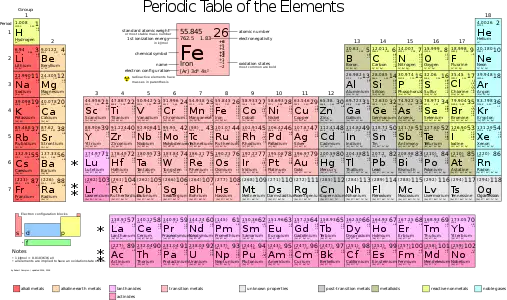
According to the Periodic Table, which category does the element with the chemical symbol 'Si' belong to?
Metals
Nonmetals
Metalloids
Noble gases
What does the atomic number of an element represent?
The number of neutrons in an atom of the element
The number of protons in an atom of the element
The total number of protons and neutrons in an atom of the element
The number of electrons in the outermost shell of an atom of the element
In an electrically neutral atom, the number of protons is equal to the number of what other subatomic particle?
Neutrons
Electrons
Isotopes
Nucleons
What is the symbol for the element with atomic number 1?
He
O
H
N
What does the mass number of an atom represent?
The number of protons in the nucleus
The number of electrons in the atom
The number of protons and neutrons in the nucleus
The total number of particles in the atom
Based on the image, what is the mass number of a carbon atom with 6 protons and 6 neutrons?
6
12
18
24
What is the mass number of a fluorine atom with 9 protons and 10 neutrons, as shown in the image?
9
10
19
29
According to the image, what is the mass number of a calcium atom with 20 protons and 20 neutrons?
20
40
60
80

