

wayground logo

Free Printable Worksheets

Font size

S
M
L
XL
Worksheets

Unit 6 Test

Total questions: 48

Worksheet time: 38mins

Name
Class
Date
1.

In which phase of Meiosis does crossing-over happen?

a)

Prophase I

b)

Metaphase I

c)

Anaphase I

d)

Telophase I

2.

Which phase of meiosis is shown in the picture?

a)

Prophase I

b)

Metaphase I

c)

Anaphase I

d)

Telophase I

3.

Which phase of meiosis is shown in the picture?

a)

Prophase II

b)

Metaphase II

c)

Telophase I

d)

Telophase II

4.

Which phase of meiosis is shown in the picture?

a)

prophase I

b)

metaphase I

c)

anaphase I

d)

telophase I

5.

The four cells that are produced after Meiosis are _______.

a)

haploid because they contain just half the number of chromosomes as the parent cell.

b)

diploid because they contain as many chromosomes as the parent cell.

c)

diploid because they contain twice as many chromosomes as the parent cell.

6.
Looking at the karyotype, is this person male or female, and how do you know?
a)
There is no way to tell from a karyotype.
b)
Male - has two X's
c)
female - has two X's
d)
Male - has an X and Y
7.
How is hemophilia inherited, and what would be a genotype for an affected male?
a)
X-linked recessive; Xhy
b)
X-linked dominant; XHy
c)
autosomal dominant; HH or Hh
d)
autosomal recessive; hh
8.
How is this trait inherited?
a)
autosomal dominant
b)
autosomal recessive
c)
x-linked dominant
d)
x-linked recessive
9.
If this is an autosomal recessive inheritance, which of the following would be true statements about carriers of this trait?
a)
In generation 1, person 1 is a carrier, but 2 would not have to be a carrier.
b)
In generation III, both 1 and 2 have to be carriers.
c)
In generation II, 1, 3, and 4 have to be carriers.
d)
In generation IV, 2,3 and 4 must be carriers.
10.

Ophioglossum reticulatum, a homosporous fern, has a diploid number of 1,520. What is the haploid number?

a)

n=790

b)

2n=820

c)

n=760

d)

n=3040

11.

Strawberries have a chromosome number of 28 in their haploid cells, what is the diploid number?

a)

2n=112

b)

2n=14

c)

2n=56

d)

n=16

12.

Is weak, prefers to "hide"

a)

dominant genes

b)

trait

c)

recessive genes

d)

genes

13.

Only takes 1 in a gene pair for a trait to show up

a)

recessive genes

b)

DNA

c)

offspring

d)

dominant genes

14.
Which of the following shows homozygous alleles?
a)
Ww
b)
ww
15.
Which of the following describes how the genes are described?
a)
genotype
b)
phenotype
16.
Which of the following describes how the organism looks?
a)
genotype
b)
phenotype
17.
Two brown eyed parents (Bb) have a baby. What is the chance the baby is blue eyed?
a)
0 %
b)
25%
c)
50%
d)
75%
18.
Snapdragon flowers come in red, pink and white.  What type of inheritance is this?
a)
Complete Dominance
b)
Incomplete Dominance
c)
Codominance
d)
Polygenic Inheritance
19.
Incomplete dominance means that the traits are
a)
expressed equally
b)
dominant
c)
recessive
d)
blended
20.
One form of a gene is called_______________
a)
a DNA
b)
a Phenotype
c)
a trait
d)
an allele
21.
Heterozygous is when...
a)
the alleles are the same
b)
the alleles are different
c)
the alleles are absent
d)
the alleles are present
22.

three or more possible alleles of a gene that determine a trait

a)

homozygous

b)

phenotype

c)

codominance

d)

multiple alleles

23.

having two identical alleles for a particular gene (HH, hh)

a)

heterozygous

b)

homozygous

c)

multiple alleles

d)

trait

24.

a situation in which both alleles for a gene are expressed equally (both are seen at the same time)

a)

carrier

b)

codominance

c)

genotype

d)

incomplete dominance

25.
Term for an organism that display two dominant phenotypes at the same time
a)
codominance
b)
incomplete dominance
c)
multiple alleles
d)
linked genes
26.
A heterozygous yellow pea plant's genotype would be:
a)
YY
b)
yy
c)
Yy
d)
Yg
27.
What goes in box 3
a)
Aabb
b)
AABB
c)
AAbb
d)
aaBb
28.
Using the dihybrid cross and key provided, what is the probability of the offspring being tall and white?
a)
9
b)
2
c)
3
d)
6
29.

What genotype is missing?

a)

YyRR

b)

YyrR

c)

YYrR

d)

yyrR

30.

Based on the results in the monohybrid punnett square, what is the genotypic ratio?

a)

1:2:1

b)

0:2:2

c)

0:0:4

d)

none

31.

Down syndrome is caused by nondisjunction during prophase 1 of meiosis, this is also called...

a)

monosomy 23

b)

trisomy 21

c)

disomy 14

d)

trisomy 12

32.

Colorblindness is carried on the _______

a)

Y chromosome of pair 23

b)

X chromosome of pair 23

c)

X chromosome of pair 19

d)

X chromosome of pair 21

33.

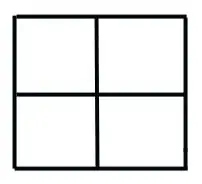
Draw a Punnett square for the cross between a mom who is heterozygous for B type blood and a father that is type AB. Give the phenotypic and genotypic ratios
34.

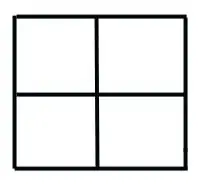
Cross 2 parents that are heterozygous for flower color given the alleles R for red and W for white, give the genotypic and phenotypic ratios
35.

What type of antigens can be found on the surface of RBC's when someone has blood type O?

a)

A

b)

B

c)

AB

d)

none

36.

What type of antigens can be found on the surface of RBC's when someone has blood type AB?

a)

A

b)

B

c)

AB

d)

none

37.
What is NOT a possible genotype for someone with type B blood?
a)
IBIB
b)
IAIB
c)
IB i
38.
which blood type is the universal donor (all people can receive it)?
a)
O
b)
AB
c)
A
d)
B
39.

In the image above, what is the percentage of the offspring has the possibility of inheriting blood type O?

a)

0%

b)

25%

c)

50%

d)

100%

40.

Which of the following codes for blood type O?

a)

IA IA

b)

IB i

c)

IA IB

d)

ii

41.
How many alleles (letters) do each person carry for a trait?
a)
1
b)
2
c)
3
d)
4
42.
How many alleles (letters) does a child get from each parent for each trait?
a)
1
b)
2
c)
3
d)
4
43.
this image is an example of
a)
codominance
b)
dominance
c)
incomplete dominance
44.
this image is an example of
a)
codominance
b)
dominance
c)
incomplete dominance
45.

In Huntington's disease, if the allele is present at all you have the trait. this is an example of...?

a)

an autosomal recessive trait

b)

an X-linked trait

c)

a dominant trait

d)

an X-linked recessive trait

46.
Gregor Mendel is often called ....
a)
The father of heredity.
b)
The father of genetics.
c)
The king of peas
d)
The father of punnett squares.
47.

What type of plants did Gregor Mendel experiment with?

a)

Corn Plants

b)

Peanut Plants

c)

Pea Plants

d)

Basil Plants

48.

How many generations are represented in the pedigree?

a)

2

b)

3

c)

4

d)

5
