
Font size
 Worksheets
Force and Motion Review
Total questions: 43
Worksheet time: 22mins
What is the difference between distance and displacement?
Distance is the force exerted on an object, while displacement is the momentum of the object.
Distance is the rate of change of velocity, while displacement is the resistance to a change in motion.
Distance is the speed of an object, while displacement is the direction of its motion.
Distance is how far an object has moved, while displacement is the difference in starting and ending point.
What is the formula for calculating average speed?
Total time traveled divided by total distance traveled
Total time traveled multiplied by total distance traveled
Total distance traveled multiplied by total time traveled
Total distance traveled divided by total time traveled
What does the slope on a distance vs. time graph represent?
Acceleration of the object
Speed of the object
Direction of the object's motion
Inertia of the object
What is the rate of change of velocity known as?
Inertia
Speed
Acceleration
Distance
What is the force that opposes the motion of objects that move through the air called?
Inertia
Friction
Air resistance
Rolling friction
What is the tendency of an object to resist a change in its motion called?
Friction
Inertia
Momentum
Acceleration
What is the formula for calculating weight of an object?
P = m * v
F = m * a
W = P * t
W = F * d
What is the Law of Conservation of Momentum?
Momentum is not affected by collisions
Momentum is gained or lost during a collision
Momentum is transferred during a collision
Momentum is doubled during a collision
What is the force that resists a change in motion caused by two objects in contact with one another?
Rolling friction
Air resistance
Friction
Inertia
What is the difference between balanced and unbalanced forces?
Balanced forces have a net force of 0 N, while unbalanced forces have a net force of 1 N
Balanced forces cause a change in motion, while unbalanced forces do not
Balanced forces are equal in size and opposite in direction, while unbalanced forces are not
Balanced forces are always greater than unbalanced forces
When an object changes its position, it is called
reference point
distance
motion
displacement
an indicator that orients you; the place from which you measure, record, or witness an event
motion
reference point
displacement
distance
the speed at a given point in time; this is what is shown on a speedometer
average speed
instantaneous speed
velocity
acceleration
The cross-country team goes on a 10 mile run after school. They end the run outside of the locker room, where they started. Find the distance and displacement of the runners.
distance: 10 miles
displacement: 10 miles
distance: 10 miles
displacement: 20 miles
distance: 10 miles
displacement: 0 miles
distance: 10 miles
displacement: 1 mile
A family travels 110 km east to spend the night in a hotel. The next day they drive back home, but after traveling 45 km west they decide to stop and visit with friends for the night. Find the distance and displacement of the family.
distance: 110 km
displacement: 110 km
distance: 155 km
displacement: 65 km East
distance: 155 km
displacement: 45 km East
distance: 200 km
displacement: 0 km
A car drives 215 km west and then 85 km south. Find the distance and displacement of the car.
distance: 215 km
displacement: 85 km SW
distance: 300 km
displacement: 215.5 km SW
distance: 300 km
displacement: 231.2 km SW
distance: 300 km
displacement: 5.2 km SW
Which of the following is an example of velocity?
14 meters
71 degrees Celsius
23 kilometers per hour Southwest
65 miles per hour
Lisa is watching a friend run a race. What does she need to know to find her friend's speed?
Distance and time
Position and motion
Distance and position
Time and motion
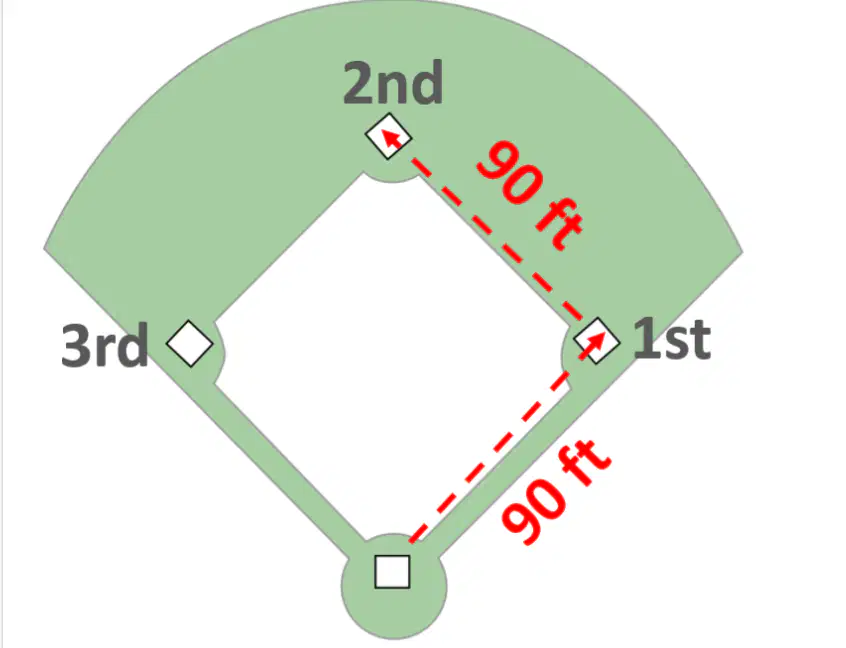
A baseball player runs 90 feet to first base, and then another 90 feet to second base, as shown in the figrure below. The total distance of the baseball player is 180 feet.
True
False
The base metric units for speed are _________ .
miles/hour
meters/second
grams/milliliter
miles/second2
Melanie is accelerating as she skates on the ice. However, the speed at which she is skating has not changed. A possible explanation for this is that Melanie
is changing directions as she skates in a circle
is skating in a straight line
has reached the top speed at which she can skate
has stopped skating and is now standing still
On a roller coaster, the cars first climb a hill at a decreasing speed. Then the cars speed up as they go down the hill, before coasting at a constant speed on a straight track. Finally, the cars slow down as the ride ends. The cars have zero acceleration while
climbing the hill
going down the hill
coasting on the straight track
slowing down at the end of the ride
What is the acceleration of an elephant that accelerates from 7m/s to 14 m/s in 7 second?
1 m/s2
1
-1 m/s2
7 m/s2

Richard started riding his bicycle to a friend's house at a velocity of 4 m/s east. As he neared the house, his velocity was 6 m/s east. Richard's trip showed ______________________.
positive acceleration
negative acceleration
zero acceleration
constant speed

During which 10-second interval was the runner's speed the greatest?
0-10 seconds
20-30 seconds
30-40 seconds
50-60 seconds
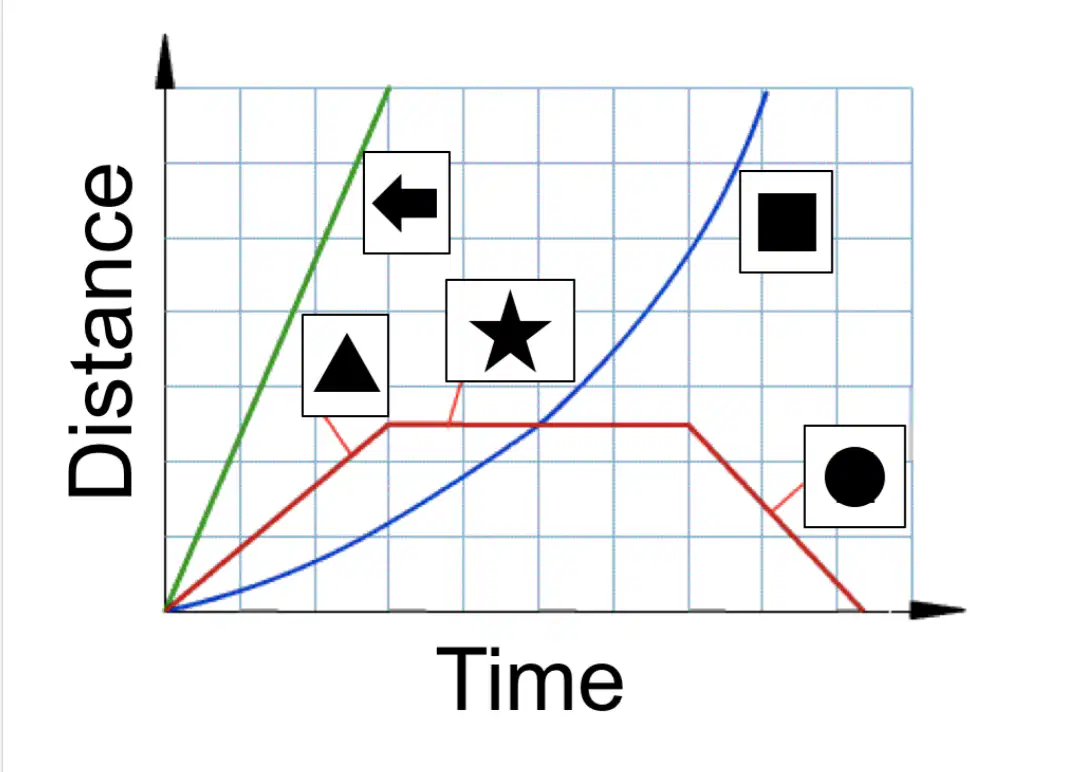
Which shape represents the fastest steady speed?
Triangle
Star
Square
Arrow

Which shape represents positive acceleration?
Arrow
Star
Triangle
Square
"Deceleration" is a word that people sometimes use when they mean to say ________________________ .
positive acceleration
negative acceleration
velocity
speed
Which of the laws of motion states, "To every action there is an equal but opposite reaction"?
Newton's 1st law
Newton's 2nd Law
Newton's 3rd Law
Law of Conservation of Momentum
Which of the following factors does not affect air resistance?
Speed
Spin
Size
Shape
Rank the following objects from the least amount of inertia to most inertia
bottle of water, pencil, teacher, textbook
pencil, textbook, bottle of water, teacher
teacher, textbook, bottle of water, pencil
pencil, bottle of water, textbook, teacher
Carl and Juan are playing catch. Carl throws a fastball to Juan and it hurts Juan's hand. Why is this the case?
Greater the acceleration, the greater the force
Greater the mass, greater the acceleration
Greater the acceleration, the less the force
Greater the mass, the less the force
A person is on a paddleboard. The person exerts a force on the water with the paddle, causing hte water to
move. The paddleboard also moves, but ni hte opposite direction. Which statement best explains why this happens?
Inertia
Action and reaction forces
Newton's 2nd Law
Law of Conservation of Momentum
What is the weight of a person with a mass of 95 kg?
95 kg
95 N
931 kg
931 N
An object has 16 N of force being applied to the right, 16 N of force being applied to the left, and 4 N of force being applied downward. What is the acceleration of the object if it's mass is 0.35 kg?
11.4 m/s2
34.3 m/s2
45.7 m/2
102.9 m/s 2
A 700 kg car is driving 50 m/s down the interstate. It speeds up to 75m/s in 8 seconds. What was the force required for the car to accelerate in that amount of time?
4,375 N
2,187.5 N
224 N
0.0045 N
A 98 kg man is accelerating forward at a rate of 1.2 m/s2. What is the unbalanced force necessary to produce this movement?
117.6 N
81.6 N
98 N
96.8 N
A magician pulls a tablecloth out from under dishes and glasses on a table without disturbing them
Newton's 1st Law
Newton's 2nd Law
Newton's 3rd Law
None of them
Pushing a child on a swing is easier than pushing an adult on the same swing, because the adult has more mass.
Newton's 1st Law
Newton's 2nd Law
Newton's 3rd Law
None of them
A person steps out of the boat and onto the dock. As the person moves forward onto the dock, the boat moves backward. Which statement best describes the backward motion of the boat as the person steps forward?
For every action there is an equal and opposite reaction.
Every mass exerts a force on every other mass.
An object at rest tends to stay at rest.
Friction opposes the motion of an object.

A person not paying attention while skateboarding hits a rock. The skateboard stops...they didn't.
The Law of Acceleration
The Law of Inertia
The Law of Conservation of Momentum
The Law of Universal Gravitation

During which interval is the object not moving?
B to C
C to D
D to E
only at point A
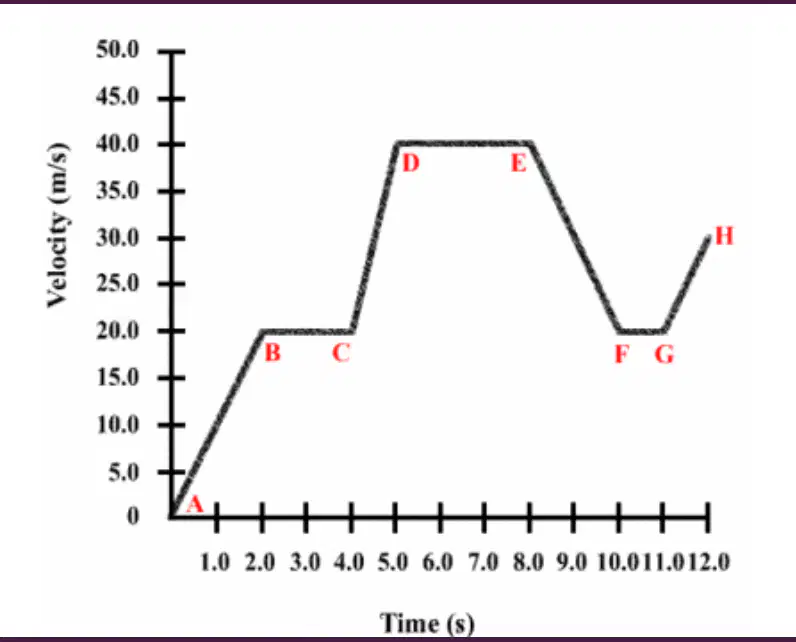
During which interval is the object traveling at a constant velocity?
B to C
D to E
F to G
It is traveling at a constant velocity during all of the intervals shown

