
 Worksheets
EET308 Comprehensive Course Work Test 1
Total questions: 43
Worksheet time: 22mins
Name
Class
Date
1.
Name of the Student
4 lines
2.
Batch
a)
E1
b)
E2
3.
Roll Number
4 lines
4.

a)
1 A
b)
b. 2 A
c)
c. ½ A
d)
d. 0
5.
2. In a series RL circuit, the voltage across the resistance is 40V and the voltage across inductance is 40V. Then the total voltage across the series circuit is
a)
a. 40V
b)
b. 56.56V
c)
c. 80V
d)
d. 5.656V
6.
3. In RL series circuit R=2Ω and L=2mH. What is the value of time constant?
a)
a. 1 ms
b)
b. 1 s
c)
c. 4msec
d)
d. 100sec
7.
4. Time constant is the time taken for response to rise -------of maximum value?
a)
a. 100%
b)
b. 90%
c)
c. 63.2%
d)
d. 68.3%
8.
5. A 10 Ω resistor, a 1 H inductor and 1 µF capacitor are connected in parallel. The combination is driven by a unit step current. Under the steady state condition, the source current flows through.
a)
(a) the resistor
b)
(b) the inductor
c)
(c) the capacitor only
d)
(d) all the three elements
9.

a)
a. 60 V and -0.3 A
b)
b. 150 V and zero
c)
c. Zero and 0.3 A
d)
d. 90 V and -0.3 A
10.
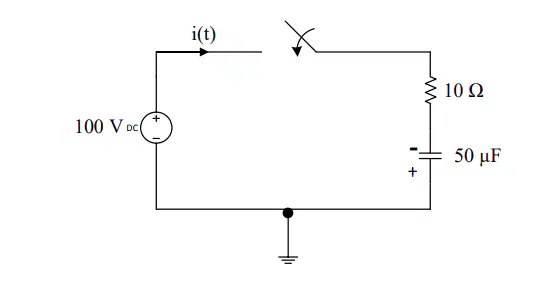
7. In the circuit shown below, the initial charge on the capacitor is 2.5 mC, with the voltage polarity as indicated. The switch is closed at time t = 0. The current i(t) at a time t after the switch is closed is
a)
(a)
b)
(b)
c)
(c)
d)
(d)
11.
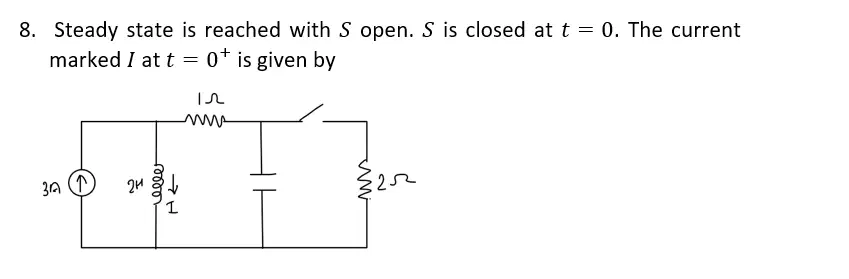
a)
a. 3
b)
b. 3.8
c)
c. 4
d)
d. 1.8
12.

9.
a)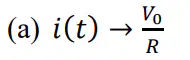
a
b)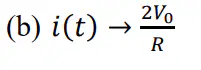
b
c)
c
d)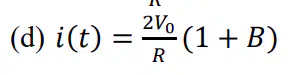
d
13.

10.
a)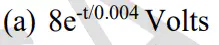
a
b)
b
c)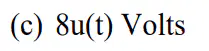
c
d)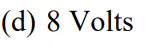
d
14.

a)
a. 2 mA
b)
b. 4/3 mA
c)
c. 3 mA
d)
d. 12 mA
15.
12. In superposition theorem, when we consider the effect of one voltage source, all the other current sources are ____________
a)
a) Shorted
b)
b) Opened
c)
c) Removed
d)
d) Undisturbed
16.
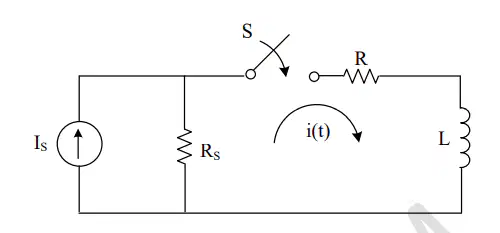
13. In the following circuit, the switch S is closed at t =0. The rate of change of current 𝑑𝑖/𝑑𝑡 (0+) 𝑖𝑠 𝑔𝑖𝑣𝑒𝑛 𝑏y
a)
(a) 0
b)
(b) RsIs/L
c)
(c) (R+Rs)Is/L
d)
(d) Infinity
17.

14. . In the following figure C1 and C2 are ideal capacitors. C1 had been charged to 12V before the ideal switch S is closed at t = 0. The current i(t) for all t is
a)
(a) Zero
b)
(b) A step function
c)
(c) An exponentially decaying function
d)
(d) An impulse function
18.

a)
a.
b)
b.
c)
c.
d)
d.
19.
16. In an ac circuit, if voltage V=(a+jb) and current i=(c+jd), then the reactive power is given by?
a)
a. ac+bd
b)
b. ac+ad
c)
c. bc-ad
d)
d. bc+ad
20.
17. If there is complex impedance in a circuit. part of energy is ____ by reactive part and part of its energy is ____ by the resistance
a)
a. alternately stored and returned, alternately stored and returned
b)
b. alternately stored and returned, dissipated
c)
c. dissipated, alternately stored and returned
d)
d. dissipated, dissipated
21.
18. KCL is based on the fact that
a)
a. There is a possibility for a node to store energy.
b)
b. There cannot be an accumulation of charge at a node.
c)
c. Charge accumulation is possible at node
d)
d. Charge accumulation may or may not be possible.
22.
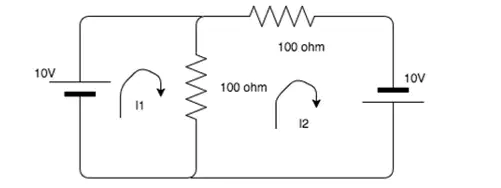
19. Find the value of the currents I1 and I2.
a)
a) 0.3, 0.1
b)
b) -0.1, -0.3
c)
c) -0.3, -0.1
d)
d) 0.3, 0.2
23.
20. Which of the following theorems can be applied to any network linear or non-linear, active or passive, time variant or time-invariant?
a)
a) Thevenin Theorem
b)
b) Nortons theorem
c)
c) Tellegen’s Theorem
d)
d) Superposition theorem
24.
21. Two ideal voltage sources of unequal output voltages cannot be placed in.................
a)
a) Series
b)
b) Parallel
c)
c) Both series and parallel
d)
d) None of the above
25.
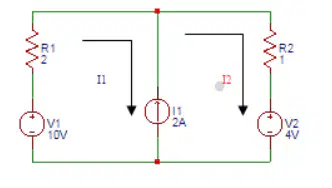
22. Consider the circuit shown below. Find the current I1 (A).
a)
a) 1
b)
b) 1.33
c)
c) 1.66
d)
d) 2
26.
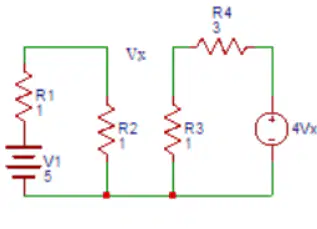
23. Consider the circuit shown in the figure. Find voltage Vx.
a)
a) 1
b)
b) 1.25
c)
c) 1.5
d)
d) 1.75
27.
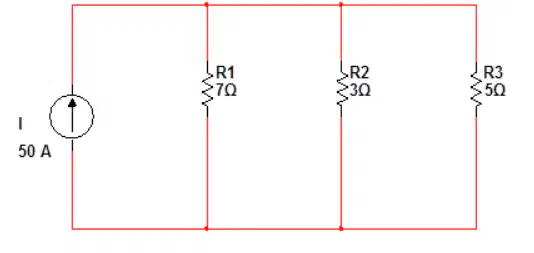
24. Determine the current in all resistors in the circuit shown below.
a)
a) 2A, 4A, 11A
b)
b) 5A, 4.8A, 9.6A
c)
c) 9.3A, 20.22A, 11A
d)
d) 10.56A, 24.65A, 14.79A
28.

25. Find Vx due to the 3A source
a)
a) 56V
b)
b) 78V
c)
c) 38V
d)
d) 48V
29.
26. Superposition theorem is valid for _________
a)
a) Linear systems
b)
b) Non-linear systems
c)
c) Both linear and non-linear systems
d)
d) Neither linear nor non-linear systems
30.
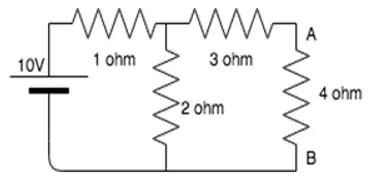
27. Calculate the Thevenin resistance across the terminal AB for the following circuit.
a)
a) 4.34 ohm
b)
b) 3.67 ohm
c)
c) 3.43 ohm
d)
d) 2.32 ohm
31.
28. The Thevenin voltage is the__________
a)
a) Open circuit voltage
b)
b) Short circuit voltage
c)
c) Open circuit and short circuit voltage
d)
d) Neither open circuit nor short circuit voltage
32.
29. Which of the following is also known as the dual of Thevenin’s theorem?
a)
a) Norton’s theorem
b)
b) Superposition theorem
c)
c) Maximum power transfer theorem
d)
d) Millman’s theorem
33.
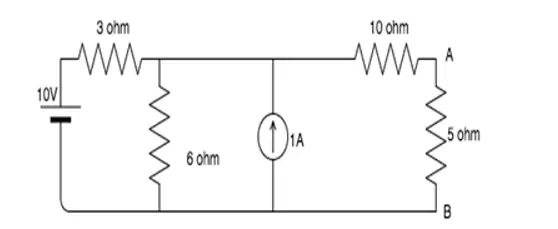
30. Calculate the short circuit current if the 5 ohm resistor is the load resistance.
a)
a) 0.72A
b)
b) 0.32A
c)
c) 0.83A
d)
d) 0.67A
34.
31. The superposition theorem requires as many circuits to be solved as there are
a)
a) Nodes
b)
b) source
c)
c) nodes and sources
d)
d) Meshes
35.
32. What is tanϕ for RC circuit?
a)
a) XC/R
b)
b) XL/R
c)
c) R/Z
d)
d) Z/R
36.
33. For an RL circuit, the phase angle is always ________
a)
a) Positive
b)
b) Negative
c)
c) 0
d)
d) 90
37.
34. If in an alternating current circuit, resistance is 5 ohm, capacitive reactance is 12 ohm, what is the impedance?
a)
a) 5 ohm
b)
b) 10 ohm
c)
c) 12 ohm
d)
d) 13 ohm
38.
35. For addition and subtraction of phasors, we use the _________ form.
a)
a) Rectangular
b)
b) Polar
c)
c) Either rectangular or polar
d)
d) Neither rectangular nor polar
39.
36. For a direct current, the rms voltage is ________ the mean voltage.
a)
a) Greater than
b)
b) Less than
c)
c) Equal to
d)
d) Not related to
40.
37. The resistance of wire varies inversely as
a)
a. Area of cross section
b)
b. Length
c)
c. Resistivity
d)
d. Temperature
41.
38. The diameter of the wire is reduced to one half keeping the length constant. The new resistance will be
a)
a. Half the original
b)
b. 4 times the original
c)
c. Double of the original
d)
d. One-fourth of the original
42.
39. Three resistors, each of R ohms are connected to form a triangle. The resistance between any two terminals will be
a)
a. 2/3 R ohms
b)
b. 3/2R ohms
c)
c. R ohms
d)
d. 3R ohms
43.
40. Kirchhoff’s laws are valid for
a)
a. Linear circuits only
b)
b. Passive time invariant circuits
c)
c. Non- linear circuits only
d)
d. Both linear and non-linear circuits
100 %

