
 Worksheets
Third Review Quiz
Total questions: 77
Worksheet time: 26mins
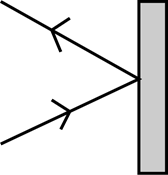
In the illustration, the light ray striking the object is-

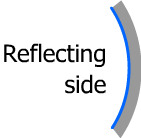

Type of mirror used in a convenience store to provide a wide angle view...
Plane
Convex
Concave

Type of mirror used by a dentist to get magnified view of a patient's teeth...
Plane
Convex
Concave

Type of mirror that can produce an inverted image...
Plane
Convex
Concave
An image that forms where light seems to come from a point but light rays don't actually meet is a
virtual image
real image
Inverted Image
clear image
The point in the middle way between a curved mirror and the center of curvature is the
principal point
focal point
center of curvature
principal axis

A student is conducting an experiment with four different types of mirrors. Which mirror in the experiment is a convex mirror?
mirror 1
mirror 2
mirror 3
mirror 4
It is the bouncing of light rays when it hits a surface like mirror.
Refraction
Reflection
Diffraction
It is a type of mirror which has the shape of piece cut out of a spherical surface.
Plane Mirror
Mirror
Curved Mirror
Which of the following are the characteristics formed by plane mirror?
Virtual, Inverted, Laterally inverted, Same Size, Same Distance
Virtual, Upright, Laterally inverted, Same Size, Same Distance
Real, Inverted, Laterally inverted, Same Size, Same Distance
Concave mirror is also known as ________________.
Plane Mirror
Diverging Mirror
Converging Mirror
It is a representation of the probable path light can travel from one location to another.
Ray Diagram
Image
Principal Axis

What are the two principal rays illustrated on the diagram?
V-ray & P-F ray
P-F ray & F-P ray
C-C Ray & V-ray
A flat mirror is an example of a ___.
plane mirror
concave mirror
convex mirror
spherical mirror
If you stand three feet in front of a plane mirror, how far away would you see yourself in the mirror?
1.5 feet
3 feet
2 feet
4 feet
If the object is located at the center of curvature or C, where is the image located?
Behind C
Between F and C
At F
At C

Is a convex lens thicker or thinner in the middle?
Thicker
Thinner
A diverging lens is also known as a ____lens.
refracted
diffracted
convex
concave
What does the word "diverging" mean?
to spread apart
to come together
parallel
perpendicular
A converging lens is also known as a ____ lens.
convex
concave
double
refracted
What does the word "converging" mean?
to separate
to come together
parallel
perpendicular
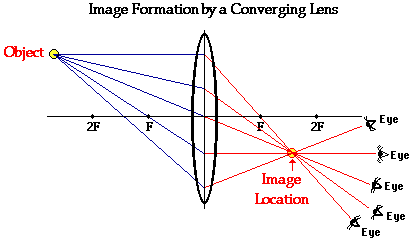
This image is.....
inverted and smaller
inverted and larger
not inverted and smaller
not inverted and larger
An object is placed 20 cm from a convex lens of focal length 15 cm. What is the image distance and the nature of the image?
60 cm, real image
30 cm, real image
Image not formed
15 cm, virtual image

Why does light refract when it encounters the glass in a lens?
because it speeds up, which causes it to bend
because it slows down, which causes it to bend
because it hits a dense medium, which causes it to bounce off
because it gets absorbed, which causes it to lessen in intensity
_____ lenses refract light rays in toward a central point. When this lens is held close to your eye, the image is magnified and right side up.
Concave
Convex
Prismatic
Refractive
Sara is using a magnifying glass to closely examine her stamp collection. Which type of lens is found in a magnifying glass.
bifocal
concave
convex
prismatic
What do a prism, a magnifying glass, a microscope, and eyeglasses ALL have in common.
They are opaque
They refract light
They reflect light
That are translucent

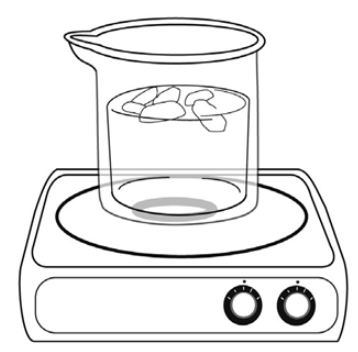
Emerson places a beaker of water on a hotplate and turns the hotplate on. The temperature in the room is 25 ºC. After the water heats to 75 ºC, she adds pieces of ice to the beaker.
Which of the following describes a transfer of heat energy that occurs during this experiment?
from the air to the water
from the ice to the beaker
from the water to the ice
from the water to the hotplate

How does the thermal energy of the liquid in the larger beaker compare to the thermal energy of the liquid in the smaller beaker?
The liquid in the larger beaker has less thermal energy than the liquid in the smaller beaker.
The liquid in the larger beaker has more thermal energy than the liquid in the smaller beaker.
The liquid in the larger beaker has the same amount of thermal energy as the liquid in the smaller beaker.
The exact volume of the liquid in each beaker must be known to compare the thermal energy of the liquids.
Which description defines heat?
total thermal energy of an object or substance
change in the temperature of a substance in degrees Celsius
energy transferred between objects at different temperatures
average kinetic energy of the particles that make up a substance
Heat loss causes matter to ________. Heat gain causes matter to ________.
contract ; expand
expand ; contract
stay ; change
change ; stay

Mariana is at the beach with her parents so she see on a clock that the temperature is 104 ºF, she asks his father what is the temperature in celsius. He father says:
279,5 ºC
40 ºC
55,5 ºC
104 ºC
How are the amount heat transferred and the change in temperature in water related?
The greater increase of temperature, the greater heat transfer.
The greater decrease of temperature, the greater heat transfer.
The greater increase of temperature, the lesser heat transfer.
They are not related.

Look at the figure: Which setup did the dye scatter the fastest?
A
B
C
Look at the figure: Which setup contains cold water?
A
B
C
Which of the following shows heat gain?
water turning into ice
shivering in a cold room
ice cream melting under the sun
hot bowl of soup becomes room temperature
1. 15⁰C to _____ ⁰F
9⁰F
99⁰F
49⁰F
59⁰F
1. 32⁰C to _____ ⁰K
30.15 K
305.15 K
45.56 K
241.15 K
When are two objects consider to be at thermal equilibrium?
when one object is hotter than the other
when on object is colder than the other
when one object is at the same temperature as the other
If you are holding an ice cube, where will the heat go?
into the ice cube
into your hand
This is a form of energy that allows the flow of electrical power or charge.
HEAT
ELECTRICITY
TEMPERATURE
If water heats slower than sand, then ----- is said to have a higher specific heat capacity.
Sand
Water
They both have the same specific heat capacity.

What kind of heat transfer happens when the sun is heating your body?
Conduction
Radiation
Convection
Density changes are responsible for which method of thermal energy transfer?
conduction only
convection only
radiation only
What is Thermal expansion?
The transfer of thermal energy between materials by the collisions of particles
Is a decrease in a materials volume when temperature decreases
An increase in a materials volume when temperature increases
The kind of heat transfer that travels through space in electromagnetic waves is ______________________.
insulation.
Radiation
Conduction
The study of heat transformation into other forms of energy is called ____
conduction
entropy
thermal equilibrium
thermodynamics
A heat engine converts heat into ___________.
light
energy
matter
work
What are the two kinds of combustion engine ? ( 2 answers)
Efficient
External
Internal
Non-Efficient
Most cars use this kind combustion of engine which burns fuel inside the engine.
Internal combustion engine
External combustion engine
External cold-nuclear-fusion engine
Internal cold-nuclear-fusion engine
110 Joule of heat is added to a gaseous system, whose internal energy is 40 J.
How much is the amount of external work done?
150 J
70 J
110 J
40 J
A heat engine receives heat from a heat source at 1000 degree Celsius and rejects heat to a sink at 40 degree Celsius. What is the thermal of heat engine?
75.5%
96%
4%
24.5%

What is the source temperature of the Carnot engine in K required to get 70% efficiency? Given sink temperature is 27 degree C.
1000 K
90 K
270 K
727 K
The Coulomb is the unit for:
Charge
Force
Distance
Mass


What is another name for the wires in a circuit?
Conductor
Load
Power Source

