
 Worksheets
HBS 3.2 Review (New)
Total questions: 50
Worksheet time: 55mins


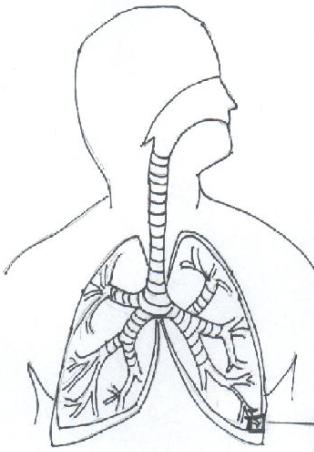
The opening between vocal cords
glottis
epiglottis
The division of the trachea forms
nose
main bronchi
lungs
alveoli
1. larynx
2. nasal cavity
3. pharynx
4. trachea
Which of the following is the correct order that air would flow during inhalation.
Which part of the Respiratory System collects air from the environment & heats/moistens the air before entering the body?
lungs
nose
heart
mouth

What is labeled at E?
bronchi
trachea
pharynx
none of the above

What part of the respiratory system is number 2?
Bronchi
Mouth
Nose
Trachea

What part of the respiratory system is number 1?
Bronchi
Mouth
Nose
Trachea

What part of the respiratory system is number 4?
Bronchi
Mouth
Nose
Trachea

What part of the respiratory system is number 3?
Bronchi
Mouth
Nose
Trachea

What part of the respiratory system is number 5?
Trachea
Alveoli
Lungs
Nose
A person has vital capacity of 5L and residual volume of 1.2 L. Total lung capacity –
6.2 L
4.8 L
500 ml
None
Lungs are made up of air-filled sacs, the alveoli. They do not collapse even after forceful expiration, because of:
Inspiratory Reserve Volume
Tidal Volume
Expiratory Reserve Volume
Residual Volume


Total lung capacity includes
tidal volume + inspiratory volume + expiratory volume
inspiratory reserve + expiratory reserve
tidal volume + vital capacity
vital capacity + residual volume
When blood leaves this chamber of the heart, it heads out to the body (not the lungs)
left atrium
right atrium
left ventricle
right ventricle
One of the body's largest blood vessels that transports blood from the body region below the diaphragm to the heart
superior vena cava
inferior vena cava
pulmonary trunk
pulmonary veins
This initiates the action potential that causes the heart to beat
Inferior vena cava
Atrioventricular node (AV node)
Superior vena cava
Sinoatrial node (SA node)
When blood leaves this chamber of the heart, it heads to the lungs
right atrium
right ventricle
left atrium
left ventricle
This is responsible for distributing electrical impulses through the heart
Atrioventricular node
Sinoatrial node
Inferior vena cava
Superior vena cava
This chamber of the heart receives oxygenated blood from the lungs
right atrium
right ventricle
left atrium
left ventricle
This chamber of the heart receives oxygenated blood from the lungs
right atrium
right ventricle
left atrium
left ventricle
These are the smallest blood vessels with the thinnest walls in order to maximize diffusion of nutrients in and out of the interstitial fluid
arteries
veins
capillaries
aorta
Which best explains why capillary walls are so thin?
because they do not need to pump blood
because they are found only in the smallest organs and tissues
because they maximize diffusion of nutrients
because blood only travels through them slowly
These carry blood towards the heart
arteries
veins
These carry blood away from the heart
Arteries
Veins
Blood traveling through the pulmonary circuit goes through the right side of the heart and out to the _______
left side of the heart
body
lungs
tricuspid valve
Blood traveling through the systemic circuit goes through the _____ side of the heart and out to the body
right
left
Blood in capillary beds flows from
arteries to veins
veins to arteries

Popliteal Artery →
True
False

Iliac artery →
True
False

Common Iliac Vein →
True
False
Term: The hydrostatic force that blood exerts against the wall of a vessel.
Diastolic Pressure
Astolic Pressure
Blood Pressure
Systolic Pressure
Term: The type of blood pressure with a smaller number and recorded second.
Diastolic
ABI
Systolic
Hydrostatic
Which does not describe cardiac output?
It is determined by body size and aerobic fitness
The amount of blood pumped by the heart each minute
It is the amount of blood pumped out of the heart each beat
It is the product of heart rate and stroke volume
What is stroke volume?
the volume of oxygen transported in the blood
the volume of blood pumped out of the heart each minute
the volume of blood pumped out of the heart in each beat
the number of beats per minute
QRS complex signifies _____ depolarization and _____ repolarization.
ventricular ; atrial
atrial ; ventricular
R ventricular ; L atrial
L atrial ; R ventricular
Normal blood pressure for an adult is
110/90 mm Hg or higher
110–140 over 60–90 mm Hg
70–80 beats/min
Less than 120/80 mm Hg
Vessels that contain valves
arteries
capillaries
veins
Vascular disease affecting blood vessels outside of the heart and especially those vessels supplying the extremities:
Peripheral Vascular Disease
Heart Disease
Myocardial Infarction
Dorsal Venous Network

The sinoatrial (sa) node, atrioventricular (av) node, and purkinje fibers function for:
Direction of blood flow through the heart
Dorsal venous network
Direction of electrical impulses through the heart
Anterior artery network
Where would you find the following pulse: carotid
neck
temples
arm/inner elbow
wrist
Where would you find the following pulse: radial
neck
temples
arm/inner elbow
wrist

