
 Worksheets
Natural Selection and adaptations
Total questions: 55
Worksheet time: 1hrs 23mins
In a population of desert plants, the timing of their blooming varies greatly. Some bloom early in the morning, others at mid-day, and others after dark. What environmental pressure might be an advantage for those plants that bloom after dark?
There is an increase in the population of nocturnal pollinators
There is a decrease in the strength of solar radiation
There is an increase in herbivores that forage at night.
There is a decrease in water for root absorption
Leopard seals are animals adapted to survive in the freezing conditions of Antarctica. Individual leopard seals vary in their different traits. Which of the following variations would give a leopard seal the greatest chance of surviving in its harsh environment?
More spots on its coat
Thicker layer of blubber
More elongated head
Wider, flatter teeth
Mountain lions are large cats and the top predator in their habitat. A population of mountain lions may vary in several characteristics. If prey becomes more scarce, which variation would provide an advantage to the individuals that possessed it?
A spotted coat
Short fur
Long legs
Abundant whiskers
Peppered moths often hide on white-colored birch trees because they are similarly colored. Which of the following environmental changes would lead to the enhanced survival of darker moths?
Warm weather causes the birch trees to grow their leaves back early.
Birch trees become covered in black ash from nearby factories.
Heavy rainfall causes birch trees to grow taller than normal
Disease kills off more than half of the birch tree population
Which of the following describes what is meant by Natural Selection?
An organism will survive no matter what its adaptations may be
An organism with adaptations that do not allow it to reproduce as effectively as others will survive.
An organism with adaptations that allow it to obtain resources and reproduce more effectively than others will survive.
No organisms will survive.
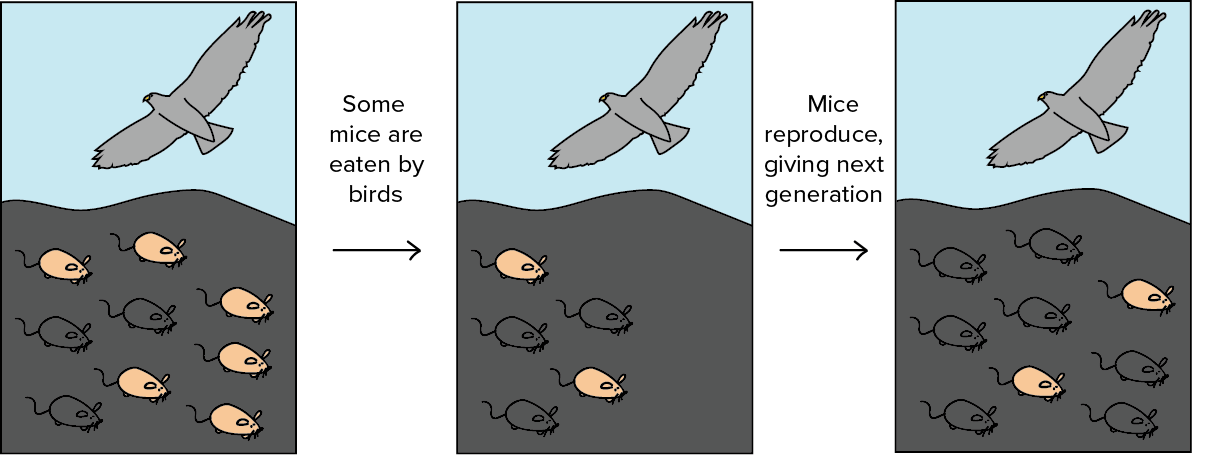
Before the industrial revolution the birds were eating more black moths. After the industrial revolution the birds started eating more white moths. Why
The birds thought the white moths tasted better.
There were not any black moths to eat
The white moths stood out on the dark trees so the birds could see them easier.

Darwin concluded that 13 species of finches on the Galapagos Islands
were identical to 13 species found in Ecuador and surrounding countries
probably evolved from one original South American species.
had adapted to the same food.
probably evolved from one original South American species.
AND
had adapted to the same food.
Darwin began to formulate his concept of natural selection after...
experimenting with animals
reading the writings of Mendel.
observing many species while aboard the H.M.S Beagle.
a vision in a dream.
According to theory, the individuals that tend to survive are those that have...
variations best suited to the environment.
the ability to change their bodies to fit the environment
the best luck.
the biggest body
A woodpecker has a long, thin, pointed beak. How would this adaptation help it survive?
It can easily pick bugs out of the bark in the trees.
It can swim fast
It can catch other animals
It can easily catch fish
The goal of every species on earth is to
(a)
What adaptation makes the most sense for living in a cold snowy area?
gills
colorful wings
white fur
striped skin
Chameleons are reptiles that have the ability to hide from predators and prey by blending in with their environment. They can change the pattern and/or color of their skin. This ability is known as --
natural selection
imitations
mimicry
camouflage
Living things have two kinds of adaptations: __________________. Choose the best answer.
behavioral and physical
physical makeup and structural
behavioral and structural
thrive and survive
Which one is a behavioral adaptation for humans?
walking upright
having thumbs
eyes on the front of our heads
molar teeth
all of the above
Which statement best describes the process of evolution?
Populations can survive in different locations on earth
Environmental conditions limit the number of species on Earth
Populations grow when resources are abundant
The traits of a species can change over time
What did Darwin notice was different about the Finches on each island?
they had different wings
they had different beak shapes
They had different coloring
All the finches were the same
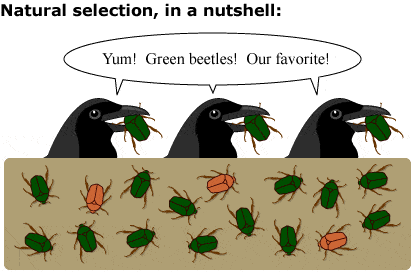
In a habitat there are red bugs and green bugs. The birds prefer the taste of the red bugs, so soon there are many green bugs and few red bugs. The green bugs reproduce and make more green bugs and eventually there are no more red bugs
Genetic Drift
Natural Selection
Gene Flow
Mutation

Fish and other animals travel in groups for protection and to find food.
What type of ADAPTATION is this?
Structural/physical
Behavioral
Physiological

Black bears in Gatlinburg, Tennessee have learned how to open car doors to search for food.
What type of ADAPTATION is this?
Structural/physical
Behavioral
Physiological
41-50.
Answer the questions below after watching the video
Who were the first to propose a unified explanation of evolution?
Gregor Mendel and Thomas Hunt Morgan
Charles Darwin and Alfred Russell Wallace
John Burdon Sanderson Haldane and Theodosius Dobzhansky
Ronald Aylmer Fisher and Sewall Wright
What concept did Darwin and Wallace use to explain how species evolve?
Gene flow
Natural selection
Mutation
Genetic drift
Who discovered the principle of heredity while working with pea plants?
Alfred Russell Wallace
Gregor Mendel
Charles Darwin
Thomas Hunt Morgan
What did Thomas Hunt Morgan identify as a key driver of evolution?
Genetic drift
Natural selection
Gene flow
Mutation
What is the Modern Synthesis a collaboration of?
Evolutionary biology and genetics
Natural selection and mutation
Genetic drift and gene flow
All of the above
Who were the first scientists to provide a unified explanation for evolution?
Charles Darwin and Alfred Russell Wallace
Ronald Aylmer Fisher and Sewall Wright
John Burdon Sanderson Haldane and Theodosius Dobzhansky
Gregor Mendel and Thomas Hunt Morgan
What is the process called that describes how a single species adapts to its environment?
Macroevolution
Genetic drift
Gene flow
Microevolution
Which scientist discovered the concept of mutation in evolution?
Thomas Hunt Morgan
Charles Darwin
Alfred Russell Wallace
Gregor Mendel
What concept explains the movement of genes between populations?
Natural selection
Gene flow
Mutation
Genetic drift
In what year was the structure of DNA discovered, enhancing our understanding of genetics?
1858
1910
1937
1953


What is a trait or behavior that helps an organism survive and reproduce in its environment?
homologous structure
adaptation
evolution
fossil

A student compares two different species of fox as shown in the table.
Arctic Fox vs. Fennec Fox
The student wants to explain why the two species are so different even though they have a common ancestor.
Which statement BEST explains the differences between the two species?
Different environments led to different adaptations
The same environment led to different adaptations
Each species developed the same adaptations in different environments
Each species migrated to environments that matched their adaptations
Which of the following is an example of adaptation?
A bear hibernating in winter.
A plant producing more seeds in a drought.
A chameleon changing its color to blend in with its surroundings.
All of the above.
What is natural selection?
The process by which individuals with beneficial traits produce more offspring, leading to changes in the traits of living organisms over time.
The ability of an organism to change its color in response to environmental changes.
A random process that results in the survival of the fittest individuals.
The process by which individuals acquire traits through use and disuse.
How does adaptation affect a species' survival?
It decreases a species' ability to survive and reproduce.
It has no effect on a species' survival.
It increases a species' ability to survive and reproduce in its environment.
It only affects a species' coloration and patterns.


Observe the two fish in the image. The cave fish and minnow are genetically related to each other and are similar in many ways. The cave fish lives very deep in the ocean where there is no light. It has only the remnants of eyes and is blind. Minnows live in shallow waters where the water has light. Their eye sight is important for their survival. Which statement below best describes these two fish?
The DNA of the cave fish has changed over time to differ from the minnow. Since there is no light where the cave fish lives, it was not necessary to have working eyes. Over time, mutations occurred which proved to improve the survival of the cave fish, which is why they are now blind and have only physical remnants of eyes.
The DNA has not mutated over time and despite all of the evidence that suggests these two are genetically similar, one has eyes and the other does not so they must not be related.
Cave fish must have been attacked by predators, which is why they only have the remnants of eyes.


Which of the following best describes the concept of "survival of the fittest"?
The strongest animals in a population are the only ones that survive.
Individuals that are best adapted to their environment survive and reproduce.
Only the fastest animals in a population can escape predators and survive.
Animals with the most aggressive behaviors dominate and survive.

