
 Worksheets
Periodic Trends Practice
Total questions: 55
Worksheet time: 1hrs 23mins
Group 1A is known as...
Noble Gases
Alkali Metals
Alkaline Earth Metals
Halogens
Group 2A is known as...
Noble Gases
Alkali Metals
Alkaline Earth Metals
Halogens
Group 17 (7A) is known as...
Noble Gases
Alkali Metals
Alkaline Earth Metals
Halogens
Group 18 (8A) is known as...
Noble Gases
Alkali Metals
Alkaline Earth Metals
Halogens
Which group is the LEAST reactive?
Noble Gases (8A)
Alkali Metals (1)
Alkaline Earth Metals (2)
Halogens (7A)
Which group is the MOST reactive?
Noble Gases
Alkali Metals
Alkaline Earth Metals
Transition Metals
The measure of an atom's ability to attract electrons from a bond is...
ionization energy
electronegativity
atomic radius
electron affinity
The energy needed to REMOVE the outermost electron from an atom is called...
atomic radius
ionization energy
electronegativity
electron affinity
As one moves down a group on the periodic table, ionization energy...
increases
stays the same
decreases
fluctuates unpredictably
Which of the following elements should have the highest ionization energy?
K
Na
Cs
H
Which of these elements would have the lowest ionization energy?
Be
Br
Ba
Bi
As one moves left to right across a period on the periodic table, electronegativity...
increases
stays the same
decreases
fluctuates unpredictably
Which of these elements has the largest electronegativity?
F
Br
Cl
I
As one moves down a group on the periodic table, atomic radius...
increases
stays the same
decreases
fluctuates unpredictably
The elements with the largest atomic radii are located on the...
upper-right of the periodic table
lower-left of the periodic table
lower-right of the periodic table
upper-left of the periodic table
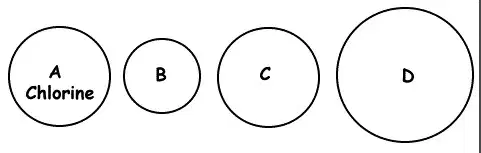
Given the representation of a chlorine atom, which circle could represent an atom of bromine?
A
C
B
D
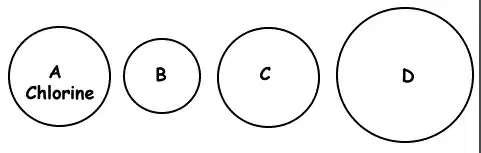
Given the representation of a chlorine atom, which circle could represent an atom of argon?
A
C
B
D
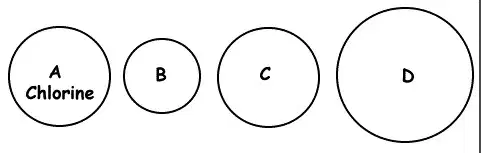
Given the representation of a chlorine atom, which circle might represent an atom of fluorine?
A
C
B
D
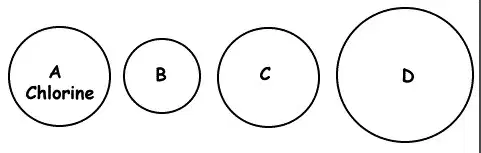
Given the representation of a chlorine atom, which circle might represent an atom of sulfur?
A
C
B
D
When an atom LOSES electrons, it becomes...
neutral
negatively charged
positively charged
spiritually motivated
Which of these elements would have the smallest atoms?
Cl
I
F
Br
Which of these elements would have the largest atoms?
N
Ne
B
Li
Which of these elements would have the smallest ionization energy?
N
Ne
Li
B
Which of these elements would have the greatest electronegativity?
C
O
F
N
The size of atoms get bigger as you go down a group on the periodic table because...
there are more protons in the nucleus
there are more energy levels (rings) around the nucleus
there are more electrons in the energy levels
there are more neutrons in the nucleus
Why does ionization energy increase as you go from left to right ACROSS a period?
There are more protons as you move from left to right
There are more electron rings as you move from left to right
There are less protons as you move from left to right
There are less electrons as you move from left to right
How many electron rings does Aluminum (Al) have?
1
2
3
4
Which element is the MOST reactive?
Sodium (Na)
Magnesium (Mg)
Aluminum (Al)
Silicon (Si)
As we move to the right on the periodic table, atoms get smaller because...
there are more protons in the nucleus
there are more energy levels (rings) around the nucleus
there are more electrons in the energy levels
there are more neutrons in the nucleus
This atom of Beryllium (Be) has 4 protons, 5 neutrons, and 4 electrons. What is the atomic mass?
4 amu
9 amu
13 amu
8 amu
An atom with 19 protons and 20 neutrons is
sodium
potassium
calcium
How many protons are in an atom of Silicon?
28
14
7
3
An atom of Fluorine (atomic #9) has an atomic mass of 19 amu and it has 6 electrons. How many neutrons does it have?
9
10
19
None of the above
Argon (atomic #18) has a full outer valence shell of electrons.
True
False
When bromine gains an electron for sodium, bromine becomes a ...
positive ion
negative ion
When chlorine gains an electron from sodium, chlorine becomes a _________.
positive ion
negative ion
How many Hydrogens (H) are in ONE molecule of water? (H2O)?
1
2
3
None of the above
How many Oxygen atoms (O) are in ONE molecule of glucose? (C6H12O6)?
6
12
18
None of the above
To fulfill the octet rule, most atoms want to have how many valence electrons?
2
3
8
None of the above
Which of the following atoms will form 3 covalent bonds? (Hint: HONC)
Sodium (Na)
Carbon (C)
Nitrogen (N)
Oxygen (O)
Which of the following atoms will form 2 covalent bonds? (Hint: HONC)
Sodium (Na)
Carbon (C)
Nitrogen (N)
Oxygen (O)
Which of the following atoms will form 4 covalent bonds? (Hint: HONC)
Sodium (Na)
Carbon (C)
Nitrogen (N)
Oxygen (O)
What does lithium (Li) want to do to fulfill the octet rule?
Lose 1 electron
Gain 1 electron
Lose 2 electrons
None of the above
What does Calcium (Ca) want to do to fulfill the octet rule?
Lose 1 electron
Gain 1 electron
Lose 2 electrons
None of the above
What does Oxygen (O) want to do to fulfill the octet rule?
Lose 1 electron
Gain 1 electron
Lose 2 electrons
None of the above
What does Bromine (Br) want to do to fulfill the octet rule?
Lose 1 electron
Gain 1 electron
Lose 2 electrons
None of the above
Lithium wants to LOSE 1 e- to fulfill the octet rule. Which element is most likely to form an ionic bond with Lithium?
Oxygen (O)
Beryllium (Be)
Helium (He)
Fluorine (F)
Which of the following is the MOST reactive?
Lithium (Li)
Sodium (Na)
Potassium (K)
Cesium (Cs)
Magnesium (Mg) forms an ionic bond with a single atom from another group. Which group is the 2nd atom PROBABLY from?
Group 1A
Group 2A
Group 6A
Group 8A
The formation of a covalent bond relies on the interaction or bonding of...
2 Nonmetals
1 Nonmetal & 1 Metal
2 Metals
2 Noble Gases

Nitrogen is a diatomic element which means in nature, it is found in two's. (N2) Nitrogen shares three pairs of electrons to make sure each atom completes the octet rule. This creates a...
single bond
double bond
triple bond
Oxygen is a diatomic element which means in nature, it is found in two's. (O2) Oxygen shares two pairs of electrons to make sure each atom completes the octet rule. This creates a...
single bond
double bond
triple bond

What does this picture illustrate? (Select all that apply)
Sharing valence electrons
Covalent bonding
transferring valence electrons
ionic bonding
two nonmetals

What type of bond will this compound likely form [Na]+ & [Cl]- ?
Ionic compound
Covalent compound
Metallic compound
How many total atoms are in the covalent compound C4H10 (Butane)?
6
8
10
12
14

