
Font size
 Worksheets
Unit 4 Cs Edexcel
Total questions: 91
Worksheet time: 48mins
Data Bus is Unidirectional
True
False
Von Neuman Architect is based on Software design
True
False
MDR is a register
for calculation
for carrying data and instructions
for carrying memory addresses
None of the above
Control Bus deals with
Processor
Input output devices
Storage devices
All of the above
Program Counter is a
Register
Memory address
Part of the processor
input device
The MDR contents go to the
Control Unit
CIR
PC
MAR
Buffer is a temporary
Storage
Memory
Bus
All of the above
Interrupt is a
Memory location
piece of hardware
Signal
None of the above
................Produce an EXE file
GUI
Interpreter
CLI
Compiler
To check line by line you are using
Assembler
Compiler
Interpreter
High level language
Operating systems
Works with hardware of the computer
Manage interface
Manage input / Output operations
All of the above
Assembly is
A high level language
A Low level language
A Machine Code
A CLI
C Language is a high level language
True
False
ALU Is
Performs Arithmetic operations
Arithmetic Logic unit
Performs Logic operations
All of the above
ALU results are stored in the
MAR
MDR
ACC
None of the above
According to the von Neumann model, _______ are stored in memory.
only data
only programs
data & programs
neither data nor programs
Tick all options that happen in the FETCH CYCLE?
PC is incremented
The Instruction at the MAR address is read from RAM
The PC value is copied to the MAR
The instruction in the MAR is decoded
The value in the MDR is written to the address in the MAR.


The Program Counter
Stores the address of the next instruction in memory
Stores the address of where the next item will be fetched from
Stores data fetched from memory, or waiting to be stored in memory
Stores the result of arithmetic calculations
Accumulator
Stores the address of the next instruction in memory
Stores the address of where the next item will be fetched from
Stores data fetched from memory, or waiting to be stored in memory
Stores the result of arithmetic calculations
Emebeded systems are the same as computers
True
False
Embeded Systems deal with Sensors and Actuators
True
False
An increase in the address and data bus (a) increases the computer performance.
A crash in the computer can occur if the system clock speed is not adjusted with the CPU resources
True
False
Interrupt is a
Memory
Signal
Memory
All of the above
Assembly language produces
Assembled file
Executable file
Low level instruction
None of the above
Printer drivers are written in
Python
Low level language
Operating system language
C++
Pretty printing is a characterisitic of the
IDE
CLI
GUI
MDR
Which of these are magnetic storage devices?


Solid state storage has no moving parts?
True
False
Which type of storage uses a laser?
Magnetic
Optical
Solid State
Which of the following is most commonly found in PCs?
Solid State Storage
Magnetic Storage
Cloud Storage
Optical Storage

What is a storage device?
A device use for calculating data
A device used to store data temporarily
A device used to supply power to the computer
A device used to store data permanently

These are offline storage?
True
False
Which type of storage is directly accessible to the CPU?
Primary
Secondary
Offline
Volatile storage keeps data when power is removed
True
False
Which of these are optical storage?
DVD
CD
DVD-RAM
Blu Ray
Which of these is not secondary storage?
Portable HDD
SDD
HDD
DVD Disc

What type of storage is this device?
Primary
Secondary
Offline
Which type of storage is great for storing backups safely?
Primary
Secondary
Offline
Solid state storage has no moving parts?
True
False
Which type of storage uses a laser?
Magnetic
Optical
Solid State
Which of these are logic gates?
AND
OR
NOT
IF
ELSE
What is the output of an OR gate if its inputs are 0 and 1?
1
0
What is the function of a NOT gate?
Inverts its input
Outputs 1 if both inputs are 1
Prevents errors
Outputs 0 if both inputs are 0
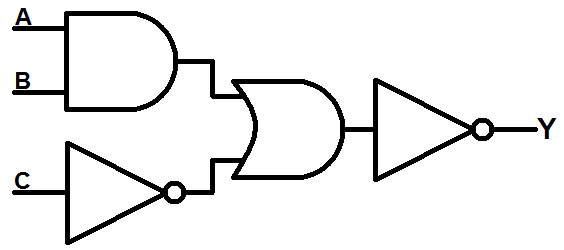
What is the output Y of this logic cricuit if A = 1, B = 1, and C = 1
0
1
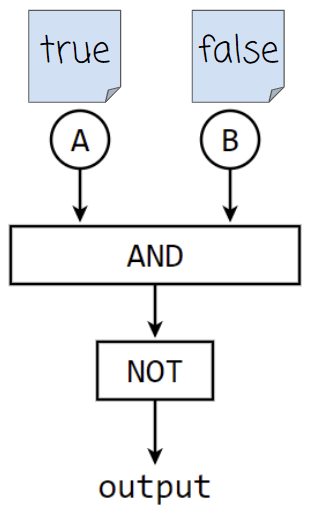
What is the output?
True
False
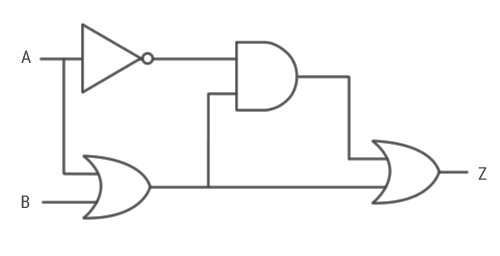
What is the output Z of this logic cricuit if A = 1 and B = 1
0
1
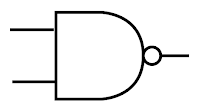
Which logic gate represented by this symbol?
AND
NOR
OR
NAND
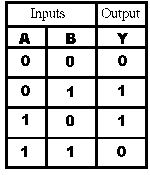
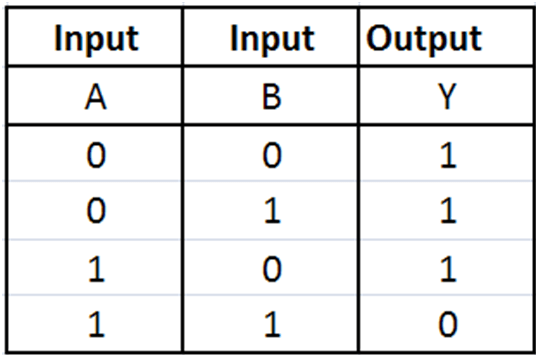
(C AND D) OR (NOT(A OR B)) = Q, If A=1, B=1, C=0 and D=1, what does Q equal?
0
1
(C AND D) OR (NOT(A AND B)) = Q, If A=0, B=1, C=0 and D=1, what does Q equal?
0
1
The ability for different people to use the same computer is made possible through:
Open-source software
Desktop elements
User accounts
Settings app
Which of the following is a function of the operating system?
To compose and send email.
To edit photographs and other high-resolution images.
To control communication and manage files.
All of these are operating system functions.
What manages the hardware and runs the software?
Computer Systems
Dedicated Systems
Embedding Systems
Operating Systems
Which of the following is NOT a translator?
Assembler
Compiler
Interpreter
Executable
Translates source code from high level languages into object code and then into machine code
Assembler
Compiler
Interpreter
Translates low level assembly language mnemonic into machine code
Assembler
Compiler
Interpreter
Assembly language is
Machine language
Low Level Language
compiled
close to the human language
Interpreter features :
Check the program line by line
Produce EXE file
Quicker than compiler
All of the above
![[Ôn tập Nghề Tin] Phần 2 - MS WORD (itnbk)](https://cf.quizizz.com/image/image-loader.svg)
