
 Worksheets
Force in One Dimension Test Review
Total questions: 64
Worksheet time: 47mins
What is friction?
A force that promotes motion
A force that opposes motion
A type of energy
A chemical reaction
Friction acts on materials that are ______.
Far apart from each other
In contact with each other
Magnetic
Electrically charged
What is the main cause of friction between two surfaces?
Smoothness of the surfaces
Irregularities in the two surfaces
Temperature of the surfaces
Color of the surfaces
Which is not a type of friction?
gravity
rolling
static
fluid
Which of the following is NOT a type of friction according to the material?
Static
Sliding
Bending
Rolling
What is an example of fluid friction ?
static friction
Air resistance
rolling friction
sliding friction
What is the air resistance force directly proportional to?
The weight and shape of an object
The speed and frontal area of an object
The color and texture of an object
The temperature and humidity of the air
Why can the heavyweight champion only exert a tiny force on the tissue paper in midair compared to the massive bag?
Because the tissue paper has a higher mass than the massive bag.
Because the tissue paper is not fixed in place and can move easily.
Because the heavyweight champion is not as strong in midair.
Because the tissue paper provides more resistance than the massive bag.
What does Newton's 3rd Law state about the interaction between forces?
When one object exerts a force on a second object, the second object does not exert a force back.
Whenever one object exerts a force on a second object, the second object exerts an equal and opposite force on the first.
The reaction force is always stronger than the action force.
Forces only occur in pairs when objects are in motion.
What happens when the forces on an object are balanced?
The object accelerates
The object moves in a circular path
The object stays still or continues to move at the same speed and in the same direction
The object spontaneously changes direction
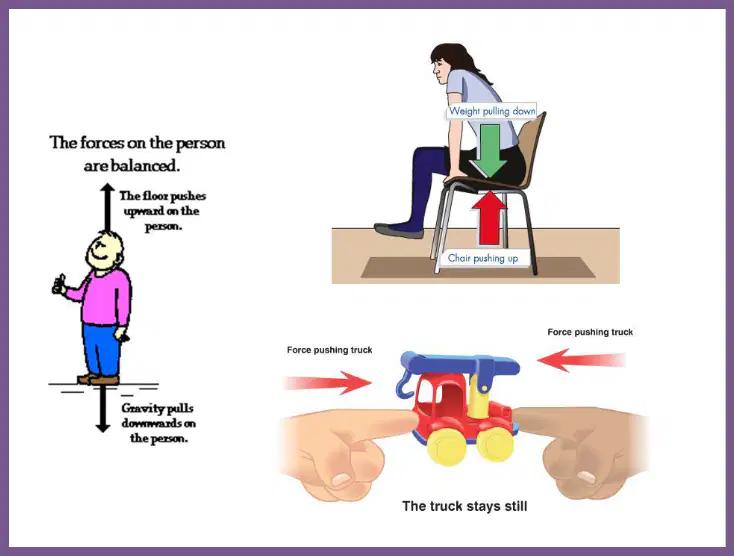
According to the image, what force is acting upward on the person standing on the floor?
Weight pulling down
Gravity pulling downward
The floor pushes upward
Chair pushing up
What force is acting downward on the person sitting on the chair?
The floor pushes upward
Chair pushing up
Weight pulling down
Force pushing truck
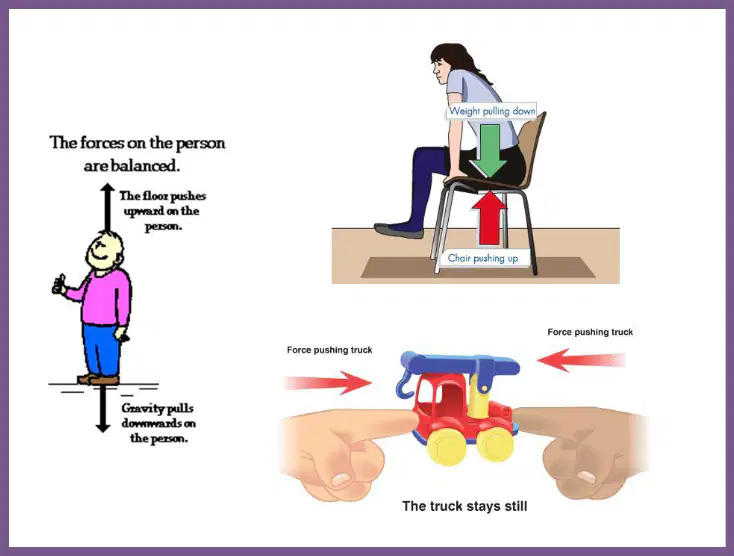
What is the result of the forces acting on the toy truck in the image?
The truck moves forward
The truck moves backward
The truck lifts off the ground
The truck stays still
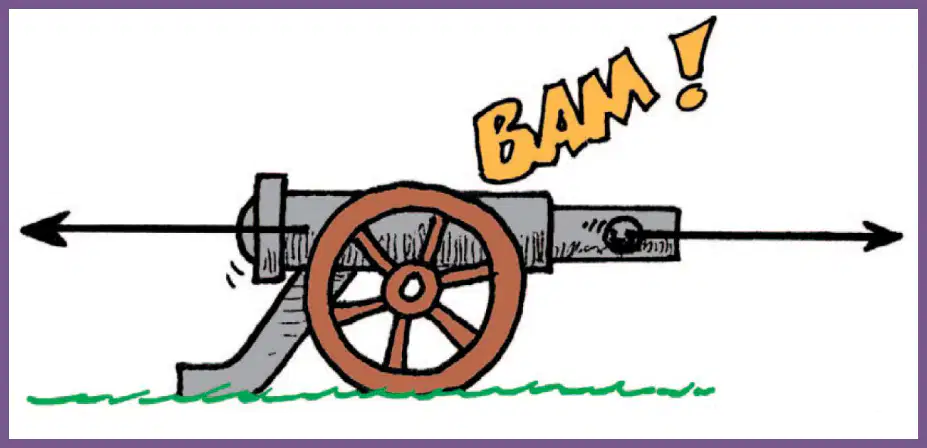
Why does the cannonball undergo more acceleration than the cannon?
Because the cannonball has more mass than the cannon.
Because the cannon is not designed to move.
Because the cannonball and cannon experience the same force, but the cannonball has less mass.
Because the cannon uses wheels to stay stationary.
In physics, a push or pull is a (a) .
(write the vocabulary term all lowercase)
The object or objects of interest is (a) .
(write the vocabulary term all lowercase)
A physical representation that shows the forces acting on a system is called a (a) .
(write the vocabulary term all lowercase)
The vector sum of all the forces on an object is the (a) .
(write the vocabulary term all lowercase)
In physics, a push or pull is a (a) .
(write the vocabulary term all lowercase)
The object or objects of interest is (a) .
(write the vocabulary term all lowercase)
A physical representation that shows the forces acting on a system is called a (a) .
(write the vocabulary term all lowercase)
The vector sum of all the forces on an object is the (a) .
(write the vocabulary term all lowercase)
(a) states that the acceleration of an object is proportional to the net force and inversely proportional to the mass of the object being accelerated.
(write the vocabulary term all lowercase)
An object that is at rest will remain at rest, and an object that is moving will continue to move in a straight line with constant speed, if and only if the net force acting on that object is zero.
(a) .
(write the vocabulary term all lowercase)
(a) is the tendency of an object to resist changes in velocity.
(write the vocabulary term all lowercase)
A net force will equal zero when all acting forces are in (a) .
(write the vocabulary term all lowercase)
The gravitational force experienced by an object is (a) .
(write the vocabulary term all lowercase)
When there are no contact forces acting to support the object
(a)
(write the vocabulary term all lowercase)
The force exerted by a fluid on an object opposing motion through the fluid is (a) .
(write the vocabulary term all lowercase)
The constant velocity that is reached when the drag force equals the force of gravity.
(a)
(write the vocabulary term all lowercase)
A pair of forces that are equal in strength but opposite in direction and act on different objects.
(a)
(write the vocabulary term all lowercase)
(a) states that all forces come in pairs.
(write the vocabulary term all lowercase)
A specific name for the force that a string or rope exerts.
(a) .
(write the vocabulary term all lowercase)
The perpendicular contact force that a surface exerts on another surface.
(a)
(write the vocabulary term all lowercase)
What is the combination of all forces that change an object’s state of motion?
Net force
Support force
Equilibrium force
Tension
What is the upward force on an object that is opposite to the force of gravity?
Support force
Tension
Net force
Frictional force
An object is in equilibrium and NOT in motion.
Stable equilibrium
Unbalanced equilibrium
Static equilibrium
Dynamic equilibrium
What is the quantity of matter in an object?
Mass
Weight
Force
Inertia
What is the quantity of matter in an object?
Mass
Weight
Force
Inertia
What is the force of gravity on an object?
Mass
Weight
Inertia
Force
An object is in equilibrium and NOT in motion.
Stable equilibrium
Unbalanced equilibrium
Static equilibrium
Dynamic equilibrium
What is the SI unit of force?
Pascal
Watt
Joule
Newton
According to Newton's 2nd Law of Motion, what is net force directly proportional to?
Inertia
Mass
Acceleration
Velocity
If the net force acting on an object doubles, what happens to its acceleration?
It remains unchanged
It is tripled
It is halved
It is doubled
If we reduce the mass of a 35 kg object by half, while still pushing with a force of 450 newtons, what happens to the acceleration?
It is tripled
It is doubled
It is halved
It remains unchanged
What is the acceleration if we double the force acting on an object?
It is doubled
It is halved
It remains unchanged
It is tripled
In physics, a push or pull is a (a) .
(write the vocabulary term all lowercase)
Whenever an object exerts a force on another object, the second object exerts a force of the same magnitude, but in the opposite direction to that of the first object.
Always true
Sometimes true
Never true

Force always come in________
waves
triplets
pairs
True or False: The size of the forces on the first object will only be equal to the size of the force on the second object if they are the same mass.
True
False
When one object collides with another object, no force is exerted back by the second object.
True
False
If you push on a wall with a force of 30 N, the force acting on you from the wall is which of the following?
0 N
10 N
20 N
30 N
Newton's (a) Law of Motion states that every action has an (b) and (c) reaction.
When a bowling ball strikes a pin, which imparts a greater force on the other?
the bowling ball
the pins
both exert the same amount of force on each other
When a bowling ball strikes a pin, which experiences a greater acceleration?
the bowling ball because it is more massive
the pin because it is less massive
the both experience the same amount of acceleration
While driving down the road, a firefly strikes the windshield of a bus and makes a quite obvious mess in front of the face of the driver. The firefly hit the bus and the bus hits the firefly.
Which of the two forces is greater: the force on the firefly or the force on the bus?
the force of the firefly
the force on the bus
the both exert the same amount of force on each other

When a heavy football player and a light one run into each other, who exerts more force? (pushes harder)
The light one
They exert the same force on each other
The heavy one
Less than 1, 000 N
1,000 N
More than 1,000 N
Air resistance against the bow
the arrow's push against the bowstring
the grip of the archer's hand on the bow
What is an opposing force?
A force in the same direction with same strength.
A force in an opposite direction with same strength.
You can't exert a force on anything unless it also exert a force on you.
False
True
When you jump up, you push the earth downwards. Why can't you tell that the earth has moved?
The force of you jumping up doesn't actually push the earth down.
The earth has much more mass so it doesn't move at all
The earth is firmly rooted
The earth has much more mass so you can't tell that it moved
Newton's First Law of Motion
Newton's Second Law of Motion
Newton's Third Law of Motion
Newton's Fourth Law of Motion

As one leg moves backward, it provides an equal and opposite force for the other foot to move forward.
No acceleration takes place. Runners are always at a fixed velocity.
The striking foot pushes backward against the ground. The friction with the ground provides an equal and opposite force forward.
The runner's upper body quickly leans forward, causing the entire body to begin accelerating forward

