
 Worksheets
PHYSICS_1_25
Total questions: 15
Worksheet time: 8mins
What is the definition of the potential difference DV between two points A and B in an electric field?
dV = VB - VA = 2∮Eds
dV = VB - VA = 3∮Eds
dV = VB - VA = 5∮Eds
dV = VB - VA = 1∮Eds
What does the potential difference between two points in an electric field depend on?
The charge and the field as a system
The charge and the field separately
The presence of other charges in the vicinity
The type of medium in which the charges are present
What is the work done by an external agent in moving a charge q through an electric field at constant velocity?
W = q∮Eds
W = q*DV
W = qE∮ds
W = q*V*∮Eds
What is the most common term used to describe the potential difference between two points in an electric field?
Voltage
Work
Electric Potential Difference
Energy
What is the unit of voltage and potential difference?
Volts per meter
Joules per coulomb
Amperes per ohm
Watts per second
The potential difference between two points in an electric field measured in
Amperes
Ohms
Watts
Volts
In a uniform electric field, what happens to the electric potential energy of a positive charge as it moves in the direction of the field?
The electric potential energy increases
The electric potential energy remains constant
The electric potential energy decreases
The electric potential energy becomes zero
What is the expression for the electric potential at a point located a distance r from an isolated positive point charge q?
V = k(e)q/rB - k(e)q/rA
V = k(e)q/r^2
V = k(e)q/r
V = k(e)q/rA
What does it mean when the potential difference (dV) is zero along an equipotential surface?
The electric potential is not constant
The electric field is constant
The electric field is not constant
The electric potential is constant
What is the mathematical expression for the x-component of the electric field (Ex) in terms of the electric potential (V) and position (x)?
Ex = dV/dx
Ex = -dV/dx
Ex = 2dV/dx
Ex = -2dV/dx
V=U/q what formula is it ?
The potential difference
The dipole of charges
The electric potential
The work of electric energy
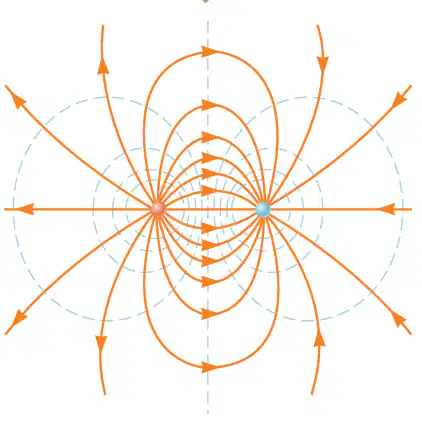
What scheme is described in the picture?
An electric flux between the two charges
An electric potential between the two charges
An electric field produced by an electric dipole
What is the electric potential energy associated with a pair of point charges separated by a distance r(1 2)?
U = ke * q1 * q2 / r12
U = ke *q1 * q2 * r12
U = ke * q1 + q2 *r12
U = ke / q1 * q2 / r12
The amount of work needed to move a unit charge from a reference point to a specific point against an electric field
The energy of charged conductor
The Electric field
The Electric Potential
non of the above
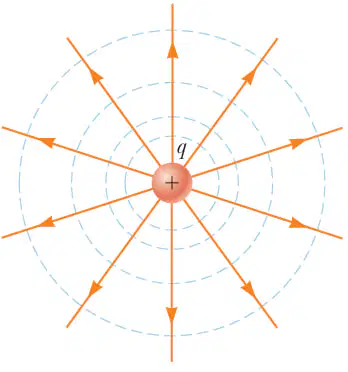
What is described in the picture?
non of them
A uniform electric field produced by an infinite sheet of charge
An electric field produced by an electric dipole
A spherically symmetric electric field produced by a point charge

