
 Worksheets
IGCSE Physics - Mock Exam Revision
Total questions: 100
Worksheet time: 3hrs 20mins
Velocity is?
a helium nucleus
rate of change of distance moved with the direction
the energy store in a body due to its height
the amount of matter that an object is made of
Work done?
Force x distance moved in the direction of the force
force per uint area
number of complete oscillations per unit of time on the wave
the force exerted by the Earth
Velocity is?
a helium nucleus
rate of change of distance moved with the direction
the energy store in a body due to its height
the amount of matter that an object is made of
Work done?
Force x distance moved in the direction of the force
force per uint area
number of complete oscillations per unit of time on the wave
the force exerted by the Earth
Kinetic energy?
Energy stored in chemical substances
Energy that an object has due to its position (height)
Energy that an object has due to its motion
Power?
the amount of energy transfer
Force/cross-sectional area
Current x time
the rate at which work is done (work done/time taken)
The law of Conservation of energy states that:
"Energy cannot be .......... or .........., it only changes from one form to another."
created - destroyed
changed - transfered
stored - moved
Pressure?
rate of change of velocity
force per unit of area (force/area)
vibration of the particles are parallel to the direction that energy transfers.
force x distance moved in the direction of the force
acceleration
a scalar quantity has magnitude only
rate of change of distance moved
rate of change of velocity
number of oscillations per unit time of a point on the wave
mass
position where zero amplitude
the amount of matter in an object
the force exerted by the Earth
force/area
Weight
Current in a circuit
Force exerts on a body due to gravity
the amount of matter in a body
energy of a mass due to its motion
Gravitational potential energy
Energy stored in chemical substances
Energy of an object due to its motion
Energy of an object due to its position (height)
rate of change of velocity
Hooke's law
rate of change of velocity
Force due to gravity
Force/area
force is proportional to the extension unless the limit of proportionality is exceeded
Electric field
proton
electron
region of space where a force acts on a stationary charge
the amount of energy converted from chemical to electrical
Pressure is ______.
region of space where a force acts on a mass
Force per unit of area
vibrations of the particles are perpendicular to the direction of the propagation of energy
rate of change of velocity
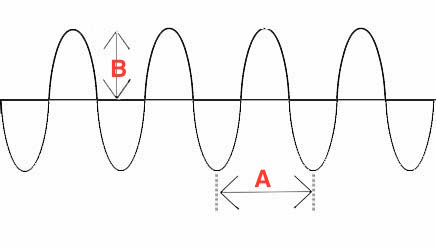
What property of this wave is represented by the letter "A"
amplitude
crest
trough
wavelength

An object has which color for being a good absorber?
Black
White
Yellow
Green
__________ is a phenomenon that the light is reflected when it hits a shiny surface such as a mirrior.
Diffraction
Refraction
Reflection
Turning effect
What is the correct equation for kinetic energy
21mv2
m x v2
21vm2
What is the correct equation for gravitational potential energy
m x g x h
m x g / h
m x h / g

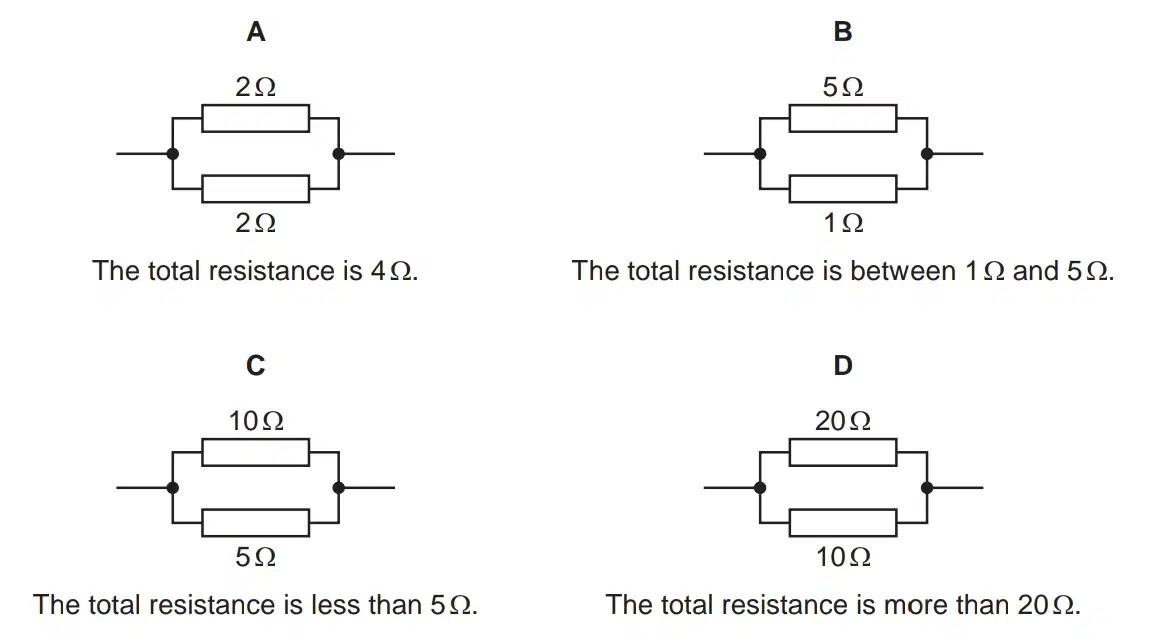
A
B
C
D
The Conservation law of Energy states that: "Energy cannot be _______ or _________, it can only change from one form to another". Fill in the blanks.
moved - changed
moved - transformed
created - destroyed
What is the efficiency of a solar cell if 1000 J of solar energy hits the cell and 200 J are converted into electrical energy?
10%
20%
30%
40%
Power is rate of work done.
Which formula can be used to calculate power?
P = W/t
P = Wt
P = t/W
A motor is used on a building site to raise a block of stone. The mass of the block is 72 kg and it is raised 20 m. Calculate the work done. Take g = 10m/s2
720 J
7200 J
1440 J
14 400 J

A
B
C
D

A
B
C
D

A
B
C
D

What type of wave is shown by "F"?
Transverse
Longitudinal
Combination
Light

When the speed of a wave is constant, the wavelength and frequency have what type of relationship?
Directly proportional
Parallel
Inversely proportional
Equal
What is the speed of electromagnetic waves in a vacuum?
3×10⁸ m/s
3×10⁷ m/s
3×10⁶ m/s
3×10⁴ m/s
Particles of the medium vibrate ____ to the direction of the wave in LONGITUDINAL WAVES.
Parallel
Perpendicular
Equal
Inverse
Particles of the medium vibrate ____ to the direction of the wave in TRANSVERSE WAVES.
Parallel
Perpendicular
Equal
Inverse
An example of a longitudinal wave is
visible light
Electromagnetic waves
Gamma rays
Infrared waves
Sound

Which wave has the largest wavelength?
A
B
C
They have the same wavelength.

A wave has a frequency of 5 Hz and a speed of 25 m/s. What is the wavelength of the wave?
0.2 m
125 m
5 m
30 m
A wave has a frequency of 14 Hz and a wavelength of 3 m. At what speed will this wave travel?
4.67 m/s
42 m
42 m/s
4.67 m
A wave has a frequency of 540 Hz and is traveling at 340 m/s. What is its wavelength?
1.59 m
0.63 m
183600 m
91800 m
A wave has a frequency of 100 Hz. What is the time period of this wave?
100 s
10 s
0.1 s
0.01 s
Frequency is how many waves pass a point in 1 second. If 100 waves pass a given point in 4 seconds, what is the wave's frequency?
4 Hz
25 Hz
100 Hz
400 Hz

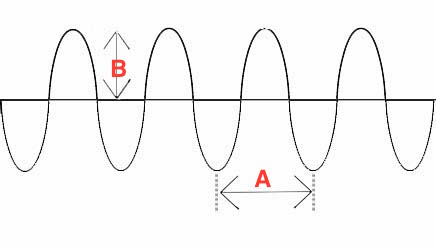
In the diagram of a compressional wave, A is showing a ___ while B is showing a ___.
compression, rarefaction
crest, trough
rarefaction, compression
trough, crest
Sound waves cannot travel through
vacuum
solids
liquids
gases
Sound waves propagate by ................
transferring matters
passing on the vibration
expanding the volume
changing the position of matters
Audible frequency is the range of frequencies that can be heard by a healthy human ear. This range of frequencies is
10 Hz - 10 000 Hz
smaller than 20 Hz
20 Hz - 20 kHz
larger than 20 000 Hz
The force of gravity. This keeps human standing on the Earth.
Weight
Friction
Air resistance
Upthrust
The relationship between resultant force, mass and acceleration can be shown by equation:
resultant force = mass x acceleration
resultant force = mass / acceleration
resultant force = acceleration / mass
Mass is?
the force of gravity
the amount of matter that an object is made of.
the quantity shows how fast an object traveled
the quantity shows how fast the velocity of an object changes.
Weight is?
the force of gravity which keeps us standing on the Earth
the amount of matter that an object is made of.
the quantity shows how fast an object traveled
the quantity shows how fast the velocity of an object changes.
The equation linking, weight, mass and gravitational field strength.
weight = mass x time
weight = mass ÷ gravitational field strength
weight = mass x gravitational field strength
weight = mass x velocity squared
The symbol equation linking weight, mass and gravitational field strength.
W = mg
W = m/g
W = g/m
The difference(s) between Mass and Weight is?
Mass changes while Weight unchanges with location.
Mass is measured in kilograms (kg) while Weight is measured in Newton (N)
Mass and Weight unchanges with location
Mass unchanges while Weight changes with location.
A ball has a mass of 200 g. What is the weight of the ball? Take gravitational field strength g = 10 m / s2
2000 N
200 N
20 N
2 N
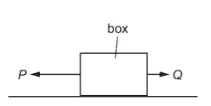
The diagram shows a large force of magnitude P and a small force of magnitude Q acting on a box.
Which expression gives the magnitude of the resultant force on the box?
P + Q
P - Q
P x Q
P / Q
A forklift truck lifts a crate that has a mass of 140 kg. The gravitational field strength, g = 10 N/kg. What is the weight of the crate?
14 m/s
1400 m/s
14 N
1400 N
........................... is defined as the rate of mass per a unit of volume.
Velocity
Density
Acceleration
Distance
A solid cube is made from a material with density 0.60 g/cm3. The side of the cube is 2 cm.
What is the mass of this cube?
0.048 g
0.48 g
4.80 g
48.0 g
Five identical solid glass balls, each of mass 5.0 g, are put into a measuring cylinder containing water.
The water level in the measuring cylinder rises from the 30 cm3 mark to the 40 cm3 mark.
What is the density of the glass from which the balls are made?
0.50 g/cm3
1.20 g/cm3
1.60 g/cm3
2.5 g/cm3

What is the resistance in this circuit?
0.05Ω
1.8Ω
20Ω
What is the resistance of an object that draws 0.24 A when connected to a 120 V circuit?
0.024 Ω
28.8 Ω
124 Ω
500 Ω
What is the unit of electrical power?
amperes
joules
volts
watts
What is the correct equation linking charge current and time
Q = It
I = Qt
t = QI
What is the correct equation for electrical power
P = I x V
P = V / I
P = I / V
What is the name of the Law that relates current, voltage and resistance in an electrical circuit?
Ohm's Law
Lenz's Law
Faraday's Law
Hooke's Law
Which is the right form of Ohm's Law linking voltage, current and resistance?
V=I/R
V=R/I
I=V/R
I=R/V
A computer circuit board contains a 4 kΩ resistor and has a p.d. of 8 V across it.
What is the current through the resistor?
2 mA
2 A
16 mA
16 A
To get a large current to flow in a wire, you can either
increase the wire resistance or increase the supply voltage
increase the wire resistance or decrease the supply voltage
decrease the wire resistance or increase the supply voltage
decrease the wire resistance or decrease the supply voltage
Which of the following is the correct unit for charge?
coulombs (C)
Amps (A)
current (I)
charge (Q)
A 6 V light bulb is switched on for a short time. A 6 V battery transfers 2 C of charge to the bulb in this time. What energy has been transferred?
0.33 J
3 J
6 J
12 J
170 W
170 Ω
1.7 Ω
1.7 W

Remember: V=IR and P=VI
80 W
200 W
2.5 A
22.5 kJ
10C of charge flows in a wire every 2 seconds. Calculate the current in the wire.
5 Ohms
5 Amps
0.2 Volts
0.2 Amps
What is a formula to calculate Charge
Q=It
Q=tI
Q=VE
Q=IR
How do you calculate the energy transferred in a component?
E=IVt
E=IVt
E=IV
E=Q/t
A current of 12 A flows for 20 minutes into an electric cooker.
How much charge has the cooker used?
14400 C
280 C
100 C
0.6 C
The current in a motor is 2.1 A and the potential difference across it is 12V. The motor takes 1.5 seconds to lift a mass. What is the energy transferred to the motor as it lifts the mass?
85 J
3.8 J
38 J
8.5 J
A 240 volt, 3 amp heater is left running for 5 minutes.
Which of these gives the total energy output?
3.6 kJ
216 kJ
72 kJ
0.9 kJ
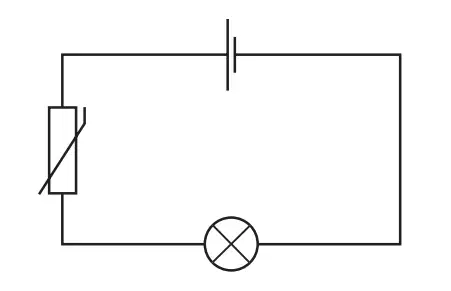
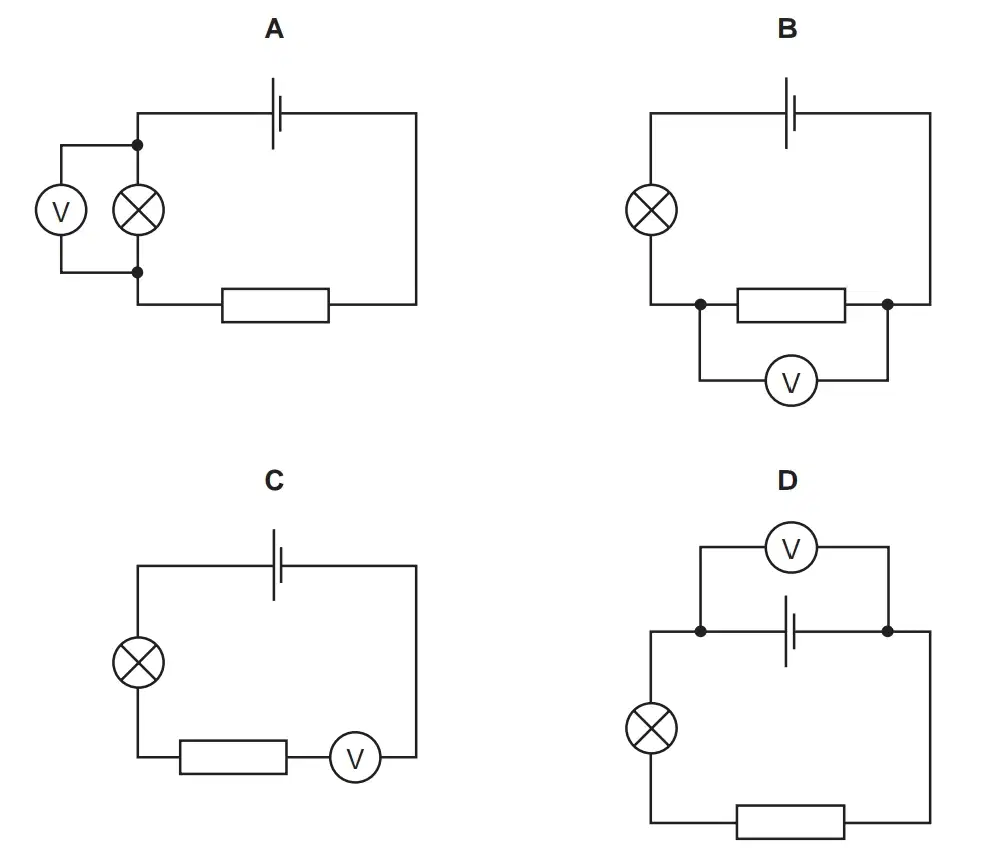

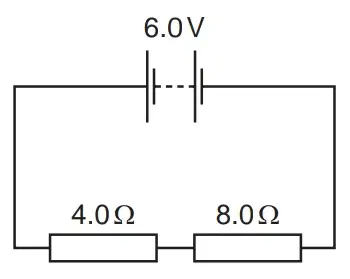
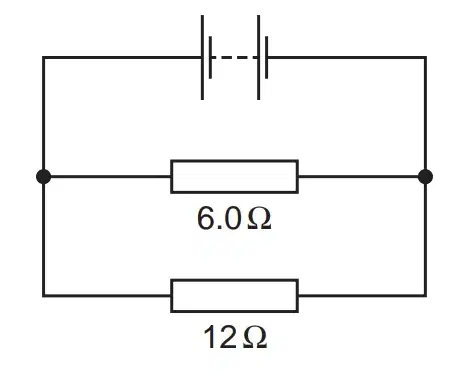

The diagram shows the speed-time graph for a car.
Which area represents the distance traveled while the car is accelerating?
X
X + Y
Y
Y - X

The speed-time graph shows the motion of a car.
Which choice describes the motion?
accelerating between P and Q; moving at constant speed between Q and R.
accelerating between P and Q; not moving between Q and R.
moving at constant speed between P and Q; decelerating between Q and R.
moving at constant speed between P and Q; not moving between Q and R.
A change in speed over a given period of time is
velocity
motion
speed
acceleration


The diagram shows a tug-of-war between team X and team Y. The arrows show the forces exerted by the teams on the rope.
What is the size of the resultant force on the rope and in which direction does the resultant force act?
size of resultant force = 75 N; direction of resultant force = to the left
size of resultant force = 75 N; direction of resultant force = to the right.
size of resultant force = 725 N; direction of resultant force = to the left
size of resultant force = 725 N; direction of resultant force = to the right.

A
B
C
D
A cuboid made of iron has a width of 12 cm,a length of 10 cm,a mass of 0.5 kg,and a density of 7.9 g/cm3.What is its height?
0.53 cm
0.2 cm
0.3 cm
2 cm
What is the pressure exerted by a force of 50 N on an area of 2 m²?
10 Pa
100 Pa
50 Pa
25 Pa
What is the density of an object with a mass of 50 kg and a volume of 10 m³?
0.5 kg/m³
5 kg/m³
50 kg/m³
500 kg/m³

The region where a charge experiences a force is ..............................
magnetic field
current
electric field
gravitational field

