wayground logo

Free Printable Worksheets

Font size

S
M
L
XL
Worksheets

Waves

Total questions: 97

Worksheet time: 8hrs 5mins
Name
Class
Date
1.
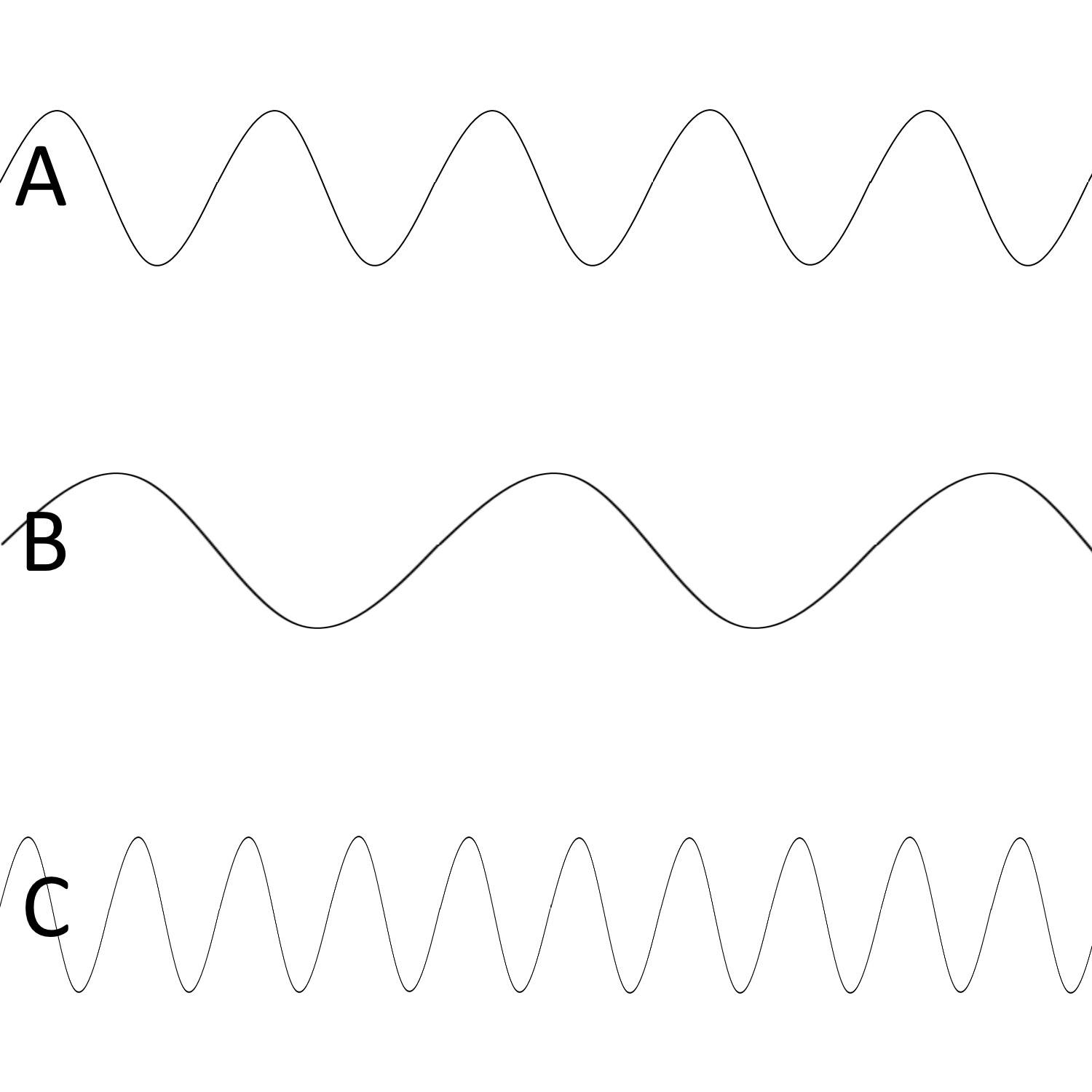
Which wave has the largest wavelength?
a)
A
b)
B
c)
C
d)
None (same wavelength)
2.
Which wave has the largest frequency?
a)
A
b)
B
c)
C
d)
None (same frequency)
3.
If all three are waves of light, which wave has the largest speed?
a)
A
b)
B
c)
C
d)
None (same speed)
4.

Which particle is a wave of light?

a)

proton

b)

neutron

c)

electron

d)

photon

5.
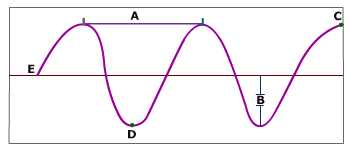
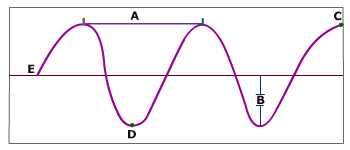
Which letter represents wavelength?
a)
A
b)
B
c)
C
d)
D
6.
Which letter represents the wave crest?
a)
A
b)
B
c)
C
d)
D
7.
Which letter represents the wave trough?
a)
A
b)
B
c)
C
d)
D
8.
Which letter represents amplitude?
a)
A
b)
B
c)
C
d)
D
9.
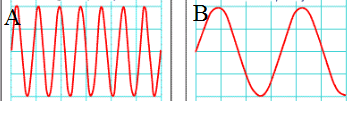
Which wave has a greater frequency?
a)
A
b)
B
10.
What is another name for wave height?
a)
Frequency
b)
Amplitude
c)
Wavelength
d)
Origin
11.
What is measured from crest to crest or trough to trough?
a)
Frequency
b)
Amplitude
c)
Wavelength
d)
Origin
12.
If a wave has a greater frequency, what happens to the wavelength?
a)
increases
b)
decreases
c)
stays the same
13.
If a wave has a greater frequency, what happens to number of waves per second?
a)
increases
b)
decreases
c)
stays the same
14.
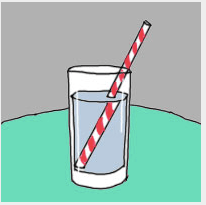
A straw appears bent in a glass of water, entering a new medium. Which phenomenon is happening?
a)
constructive interference
b)
refraction
c)
reflection
d)
diffraction
15.
You shine a light on a mirror and the light waves bounce back. Which phenomenon is happening?
a)
constructive interference
b)
refraction
c)
reflection
d)
diffraction
16.
A sound wave bends around a door and you can hear it in the hallway. Which phenomenon is happening?
a)
constructive interference
b)
refraction
c)
reflection
d)
diffraction
17.

What does a wave carry from place to place?

a)

energy

b)

matter

c)

people

18.

Which property of the wave would change if you changed the amount of energy the wave had?

a)

amplitude

b)

frequency

c)

wavelength

d)

wave speed

19.

Water waves are unique because they:

a)

are transverse waves

b)

are longitudinal waves

c)

carry energy

d)

move matter from place to place

20.
The image above shows a student using a Slinky to create a wave. The slinky is stretched at one end and the resulting wave travels back and forth. This is an example of a...
a)
Superposition Wave
b)
Refracted Wave
c)
Longitudinal Wave
d)
Transverse Wave
21.
Imagine one end of a rope is tied to a door handle. The other end is caused to vibrate vertically(up & down). The wave that travels along the rope is an example of a(n)...
a)
Electromagnetic Wave
b)
Microwave
c)
Transverse Wave
d)
Longitudinal Wave
22.
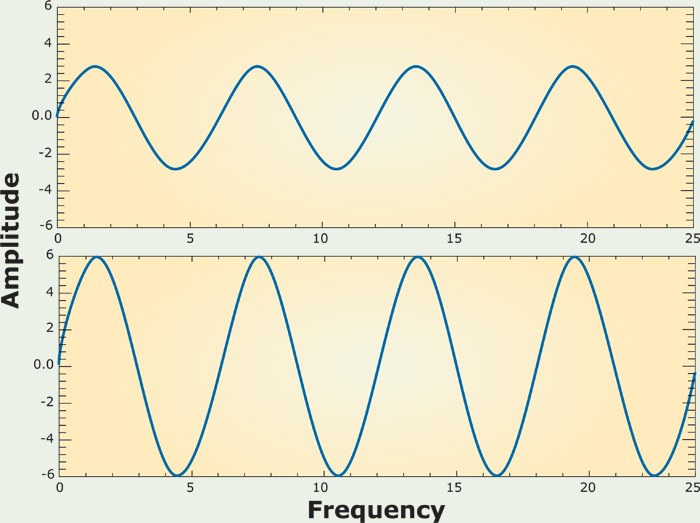
Look at the waves amplitudes. Which has a higher intensity? 
a)
top wave
b)
bottom wave
c)
neither 
d)
they have the same intensity
23.
How much energy is the bottom wave carrying, compared to the top wave? 
a)
bottom is carrying more energy than top
b)
bottom is carrying the same energy as top
c)
you cannot tell from the picture
d)
bottom is carrying less energy than top
24.
Which of the waves below travel fastest through air? 
a)
light waves
b)
water waves
c)
seismic waves
d)
sound waves
25.
Which of the waves below travel faster through solids? 
a)
water waves
b)
seismic waves
c)
sound waves
d)
light waves
26.
What does the picture tell you about the light waves coming from these lightbulbs?
a)
the wave from the bulb on the left has a higher amplitude
b)
the wave from the bulb on the left has a higher intensity
c)
the wave from the bulb on the right has a higher amplitude
d)
the wave from the bulb on the right has a lower intensity
27.
Another name for Reflection is...
a)
flip
b)
turn
c)
slide
d)
dilation
28.
What do you see when water droplets refract and diffract sunlight?
a)
thunderstorm
b)
eclipse
c)
rainbow
d)
clouds
29.
A ray of white light passes through a prism.  On the other side of the prism, you see a rainbow.  What is this phenomenon called?
a)
Reflection
b)
Refraction
c)
Medium
d)
Dispersion
30.
What happens when light hits a mirror?
a)
it makes a color
b)
it reflects
c)
it makes a rainbow
d)
it passes through
31.
The picture best represents
a)
Refraction
b)
Reflection
c)
Diffraction
d)
Interference
32.
The ray of light that strikes a reflecting surface is called ________.
a)
incident ray
b)
reflected ray
c)
normal ray
d)
none of the above
33.
The imaginary line perpendicular to a reflecting surface is called _____.
a)
crooked line
b)
parallel line
c)
angular line
d)
normal line
34.
What does incidence angle equal?
a)
reflection angle
b)
∠C
c)
∠D
d)
all of these
35.
If the angle of incidence is 45 degree, what is the angle between the incident ray and reflecting surface
a)
45
b)
90
c)
180
d)
none of the above
36.
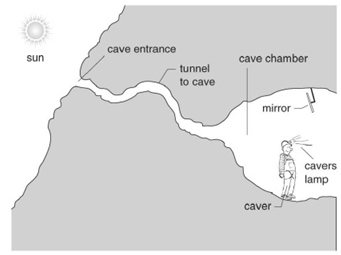
Which of the following is not a source of light? 
a)
A. candle
b)
B. caver’s lamp
c)
C. mirror
d)
D. sun
37.
If his lamp stopped working, what would the caver be able to see? 
a)
A. the tunnel to the cave
b)
B. a mirror
c)
C. nothing
d)
D. the walls of the cave
38.
What is A?
a)
Angle of incidence
b)
Angle of reflection
c)
Incident ray
d)
Reflected ray
39.
Law of reflection state that - The angle of incidence is .................. to the angle of reflection.
a)
equal
b)
double
c)
half
40.
Which of these statements is true?
a)
Light travels in straight lines.
b)
Light is stopped when it meets a solid object.
c)
Light does not travel in straight lines.
d)
Light will only travel for about 2000km before it stops.
41.

What happens when a beam of light hits an object?

a)

The light passes through it

b)

All the light is absorbed

c)

A shadow forms

d)

All the light is reflected

42.

What might explain why light travels in a straight line?

a)

If there is nothing to interfere with light waves, they should travel in a straight line.

b)

Light waves will always travel in a straight line, even if they come into contact with another object.

c)

Light waves don't travel in a straight line.

d)

Light waves travel in a straight line because sound waves travel in a straight line.

43.

Why doesn’t the surface of a wooden boat reflect light as the surface of water does?

a)

Because the boat's surface is rough and absorbs more light.

b)

Because the surface of the boat is red, not blue.

c)

Because the boat is not a natural object like the water is.

d)

Because the boat is on top of the water's surface.

44.

What is the value of the unknown angle (theta) in the following diagram?

a)

A. 30 degrees

b)

B. 45 degrees

c)

C. 90 degrees

d)

D. 60 degrees

45.

Which color shirt would you rather wear outside on a sunny 90 degree day?

a)

black

b)

white

c)

gray

d)

navy blue

46.

Why does the straw appear to be bent?

a)

light is reflected

b)

light is absorbed

c)

light is turned

d)

light is refracted

47.

When light passes from air to water, what happens to the speed of the light?

a)

speeds up

b)

slows down

c)

stays the same

48.

In the diagram, which letter represents the angle of incidence?

a)

A

b)

B

c)

C

d)

D

49.

Given that the angle of incidence = 30 degrees

a. Draw a ray diagram, labelling clearly the normal, incident ray, angle of incidence, reflected ray and angle of reflection accurately.

Which is the correct diagam?

a)

A

b)

B

c)

C

d)

D

50.

If a capital letter R is seen in an ordinary mirror, what does it look like?

a)

A

b)

B

c)

C

d)

D

51.

What does the pencil in this picture show about light?

a)

Light is refracted when it hits a curved object.

b)

Light is reflected when it hits a curved object.

c)

Light is refracted when it passes from air into water.
d)

Light is reflected when it passes from air into water.

52.
What surface best reflects light?
a)
dull
b)
shiny
c)
clear
d)
black
53.
How is refraction different from reflection.
a)
Reflection is the bouncing of light off an object and refraction is the bending of light when it moves through one kind of matter to another.
b)
Reflections is the bending of light when it moves through one kind of matter to another and refraction is the bouncing of light off an object.
54.
If a black and white car were in the parking lot all day. Compare the temperatures of the two cars.
a)
The black car would be cooler.
b)
The white car would be hotter.
c)
The black car would be hotter.
d)
They would be the same
55.
A ray of light is incident on a plane mirror and the angle of incidence is 25 degrees. What is the angle of reflection?
a)
A. 0 degrees
b)
B. 50 degrees
c)
C. 90 degrees
d)
D. 25 degrees
56.
An image that you can see , but does not really exist is called which of the following?
a)
Real Image
b)
Fake Image
c)
Virtual Image
d)
Digital Image
57.

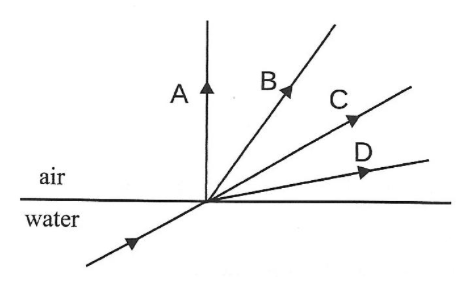
A light ray is incident from water to air. Which of the refracted rays is correct?

a)

A

b)

B

c)

C

d)

D

58.

Which of the following characteristics are correct for the image formed in a plane mirror?


I. Upright

II. Inverted

III. Real

IV. Same size as the object

V. Virtual

a)

I, II, III

b)

I, III, IV

c)

I, IV, V

d)

III, IV, V

59.

A mirror is titled at an angle of 20°. A light ray is incident at the surface of a plane mirror at an angle of 20°.


What is the angle of reflection?

a)

20°

b)

40°

c)

50°

d)

70°

60.

The diagram shows a patient having her eyes tested. A chart with letters on it is placed behind her and she sees the chart reflected in a plane mirror.


How far away from the patient is the image of the chart?

a)

2 m

b)

4 m

c)

5 m

d)

7 m

61.

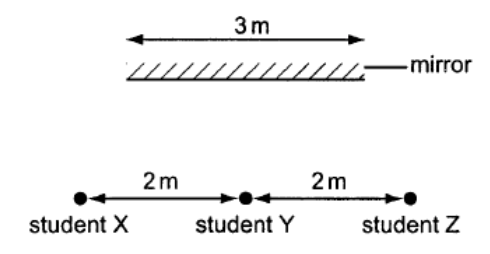
Three students stand 2 m apart in front of a plane mirror which is 3 m long.


Student Y is standing opposite the mid-point of the mirror.


How many students can see the images of the other two?

a)

0

b)

1

c)

2

d)

3

62.

The diagram shows a ray of light entering a glass block of refractive index 1.41 at an angle of incidence of 45°.


By how many degrees does the light ray change direction when entering the glass?

a)

15

b)

30

c)

45

d)

90

63.

Which block is made from the material with a refractive index of 1.52?

a)

A

b)

B

c)

C

d)

D

64.

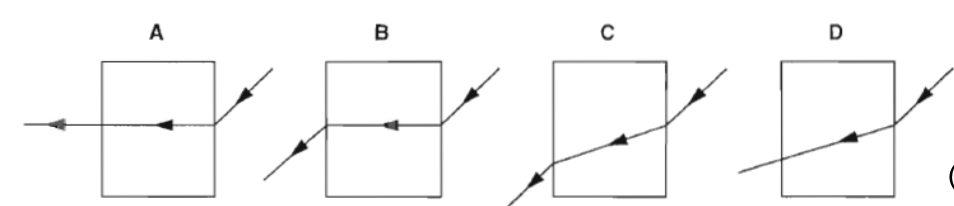
A ray of light travels from air into a glass block.


Which diagram correctly shows the path of the ray through the glass block?

a)

A

b)

B

c)

C

d)

D

65.
What colours is white light made from?
a)
Orange, Green, Pink, Magenta, Peach, Rose, Lemon
b)
Red, Orange Yellow, Green, Black, Indigo, Violet
c)
Red, Orange, Yellow, Green, Blue, Indigo, Violet
d)
Red, Orange, Yellow, Grey, Blue, Indigo, Violet
66.

A leaf is green. What does this tell you about the light that is being absorbed?

a)

The light is a UV ray.

b)

The light is not a part of the light spectrum.

c)

All colors are reflected except green.

d)

All colors are absorbed except green

67.

Which diagram shows the correct image of the key in a plane mirror?

a)

A

b)

B

c)

C

d)

D

68.
A wave has wavelength of 10 m and a speed of 340 m/s. What is the frequency of the wave?
a)
34 m/s
b)
3400 Hz
c)
3.4 Hz 
d)
34 Hz
69.
1.  A wave has frequency of 5 Hz and a speed of 25 m/s. What is the wavelength of the wave?
a)
25 m
b)
125 m
c)
5 m
d)
25 m/s
70.

Velocity= ________

Wavelength= 0.5 m

Frequency= 150 Hz

a)

0.75 m/s

b)

75 m/s

c)

300 m/s

d)

30 m/s

71.
This is what you get when sound waves are reflected, or bounce back, off of a hard surface.
a)
Amplitude
b)
Pitch
c)
Volume
d)
Echo
72.
This is the unit used to measure the volume of a sound. 
a)
Decibel
b)
Medium
c)
Vibration
d)
Oscilloscope
73.
Sound waves are what kind of wave?
a)
Longitudinal
b)
Transverse
c)
Surface
d)
Electromagnetic
74.
Why is sound able to travel faster through a solid than a gas?
a)
Gas molecules are packed tightly.
b)
Sound does not travel faster through a solid than a gas.
c)
Solid molecules are packed tightly.
d)
Gas molecules move slowly.
75.

One end of the rope is vibrated to produce a wave with a wavelength of .25 m. The Frequency of the wave is 3.0 Hz. What is the speed of the wave?

a)

3.00 m/s

b)

2.50 m/s

c)

0.75 m/s

d)

1.25 m/s

76.
 A wave has frequency of 50 Hz and a wavelength of 10 m. What is the speed of the wave?
a)
500 m/s
b)
50 m/s
c)
5 m/s
d)
0.5 m/s
78.
A wave has wavelength of 10 m and a speed of 340 m/s. What is the frequency of the wave?
a)
34 m/s
b)
3400 Hz
c)
3400 m/s
d)
34 Hz
78.
A wave has wavelength of 10 m and a speed of 340 m/s. What is the frequency of the wave?
a)
34 m/s
b)
3400 Hz
c)
3400 m/s
d)
34 Hz
79.

Sound travels the fastest in which state of matter?

a)

solid

b)

gas

c)

liquid

d)

plasma

80.

What is the refractive index of the medium in which the speed of light is 1.5 × 10⁸ m/s?

a)

1

b)

2

c)

3

d)

4.5

81.

An optician's test card is fixed 80 cm behind the eyes of a patient, who looks into a plane mirror 300 cm in front of him, as shown in the diagram.

The distance from his eyes to the image of the card is ....

a)

690 cm

b)

600 cm

c)

390 cm

d)

300 cm

82.

On most ambulances its name is written such that it can be read in the rear view mirror of the car in front. This phenomenen is known as ....

a)

back to front

b)

parallax

c)

a virtual image

d)

lateral inversion

83.

This experiment shows that

a)

light can be reflected.

b)

light is a form of energy.

c)

light travels faster than sound.

d)

light travels in straight lines.

84.

The Sun is 149.6 million km from the Earth. How long does it take light to travel from the Sun to the Earth?

a)

0.5 seconds

b)

498.7 seconds

c)

4.5 x 10¹⁹ seconds

d)

1 light year

85.

The diagram shows a ray of light reflected from a plane mirror. The angle of incidence is ....45

a)

60o

b)

45o

c)

50o

d)

70o

86.

A figure F is placed in front of a plane mirror. Which is the correct mirror image?

a)

A

b)

B

c)

C

d)

D

87.

Which is the correct mirror image of the word REFLECTION?

a)

A

b)

B

c)

C

d)

D

88.

What is the angle of mirror in periscope

a)

35

b)

45

c)

55

d)

65

89.

How many mirrors there are in the periscope?

a)

5

b)

4

c)

3

d)

2

90.

How does periscope works?

a)

A periscope works by using two mirrors to reflect light from one mirror to another for the person to see the things that is behind a high obstacle.

b)

It works by using one mirror to reflect for us to see things behind a high obstacle.

c)

It works by using one glass to reflect for us to see things behind a high obstacle.

91.

What is the working principle of a periscope?

a)

A periscope works on the Refraction of Light.

b)

A periscope works on the Law of Reflection.

c)

A periscope works on the Dispersion of Light.

92.

What is the type of mirror use in periscope?

a)

Convex mirror

b)

Concave mirror

c)

Plane mirror

93.

Sonar and echolocation use ----- to detect objects under water.

a)

Refraction

b)

Reflection

94.

A student listed some properties of waves.


Which properties did the student list incorrectly?

a)

3 and 2

b)

4 and 1

c)

2 and 4

d)

1 and 3

95.

Two sound waves of different frequencies interfere and produce a resulting waveform shown with four points (W, X, Y, and Z) marked on the new wave.


At which point will the sound be the loudest ?

a)

W

b)

X

c)

Y

d)

Z

96.

The students in the diagram are communicating with the cans and string.


Which is the most likely explanation of how the students can hear and communicate using the objects?

a)

A Mechanical Wave transfers sound through the string

b)

sound bounces off the can and echoes

c)

sound travels through the string as an electromagnetic wave

d)

Transverse wave transfers sound through rope

97.

The diagram shows a research vessel using sonar to map the ocean floor.


Upon which basic behavior of sound waves does this technology depend?

a)

absorption

b)

compression

c)

reflection

d)

refraction