
NEW
Font size
 Worksheets
Chapter 9 Study Guide 8th Grade
Total questions: 38
Worksheet time: 38mins

Metals are found on the ______________ side of the periodic table.
nonmetals
left
right
metals
This group of elements have properties that are opposite those of metals. ______________________
luster
nonmetals
metalloids
metals
This group of elements sit along a stair step line on the periodic table and have properties of both metals and nonmetals. _________________________
luster
metals
nonmetals
metalloids
Electrons orbit a certain distance from the nucleus. Either radiate or absorb energy when jumping orbitals.
Dalton
Thomson
Rutherford
Bohr
The atom is mostly large empty space with a small, dense nucleus at the center
Dalton
Thomson
Rutherford
Bohr
Atom is a positively charged cloud with embedded negative electrons
Dalton
Thomson
Rutherford
Bohr
Atoms are indivisible (cannot be broken down)
Dalton
Thomson
Rutherford
Bohr

What scientist proposed this atomic model?
Dalton
Thomson
Rutherford
Bohr

What scientist proposed this atomic model?
Dalton
Thomson
Rutherford
Bohr
What did Dmitri invent?
Children
Periodic Table
Russian currency
Calculator
How many elements were on the original Periodic Table?
60
56
75
118
How are the elements arranged on the periodic table today?
By atomic mass
By number of electrons
By atomic number
By alphabetic order
What is the atomic number?
the number of protons
the number of protons and neutrons
the number of neutrons
the number of atoms
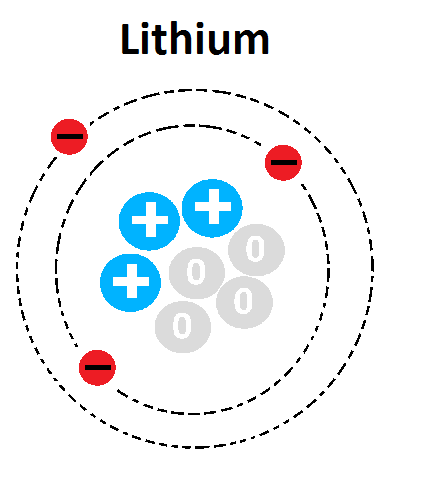
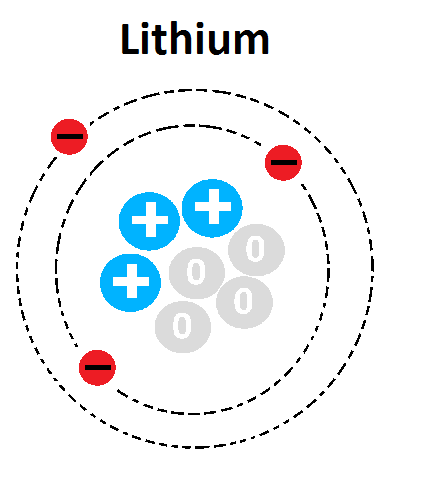
What is the mass number of this atom?
1
3
4
7

The fluorine atom has an atomic number of
19
9
Isotopes of an element have a different number of...
Protons
Neutrons
Electrons
Mass
Where is a Valence electron located?
The innermost shell
The nucleus
The outmost shell
A __________ goes up and down on the periodic table.
Group
Period
A _________ goes side to side on the periodic table.
Group
Period

What element is in period 4, group 1?
K - Potassium
V - Vandium
C - Carbon
Ti - Titanium

How many Valence electrons does Ba-Barium have?
3
2
6
56
The _______ tells us how many energy shells an element has.
group
period
atomic number
element symbol
The _________ tells us how many valence electrons an element has.
Group
Period
Atomic Number
Element
Why do elements form bonds?
to get a charge
so they can make friends
to become stable by getting a full valence shell
to become stable by increasing their mass
If an atom loses electrons, the charge will be positive.
true
false
The center of an atom is called the
middle
medium
median
nucleus
What two particles can be found in the nucleus of an atom?
rocks and marbles
protons and electrons
protons and neutrons
neutron and electrons
All 3 particles are pretty much the same size, but how much heavier are protons and neutrons as compared to electrons?
2 times heavier
9 times heavier
18 times heavier
1800 times heavier
Matter that is only made up of one type of atom
materials
elements
particles
compounds
While most elements are found in nature, several have been created by scientists. These are called
fake elements
unnatural elements
un elements
synthetic elements
What do scientists use to make synthetic elements?
chemicals
particle accelerators
dirt and water
magic

