
 Worksheets
C1-C3 Summative Review
Total questions: 65
Worksheet time: 33mins
Name
Class
Date
1.
What two factors determine the strength of electric attraction and repulsion between objects?
a)
Net charge & distance
b)
Net charge & mass
c)
Net charge & velocity
d)
Distance & mass
2.
Which is NOT a way that objects become charged?
a)
Charging by friction
b)
Charging by induction
c)
Charging by contact
d)
Charging by heating
3.
Why does static electricity make your hair stand on end?
a)
Similar charges on your hairs repel, causing them to stand away from each other
b)
Opposite charges on your hairs repel, causing them to stand away from each other
c)
Opposite charges on your hairs attract, causing the hair to stick together and up
d)
Similar charges on your hairs attract, causing the hair to stick together and up
4.
Most objects are...
a)
Positively charged
b)
Negatively charged
c)
Neutral
d)
It varies
5.
When objects become charged, what type of charges move from one object to another?
a)
Negative charges
b)
Positive charges
c)
Neutral charges
6.
Charges can be created, and charges can be destroyed.
a)
True
b)
False
7.
If you bring two charged objects farther away from each other, they will attract...
a)
less
b)
more
c)
the same amount
d)
depends on if they are attracting or repelling
8.
If you bring two charged objects closer to each other, they will attract...
a)
less
b)
more
c)
the same amount
d)
depends on if they are attracting or repelling
9.
What type of particle transfers from one object to another when objects become charged?
a)
Proton
b)
Electron
c)
Neutron
10.
How many charged particles are there in your pencil?
a)
A few
b)
None, because it is neutral
c)
A very very large number
d)
A hundred
11.
Neutral objects can be attracted to..
a)
Positively charged objects
b)
Negatively charged objects
c)
Neutral objects
d)
Both positively and negatively charged objects.
12.
What is the name of the positively charged particles in an atom?
a)
Electron
b)
Proton
c)
Neutron
13.
Oppositely charged objects will......
a)
attract
b)
repel
c)
exert no force on each other
d)
create an insulator
14.
What is the name of the negatively charged particles in an atom?
a)
Electron
b)
Proton
c)
Neutron
15.
Negatively charged objects can only have negatively charged particles.
a)
True.
b)
False.
c)
I don't know
d)
I wasn't there that day.
16.
Scientific Models Never Change
a)
True. They are constant all the time.
b)
True. The way they are presented may change but the main idea does not.
c)
False. I can change a model if I don't like it or understand it.
d)
False. They can change if new data from experimentation is found.
17.
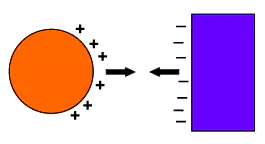
The objects in the image will..............
a)
attract because they have opposite charges
b)
repel because they have opposite charges
c)
attract because they have like charges
d)
repel because they have like charges
18.
Two objects would repel if..........
a)
They both have positive charges
b)
They both are neutral
c)
They have opposite charges
d)
One is negative and one is positive
19.
Like charged objects will......
a)
repel
b)
attract
c)
exert no force on each other
d)
create an insulator
20.
What is the name of the uncharged particles in an atom?
a)
Electron
b)
Proton
c)
Neutron
21.
Like charges __________ each other while unlike charges _____________each other.
a)
attract, attract
b)
repel, attract
c)
attract, repel
d)
repel, repel,
22.
A positively charged object has....
a)
More positive charges than negative charges
b)
More negative charges than positive charges
c)
An equal amount of positive charges and negative charges
d)
No charges at all.
23.
A negatively charged object has...
a)
More positive charges than negative charges
b)
More negative charges than positive charges
c)
An equal amount of positive and negative charges
d)
No charges at all
24.
A Neutral Object has...
a)
More positive charges than negative charges
b)
More negative charges than positive charges
c)
An equal number of positive and negative charges
d)
No charges at all
25.
Charge of a PROTON
a)
positive
b)
neutral
c)
negative
d)
I don't know
26.
If an object has: 6 protons and 5 electrons, ...it's net charge is:
a)
1
b)
-1
c)
4
d)
-4
27.
If an object has: 6 protons and 3 electrons, it's net charge is:
a)
3
b)
0
c)
-3
d)
6
28.
What can new and revised scientific models be good for?
a)
To confirm predictions that we already made.
b)
To help us make new predictions.
c)
To challenge the predictions of others.
d)
Models can't be changed.
29.
Charge of an ELECTRON
a)
negative
b)
positive
c)
neutral
d)
I don't know
30.
If an object has: 3 protons and 3 electrons.....it's net charge is:
a)
-2
b)
-1
c)
0
d)
2
31.
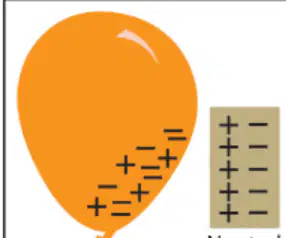
Which of the objects in the picture shown is neutral?
a)
The cloth
b)
The balloon
c)
The cloth and the balloon
d)
Neither object is neutral
32.
A rubber wand is rubbed with a wool cloth. The cloth becomes positively charged. Why?
a)
It lost electrons
b)
Electrons leave the area and the area is left positively charged causing the objects to repel and separate.
c)
It gained electrons
d)
It gained protons
33.
Which of the following atoms is considered neutral?
a)
an atom with 5 protons, 6 neutrons, and 5 electrons
b)
an atom with 5 protons, 5 neutrons and 6 electrons
c)
an atoms with 6 protons, 5 neutrons, and 5 electrons
d)
an atom with 6 protons, 6 neutrons and 5 electrons
34.
A good scientific model
a)
Makes unclear assumptions about future experiments
b)
Helps other scientists learn how to do their own unauthorized experiments.
c)
Explain observations that have already been tested or made.
d)
Is easily drawn and is only limited to the imagination of the scientist drawing it.
35.
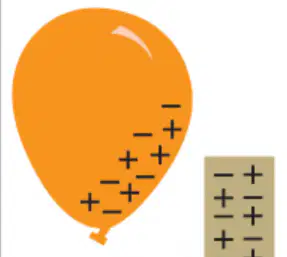
Which of the items shown in the picture is neutral?
a)
The balloon
b)
The cloth
c)
Both the cloth and the balloon
d)
Neither object is neutral
36.
When a negatively charged object is brought close to a neutral wall:
a)
Positive charges in the wall move away from the object
b)
Electrons in the wall move away from the object
c)
Electrons in the wall move towards the object
d)
Charges in the wall do not move
37.
When a positively charged object is brought close to a neutral wall:
a)
Positive charges in the wall move away from the object
b)
Electrons in the wall move away from the object
c)
Electrons in the wall move towards the object
d)
Charges in the wall do not move
38.
You notice that two objects attract when you bring them closer together. What is a possible reason for why they are attracted?
a)
A. One object if positively charged and the other object is negatively charged
b)
B. One object has a net charge and the other object is neutrally charged.
c)
C. Both objects have a neutral charge.
d)
Both A and B.
39.
Two electrically neutral objects will......
a)
exert no force on each other
b)
repel
c)
attract
d)
create an electric field
40.
Materials contain a large number of charges that cannot be created or destroyed
a)
False, we charged objects in class so we created charge
b)
False, objects contain a small number of charges
c)
True, when we charge objects the charges do not transfer
d)
True, when we charge objects we are transferring charge
41.
A material that allows the transfer of charge easily is a ______________
a)
transferer
b)
conductor
c)
insulator
d)
None of these
42.
A material that does not allow the transfer of charge easily is a ______________
a)
transferer
b)
conductor
c)
insulator
d)
None of these
43.
plastic spoon
a)
insulator
b)
conductor
c)
---
d)
---
44.
Metals are good...
a)
Insulators because they can hold a charge on the surface. Since metals behave this way, they must be insulators.
b)
Conductors because they allow charges to flow freely. Since metals behave this way, they must be conductors
c)
Insulators because they cannot hold a charge on the surface. Since metals behave this way, they must be insulators.
d)
Conductors because they do not allow charges to flow freely. Since metals behave this way, the must be conductors.
45.
plastic lawn chair
a)
insulator
b)
conductor
c)
---
d)
---
46.
metal spoon
a)
conductor
b)
insulator
c)
---
d)
---
47.
Only __________________________ charges move.
a)
negative
b)
positive
c)
neutral
d)
none of the above
48.
carpet
a)
insulator
b)
conductor
c)
---
d)
---
49.
You've build up charge from rubbing your wool socks against the carpet. You then touch a doorknob that has a higher conductivity than you do. What will be your overall charge, after you touch the doorknob?
a)
Positively charged
b)
Negatively charged
c)
Neutral
d)
Nothing will happen
50.
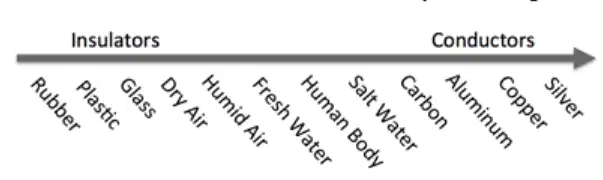
Which of these materials would allow electrons to most easily flow through it?
a)
Copper
b)
Aluminum
c)
Fresh Water
d)
Glass
51.
copper
a)
conductor
b)
insulator
c)
---
d)
---
52.
When you experience a shock, electrons flow from a____________ location to a ______________ location.
a)
less negatively charged, more negatively charged.
b)
more negatively charged, less negatively charged.
c)
less positively charged, more negatively charged.
d)
more positively charged, less negatively charged.
53.
When we saw the metal tinsel repel away from our metal can/plastic cup apparatus, this was because:
a)
Charges moved through the metal can and tinsel
b)
Charges moved through the plastic can and tinsel
c)
The metal can was initially charged
d)
The plastic cup was initially charged
54.
When we brought a charged Styrofoam plate near one end of our soda can / plastic cup, the metal tinsel taped to the other side of the apparatus:
a)
Did not repel
b)
Repelled for both the soda can and plastic cup
c)
Repelled for only the soda can
d)
Repelled for only the plastic cup
55.
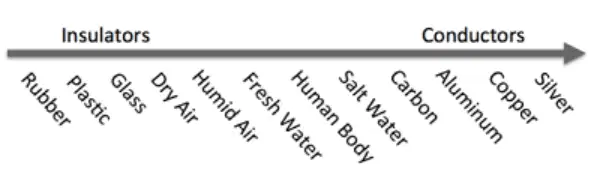
Which of these materials would build up the most electrons on the surface when rubbed with wool?
a)
Silver
b)
Salt Water
c)
Glass
d)
Rubber
56.
Charged objects can become discharged when rubbed with a neutral object
a)
True
b)
False
c)
-
d)
-
57.
How many charged particles are there in your pencil?
a)
A few
b)
None, because it is neutral
c)
A very very large number
d)
A hundred
58.
If you bring two charged objects closer to each other, they will attract...
a)
less
b)
more
c)
the same amount
d)
depends on if they are attracting or repelling
59.
Which is NOT a way that objects become charged?
a)
Charging by friction
b)
Charging by induction
c)
Charging by contact
d)
Charging by heating
60.
If you bring two charged objects farther away from each other, they will attract...
a)
less
b)
more
c)
the same amount
d)
depends on if they are attracting or repelling
61.
Neutral objects can be attracted to..
a)
Positively charged objects
b)
Negatively charged objects
c)
Neutral objects
d)
Both positively and negatively charged objects.
62.
What two factors determine the strength of electric attraction and repulsion between objects?
a)
Net charge & distance
b)
Net charge & mass
c)
Net charge & velocity
d)
Distance & mass
63.
What is the name of the uncharged particles in an atom?
a)
Electron
b)
Proton
c)
Neutron
64.
You notice that two objects attract when you bring them closer together. What is a possible reason for why they are attracted?
a)
A. One object if positively charged and the other object is negatively charged
b)
B. One object has a net charge and the other object is neutrally charged.
c)
C. Both objects have a neutral charge.
d)
Both A and B.
65.
Negatively charged objects can only have negatively charged particles.
a)
True.
b)
False.
c)
I don't know
d)
I wasn't there that day.
100 %

