
 Worksheets
Wave Types and Parts
Total questions: 74
Worksheet time: 1hrs 3mins
A student is playing with a small toy boat on a pond. The student throws a rock in the pond. This creates waves that move the boat toward the shore. The boat moves toward the shore because the waves transfer ___.
Energy
Heat
Motion
Water
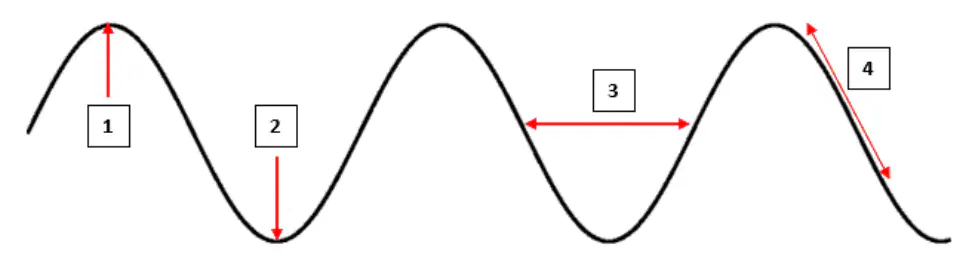
Identify part 1 of the wave in the illustration.
Trough
Compression
Crest
rarefaction
wavelength

What is a wave ?
a disturbance that transfers matter
a disturbance that transfers energy
a disturbance that transfers both matter and energy

Wave A is a longitudinal wave and wave B is a transverse wave.
True
False

The height of a wave from it's resting point is called it's
Frequency
Velocity
Wavelength
Amplitude
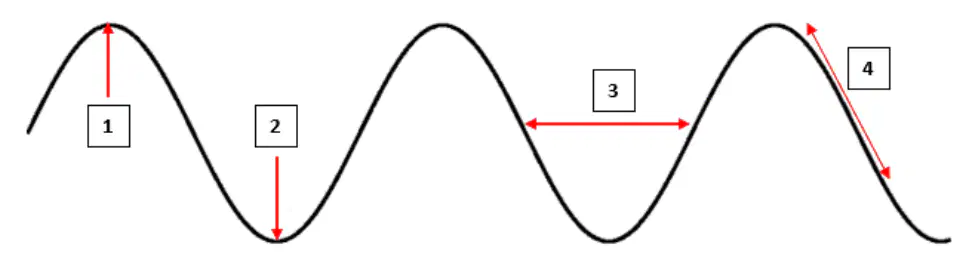
Identify part 2 of the wave in the illustration
Trough
Rarefaction
Crest
Compression
Wavelength

The distance between any two crests (peaks) or troughs.
Frequency
Amplitude
Wavelength
Transverse

What part of the wave is represented by the blue lines?
Frequency
Wavelength
Amplitude
Resting Point
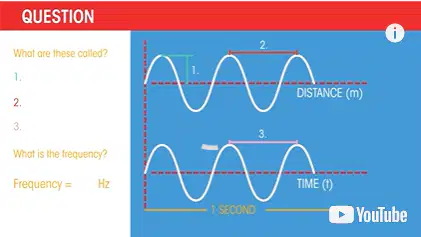
In the illustration what is #1 pointing to?
Amplitude
Frequency
Velocity
Wavelength
In a _________ wave the particles move parallel to the direction of the waves energy.
Longitudinal
Transverse
Water
Light

Sound waves require a medium to transfer energy from one place to another. From this statement you can infer that sound can travel through ____.
solid platinum liquid iodine
nitrogen gas
the vacuum of space
liquid iodine
nitrogen gas
solid platinum
the vacuum of space
nitrogen gas
solid platinum
liquid iodine
the vacuum of space
solid platinum
the vacuum of space
liquid iodine
nitrogen gas

The lowest point or valley of a transverse wave, point D and point H, is the ......
wavelength
trough
crest
In a ___________ the particles move perpendicular to the direction of the waves energy.
Longitudinal
Transverse
Compression
Sound

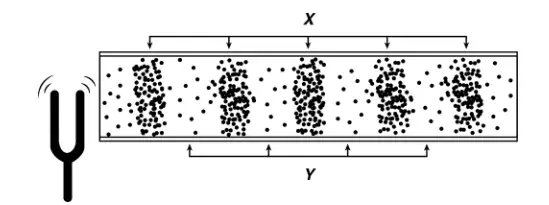
This illustration shows a sound wave traveling from a tuning fork through the air.
The black dots represent the air particles. Another name for the air particles is ___.
Energy
crest and trough
medium
transverse waves
In a mechanical wave, particles move and carry energy from one place to another. The particles are called _____.
medium
energy
transverse
vacuum

What is the matter that a wave moves through?
a vessel
a vacuum
a medium
How would you describe the movement of matter in a transverse wave?
perpendicular to direction of energy
parallel to the direction of energy
In zigzags
Linear

A sound wave is a longitudinal wave
True
False

What type of wave is pictured?
Transverse wave
Longitudinal wave
Waving goodbye
Stadium wave

What type of wave is pictured?
Transverse wave
Longitudinal wave
Wave, what wave?
Slinky wave

What type of waves are these?
Transverse waves
Longitudinal waves
How do we know that light does not need a medium in which to travel?
I can see light from the bulb in the ceiling.
I can see light that travels through outer space from the sun.
When I hold up a piece of paper to a lit flashlight, I can still see the light.
How do we know that light does not need a medium in which to travel?
I can see light from the bulb in the ceiling.
I can see light that travels through outer space from the sun.
When I hold up a piece of paper to a lit flashlight, I can still see the light.
The compressed part of a longitudinal wave is called a ______________________.
Rarefaction
Compression
Transverse
The compressed part of a longitudinal wave is called a ______________________.
Rarefaction
Compression
Transverse
The spread out part of a longitudinal wave is called a ________________.
Rarefaction
Compression
Space
Transverse
A wave that requires a medium to travel.
Mechanical
Electromagnetic
A wave that does not require a medium to travel, for example, it can travel through a vacuum.
Electromagnetic
Mechanical
a wave that is an oscillation of matter, and therefore transfers energy through a medium
Mechanical Wave
Light Wave
Hertz
Frequency
A medium is...
the only known wave that can travel through empty space (a vacuum).
the unit of measurement of frequency.
a substance a wave travels through (i.e. space, air, water, solids, cables).
measurement of the height of a wave.
the only known wave that can travel through empty space (a vacuum)
Light Waves
Seismic Waves
Sound Waves
Tsunami Waves
Light waves can travel through space.
True
False
Sound waves can travel through space.
True
False
When particles move parallel to the motion of the wave, the wave is called....
Transverse
Longitudinal
S-wave
EMR wave
Sound waves are an example of
S-waves
transverse waves
longitudinal waves
EMR waves

Which statement is correct about the wave shown in the diagram?
It is a transverse wave because the particles are moving perpendicular to the motion of the wave.
It is a transverse wave because the particles are moving parallel to the motion of the wave.
It is a longitudinal wave because the particles are moving perpendicular to the motion of the wave.
It is a longitudinal wave because the particles are moving parallel to the motion of the wave.

The wave shown in the diagram is an example of a(n)...
transverse wave
EMR wave
longitudinal wave
light

The wave shown in the diagram is an example of a
longitudinal wave
mechanical wave
P-wave
transverse wave
How would you describe the movement of matter in a longitudinal wave?
perpendicular to direction of energy
parallel to the direction of energy
In zigzags
Linear
Sound can only travel through solids, liquids and gases. It can't travel through empty space. Which type of wave is sound?
Electromagnetic
Mechanical
Which is NOT true about longitudinal waves?
A sound wave is an example of this type of wave.
Particles transmitting this wave will have parallel motion to the wave.
They require a medium to travel through (don't travel in space).
A light wave is an example of this type of wave.
Which is NOT true about transverse waves?
A sound wave is an example of this type of wave.
They can travel through the vacuum of space.
They do not require a medium to travel through.
A light wave is an example of this type of wave.

A wave is a disturbance that transfers ________ from one place to another.
Matter
Mass
Energy

The highest point or peak of a transverse wave, point B and F, is the ________________ .
trough
amplitude
crest

An area of bunched up particles (bottom blue arrow) in a longitudinal wave is an area of ________________ .
rarefaction (low pressure)
compression (high pressure)
amplitude (energy)

An area of spread out particles (bottom red arrow) of a longitudinal wave is an area of ________________.
rarefaction (low pressure)
compression (high pressure)
amplitude (energy)
The length of a crest (peak) or trough measured from the middle line.
Wavelength
Frequency
Amplitude
Medium
The length of a crest (peak) or trough measured from the middle line.
Wavelength
Frequency
Amplitude
Medium
The distance between any two crests (peaks) or troughs.
Frequency
Amplitude
Wavelength
Transverse

The bottom part of the wave is called trough.
True
False

What is the distance between the calm sea and the highest wave called?
Wave
Frequency
Amplitude
Magnitude

This is a high frequency wave. Which part of the wave is "B"
crest/peak
wavelength
trough

Look at this wave. "A" is which part of a wave?
Crest/Peak
Wave Speed
Resting Point


A wavelength is the distance between which 2 points?
B and G
A and C
C and F
A and H
Longitudinal waves have:
crests and troughs
crests and compressions
compressions and rarefactions
troughs and rarefactions
Sound waves cannot travel in
steel
air
a vacuum
water

