wayground logo

Free Printable Worksheets

Font size

S
M
L
XL
Worksheets

Cooking Chemistry Revision

Total questions: 100

Worksheet time: 2hrs 2mins

Name
Class
Date
1.

Material that has mass and takes up some amount of space.

a)

Matter

b)

Atom

c)

Subatomic particle

d)

neutron

2.

The smallest unit of matter.

a)

nucleus

b)

proton

c)

atom

d)

matter

3.

The center of the atom.

Contains protons + neutrons.

a)

neutron

b)

nucleus

c)

electron

d)

atom

4.

Has a positive charge.

Found in the nucleus.

a)

neutron

b)

electron

c)

nucleus

d)

proton

5.

Has no charge ( neutral ).

Found in the nucleus.

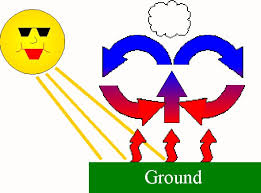
a)

proton

b)

neutron

c)

electron

d)

nucleus

6.

Has a negative charge.

Found orbiting the nucleus.

a)

proton

b)

neutron

c)

electron

d)

nucleus

7.

A pure substance that is made from a single type of atom. The building blocks for all the rest of the matter in the world.


Examples include iron, oxygen, hydrogen, gold, and helium.

a)

matter

b)

atom

c)

particle

d)

element

8.

A combination of different atoms and molecules, physically combined.

a)

element

b)

compound

c)

mixture

9.

2 or more elements chemically bonded together.

a)

element

b)

compound

c)

mixture

10.

A pure substance that cannot be broken down into any other substance.

a)

element

b)

compound

c)

mixture

11.

What does this picture show?

a)

element

b)

compound

c)

mixture

12.

What does this picture show?

a)

element

b)

compound

c)

mixture

13.

What does this picture show?

a)

element

b)

compound

c)

mixture

14.

What does this picture show?

a)

element

b)

compound

c)

mixture

15.

What does this picture show?

a)

element

b)

compound

c)

mixture

16.

What does this picture show?

a)

elements

b)

compounds

c)

mixtures

17.

This picture shows a:

a)

element

b)

compound

c)

mixture

18.

Gold is an example of an:

a)

element

b)

compound

c)

mixture

19.

2 or more atoms bonded together

(can be the same or different)

a)

molecule

b)

element

c)

compound

d)

mixture

20.

Matter is anything that has mass and takes up space

a)

True

b)

False

21.

These are 3 states of matter.

a)

True

b)

False

22.
Molecules have energy and _________ stop moving
a)
rarely
b)
always
c)
never
d)
sometimes
23.
Matter changes state when...
a)
energy is added or removed
b)
energy is added
c)
energy is removed
d)
there is no energy
24.
As molecules gain energy, they move _____ and spread apart, and vise versa.
a)
faster
b)
slower
c)
less
d)
inside
25.
Energy(heat) is added in order to go from ...
a)
solid to gas
b)
liquid to solid
c)
gas to liquid
d)
gas to solid
26.
Energy(heat) is removed in order to go from ....
a)
gas to solid
b)
solid to liquid
c)
solid to gas
d)
liquid to gas
27.
Matter will change state when enough energy (heat) is added to , or removed from, the molecules. 
a)
true
b)
false
28.
If you want to change liquid water into a gas you must:
a)
remove heat from the water
b)
apply pressure to the water
c)
add heat to the water
d)
add chemicals to the water
29.
Suppose you pour a glass of ice water and set it on the kitchen table. After a few minutes, the outside of the glass will be covered with drops of water. Why did this happen?
a)
Oxygen in the air cooled and condensed onto the cold glass.
b)
Water vapor in the air cooled and condensed onto the cold glass.
c)
Water vapor in the air cooled and evaporated onto the cold glass.
d)
Water seeped through pores in the glass.
30.
What happens to a substance when it changes from a liquid to a solid?
a)
it gains mass
b)
it gains energy
c)
it loses mass
d)
it loses energy
31.

What is an example of sublimation?

a)

Ice cream melting

b)

Dry ice being added to water

c)

Frost forming on grass

32.

A phase change from liquid to gas is called ...

a)

condensation

b)

evaporation

c)

sublimation

d)

deposition

33.
When a gas forms directly into a solid, skipping the liquid phase
a)
deposition
b)
sublimation
c)
evaporation
d)
condensation
34.
Sublimation is
a)
when solid turns into gas
b)
when gas turns into plasma
c)
when liquid turns into gas
d)
when gas turns into solid
35.

What type of energy does a substance lose when it cools?

a)

thermal

b)

gravitational

c)

nuclear

d)

potential

36.
What is the opposite of melting?
a)
condensation
b)
evaporization
c)
freezing
d)
sublimation
37.
Which is needed for both boiling and melting to occur?
a)
solids
b)
gases
c)
heat
d)
pressure
38.
 The process where water vapor changes from a gas to a liquid is called:
a)
sublimation
b)
precipitation
c)
evaporation
d)
condensation
39.

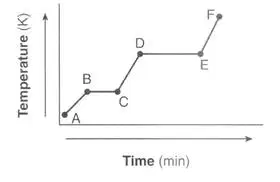
What is happening between B-C?

a)

evaporating

b)

melting

c)

condensing

d)

freezing

40.

What is happening between D-E?

a)

evaporating

b)

melting

c)

condensing

d)

freezing

41.

What could happen at temperature C?

a)

evaporating

b)

melting

c)

condensing

d)

freezing

42.

What could happen at temperature D?

a)

evaporating

b)

melting

c)

condensing

d)

freezing

43.

What state of matter is the substance between A-B?

a)

solid

b)

liquid

c)

gas

44.

What state of matter is the substance between C-D?

a)

solid

b)

liquid

c)

gas

45.

What state of matter is the substance between E-F?

a)

solid

b)

liquid

c)

gas

46.

Boiling Water (a)  

Choose from the below words
Conduction
Convection
Radiation
47.

Curling Iron (a)  

Choose from the below words
Conduction
Convection
Radiation
48.

Weather Patterns (a)  

Choose from the below words
Conduction
Convection
Radiation
49.

Sun Bathing (a)  

Choose from the below words
Conduction
Convection
Radiation
50.

Mantle (a)  

Choose from the below words
Conduction
Convection
Radiation
51.

Feet on Hot Sand (a)  

Choose from the below words
Conduction
Convection
Radiation
52.

Lava Lamp (a)  

Choose from the below words
Conduction
Convection
Radiation
53.

Heat Lamps (a)  

Choose from the below words
Conduction
Convection
Radiation
54.

Cold Pack on Person

a)

Heat is transferred from the cold pack to the person.

b)

Heat is transferred from the person to the cold pack

c)

The cold pack is getting warmer. The person is getting colder.

d)

The cold pack is getting colder. The person is getting warmer.

55.

What is the transfer of heat by movement of liquids or gases? (a)  

Choose from the below words
Radiation
Convection
Conduction
Heat
56.

What is a transfer of heat energy by electromagnetic waves? (a)  

Choose from the below words
Radiation
Convection
Conduction
Heat
57.

What is the transfer of heat by direct contact? (a)  

Choose from the below words
Convection
Electromagnetic waves
Radiation
Conduction
58.

What is the measurement of the average kinetic energy of a substance? (a)  
Choose from the below words
Kinetic energy
Temperature
Thermal energy
Potential energy
59.

Warm air rises and the cool air sinks. This is...

(a)  

60.

Heat transfers from an area of ​ (a)   temperature to an area of ​ (b)   temperature.

Choose from the below words
low
high
61.

Warm water from the ocean moves to the north while cool waters moves to the south. This is an example of..  (a)  

Choose from the below words
Conduction
Convection
Radiation
62.

If an object has particles that are moving very quickly, the object 's temperature is probably (a)   .

Choose from the below words
cold
slow
big
hot
63.
You're holding hands with your best friend.  Your friend's hands are REALLY warm and yours are really cold.  After a few minutes, this has changed.  How might you explain what happened?
a)
The cold energy from your hand transferred to your friend's hand through conduction.
b)
The heat energy from your friend's hand transferred to your hand through conduction. 
c)
The cold energy from your hand transferred to your friend's hand through convection.
d)
The heat energy from your friend's hand transferred to your hand through convection.
64.

Match the following

a)

conduction

1.

ironing a shirt

b)

convection

2.

a radiator heating a cold room

c)

radiation

3.

a microwave heating food

65.

Heat transfer through waves is called___

a)

conduction

b)

convection

c)

radiation

66.

Boiling Water (a)  

Choose from the below words
Conduction
Convection
Radiation
67.

Curling Iron (a)  

Choose from the below words
Conduction
Convection
Radiation
68.

Weather Patterns (a)  

Choose from the below words
Conduction
Convection
Radiation
69.

Sun Bathing (a)  

Choose from the below words
Conduction
Convection
Radiation
70.

Mantle (a)  

Choose from the below words
Conduction
Convection
Radiation
71.

Feet on Hot Sand (a)  

Choose from the below words
Conduction
Convection
Radiation
72.

Lava Lamp (a)  

Choose from the below words
Conduction
Convection
Radiation
73.

Heat Lamps (a)  

Choose from the below words
Conduction
Convection
Radiation
74.

Cold Pack on Person

a)

Heat is transferred from the cold pack to the person.

b)

Heat is transferred from the person to the cold pack

c)

The cold pack is getting warmer. The person is getting colder.

d)

The cold pack is getting colder. The person is getting warmer.

75.

What is the transfer of heat by movement of liquids or gases? (a)  

Choose from the below words
Radiation
Convection
Conduction
Heat
76.

What is a transfer of heat energy by electromagnetic waves? (a)  

Choose from the below words
Radiation
Convection
Conduction
Heat
77.

What is the transfer of heat by direct contact? (a)  

Choose from the below words
Convection
Electromagnetic waves
Radiation
Conduction
78.

What is the measurement of the average kinetic energy of a substance? (a)  

Choose from the below words
Kinetic energy
Temperature
Thermal energy
Potential energy
79.

Warm air rises and the cool air sinks. This is...

(a)  

80.

Heat transfers from an area of (a)   temperature to an area of (b)   temperature.

Choose from the below words
high to low
low to high
high to high
81.

Warm water from the ocean moves to the north while cool waters moves to the south. This is an example of..  (a)  

Choose from the below words
Conduction
Convection
Radiation
82.

If an object has particles that are moving very quickly, the object 's temperature is probably (a)   .

Choose from the below words
cold
slow
big
hot
83.
You're holding hands with your best friend.  Your friend's hands are REALLY warm and yours are really cold.  After a few minutes, this has changed.  How might you explain what happened?
a)
The cold energy from your hand transferred to your friend's hand through conduction.
b)
The heat energy from your friend's hand transferred to your hand through conduction. 
c)
The cold energy from your hand transferred to your friend's hand through convection.
d)
The heat energy from your friend's hand transferred to your hand through convection.
84.

Match the following

a)

conduction

1.

ironing a shirt

b)

convection

2.

a radiator heating a cold room

c)

radiation

3.

a microwave heating food

85.

Heat transfer through waves is called___

a)

conduction

b)

convection

c)

radiation

86.
What happens in ALL chemical changes?
a)
Change in state of matter
b)
A new substance is formed
c)
Bubbles are produced
d)
An explosion
87.
Is wood burning a physical or chemical change?
a)
Physical 
b)
Chemical
88.
Is milk going sour a physical or chemical change?
a)
Physical 
b)
Chemical
89.
Is mold growing on cheese a physical or chemical change?
a)
Physical 
b)
Chemical
90.
Is making orange juice a physical or chemical change?
a)
Physical 
b)
Chemical
91.
Is sharpening a pencil a physical or chemical change?
a)
Physical 
b)
Chemical
92.
Which of the following is a reactant
a)
CH4
b)
H2O
c)
CO2
d)
2H2O
93.
The Law of Conservation of Mass tells us matter can't  ______________.
a)
change color
b)
change state of matter
c)
be created or destroyed
d)
change temperature
94.
Which of the following IS a clue that a chemical change has occurred? 
a)
State of matter change
b)
Size Change
c)
Change in temperature
d)
Shape change
95.
The _____is the part that gets dissolved. 
a)
solute 
b)
solvent 
c)
solution 
d)
Sacajawea 
96.
A solution is a kind of ________. 
a)
mixture 
b)
compound 
c)
element 
d)
stuff 
97.
A solution is a ________ mixture. 
a)
heterogeneous 
b)
homogeneous 
c)
dumb 
d)
mixed 
98.
This is the part of the solution that does the dissolving. 
a)
solute
b)
solvent 
c)
salt water 
d)
First Continental Congress 
99.

Dissolving is a ___________ change.

a)
neat 
b)
chemical 
c)
physical 
d)
an organic 
100.

This is a mixture that will settle over time if you let it sit.

a)

Suspension

b)

Colloid

c)

Mix - Mix a lot