wayground logo

Free Printable Worksheets

Font size

S
M
L
XL
Worksheets

Y12 Practice 29th Feb 2024

Total questions: 133

Worksheet time: 3hrs 47mins
Name
Class
Date
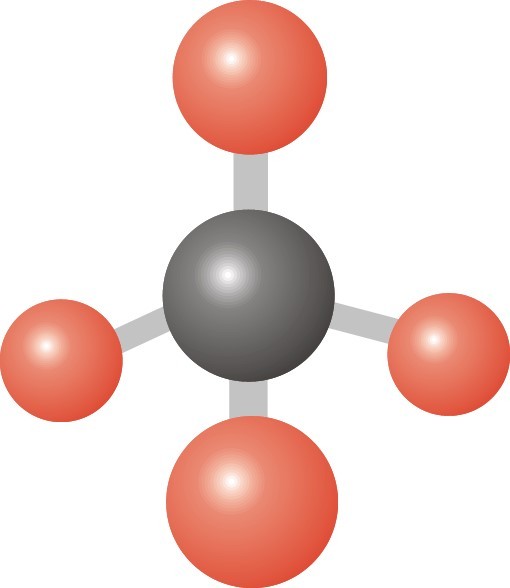
1.

What would be the bond angle between atoms in this molecule?

a)

180

b)

120

c)

90

d)

109.5

2.

What would be the bond angle between atoms in this molecule?

a)

109.5

b)

120

c)

180

d)

90

3.

What shape would a molecule have if it has 2 bonded pairs and 1 lone pair around its central atom? (It may help if you sketch this out)

a)

Linear

b)

Trigonal planar

c)

Tetrahedral

d)

Bent

4.

What is the name of this molecule's shape?

a)

Bent

b)

Linear

c)

Tetrahedral

d)

Trigonal pyramidal

5.

What 3-D shape would this molecule have: H2S ?

a)

bent

b)

tetrahedral

c)

linear

d)

trigonal pyramidal

6.

What is the name of this molecular shape?

a)

trigonal pyramid

b)

tetrahedral

c)

bent

d)

trigonal planar

7.

What 3-D shape would this molecule have?

a)

Trigonal planar

b)

Pyramidal

c)

Tetrahedral

d)

Bent

8.

What 3-D shape would this molecule have?

a)

tetrahedral

b)

trigonal planar

c)

trigonal pyramid

d)

bent

9.

What would be the bond angle between atoms in this molecule?

a)

90

b)

120

c)

180

d)

109.5

10.

Which best describes a triple bond?

a)

3 shared pairs of electrons

b)

3 shared electrons

c)

a central electron with 3 atoms bonded around it

11.

What shape would a molecule have if it has 4 bonded pairs around its central atom? (It may help if you sketch this out)

a)

Linear

b)

Trigonal planar

c)

Tetrahedral

d)

Bent

12.

The word "molecule" applies to substances made of

a)

ionic bonds

b)

covalent bonds

c)

metallic bonds

d)

2 or more different atoms

13.
 A lone pair is defined as
a)
A pair of bonding electrons
b)
One non-bonding electron
c)
A pair of non-bonding electrons
d)
A pair of electrons on the central atom
14.

What shape will this molecule be?

a)

linear

b)

bent

c)

tetrahedral

d)

trigonal pyramidal

15.

What shape will this molecule be?

a)

linear

b)

bent

c)

tetrahedral

d)

trigonal pyramidal

16.

Which compound is used to treat the symptoms of indigestion?

a)

MgO

b)

Mg(OH)2

c)

CaO

d)

Ca(OH)2

17.

Which of these decreases down Group 2?

a)

First ionisation energy

b)

Atomic radius

c)

Number of protons

d)

Reactivity with water

18.

Which one of the following is a correct procedure for isolating a sample of hydrated copper(II) sulphate from a mixture of hydrated copper(II) sulphate and barium sulphate?

a)

filter, crystallise filtrate, dry the crystals

b)

filter, dry the solid on the filter paper

c)

add water, filter, dry the solid left on the filter paper

d)

add water, filter, crystallise filtrate, dry the crystals

19.

Which one of the following is the electron arrangement of the strongest reducing agent?

a)

1s2 2s2 2p5

b)

1s2 2s2 2p6 3s2

c)

1s2 2s2 2p6 3s2 3p5

d)

1s2 2s2 2p6 3s2 3p6 4s2

20.

Which one of the following statements is correct?

a)

The first ionisation energies of the elements in Period 3 show a general decrease from sodium to chlorine.

b)

The electronegativities of Group 2 elements decrease from magnesium to barium.

c)

The strength of the intermolecular forces increases from hydrogen fluoride to hydrogen chloride.

d)

The ability of a halide ion to act as a reducing agent decreases from fluoride to iodide.

21.

The solubilities of the sulphates of Group 2 metals decrease down the group because

a)

the cation size increases from Mg2+ to Ba2+

b)

the hydration energy of the cations becomes less exothermic from Mg2+ to Ba2+

c)

the sulphates ion very much smaller than these cations.

22.

Write the balanced and then ionic equation for the reactions of:


Magnesium metal with dilute hydrochloric acid

a)

Mg + 2HCl -> MgCl2 + H2


Mg(s) + 2H+(aq) -> Mg2+(aq) + H2(g)

b)

Mg + HCl -> MgCl2 + H2


Mg(s) + H+(aq) -> Mg2+(aq) + H2(g)

c)

Mg + HCl -> MgCl2 + H2O


Mg(s) + H+(aq) -> Mg2+(aq) + H2(g)

23.

Group 1 elements are also known as

a)

Noble gas

b)

Halogen

c)

Alkaline earth metals

d)

Alkali metals

24.

Arrange the elements in group 1 from the top to bottom of the group.

a)

Li, Na, K, Fr, Rb, Cs

b)

Li, Na, K, Rb, Fr, Cs

c)

Li, Na, K, Rb, Cs, Fr

d)

Fr, Cs, Rb, K, Na, Li

25.

What gas is given off when group 1 elements reacts with water?

a)

Hydrogen

b)

Oxygen

c)

Carbon dioxide

d)

Helium

26.

How many electrons are in the outer shell of group 1 elements?

a)

0

b)

1

c)

2

d)

3

27.

What can be seen when a piece of magnesium ribbon is placed in cold water?

a)

A vigorous effervescence occurs

b)

Bubbles of gas form slowly on the magnesium

c)

The magnesium floats on the surface of the water and reacts quickly

d)

The magnesium glows and a white solid is produced

28.

What can be seen when a piece of magnesium ribbon is placed in cold water?

a)

A vigorous effervescence occurs

b)

Bubbles of gas form slowly on the magnesium

c)

The magnesium floats on the surface of the water and reacts quickly

d)

The magnesium glows and a white solid is produced

29.
Which of the following is the most reactive in water?
a)
Lithium
b)
Sodium
c)
Potassium
30.
What is the symbol equation for the reaction between sodium hydroxide and water?
a)
2Na + 2H2O → 2NaOH + H2
b)
Na + H2O → NaOH + H
c)
Na + H20 → NaCl + CO2
d)
2Na + 2H2O → 2NaH2 + O2
31.
Which of the following is NOT an alkali metal
a)
Li
b)
Cl
c)
K
d)
Cs
32.
Which is the lightest alkali metal?
a)
Aluminium
b)
Hydrogen
c)
Lithium
d)
Potassium
33.
What is the atomic number of lithium
a)
1
b)
2
c)
3
d)
4
34.
Name group 2 on the periodic table.
a)
alkali metals
b)
alkaline earth metals
c)
noble gases
d)
transition metals
35.
When an alkali metal reacts with water, the hydroxide produced dissolves to form and alkaline solution, True or False?
a)
True
b)
False
36.

I can be drawn into wires

a)

Malleable

b)

Ductile

c)

Luster

d)

Conductor

37.
A nitrogen molecule (N2) has how many covalent bonds between the 2 nitrogen atoms?
a)
1
b)
2
c)
3
d)
4
38.
Which is the most electronegative atom?
a)
Helium
b)
Fluorine
c)
Chlorine
d)
Iodine
39.
True or false:
A hydrogen bond forms a stronger chemical bond than a covalent bond.
a)
True
b)
False
40.
In a water molecule, which atom(s) has/have a partial negative charge?
a)
Oxygen
b)
Hydrogen
c)
None of the atoms
d)
All of the atoms
41.
Hydrogen bonding occurs in molecules when ___________________.
a)
a hydrogen atom forms a covalent bond with another atom.
b)
a hydrogen atom in a molecule forms a bond with any atom.
c)
a hydrogen atoms form an ionic bond with another atom on an adjacent molecule.
d)
a hydrogen atom bonded to F, O or N is attracted to an electron pair on a F, O or N atom on an adjacent molecule.
42.
All solids at room temperature
a)
ionic compounds
b)
covalent compounds
43.
What explains the very high melting and boiling point of water
a)
Strong dipole-dipole bonds between water molecules
b)
Strong hydrogen bonds between water molecules
c)
Dispersion forces which are present in all molecules
d)
Asymmetrical shape of the polar bonds.
44.
Does H2O have hydrogen bonding?
a)
yes
b)
no
45.
Does H2S have hydrogen bonding?
a)
yes
b)
no
46.
Does NH3 have hydrogen bonding?
a)
yes
b)
no
47.
London forces are stronger in heavier atoms or molecules, and weaker in lighter atoms or molecules.  Which of these has the strongest London forces?
a)
F2
b)
Br2
c)
I2
d)
Cl2
48.
All molecules have London forces between them, but dipole-dipole and hydrogen bonding are so much stronger that when they are present we can ignore London forces.  Which of these has ONLY London forces?
a)
I2
b)
NH3
c)
OCl2
d)
SH2
49.
Rank these in order of strength:
covalent bond
London forces
hydrogen bond
dipole-dipole attraction
a)
dipole-dipole>covalent bond>hydrogen bond>London
b)
London>dipole-diple>hydrogen bond>covalent bond
c)
covalent bond>hydrogen bond>dipole-dipole>London
d)
hydrogen bond>dipole-dipole>London>covalent bond
50.

Intermolecular forces for: NH3

a)

Dispersion Force

b)

Dipole dipole

c)

Hydrogen bonding

51.
Ionic Bonding involves...
a)
The transfer of protons
b)
The transfer of nuetrons 
c)
The transfer of electrons
d)
None Of the above
52.
Define electronegativity
a)
ability to donate electron
b)
tendency to lose electron
c)
tendency to lose electron to its neighbor
d)
tendency of atom to attract shared electron to itself
53.
Covalent bond is equal sharing of electron. Polar covelent bond is
a)
unequal sharing of electrons
b)
different distribution of electrons
c)
presence of hydrogen bonding
d)
presence of polar atoms
54.

If fluorine has a larger electronegativity value than carbon, what charge will the fluorine receive if these two atoms bond?

a)

negative

b)

slight negative

c)

positive

d)

slight positive

55.

Water has an unusually high boiling point for a molecular compound because it has

a)

hydrogen bonding

b)

ion-ion attractions

c)

a high density

d)

a large gram formula mass

56.
What type of interaction does this represent?
a)
non-polar covalent
b)
dipole
c)
dipole-dipole
d)
none that I know of
57.

Nonpolar molecules will mix with

a)

nonpolar molecules only

b)

polar molecules only

c)

both polar and nonpolar molecules

58.

Which intermolecular force is present in all molecules and atoms?

a)

London dispersion forces

b)

dipole-dipole forces

c)

hydrogen bonding

d)

none of the above

59.

Which intermolecular force is due to the formation of an instantaneous dipole?

a)

London dispersion forces

b)

dipole-dipole forces

c)

hydrogen bonding

d)

none of the above

60.

All molecules have London forces between them, but dipole-dipole and hydrogen bonding are so much stronger that when they are present we can ignore London forces. Which of these has ONLY London forces?

a)

CF4

b)

NH3

c)

OCl2

d)

SH2

61.

Which substance would have the weakest intermolecular forces of attraction?

a)

CH4

b)

NaCl

c)

H2O

d)

H2S

62.

Which substance has the strongest intermolecular forces?

a)

C3H8

b)

C2H6

c)

C4H10

d)

C5H12

63.

Rank the noble gases from highest to lowest boiling point

a)

He > Ne > Ar > Kr

b)

Kr > Ar > Ne > He

c)

Ne > Ar > Kr > He

d)

He > Kr > Ar > Ne

64.
Does CH4 have hydrogen bonding?
a)
yes
b)
no
65.
Intermolecular force present in HCl?
a)
dipole dipole
b)
dispersion
c)
H-bond
d)
ionic
66.
Intermolecular force present in Cl2?
a)
dipole dipole
b)
H-bond
c)
dispersion
d)
metallic
67.
Which of the following has the highest boiling point?
a)
H2
b)
NH3
c)
N2
d)
O2
68.
What geometry will this molecular structure have?: CH4
a)
bent
b)
tetrahedral
c)
linear
d)
trigonal pyramidal
69.
What geometry will this molecular structure have?: PH3
a)
bent
b)
tetrahedral
c)
linear
d)
trigonal pyramidal
70.

Which of the following has two bonding pairs and two unshared pairs of electrons around the central atom?

a)

CH4

b)

H2O

c)

NH3

d)

HF

71.
Will this molecule be polar or nonpolar? H2S
a)
polar
b)
nonpolar
72.
Will this molecule be polar or nonpolar? CH4
a)
polar
b)
nonpolar
73.

Which substance has the weakest intermolecular forces?

a)

Substance A, boiling point of 75 °C

b)

Substance B, boiling point of 105 °C

c)

Substance C, boiling point of 25 °C

d)

Substance d, boiling point of 45 °C

74.

Which one has higher melting point? CO2 or H2O

a)

CO2

b)

H2O

75.

Which equation is a propagation step in the conversion of trichloromethane into tetrachloromethane by reaction with chlorine in the presence of ultraviolet light?

a)

CHCl3 + Cl2 ⟶ CCl4 + HCl

b)

●CCl3 + ●Cl ⟶ CCl4

c)

CHCl3 + ●Cl ⟶ CCl4 + ●H

d)

●CCl3 + Cl2 ⟶ CCl4 + ●Cl

76.
Which of the following statement is FALSE about stereoisomerism?
a)
Same molecular formula
b)
Same structural formula
c)
Different structural arrangement or connectivity
d)
Different spatial arrangement
77.
Name the molecule using E/Z naming system
a)
[E] 1-bromo, 2-chloro-1-iodoethene
b)
[Z] 1-bromo, 2-chloro-1-iodoethene
c)
[E] 1-bromo, 1-iodo-2-chloroethene
d)
[Z] 1-bromo, 1-iodo-2-chloroethene
78.
Name the molecule using E/Z naming system
a)
[Z] 1,2 dichloroethene
b)
[E] 1,2 dichloroethene
c)
[Z] 1,2 dichloroethane
d)
[E] 1,2 dichloroethane
79.
Name the molecule using E/Z naming system
a)
[Z] 2-chlorobut-2-ene
b)
[E] 2-chlorobut-2-ene
c)
[Z] 1 chloro, 1,2-dimethylethene
d)
[E] 1 chloro, 1,2-dimethylethene
80.
Molecule shown below is in
a)
E isomer
b)
Z isomer
c)
Trans isomer
d)
Cis isomer
81.
Molecule shown below is in
a)
E isomer
b)
Z isomer
c)
Trans isomer
d)
Cis isomer
82.
Molecule shown below is in
a)
E isomer
b)
Z isomer
c)
Trans isomer
d)
Cis isomer
83.
If an alkane has 20 carbon atoms, how many hydrogen atoms will it have?
a)
20
b)
22
c)
40
d)
42
84.
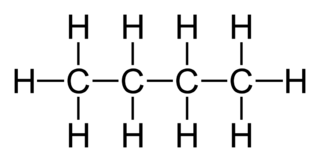
Name this alkane
a)
Methane
b)
Ethane
c)
Propane
d)
Butane
85.
Name this alkane
a)
Methane
b)
Ethane
c)
Propane
d)
Butane
86.
The "ane" ending in "alkane" tells someone that they are dealing with _________-bonded carbons.
a)
single
b)
double
c)
triple
d)
quadruple
87.
Give the name of this compound...
C3H8
a)
Propene
b)
Butane
c)
Butene
d)
Propane
88.
The molecular formula for Heptane is
a)
C4H10
b)
C8H18
c)
C5H12
d)
C7H16
89.
Hydrocarbons are compounds that contain
a)
Carbon, only
b)
Carbon and Hydrogen, only
c)
Carbon, Oxygen, and Hydrogen, only
d)
Carbon, Oxygen, Hydrogen, and Nitrogen, only
90.
General formula of Alkane is 
a)
CnH2n+2
b)
CnH2n
c)
CnH2n+1OH
d)
CnH2n+1COOH
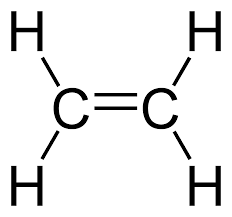
91.
Classify the compound based on the functional group present.
a)
alkane
b)
alkene
c)
alkyne
d)
aromatic
92.

Which of the following shows the structure of ethene?

a)
b)
c)
d)
93.
The boiling points and viscosity of alkane molecules increase as their molecular sizes increase.
a)
True
b)
False
94.
The first member of the alkene series is methene.
a)
True
b)
False
95.
Both alkanes and alkenes react rapidly with aqueous bromine at room temperature.
a)
True
b)
False
96.
The "ane" ending in "alkane" tells someone that they are dealing with _________-bonded carbons.
a)
single
b)
double
c)
triple
d)
quadruple
97.

Complete the equation C16H34 ---> __________ + C2H4

a)

C16H34

b)

C2H30

c)

C10H20

d)

C14H30

98.
What liquid detects the presence of an alkene?
a)
Alkene water
b)
Bromine water
c)
Water
d)
Limewater
99.

When testing for alkenes (unsaturation) bromine water turns from...

a)

orange --> blue/black

b)

colourless --> pink

c)

orange --> colourless

d)

orange --> clear

100.

Which of the following statements regarding the mole is INCORRECT?

a)

A mole is a unit of quantity equal to 6.02 x 10²³ particles.

b)

The number of particles in a mole is known as Avogadro’s number.

c)

A mole of particles of an element is numerically equal to the atomic mass of the element.

d)

none of the above

101.

The mass of one mole of an element is equal to

a)

its atomic number from the periodic table, but in amus.

b)

its atomic mass from the periodic table, but in amus.

c)

its atomic mass from the periodic table, but in grams.

d)

its atomic number from the periodic table, but in grams.

102.

What is the molar mass of PbSO4?

a)

303.27 g/mol

b)

255.27 g/mol

c)

163.87 g/mol

d)

372.27 g/mol

103.

How many formula units are in 2.5 moles of NaCl?

a)

1.5 x1024 formula units

b)

1.5 formula units

c)

4.2 formula units

d)

4.2 x10⁻²⁴ molecules

104.

Shivani measures out 6.0 moles of epsom salt (MgSO4) to put in her bath. How many grams of MgSO4 went in the bath?

a)

3.6 x 1024 g

b)

720 g

c)

0.050 g

d)

340 g

105.
How many molecules are there in 31.8 moles of water?
a)
5.28 x 10⁻²³ molecules
b)
1.91 x 1025 molecules
c)
5.28x 10⁻²⁵
d)
1.91 x 10²²
106.

Determine the mass of 4.20 moles of C6H12

a)

353 g

b)

0.0499 g

c)

337 g

d)

2.53 x 1024 g

107.

Which of the following dimensional analysis setups will correctly convert 27.76 g of Li to atoms of Li?

a)

A

b)

B

c)

C

d)

D

108.

What is the mass of 1.2 x 1024 atoms of C?

a)

2.0 grams

b)

24 grams

c)

0.17 grams

d)

1.4 x 1025 grams

109.

Calculate the number of atoms in 0.0340 g Zn.

a)

5.20 x 10⁻⁴ atoms Zn

b)

3.13 x 10²³ atoms Zn

c)

3.13 x 10²⁰ atoms Zn

d)

2.05 x 10²² atoms Zn

110.

How many grams are in 1.2 moles of neon?

a)

0.059 grams

b)

7.2 x 10²³ grams

c)

2.0 x 10⁻²⁴ grams

d)

24 grams

111.

How many moles are in 98.3 grams of aluminum hydroxide, Al(OH)3?

a)

1.26 moles

b)

0.8 moles

c)

7,670 moles

d)

1.63 x 10⁻²² moles

112.
What is the molarity of 4 grams of sodium chloride (NaCl) in 3,800 mL of solution?
a)
0.018 M
b)
0.018 m
c)
1.052 M
d)
1.052 m
113.
How many moles of NaCl are present in a solution with a molarity of 8.59M and 125 mL of solution?
a)
1.074 mol
b)
62.7 mol
c)
1.07 mol
d)
62.7 grams
114.
What is the molarity of a solution which contains 22.41 grams of NaCl in 50.0 mL of solution?
a)
0.488 M
b)
7.66 M
c)
7.67 M
d)
0.00767 M
115.
How many grams of solute are dissolved in 125.0 mL of 5.00M NaCl?
a)
0.625 g NaCl
b)
36.52 g NaCl
c)
36.5 g NaCl
d)
0.625 mol NaCl
116.
Solvent is best defined as-
a)
a mixture in which the substances are spread out evenly between one another and cannot be told apart
b)
the ability of a substance to dissolve in another substance
c)
a substance that dissolves in another substance
d)
a substance into which another substance dissolves
117.
acid + alkali ₋>
a)
salt + hydrogen
b)
salt + water
c)
salt + carbon dioxide + water
d)
salt
118.
HCl + NaOH → 
a)
NaH + ClOH
b)
NaCl + H2
c)
NaCl + H2O
d)
NaCl + Cl2
119.
I am titrating 1M HCl with 1M NaOH.  I have 25cm3 of HCl. How much NaOH will I need?
a)
2.5cm3
b)
5cm3
c)
25cm3
d)
50cm3
120.
what is the reading on this burette?
a)
4.4cm3
b)
3.5cm3
c)
3.6cm3
d)
4.5cm3
121.
I have 25cmof 1M HCl which neutralises 20cm3 of NaOH. What is the concentration of the NaOH?
a)
0.8 M
b)
1 M
c)
1.25 M
122.
I have 50cmof 0.1M HCl. How many moles of NaOH will I need to neutralise it?
a)
5
b)
0.5
c)
0.05
d)
0.005
123.
What's the white tile for in the titration?
a)
To clearly see the colour change
b)
To protect the workbench from acid spills
124.
Why do we use water to wash the solution from the burette into the flask
a)
To ensure accuracy (all solution reacts)
b)
To dilute the reagents
c)
To help the reaction go faster
d)
To see the colour of the indicator better
125.

What colour does the Methyl Orange indicator turn once the acid has neutralised it?

a)

blue

b)

green

c)

yellow

d)

pink

126.

What is the role of an indicator in a reaction?

a)

To help reactants react successfully.

b)

To bind to the analyte to form a products.

c)

To show when the reaction has reached or past the equivalence point.

d)

To provide a surface for the reaction to occur.
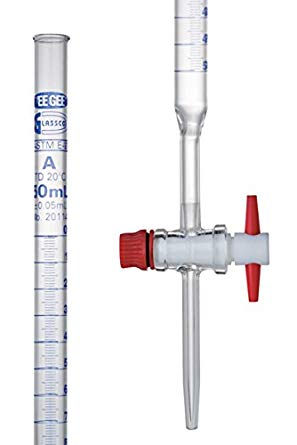
127.

What is this piece of apparatus called

a)

Pipette

b)

Burette

c)

Janette

d)

Cuvette

128.

What is the reading on this burette?

a)

24.0cm3

b)

25.8cm3

c)

24.2cm3

d)

23.9cm3

129.

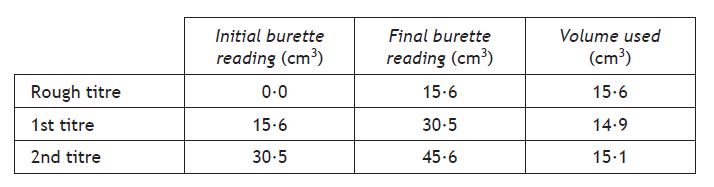
Calculate the average volume of acid needed for this neutralisation

a)

15.2cm3

b)

15.0cm3

c)

35.5cm3

d)

30.1cm3

130.

What is the average titre needed for neutralisation?

a)

25.2cm3

b)

59.7cm3

c)

25.0cm3

d)

25.4cm3

131.

30cm3 of NaOH is neutralised by 12.3cm3 of 0.2mol/l HCl. What is the concentration of the NaOH.

a)

82 mol/l

b)

0.82 mol/l

c)

0.49 mol/l

d)

0.082 mol/l

132.
I have 50cmof 0.1M HCl. How many moles of NaOH will I need to neutralise it?
a)
5
b)
0.5
c)
0.05
d)
0.005
133.

30cm3 of NaOH is neutralised by 12.3cm3 of 0.2mol/l HCl. What is the concentration of the NaOH.

a)

82 mol/l

b)

0.82 mol/l

c)

0.49 mol/l

d)

0.082 mol/l