Wayground logo

Free Printable Worksheets

Font size

S
M
L
XL
Worksheets

Unit 7 Test 3-1-24

Total questions: 50

Worksheet time: 53mins

Name
Class
Date
1.
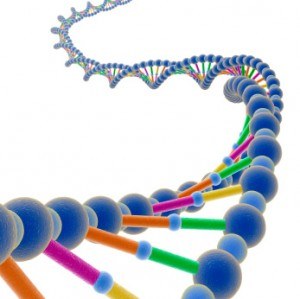
Who is responsible for producing this image?
a)
Francis Crick
b)
James Watson
c)
Rosalind Franklin
d)
Watson and Crick
2.
What did Erwin Chargaff conclude from his experiments?
a)
Nitrogen bases are held together by peptide bonds
b)
A and T, C and G always occur in equal amounts
c)
Proteins are the carriers of genetic information
d)
C and G rarely occur in eukaryotic organisms
3.
What was Watson and Crick's main scientific accomplishment?
a)
Building the first accurate model of DNA
b)
Isolating strains of pneumonia causing bacteria
c)
Determining base pairing rules
d)
Discovering the process of genetic transformation
4.
From his work with mice and pneumonia-causing bacteria, Frederick Griffith discovered what?
a)
Replication
b)
Transcription
c)
Transformation
d)
Translation
5.
Which sugar is contained in DNA
a)
Dextrose
b)
Ribose
c)
Deoxyribose
d)
Glucose
6.
Which of the following best describes a DNA molecule?
a)
double helix
b)
contains ribose
c)
made of amino acids
d)
contains Uracil
7.
Nitrogenous bases are joined by which type of bond?
a)
polar bonds
b)
ionic bonds
c)
covalent bonds
d)
hydrogen bonds
8.
Which 2 molecules forms the sides (backbone) of the DNA ladder?
a)
deoxyribose and adenine
b)
deoxyribose and a hydrogen bond
c)
sugar and the nucleus
d)
deoxyribose (sugar) and phosphate
9.
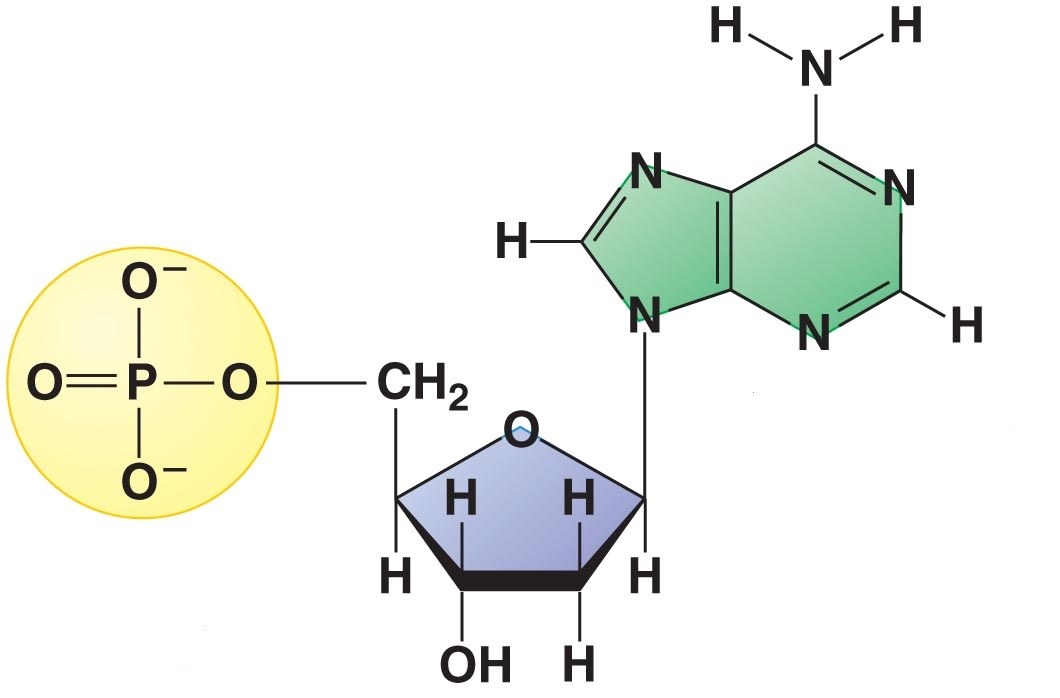
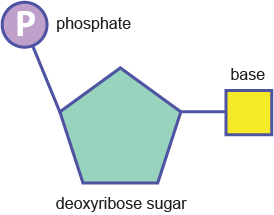
What are the three components of a nucleotide?
a)
sugar, hydrogen, nitrogen base
b)
sugar, oxygen, nitrogen base
c)
sugar, phosphate, nitrogen base
d)
sugar, phosphate, protein
10.
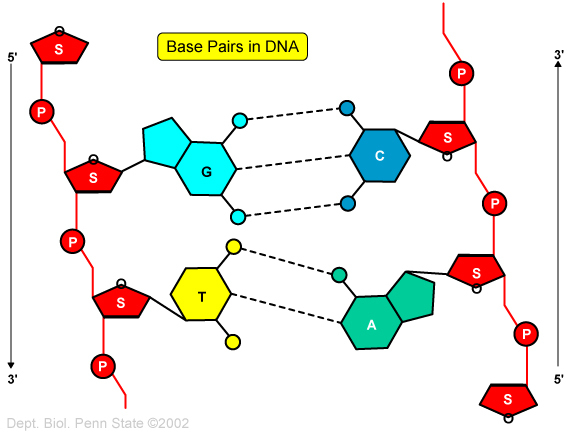
Cytosine always pairs with
a)
Adenine
b)
Thymine
c)
Uracil
d)
Guanine
11.
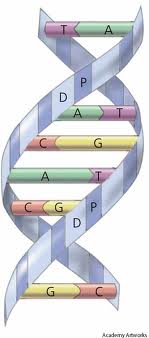
Name this structure
a)
double helix
b)
nucelotide
c)
twisted ladder
d)
hydrogen bond
12.
Which organelle is DNA usually found in?
a)
cell membrane
b)
vacuole
c)
ribosome
d)
nucleus
13.
Nucleotides are made up of a sugar, phosphate, and..?
a)
nitrogenous base
b)
nucleic acid
c)
cholesterol
d)
fatty acid
14.
Guanine bonds with ______________.
a)
Adenine
b)
Guanine
c)
Cytosine
d)
Thymine
15.

Which of the following is a base pair?

a)

Adenine - Cytosine

b)

Cytosine - Thymine

c)

Deoxyribose - Cytosine

d)

Cytosine - Guanine

16.
Which of the following is not a component of DNA?
a)
5 Carbon Sugar
b)
Phosphate Group
c)
Carbon Base
d)
Nitrogen Base
17.
Which of the following is not a nitrogen base found in DNA?
a)
Thymine
b)
Uracil 
c)
Guanine
d)
Adenine
18.
Which sequence of DNA bases would pair with this partial strand
ATG TGA CAG
a)
ATG TGA CAG
b)
TAC ACT GTC
c)
GTA AGT GAC
d)
CAT TCA CTG
19.
The enzyme that unzips the DNA to prepare for replication
a)
helicase
b)
replicase
c)
polymerase
d)
synthase
20.
DNA replication results in two DNA molecules,
a)
each one with two original strands
b)
each one with two new strands
c)
each one with one new strand and one original strand
d)
one with two new strands and the other with two original strands
21.
What is the correct complimentary strand for the following DNA?ATCGAG
a)
TACGAG
b)
ATCGAG
c)
TAGCTG
d)
TAGCTC
22.
Which enzyme is responsible for adding nucleotides ("The Builder")?
a)
Topoisomerase
b)
DNA Polymerase
c)
Ligase
d)
Primase
23.

Which is the first step?

a)

DNA Helicase unwinds original DNA strand

b)

RNA Primase lays down RNA primer for new nucleotide bases.

c)

DNA polymerase builds new strands by bring in new nucleotide bases.

d)

Ligase knits together fragments on lagging strand

24.
Which sequence of DNA bases would pair with this partial strand
CAT TCA CTG
a)
ATG TGA CAG
b)
TAC ACT GTC
c)
GTA AGT GAC
d)
CAT TCA CTG
25.

Why does DNA replicate?

a)

To create a duplicate copy in case the original gets damaged

b)

New cells will have a copy of the DNA

c)

To create a new copy to replace the damaged original

26.

What is the function of DNA?

a)

Store genetic information

b)

Store energy

c)

Form enzymes

d)

Form the cell membrane

27.

What is this a picture of?

a)

DNA

b)

mRNA

c)

rRNA

d)

tRNA

28.

What process is occurring in this picture?

a)

DNA Replication

b)

DNA Transcription

c)

DNA Translation

d)

DNA Synthesis

29.

What process is occurring in this image?

a)

DNA transription

b)

DNA replication

c)

DNA translation

d)

Mitosis

30.
DNA codes for...
a)
cholesterol
b)
proteins
c)
fatty acids
d)
a sandwich
31.
Which is a difference between DNA and RNA
a)
RNA is double stranded
b)
RNA is not made of nucleotides
c)
RNA contains Uracil instead of Thymine
d)
RNA does not contain a sugar
32.
In order for DNA instructions to move from the nucleus to the ribosomes in the cytoplasm of a cell, an RNA copy of a DNA strand must be made. This process, which takes place in the cell nucleus, is called
a)
translation
b)
mutation
c)
DNA replication
d)
transcription
33.
Which RNA bases would pair with TACGAA in transcription? 
a)
AUGCUU
b)
ATGCTT
c)
GCATCC
d)
GCAUCC
34.

What happens to the mRNA sequence after it has been synthesized?

a)

stays in the nucleus

b)

leaves the cell

c)

leaves the nucleus

d)

separates into smaller pieces

35.
What does tRNA do?
a)
provides information from DNA to ribosomes
b)
transfers amino acids to the ribosomes
c)
makes up ribosomes
d)
builds proteins
36.

Where are proteins made?

a)

ER

b)

nucleus

c)

cytoplasm

d)

mitochondria

37.
What does rRNA do?
a)
provides information from DNA to ribosomes
b)
transfers amino acids to the ribosomes
c)
makes up ribosomes
d)
builds proteins
38.
What is the correct sequence?
a)
RNA --> DNA --> Protein
b)
Protein --> RNA --> DNA
c)
DNA --> RNA --> Protein
d)
DNA --> Protein --> RNA
39.
If an mRNA codon is AGU, which of the following would be the appropriate tRNA anticodon?
a)
TCA
b)
UGA
c)
AGU
d)
UCA
40.
How many amino acids are coded for by this sequence of nucleotides:
ATG GGA ACT CCA
a)
4
b)
2
c)
6
d)
12
41.
The process of transferring the codons to the amino acids ends with what codon?
a)
Stop
b)
Terminal
c)
End
d)
Cancel 
42.
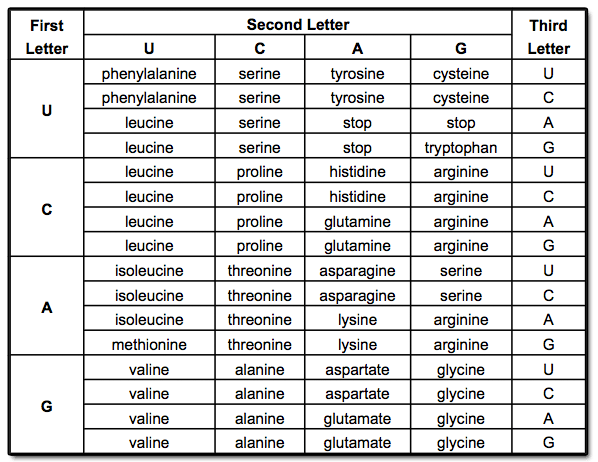
What is the correct amino acid sequence for the mRNA code AUGCCAGUAUGA
a)
Met-Pro-Ala-Val
b)
Met-Pro-Val
c)
Tyr-Gly-His
d)
Tyr-Gly-Arg-His
43.
What will be the resulting mRNA from this DNA sequence:
GAT-TAC-AGA-TTA-CAT?
a)
CTA-ATG-TCT-AAT-GTA
b)
GAU-UAG-UGA-UUA-GUT
c)
CUA-AUG-UCU-AAU-GUA
d)
CAT-ACA-TAC-ATA-TAG
44.
If you are missing or have an extra base  at the end of your mutated DNA . What type of mutation occurred?
a)
Substitution
b)
Frameshift
c)
Duplication 
d)
Insertion
45.
A type of substitution in which no  amino acids change is called 
a)
Missense
b)
Nonsense
c)
Silent
d)
Deletion
46.
Which of the following would result in a frameshift mutation?
a)
Insertions only
b)
Substitution only
c)
Deletion only
d)
Insertions and Deletions
47.

A mutation in the third base of a codon for the amino acid Proline (Pro) will always be a silent mutation. Which of the following pieces of information best supports this claim?

a)

Proline is always made from the same 3 bases

b)

As long as the first two bases on the mRNA codon are both C, it will always code for proline; regardless of the 3rd base

c)

Proline is a stop codon, so it isn't actually an amino acid and therefore cannot be mutated

d)

Proline has evolved to become resistant to harmful mutations

48.
A lab technique used in crime fighting to prove a suspects innocence or guilt is known as:
a)
genetic engineering
b)
PCR
c)
electrophoresis
d)
gene therapy
49.
What is recombinant DNA?
a)
Adding DNA from one organism into the DNA of another
b)
DNA which has been changed over generations by natural selection
c)
DNA that causes genetic disorders
d)
DNA that has been sequenced
50.

Which suspect left the blood stain?

a)

Bob

b)

Sue

c)

John

d)

Lisa