
 Worksheets
9189PH1CHPPT3
Total questions: 46
Worksheet time: 2hrs 18mins
What components are more commonly included in modern system boilers?
Thermostat, timer, and pressure relief valve
Circulator, automatic bypass, and an expansion vessel
Heat exchanger, pilot light, and flue
Burner, control panel, and safety valve
What is the advantage of installing a system boiler?
It is more energy-efficient than other boilers.
It saves time and space on the installation.
It can operate without electricity.
It provides instant hot water.
When is a system boiler the preferred choice?
When a non-sealed system is required
When a sealed system is required
When the lowest cost option is needed
When the highest capacity is needed
What is the purpose of a sealed expansion vessel in a sealed system?
To replace the feed and expansion cistern of the open system
To provide a point at which the system can be filled under mains pressure
To prevent the over-pressurisation of the system if the expansion vessel fails
To incorporate a number of components to replace the feed and expansion cistern, cold feed and open vent
What is the function of a pressure relief valve (blow off) in a sealed system?
To replace the feed and expansion cistern
To allow the system to be filled under mains pressure
To prevent the over-pressurisation of the system if the expansion vessel fails
To incorporate components to replace the vent system
What is the purpose of installing a filling connection with a detachable filling loop in a sealed system?
To replace the feed and expansion cistern
To provide a point at which the system can be filled under mains pressure
To prevent the over-pressurisation of the system
To replace the vent systems seen previously
What needs to be installed to prevent the possibility of back siphonage of central heating water into mains water?
A) A single check valve
B) A pressure relief valve
C) A double check valve
D) A thermostatic mixing valve
According to the Water Regulations, what must be done with the filling loop after the system has been charged to the correct pressure?
A) It should be left connected
B) It should be inspected
C) It should be disconnected
D) It should be replaced
What needs to be fitted on both of the filling loop connections?
A) A means of control
B) A means of isolation
C) A means of regulation
D) A means of detection
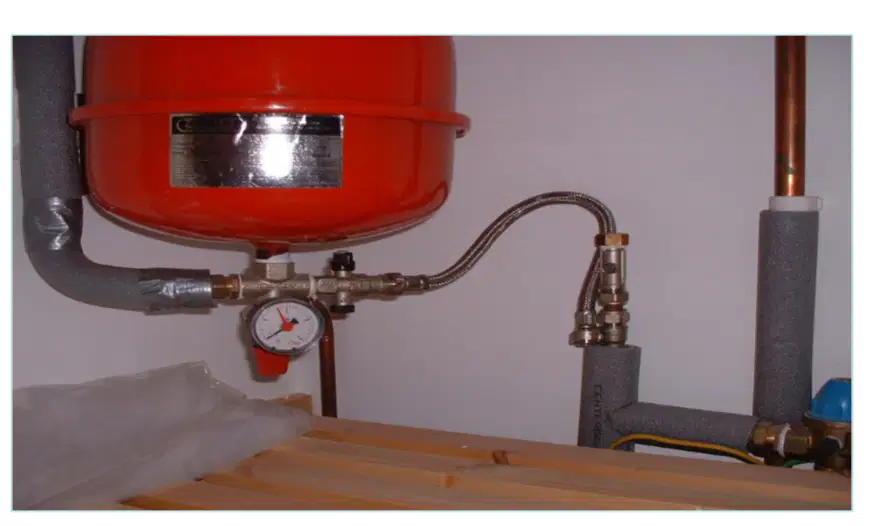
What components are typically included in the installation shown in the image?
Expansion vessel, pressure gauge, and vent pipe
Expansion vessel, pressure relief valve, and a filling loop
Expansion tank, safety valve, and a drainage loop
Expansion chamber, pressure release valve, and a service loop
What is the function of the expansion vessel in a sealed heating system?
To pump water through the system
To provide a space for the heated water to expand
To measure the pressure of the water in the system
To heat the water
Where is the pressure gauge located in the sealed system diagram?
Next to the boiler
On the expansion vessel
Near the radiators
Attached to the pressure relief valve
What is the purpose of the pressure relief valve in the sealed system?
To control the flow of water to the radiators
To prevent overpressure by releasing water
To indicate the temperature of the water
To fill the system with water
What does the temporary filling loop with double check valve arrangement do in the system?
It permanently adds water to the system
It measures the temperature of the water
It allows for temporary filling of the system and prevents backflow
It controls the heating of the water
What has become one of the most popular forms of central heating in the UK in recent years?
Electric heaters
Solar heating systems
Combination boilers (combis)
Wood-burning stoves
What is a characteristic feature of a combi boiler regarding hot water and heating?
It provides both simultaneously.
It provides neither heating nor hot water.
It provides hot water or heating, but not both at the same time.
It provides heating only.
What is the term used to describe the system where a combi boiler gives priority to hot water over heating?
Cold water priority system
Balanced water system
Hot water priority system
Heating priority system
Which of the following is an integral part of modern combination boilers?
Integral cooling loop
Integral filling loop
Integral draining loop
Integral bypass loop
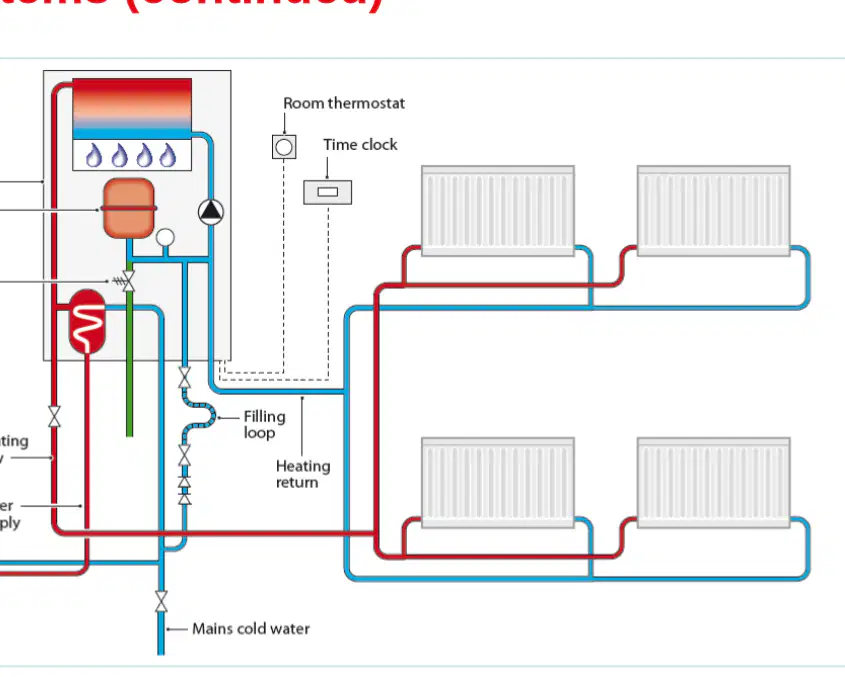
What is the main component labeled in the diagram that heats the water for both the heating system and domestic hot water supply?
Expansion vessel
Pressure relief valve and discharge pipe
Combination boiler
Filling loop
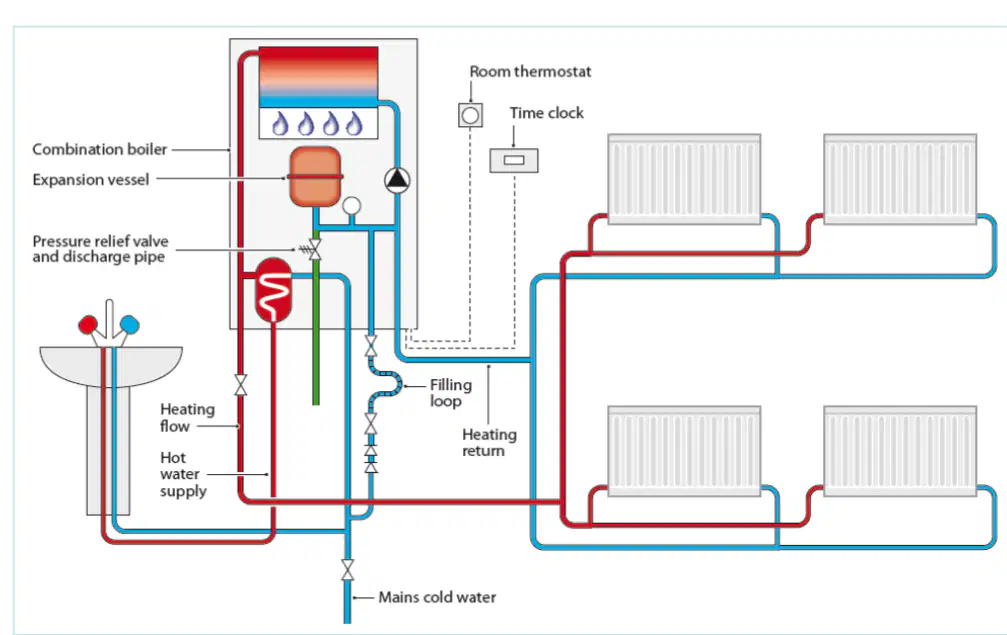
What is the purpose of the component labeled 'Expansion vessel' in the diagram?
To regulate the time when the heating is turned on and off
To provide a backup heating source
To accommodate the expansion of water when it is heated
To fill the heating system with water
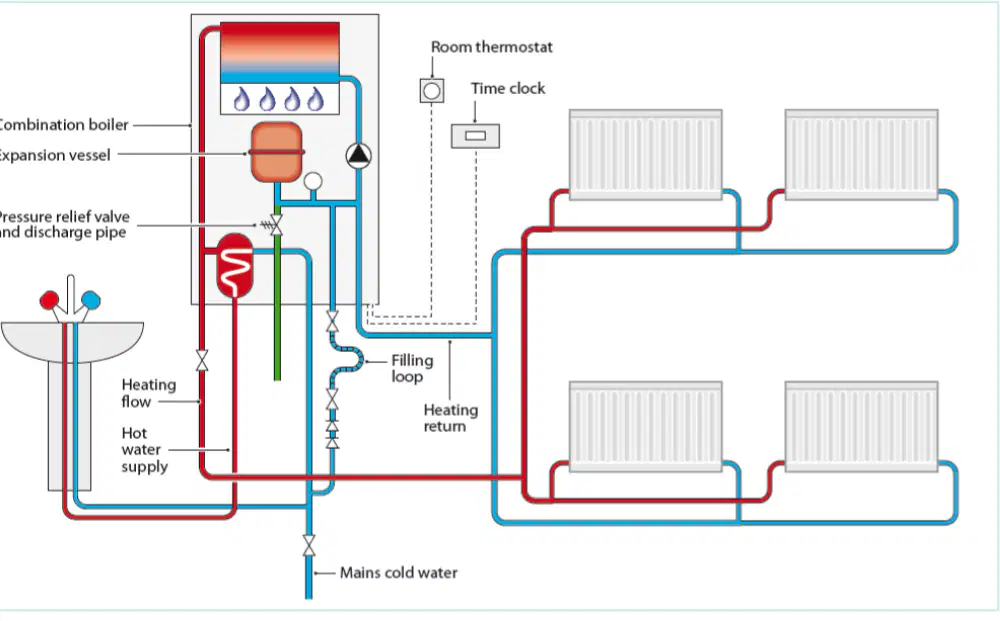
Which component in the diagram is responsible for maintaining the pressure in the heating system?
Room thermostat
Filling loop
Pressure relief valve and discharge pipe
Mains cold water
Combination boilers are popular for which types of properties?
Large commercial properties
Small to medium residential properties
Outdoor installations
Single-room use
What is replaced by the use of a combination boiler?
The need for a separate water tank
The need for electrical heating elements
The need for a DHW cylinder, CWSC and F&E
The need for solar heating panels
What must be checked before installing a combination boiler?
The color of the property's walls
Flow rates at the property
The electrical wiring in the property
The property's insulation levels
What is one of the limitations of a combination boiler regarding the supply of domestic hot water (DHW)?
It can supply DHW to multiple draw-off points simultaneously.
It can only supply DHW to one draw-off point at any one time.
It provides an instant supply of DHW without any delay.
It increases water pressure when DHW is demanded.
What happens when domestic hot water (DHW) is demanded from a combination boiler?
The CH circuit remains on to provide continuous heating.
The flow rates decrease to conserve energy.
The CH circuit is cut off.
The temperature of DHW instantly rises to the set level.
What is a potential issue with combination boilers in hard water areas?
The risk of freezing is higher in hard water areas.
They are less energy-efficient in hard water areas.
Scaling can occur in hard water areas.
They cannot function at all in hard water areas.
What happens to the domestic hot water (DHW) supply if the mains is cut off in a home with a combination boiler?
The boiler switches to using a backup tank.
The boiler continues to supply DHW using internal reserves.
There is no DHW back-up if mains is cut.
The boiler generates DHW from alternative energy sources.
What are the typical diameters of flow and return pipes in a micro-bore system?
6mm, 8mm, 10mm
28mm–22mm
15mm
50m
What is a manifold in the context of micro-bore or minibore systems?
A type of heat emitter
A multi-connection fitting
A small bore tube
A machine used for bending pipes
How long can microbore tubes be supplied in coil form?
Up to 10m
Up to 22mm
Up to 50m
Up to 15mm
What is the purpose of microbore in a two-pipe system?
To connect the manifold to the heat emitters
To provide insulation for the pipes
To increase the temperature of the water
To reduce the water flow in the system
What is the general diameter of microbore pipework used for heat emitters in manifold systems?
5mm or 7mm
8mm or 10mm
12mm or 15mm
20mm or 25mm
How are manifolds typically fitted in relation to each other?
In series
In parallel
In pairs, beside each other
At opposite ends of the system
Underfloor heating is popular for several reasons. Which of the following is NOT one of the reasons mentioned for its popularity?
Comfort
Economy
High maintenance
Flexibility
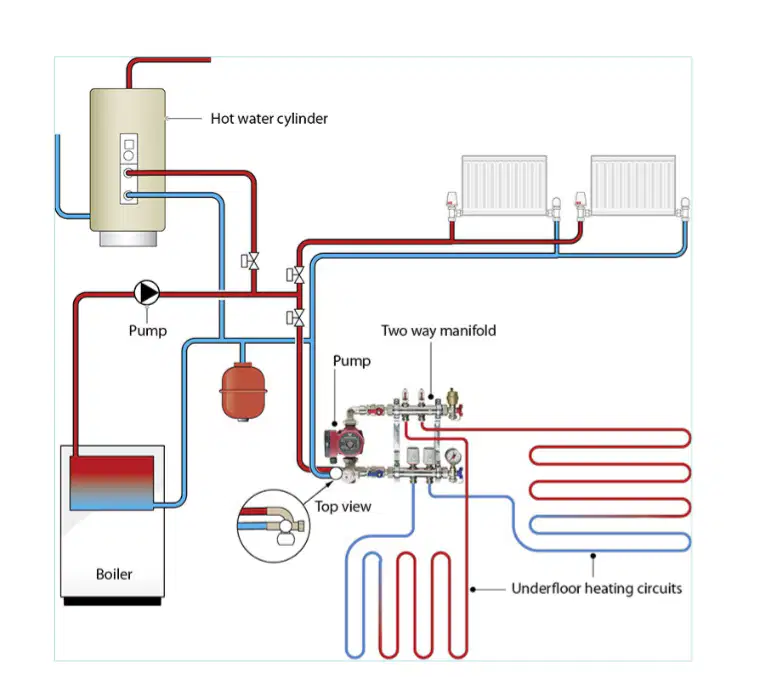
What is the main component that distributes heat in an underfloor heating system?
Boiler
Pump
Hot water cylinder
Two way manifold
Underfloor heating is becoming more popular and is sometimes referred to as what?
Embedded pipe systems
Surface pipe networks
External pipe coils
Integrated pipe grids
What does the pipework of an underfloor heating system lay on?
A thermally non-insulated bed
A thermally insulated bed
A bare concrete floor
A wooden base
How is the pipework of underfloor heating typically arranged on the floor of the room?
In a straight line
In a zigzag pattern
In a loop or coil formation
Randomly scattered
What is done after the pipework is laid for underfloor heating?
It is covered with wooden planks
It is screeded over with concrete or installed in suspended floors
It is left exposed for air heating
It is painted over
What is the purpose of the insulated bed in an underfloor heating system?
To prevent heat loss downwards
To increase heat loss upwards
To support the weight of the pipes
To insulate the room from noise
How far apart are pipes usually installed in an underfloor heating system across the floor of the room?
50–75mm apart
100–125mm apart
150–225mm apart
250–300mm apart
What is the purpose of the special mixing valve in an underfloor heating system?
To regulate the water pressure in the system
To ensure that the floor does not reach too high a temperature
To control the flow of water to the manifolds
To pump hot water through the system
How is each room's temperature controlled in an underfloor heating system?
By a central thermostat
By the boiler's temperature settings
By its own room thermostat
By the mixing valve
What are some of the benefits of the underfloor heating system mentioned in the text?
Comfort, economy, flexibility, and high maintenance
Comfort, complexity, inflexibility, and no maintenance
Discomfort, economy, flexibility, and no maintenance
Comfort, economy, flexibility, and virtually no maintenance
What do the pipework loops connect to in an underfloor heating system?
A single manifold for both flow and return
Separate boilers for flow and return
A pair of manifolds, one for the flow and one for the return
A single pump for both flow and return

