
 Worksheets
9189PH1HWPPT2
Total questions: 45
Worksheet time: 2hrs 15mins
What must the cylinder of an unvented hot water system be fitted with to ensure the hot water never reaches 100°C?
A) A pressure relief valve
B) A range of safety (temperature) controls
C) An automatic shut-off switch
D) A thermostat
Where should the discharge pipes of an unvented hot water system be located?
A) In a visible location
B) In a safe place
C) Near the water source
D) Outside the building
Who must maintain the unvented hot water system?
A) Any person
B) A competent person
C) The local authority
D) The system manufacturer
How must installations of unvented hot water systems be notified?
A) To the manufacturer
B) To the local authority or self-certified (competent persons scheme)
C) To the building owner
D) To the public utilities company
What is the maximum temperature that the water within the storage cylinder of an unvented hot water system should not exceed?
90°C
100°C
110°C
120°C
What is the purpose of mechanical safety devices in an unvented hot water system?
To heat the water to the desired temperature
To ensure the water flows properly through the pipes
To control the expansion of water and ensure the temperature does not exceed 100°C
To cool down the water before it enters the storage cylinder
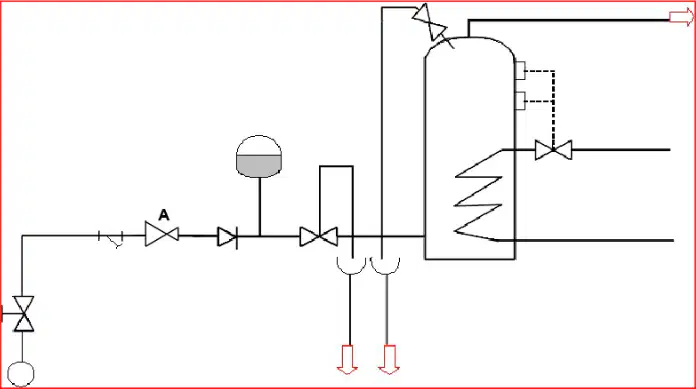
What does the pipework layout in the image show?
Hot water outlet and cold water inlet via safety valves
Cold water inlet via safety valves and unvented hot water outlet
Hot water inlet and cold water outlet via safety valves
Unvented cold water inlet and hot water outlet
What is the purpose of the expansion vessel in an indirect hot water system?
To heat the water
To store cold water
To absorb excess pressure
To filter impurities from the water
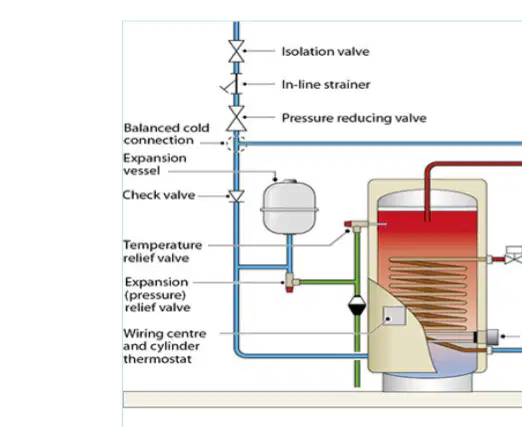
Where is the immersion heater located in the diagram of the indirect hot water system?
Inside the system boiler
Within the expansion vessel
Inside the hot water cylinder
Next to the filling loop
What is the function of the check valve in the hot water system layout shown?
To regulate water temperature
To prevent backflow of water
To reduce water pressure
To isolate the system for maintenance
Which component in the diagram ensures the safe operation of the hot water system by releasing water in case of excessive temperature?
Pressure reducing valve
Temperature relief valve
In-line strainer
Isolation valve
What type of system is a water jacket heater or thermal store unit?
A form of storage heating system
A form of instantaneous hot water under mains pressure
A traditional boiler system
A solar heating system
How does a water jacket heater or thermal store unit work in comparison to an indirect cylinder?
In a completely different manner
In the same way
In reverse
It does not work similarly at all
What is filled with primary water in a water jacket heater or thermal store unit?
(a)
What happens when a hot draw off point is opened in a water jacket heater or thermal store unit?
Water flows through the cylinder and is heated
Water flows through the coil and is cooled
Water flows through the coil and is heated
Water flows through the blending valve and is heated
What is the purpose of the blending valve in a water jacket heater or thermal store unit?
What is the purpose of the overflow in a water jacket heater or thermal store unit?
To provide hot water to taps
To supply mains water
To prevent over-pressurization by allowing excess water to escape
To return water to the boiler
Where does the hot water to radiators come from in a water jacket heater or thermal store unit?
Directly from the boiler
From the mains water supply
From the overflow
From the vent to cold water storage tank
What is the function of the vent to cold water storage tank in a water jacket heater or thermal store unit?
To supply hot water to taps
To allow air to escape and prevent vacuum formation
To return water to the boiler
To provide an additional water supply
How is the mains water supply utilized in a water jacket heater or thermal store unit?
It is heated and supplied to taps
It is used to fill the vent to cold water storage tank
It is circulated through radiators
It is used to cool down the system

What is the main focus of the image provided in the learning material?
A) A thermal store unit in situ
B) A domestic heating radiator
C) A plumbing toolkit
D) A water filtration system
Instantaneous hot water systems can be which of the following?
Only centralised
Only localised
Either centralised or localised
Neither centralised nor localised
On what principle do instantaneous hot water systems work?
Heating the domestic hot water continuously
Heating the domestic hot water only when it is needed
Cooling the domestic hot water
Transferring cold water to the heat exchanger
How does the appliance in an instantaneous hot water system transfer heat to the water?
Slowly as it passes through the heat exchanger
Only after storing the hot water
Very quickly as it passes through the heat exchanger
Without using a heat exchanger
Where is a single point water heater commonly used?
Close to a DHW storage vessel
Where an isolated basin/sink is too far away from a DHW storage vessel
In every household bathroom
Near a central heating system
What does a single point water heater rely on?
A closed spout connected to a pump
An open spout, always open to atmosphere
A direct connection to a heating element
A sealed tank system
How is a single point water heater generally fed?
With a gravity-based feed system
By a direct connection to a boiler
It needs to be mains fed but some units can be fitted to a cistern
Through an indirect heating system
What should always be checked before installing a single point water heater?
The local water regulations
The manufacturer's instructions
The warranty period
The energy efficiency rating
How does water enter a single point water heater?
Through a pressure valve
Via an electric pump
Through the tap
By a gravity feed system
What is the typical capacity of stored hot water in a single point heater?
15 litres
7 litres per minute
5 litres
Over 15 litres
Where can a single point heater be fitted?
Only above a sink
Only below a sink
Only in loft conversions
Above or below a sink and in loft conversions or extensions
What happens if the capacity of a single point heater is over 15 litres?
It requires a flow restrictor
It is considered an unvented appliance
The flow is maintained at 7 litres per minute
It cannot be fitted in loft conversions
What is the typical minimum water pressure required for a single point heater to function?
7 litres per minute
5 litres
1 bar
15 litres

What is the function of the component labeled "INLET VALVE CONTROL" in the layout of a single point heater?
To regulate the flow of hot water
To provide electrical power to the heater
To control the temperature of the water
To regulate the flow of cold water
What is the function of a multi-point water heater as described in the learning material?
To heat and store a large amount of water for central heating
To supply water to a number of outlets in one location
To control the water temperature in single-point heaters
To provide electrical heating solutions
How is the pressure maintained in a multi-point water heater according to the text?
It is not controlled and varies with usage
It is kept at a low pressure for safety reasons
It is often kept at mains pressure and outlet controlled
It relies on gravity for pressure control
What distinguishes a multi-point water heater from a single-point heater based on the information provided?
Multi-point heaters are less efficient than single-point heaters
Multi-point heaters cannot control the outlet temperature
Multi-point heaters store a large amount of water
Multi-point heaters are outlet controlled, unlike single-point heaters
What is usually required by undersink heaters that is different from oversink heaters?
A special tap or mixer tap that allows the outlet to be open to the atmosphere at all times.
A higher water pressure.
A separate heating element.
A larger capacity than 15 litres.
What is the purpose of the spout of the tap in an undersink heater system?
To control the temperature of the water.
To act as an open vent allowing expansion of water to take place.
To increase water flow to the heater.
To filter the water.
What is the typical capacity of undersink heaters?
Up to 5 litres.
Up to 10 litres.
Up to 15 litres.
Up to 20 litres.
Why are the special taps used in undersink water heaters more expensive than standard taps?
They have a more complex design
They are made of higher quality materials
They include a permanently open vent
They are gold-plated
What could be a consequence of installing the wrong type of tap for an undersink water heater?
The system would become more efficient
The system would become unvented and could pose a serious hazard in an overheat fault condition
The water would be colder than usual
The tap would not dispense any water
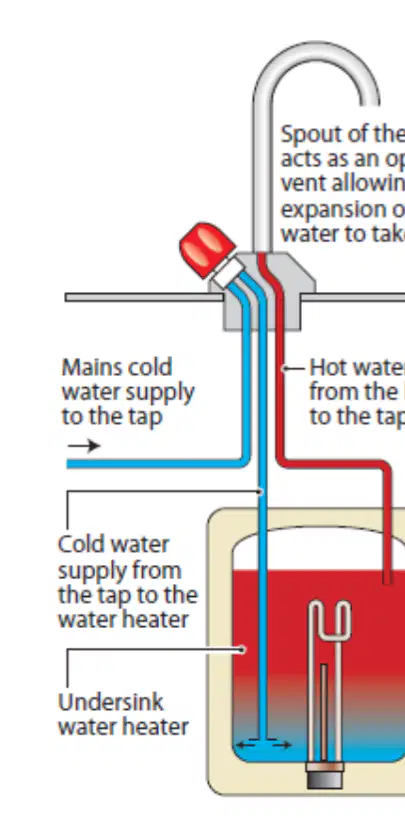
Refer to the diagram to answer: What does the spout of the tap in an undersink water heater act as?
A filter for impurities
A mechanism to control water flow
An open vent allowing expansion of water to take place
A decorative element
What type of boiler provides instantaneous hot water to multiple outlets and central heating?
Storage boiler
Electric boiler
Combination boiler
Condensing boiler
Combination boilers are known for having which type of system that gives priority to hot water?
Cold water priority system
Balanced water priority system
Hot water priority system
Energy-saving priority system

