wayground logo

Free Printable Worksheets

Font size

S
M
L
XL
Worksheets

Sem 2 Unit Test Review - Grade 8

Total questions: 80

Worksheet time: 27mins

Name
Class
Date
1.
Energy of a rock perched on a cliff is an example of...
a)
gravitational
b)
elastic
c)
chemical
d)
kinetic
2.
Energy from a compressed spring would be an example of...
a)
kinetic
b)
elastic
c)
gravitational
d)
chemical
3.
How do you calculate power?
a)
P = W/t
b)
P = E/t
c)
P = w * t
d)
P = bbq/chicken
4.
How do we calculate work?
a)
W = F * d
b)
w = f * D
c)
W = F * D
d)
w = f * d
5.
How much work is being done with 200 N of force over 426 meters?
a)
85,200 J
b)
45,620 J
c)
90,480 J
d)
62,329 J
6.
The SI unit of work is?
a)
Joules
b)
Watts
c)
Newtons
d)
meters
7.
Energy that is stored is called...
a)
Kinetic
b)
Potential 
8.
The SI unit for power is...?
a)
Watts
b)
Joules
c)
Newtons
d)
Meters
9.
If 150 Joules of work is needed to move a box 10 meters, what force was used? 
a)
1500 N
b)
15 N
c)
1.5 N
d)
150 N
10.
If 68 Joules were necessary to move a 4 Newton crate, how far was the crate moved?
a)
272 m
b)
17 m
c)
4.05 m
d)
272 cm 
11.
The faster an object moves, the ________ kinetic energy it has. 
a)
more
b)
less
c)
none of the above
d)
all of the above 
12.
Gravitational potential energy depends on the ________ and ________ of the object. 
a)
Height and mass
b)
Friction and movement
c)
Mass and Movement
d)
Height and Friction 
13.
What is the formula for calculating the total amount of mechanical energy?
a)
ME = KE + PE
b)
KE = ME + PE
c)
PE = KE + ME
d)
ME = 1/2 mv2
14.
Why does the total amount of mechanical energy stay constant in a system?
a)
energy is not created or destroyed
b)
energy leaves
c)
energy enters
d)
energy is not converted from one form into another
15.
What is the energy of position or shape that depends on weight and height, also called stored energy?
a)
Energy
b)
Kinetic energy
c)
Potential energy
d)
Sound energy
16.

Electrical energy is transferred to _____ Energy.

a)

Solar

b)

Thermal

c)

Chemical

d)

Electrical

17.

Solar energy is transferred to _____ energy.

a)

Mechanical

b)

Solar

c)

Sound

d)

Electrical

18.

When the light changes, potential energy in the car is transferred to _____ energy in the car.

a)

Potential

b)

Radiant

c)

Thermal

d)

Kinetic

19.

Electrical energy is transferred to _____ energy.

a)

Thermal

b)

Solar

c)

Electrical

d)

None

20.

When you eat pizza, chemical energy is transferred to _____ energy in your body.

a)

Solar

b)

Electrical

c)

Mechanical

d)

Chemical

21.

Electrical energy is transferred to _____ energy.

a)

Eolic

b)

Solar

c)

Electrical

d)

Thermal

22.

Kinetic energy from the car is transferred to _____ energy in the tree.

a)

Solar

b)

Electrical

c)

Thermal

d)

Potential

23.

Wind's kinetic energy is transferred to _____ energy.

a)

Solar

b)

Mechanical

c)

Electrical

d)

Potential

24.

Which items would have this energy transformation: electrical energy -> thermal energy and light energy?

a)

toaster

b)

candle burning

c)

windmill turning

d)

Iron for your clothes

25.

Which items would have this energy transformation: chemical energy -> mechanical energy?

a)

person running

b)

candle burning

c)

windmill turning

d)

radio playing music

26.

Which items would have this energy transformation: chemical energy -> thermal and light energy?

a)

toaster

b)

candle burning

c)

windmill turning

d)

calculator

27.

Which items would have this energy transformation: mechanical energy -> electrical energy?

a)

turning on a flashlight

b)

nuclear power plant

c)

windmill turning

d)

toaster

28.

Is the energy in a battery, chemical or electrical (Not connected to any devices)?

a)

electrical

b)

chemical

c)

thermal

d)

eolic

29.
When you touch something that feels cold, 
a)
heat from your hand moves into the cold substance.
b)
coldness moves from the cold substance into your hand.
c)
it melts.
d)
it freezes.
30.
This is a measure of the average kinetic energy of the particles in an object.
a)
temperature
b)
thermal expansion
c)
electricity
d)
sound
31.
What is the freezing point of water in degrees Celsius?
a)
32
b)
35
c)
0
d)
-5
32.
What is the freezing point of water in degrees Fahrenheit?
a)
100
b)
0
c)
32
d)
35
33.
4. If the atoms of an object are moving slow, the object would feel...
a)
cold or cool.
b)
hot or warm.
c)
unknown.
d)
smooth.
34.
3. If the atoms of an object are moving fast and continue to move faster the temperature would be...
a)
increasing.
b)
decreasing.
c)
staying the same.
d)
freezing.
35.
A glass beaker is placed on a hot plate or burner. 500 mL of room temperature water are added to the beaker. If the temperature continues to increase,the water in the beaker will most likely 
a)
turn into a solid.
b)
become more dense.
c)
turn into a gas. 
d)
show no change in temperature. 
36.
 When water reaches its boiling point the particles
a)
are closer together.
b)
stay the same.
c)
are moving more rapidly.
d)
are moving slowly.
37.
Which particles are moving fastest?
a)
Particles in ice.
b)
Particles in boiling water.
c)
Particles in water from the sink.
d)
Particles in steam.
38.
The flow of energy from a warmer to a cooler substance is 
a)
thermal energy.
b)
temperature.
c)
friction.
d)
heat.
39.
To find out how hot something is, we measure its            , or the average kinetic energy of its particles. 
a)
heat
b)
thermal energy
c)
conduction
d)
temperature
40.
Energy that moves particles of matter is 
a)
temperature
b)
thermal energy
c)
heat
d)
friction
41.
Why does a diver wear a wet suit?
a)
To keep in thermal energy.
b)
To keep from getting cuts.
c)
To keep from sinking.
d)
To keep out cold.
42.
What does absolute zero mean?
a)
A failed quiz.
b)
The lowest temperature possible.
c)
The hottest temperature possible.
d)
A race.
43.
On which temperature scale does water freeze at 0 degrees and boil at 100 degrees?
a)
Fahrenheit
b)
Celsius
c)
Kelvin
d)
Calvin
44.

Energy that an object has due to its motion, shape, position, or a combination of these factors.

a)

Nuclear Energy

b)

Mechanical Energy

c)

Electrical Energy

d)

Chemical Energy

45.

Energy that is stored in the nucleus.

a)

Chemical Energy

b)

Mechanical Energy

c)

Thermal Energy

d)

Nuclear Energy

46.

The center of an atom is called the ______________.

a)

electron

b)

nucleus

c)

liquid

d)

neutron

47.

The total potential and kinetic energy of particles in an object is called _______________________. It can also be called heat energy.

a)

mechanical energy

b)

chemical energy

c)

electromagnetic radiation

d)

thermal energy

48.

Form of kinetic energy that travels through space in waves.

a)

Electromagnetic Radiation

b)

Electrical Energy

c)

Chemical Energy

d)

Nuclear Energy

49.

Which types of energy are only potential energy?

a)

nuclear

b)

thermal

c)

electrical

d)

chemical

e)

electromagnetic

50.

Which type of energy is only kinetic energy?

a)

electromagnetic

b)

thermal

c)

nuclear

d)

mechanical

51.

Convert 35⁰F to Celsius (5/9 x (0F - 32))

a)

1.6⁰

b)

1.7⁰C

c)

2.0⁰

d)

16.6⁰C

52.

Convert 99.6°F to Celsius (5/9 x (0F - 32))

a)

37.6°C

b)

37.5°C

c)

73.1°C

d)

375°C

53.

Convert 30°C to Fahrenheit (1.8 x 0C) + 32

a)

860°F

b)

86°F

c)

63.8°F

d)

56°F

54.

100 Celsius is ? Kelvin (K = Celsius + 273)

a)

173 K

b)

373K

c)

273 K

d)

0 K

55.
Convert 300 K to oC
a)
27oC
b)
0oC
c)
-27oC
d)
573oC
56.

Convert 100°K to Fahrenheit, °C = 5/9 (°F-32), K = °C + 273

(hint convert to Celsius first, then Fahrenheit)

a)

-279

b)

-173

c)

-311

d)

-191

57.

Convert 150 °K to Fahrenheit, °C = 5/9 (°F-32), K = °C + 273 (hint convert to Celsius first, then Fahrenheit)

a)

-189

b)

-123

c)

423

d)

793

58.

How is energy from the Sun transferred?

a)

by radiation

b)

by conduction

c)

by convection

d)

by the force of gravity

59.

__________ is the transfer of heat by the movement of a fluid.

a)

Conduction

b)

Convection

c)

Radiation

60.

When you heat up an object, the particles in the object move _________.

a)

faster

b)

the same speed

c)

slower

61.

When you touch hot sand, heat is transferred by _________ to your skin.

a)

conduction

b)

convection

c)

radiation

62.

The Sun's heat reaches the Earth through the vacuum of space.

a)

Radiation

b)

Conduction

c)

Convection

d)

none of these

63.

Two fluids, one warm and one cold, mix. The warm fluid rises and the cool fluid sinks

a)

Radiation

b)

Conduction

c)

Convection

d)

none of these

64.

A material that stops the transfer of heat is called a(n)

a)

insulator

b)

conductor

c)

radiometer

d)

transfer

65.

A material that allows heat transfer by the heat passing through it is called a(n)

a)

insulator

b)

radiometer

c)

transport

d)

conductor

66.

Which is most responsible for the uneven heating of the air in the atmosphere?

a)

radiation

b)

convection

c)

conduction

d)

condensation

67.

People sitting around a campfire are able to feel the heat from the fire. How are the people able to feel the heat from the fire without touching the fire?

a)

The heat from the fire travels through the ground and heats the ground around the people.

b)

The heat from the fire is conducted through air molecules to the people.

c)

The heat from the fire rises in the air and then settles around the people.

d)

The heat from the fire radiates from the fire to the people.

68.
What is the definition of CONDUCTION?
a)
When heat is transferred from objects like rays of light or electromagnetically.
b)
a  hot liquid or air that  expands, becomes less dense, and rises or becomes more dense, and sinks.
c)
When heat transfers from objects that are touching.
d)
When heat transfers through the heater or AC in your house.
69.
This is a lava lamp. When the light bulb heats the wax, the wax rises. When the wax cools, it falls. This cycle of rising/falling is an example of:
a)
Conduction.
b)
Convection.
c)
Radiation.
70.

What is true of two objects when heat is passed between them?

a)

They are both hot.

b)

They are both large.

c)

They are at different temperatures.

d)

They have a lot of energy.

71.

If the temperature of each object is the same, which has the most thermal energy?

a)

a small pan of water

b)

a large bowl of water

c)

a bathtub full of water

d)

a small cup of water

72.
What is the equation to measure change in Thermal Energy?
a)
Q=mc∆t
b)
Q=mc
c)
Q= ∆mct
d)
m=QC
73.
There are four cups of hot cocoa. The cup sizes are shown. The temperature of the cocoa in each cup is 25 degrees celsius. Which cup has the MOST thermal energy?
a)
Large cup (Trenta)
b)
Small cup (Tall)
c)
Medium cup (Venti)
d)
All three are the same temperature so they have the same thermal energy
74.
What unit do you use to measure Thermal Energy?
a)
J/Kg ºC
b)
Kg
c)
ºC
d)
J
75.
When a  piece of aluminum foil is taken out of the oven and cools from 100° C to 50°C, What is the change in temperature?
a)
50°
b)
c)
100°
d)
150°
76.
The specific heat of aluminum is 0.21 cal/g°C.  How much heat(Q) is released when a 10 g piece of aluminum foil is taken out of the oven and cools from 100° to 50°?
a)
105 J
b)
10.5 J
c)
1.05 J
d)
50 J
77.
20 g of water. specific heat of water is 4.18 J/g°C.  temperature changes from 25° C to 20° Chow much heat energy (Q) moves from the water to the surroundings?
a)
418 Joules
b)
209 J
c)
83 J
d)
4.18 J
78.
The specific heat(c) of copper is 0.39 J/g °C. What is the temperature change(∆t) when 100 Joules of heat(Q) is added to 20 grams of copper?
a)
12.82 °C
b)
24.12°C
c)
351 °C
79.
What is the change in temperature when 50,000 Joules of energy is added to 200 grams of water at 25 C?
a)
0.016 C
b)
1,500 C
c)
63 C
d)
0.4 C
80.
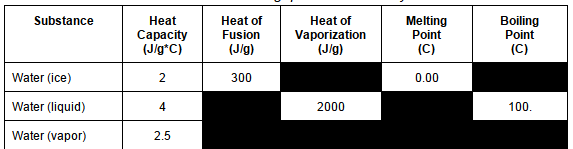
How many Joules of energy are required to change 10 gram of water from 20 C to 90 C?
a)
1400 J
b)
2800 J
c)
210,000 J
d)
1,400,000 J