
 Worksheets
Rocks and minerals
Total questions: 82
Worksheet time: 45mins

Granite's grains are all interlocked to one another, hence there are no gaps between its grains. It can be said that the granite is
Porous
Fragmental
Crystalline
Dismantled

Sandstone is formed from minerals which have different shapes to one another and have grain which are not interlock, known as...
Fragmental Rocks
Dismantled Rocks
Crystalline Rocks
Sulfuric Rocks

When Igneous type rock get heat and pressure, it will turn into ....
Sedimentary Rocks
Metamorphic Rocks
No changes at all, just still being an Igneous type rocks
Fragmental & Crystalline Rocks

When Metamorphic is subjected to extreme heat, it will turn into ....
Sedimentary Type Rock
Fragmental & Crystalline Rock
Igneous Rock
Magma

Metamorphic type rocks can turn into a sedimentary type rock when it gets.....
More Heat & Pressure
Erosion & Weathering
Heat & Weathering
Weathering & Magma

Rocks is gradually wear away due to extreme temperature, wind, water is known as.....
Physical weathering
Chemical weathering
Biological weathering
Sulfuric weathering

Earth consist of some layers, the thinnest layer in which all of human can live is called ....
The earth's core
The earth's mantle
The Crust
The lithosphere

Earth's tectonic plate has boundaries between its plate. When that boundaries is splitting/separated from one another, it is called as ...
Divergent boundaries
Convergent boundaries
Transform boundaries
Ejected boundaries

Its explosion is very explosive and the distance between the earth core and its crate is very distant, those are the characteristic of ........... volcanoes
Shield
Composite
Sulfuric
Crystalline
This type of soil consist of equal mixture of small and large grains rock. this type of soil also can retain water and contain more humus. Which type of soil is this?
silt
sandy
clay
loam
The area near the surface of earth are classified into 4 interconnected sphere. Which earth's sphere does include solid part of the earth such as rock, stone, soil
biosphere
atmosphere
hydrosphere
lithosphere
Which of the following is not the appropriate way to respond volcanic eruptions?
keep informed about volcanic progress
pay close to emergency plans, follow instruction for closure and evacuation
do your part to remain safe and help other in need
get close to the volcano erupted
What do the scientist use to identify the the history of earth?
identify living animal
identify soil and water
identify rock and fossil
identify fossil and plant
what did the scientist use to estimate the age of the earth?
Metamorphic rock
Sedimentary rock
Igneous rock
Fossil
What is the cause of earthquake?
The movement of earth's core give pressure to earth mantle
The movement of plate tectonic toward one another release pressure up to the boundaries
the movement of crust apart give pressure to the boundaries
the movement of wave on the ocean
What is tsunami?
series of huge waves created as a result of earthquake under the sea
series of huge waves created as s result of volcanic eruption
series of huge waves created as a result of landslide
series of huge waves created as a result of erotion
What is the example of metamorphic rock?
granite
sandstome
marble
basalt
What does it form when two tectonics plate move towards each other?
new landform
mountain ranges
transform fault
ocean
What is the Lithosphere?
The Crust and the bottom layer of the mantle
The Crust and the upper layer of the mantle
The Asthenosphere is the same as the lithosphere
The Core and the lower layer of the mantle
The Earths Crust is it's (a) layer
The Difference between the Oceanic Crust is that...........
There is no difference, it's the same
The Oceanic crust is thinner than the continental crust
The Continental Crust covers 70% of the surface of the crust
The Oceanic rocks are lighter than the Continental rocks
Tectonic plates are.......
Pieces of the Earths Crust and Uppermost mantel
Pieces of the Crust and core
Pieces of the Mantel and Core
I'm not sure
What was in the diagram shown on the first page?
Asthenosphere, Lithosphere, Volcanic arc, Trench, Oceanic Crust, Continental Crust.
Asthenosphere, Lithosphere, Volcanic arc
Trench, Oceanic Crust, Continental Crust.
Asthenosphere, Lithosphere, Volcanic arc, Trench, Oceanic Crust, Continental Crust and the core
The Earth's Crust is made up of
(a)
The Continental Crust is made up of constituents like silicon, aluminum, and oxygen
True
False
Tectonic Plates are about ________ km thick
100
50
500
2000
Why is the Lithosphere important
The lithosphere is the rocky outer part of the Earth.
the lithosphere is not important
there is no such thing as the lithosphere
Was our Presentation good ?
It was ok
It was Awesome
It was Rubbish
It was bad
What is the Earth crust made up of
magma,coal
water,salt
metamorphic rocks
all of the above
what is the earths crust
dominos margerita pizza outerlayer
the shell of the earth
the shell of a tortoise
the earth crust is broken into parts called plates
true
false
what is the matter of earths crust
semi-solid
liquid
gas
solid
the earths crust is the hottest part of earth
true
false
where is the crust deeper
mountains
beach
platues
ocean

The process by which rocks are broken down
Weathering
Deposition
Erosion
Sedimentation

The process in which wind, water, ice or gravity move rock fragments from one location to another
Weathering
Sedimentation
Erosion
Deposition

The process in which sediment settles out (drops to the bottom) of the water or wind that is carrying it
Weathering
Erosion
Sedimentation
Deposition

The physical breaking down of rocks into smaller pieces is...
Mechanical weathering
Chemical weathering
All weathering
Erosion weathering

The breakdown of rocks because of chemical reactions and processes
Physical weathering
Chemical weathering
All weathering
Erosion weathering

Water gradually wearing down and smoothing rocks over a long period of time is an example of...
physical weathering
chemical weathering
deposition
erosion

When iron in rocks reacts with oxygen, it forms iron oxide (rust), which weakens rocks and causes them to break apart. This is an example of...
physical weathering
chemical weathering
erosion
deposition

Rain washing away soil from a hillside is an example of...
physical weathering
erosion
deposition
chemical weathering

Waves dropping sand onto land until a beach is formed is an example of...
physical weathering
erosion
deposition
chemical weathering

Acid rain slowly wearing away rock over time is an example of...
chemical weathering
physical weathering
erosion
deposition

Water getting into cracks, freezing, and breaking rocks or pavement apart is an example of...
chemical weathering
physical weathering
deposition
erosion

What causes the greatest amount of erosion on beaches?
Waves
Glaciers
Rust
Gravity

Muddy water being carried away by a fast-moving river is an example of...
physical weathering
chemical weathering
erosion
deposition

Wind blowing sand from one location to another is called...
erosion
physical weathering
chemical weathering
deposition
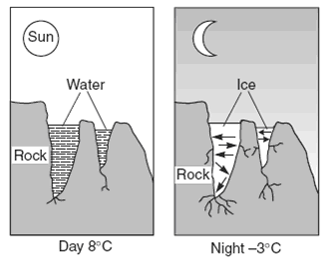
Which statement best explains why this process results in weathering?
What type of changes does erosion cause?
Physical changes
Chemical changes
Electrical changes
Magnetic changes
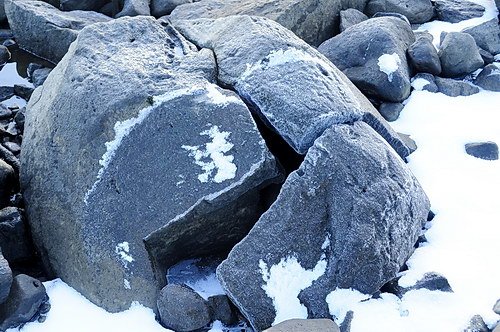

What Clastic Rock has a grain size of 0.004 cm?
Conglomerate
Breccia
Sandstone
Siltstone
Dolostone
What rock is monomineralic, composed on intergrown crystals, and resulted from the process of evaporation?
Dunite
Quartzite
Coal
Rock Gypsum
Which rock is composed out of visible angular sediments that are cemented and compacted together?
Breccia
Sandstone
Dolostone
Gneiss
It you were to find a rock with cemented shell fragments what would you classify it as?
Clastic Sedimentary
Nonfoliated Metamorphic
Bioclastic Sedimentary
Crystalline Sedimentary
According to the Earth Science Reference Tables (page 7) , which sedimentary rock would be formed by the compaction and cementation of particles 1.5 centimeters in diameter?
shale
conglomerate
siltstone
sandstone
According to the Earth Science Reference Tables (page 6), some sedimentary rocks form as the direct result of the
melting of minterals
solidification of molten magma
cementation of rock fragments
recrystalization of material
What is the approximate dewpoint temperature if the drybulb temperature is 10 degrees celsius and the difference between dry and wet-bulb temperature is 2 degress celsius? [Refer to the Earth Science Reference Tables.] (page 12)
1 degree C
-13 degrees C
6 degrees C
3 degrees C


1
2
3
4

1
2
3
4


In which horizon do most animals such as bugs live?
Humus
Topsoil
Subsoil
Parent Material
Bedrock

Which layer is the parent material?
Horizon O
Horizon A
Horizon B
Horizon C
Horizon R

Which layer is the subsoil?
Horizon O
Horizon A
Horizon B
Horizon C
Horizon R

