wayground logo

Free Printable Worksheets

Font size

S
M
L
XL
Worksheets

Waves (Test)

Total questions: 79

Worksheet time: 3595secs
Name
Class
Date
1.

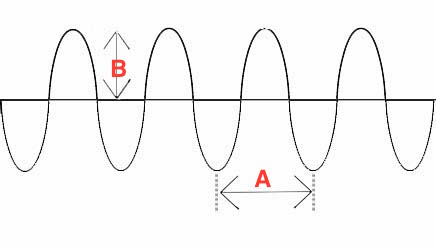
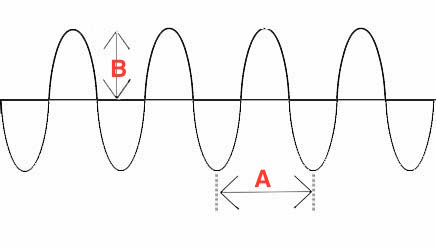
What property of this wave is represented by the letter "A"

a)

amplitude

b)

crest

c)

trough

d)

wavelength

2.
What property of the wave is represented by the letter "B"?
a)
amplitude
b)
crest
c)
trough
d)
wavelength
3.
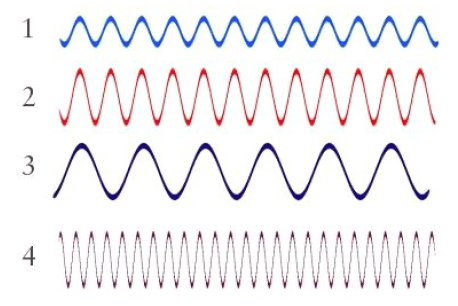
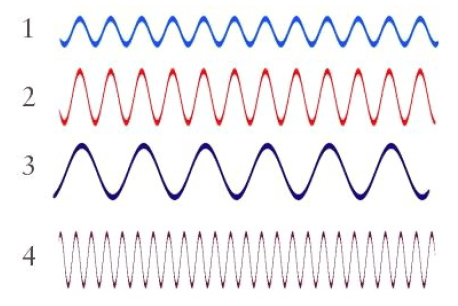
Which wave in the diagram has the greatest wavelength?
a)
1
b)
2
c)
3
d)
4
4.
Which wave in the diagram has the greatest frequency?
a)
1
b)
2
c)
3
d)
4
5.

True or false: as you move along the spectrum, left to right, the wavelengths decrease in size (get smaller)

a)

true

b)

false

6.

Select the correct order of waves on the EMS (low frequency to high)

a)

Radio, Micro, Infra, Visible, Ultra, X-ray, Gamma

b)

Gamma, X-ray, Ultra, Vis, Infra, Micro, Radio

c)

Vis, Micro, Infra, Ultra, X-ray, Gamma, Radio

d)

Micro, Radio, Vis, Infra, Ultra, X-ray, Gamma

7.

Which has the LONGEST wavelength and, therefore, the lowest frequency/energy

a)

Gamma Rays

b)

Radio Waves

c)

Visible Light

d)

Infrared rays

8.

Which has the SHORTEST wavelength and, therefore, the highest frequency/most energy

a)

Radio waves

b)

Ultraviolet Rays

c)

Gamma Rays

d)

X-rays

9.

Which section of the spectrum is the ONLY one we can see?

a)

X-rays

b)

Visible Light

c)

Gamma Rays

d)

Ultraviolet Rays

10.

Put the visible light colors in order from longest wavelength to shortest wavelength

a)

Violet, Indigo, Blue, Green, Orange, Yellow, Red

b)

Red, Yellow, Green, Orange, Violet, Blue, Indigo

c)

Red, Orange, Yellow, Green, Blue, Indigo, Violet

d)

Roy Gee Biv Purple Colors Light

11.

How are electromagnetic waves different from other waves?

a)

They have very short wavelengths

b)

They transmit energy instead of matter

c)

They can travel through a vacuum (Ex. space)

d)

They can change direction by reflection

12.
Which letter is marked at the troughs of the wave?
a)
C
b)
A
c)
B
d)
D
13.
Which letter is marked at the crests of the wave?
a)
C
b)
A
c)
B
d)
D
14.
The distance between which two letters is a wavelength?
a)
C-A
b)
A-D
c)
A-A
d)
A-B
15.

The distance a wave is from it's resting position (aka height)

a)

Frequency

b)

Wavelength

c)

Amplitude

d)

Mechanical Wave

16.
What types of mechanical wave is this?
a)
Longitudinal
b)
Transverse
17.

What is a wave?

a)

a hand motion

b)

a body of water

c)

Regular pattern of motion

d)

a wave is energy that travels through a medium

18.
What kind of wave is this?
a)
Transverse Wave
b)
Longitudinal Wave
19.
What kind of wave is this?
a)
Transverse
b)
Longitudinal
20.
What is frequency?
a)
waves
b)
distance between equilibrium to crest
c)
hand motion
d)
The number of wave cycles completed in one second
21.

Mechanical waves need a _______ to travel through.

a)

Medium

b)

Car

c)

Plane

d)

Force

22.

Do Electromagnetic waves need a medium to travel through?

a)

Yes

b)

No

c)

Sometimes

d)

Medium?? (I need to study my vocab more)

23.

Can sound waves travel through a vacuum?

a)

Yes

b)

No

c)

Yes, vacuum cleaners are loud.

24.

Which is an example of a medium that waves can travel though?

a)

Water

b)

Energy

c)

Heat

d)

Psychic

25.
What is transferred through a wave?
a)
Light
b)
Energy
c)
Water
d)
Air
26.

Compression means.....

a)

Far apart

b)

Close together

c)

Complicated

d)

Stretch

27.
Rarefaction means.....
a)
Far apart
b)
Close together
c)
Squeeze
d)
Reflect
28.
What type of medium do earthquakes travel through?
a)
water
b)
air
c)
bubbles
d)
the ground
29.

Waves that have compression and rarefaction are called...

a)

Transverse

b)

Electromagnetic

c)

Longitudinal (aka compression waves)

d)

Slinky

30.
What kind of wave is this?
a)
Transverse
b)
Longitudinal
c)
Compression
d)
Rarefraction
31.
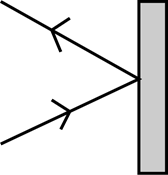
The illustration shows a light ray striking an object.
In the illustration, the light ray striking the object is-
a)
absorbed
b)
stopped
c)
reflected
d)
refracted
32.
A student placed a pencil in a cup of water.  The pencil appears broken because light-
a)
always travels in a straight line
b)
bends when it passes through water
c)
makes the water in the glass evaporate
d)
reflects the pencil on the water's surface
33.
The bouncing off of light rays from the surface of an object such as a mirror or other shiny surface is called:
a)
mirror
b)
laser
c)
reflection
d)
refraction
34.
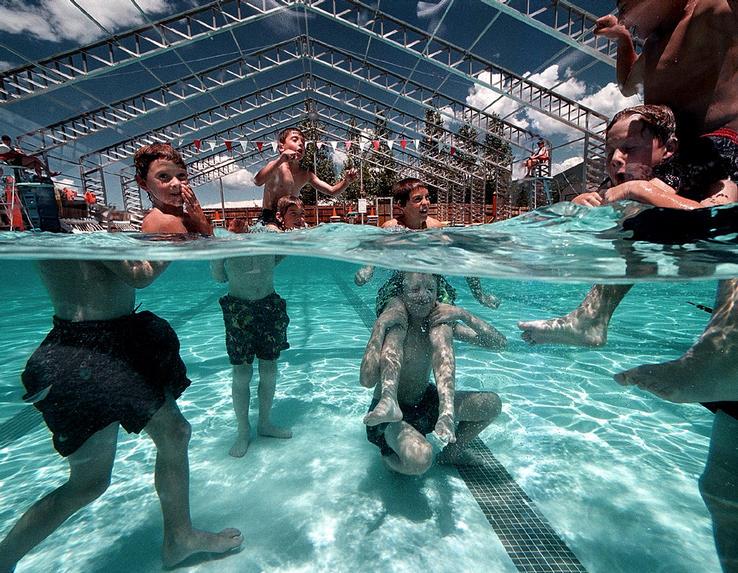
Why does the lower part of the child appear so much different in size from the upper part?
a)
The light rays that travel through water and then into air are refracted.
b)
The light rays that travel through water and then into air are enlarged.
c)
The light rays that travel through air and then into water are reflected.
d)
The light rays that travel through air and then into water are reduced.
35.
Light bending as it passes through a rain drop is an example of...
a)
Refraction
b)
Reflection
36.
Forces that are not equal
a)
Gravitation
b)
Unbalanced Forces
c)
Acceleration
d)
Forces
37.
The force that pulls you to the ground
a)
Magnetism
b)
Acceleration
c)
Friction
d)
Gravitation
38.

witch picture is diffraction

a)
b)
c)
d)
39.
What does it mean to refract?
a)
bounce off
b)
to bend
c)
curve outward
d)
reflect
40.
What happens when light hits a mirror?
a)
it makes a color
b)
it reflects
c)
it makes a rainbow
d)
it passes through
41.
a)
Reflection
b)
Refraction
42.
a)
Constructive Interference
b)
Destructive Interference
43.
A wave that does not require a medium
a)
A. electromagnetic  wave
b)
B. surface wave
c)
C. medium
d)
D. transverse wave
44.
A wave that requires a medium through wave which to travel
a)
A. electromagnetic  wave
b)
B. longitudinal wave
c)
C. mechanical wave
d)
D. transverse wave
45.
The combination of two or more waves that result in a single wave
a)
A. diffraction
b)
B. resonance
c)
C. reflection
d)
D. interference
46.
When the crests of one wave overlap the crests of another wave or waves, this occurs.
a)
A. diffraction
b)
B. destructive interference
c)
C. constructive interference
d)
D. resonant frequencies
47.
As wavelength decreases in the electromagnetic spectrum the frequency _____. 
a)
decreases
b)
stays the same
c)
increases
d)
doubles
48.
Wavelengths on the right side of the Electromagnetic spectrum are ______________.
a)
short
b)
long
c)
average
49.
This wave has the second highest frequency on the spectrum. 
a)
microwaves
b)
visible light
c)
x-rays
d)
gamma ray
50.
The higher the frequency the ______ the energy. 
a)
higher
b)
lower
c)
neither, stays the same
51.
This image is representing what wave interaction?
a)
Refraction
b)
Diffraction
c)
Reflection
d)
Interference
52.
When 2 waves meet and there amplitude increases it is known as what?
a)
Constructive Interference
b)
Amplitude Addition
c)
Positive Interference
d)
Destructive Interference
53.

What does this image describe ?

a)

Reflection

b)

Diffraction

c)

Interference

d)

Refraction

54.
a)

absorption

b)

diffraction

c)

reflection

d)

refraction

e)

transmission

55.
What color has the shortest wavelength, or the highest frequency?
a)
yellow
b)
blue
c)
red
d)
violet
56.
The full spectrum of light energy is called the__________
a)
broad spectrum
b)
electromagnetic spectrum
c)
helium spectrum 
d)
natural light spectrum
57.

The height of the sound waves

a)

Frequency

b)

Amplitude

c)

Wavelength

58.
Which of the following types of radiation has the shortest wavelength and the highest frequency?
a)
Radio Waves
b)
Infrared
c)
Visible
d)
X-Rays
59.

electromagnetic waves with the longest wavelengths and lowest frequencies

a)

radio waves

b)

gamma rays

c)

microwaves

d)

infrared waves

60.

a wave that can transfer electric and magnetic energy through the vacuum of space

a)

EM Spectrum

b)

EM wave

c)

longitudinal wave

d)

radiation

61.

electromagnetic waves that have shorter wavelengths than radio waves but longer than infrared

a)

gamma ray

b)

radio wave

c)

microwave

d)

visible light waves

62.

electromagnetic waves with wavelengths shorter than visible light but longer than x-rays

a)

UV Wave

b)

Gamma rays

c)

microwaves

d)

radio waves

63.

a wave that moves the medium in a direction parallel to the wave

a)

radio wave

b)

longitudinal wave

c)

transverse wave

d)

compression wave

64.

Which of the following are electromagnetic waves?

a)

Radio Waves

b)

Light waves (visible light)

c)

Sound waves

d)

Ocean Wave

65.

a wave that appears to stand in one place, even though it is really two waves interfering as they pass through each other

a)

longitudinal wave

b)

standing wave

c)

transverse wave

d)

mechanical wave

66.

the complete range of electromagnetic waves placed in order of increasing frequency

a)

Electromagnetic waves

b)

Electromagnetic spectrum

c)

radiation

d)

Visible light

67.

Which of the following vocabulary terms can you observe in the wave shown?

a)

crests

b)

troughs

c)

wavelength

d)

amplitude

68.

As a wave travels into a medium in which its speed increases, its wavelength would....

a)

decrease

b)

increase

c)

remain the same

d)

none of the above

69.

Select the correct order of the waves on the EMS (low frequency to high)

a)

radio microwave infrared visible ultraviolet xray gamma

b)

gamma xray ultraviolet visible infrared microwave radio

c)

radio visible infrared microwave xray ultraviolet gamma

d)

gamma visible infrared microwave xray ultraviolet radio

70.

Select the correct order of the waves on the EMS (shortest wavelength to longest)

a)

radio microwave infrared visible ultraviolet xray gamma

b)

gamma xray ultraviolet visible infrared microwave radio

c)

radio visible infrared microwave xray ultraviolet gamma

d)

gamma visible infrared microwave xray ultraviolet radio

71.

Which type of EM waves are used to transmit signals for WIFI and cell phones?

a)

radio

b)

gamma

c)

visible light

d)

X-rays

72.

Which color on the visible light spectrum has the most frequency and highest energy?

a)

red

b)

yellow

c)

blue

d)

violet

73.

electromagnetic waves that have shorter wavelengths and higher frequencies than radio waves

a)

microwaves

b)

visible light and UV light

c)

infrared wave

d)

x-rays

e)

gamma rays

74.
a)
Constructive Interference
b)
Destructive Interference
c)
Refraction
d)
Diffraction
75.
Sound waves are _______________
a)
Transverse waves
b)
Longitudinal waves
c)
Circular waves
d)
Seismic waves
76.

Instead of crest/trough, longitudinal waves have

a)

Node/anti-nodes

b)

Compression/rarefaction

c)

Convergence/dispersion

d)

Clump/spread

77.
When 2 waves meet and there amplitude increases it is known as what?
a)
Constructive Interference
b)
Amplitude Addition
c)
Positive Interference
d)
Destructive Interference
78.
What is "?" ?
a)
rarefaction
b)
compression
c)
expansion
d)
reflection
79.
If two overlapping waves are in-phase, the resultant wave will have ______ compared to the two waves.
a)
Greater amplitude
b)
Greater frequency
c)
Greater wavelength
d)
Greater wave speed