
 Worksheets
Mechanical Systems Review #2
Total questions: 74
Worksheet time: 1hrs 14mins
The amount by which a machine multiplies effort force is known as the
Mechanical advantage is a measure of how much a machine multiplies the effort
What is mechanical advantage?
The advantage a machine has over a bicycle
A measure of how much a simple machine reduces work
A measure of when is the best time to use a simple machine
the number of times a machine increases input force
A machine with a mechanical advantage greater than 1:
multiplies the effort force so the machine would be good to help move heavy objects.
does not multiply the force, but increases distance and speed.
has no effect on speed or effort force
A machine with a mechanical advantage of less than 1:
multiplies the effort force so the machine would be good to help move heavy objects.
does not multiply the force, but increases distance and speed.
does not affect distance or speed
A machine with a mechanical advantage equal to 1:
multiplies the effort force so the machine would be good to help move heavy objects.
does not multiply the force, but increases distance and speed.
does not affect distance or speed

To increase the mechanical advantage of a lever
make sure the fulcrum is in the middle of the lever
move the fulcrum closer to the load
move the fulcrum closer to the person
use a bigger fulcrum
The mechanical advantage of a lever is greater when the effort arm is...
smaller
longer
just right

Which lever would be the easiest to lift the load?
C
A
B
If a pulley system has a mechanical advantage of 4, what does that mean?
This means that it is 4 times easier to lift this load.
This means you only need a quarter of the effort to lift the load.
For example, if you lifted 100 kg, it would only take 25 kg of effort.
All of the above
What are the units for mechanical advantage?
no units
J
N
%
if a load of a lever is 100 newtons and the force you apply is 20 newtons, what is your mechanical advantage?
2000 N
5
2000
5 N


What is the mechanical advantage of the lever shown?
10
0.1
50
250

What is the mechanical advantage for this lever?
1
2
1/2
8
A lever used to lift a heavy box has an input arm of 4 meters and an output arm of 0.8 meters. What is the mechanical advantage of the lever?
1
2.5
5
10

What is the theoretical mechanical advantage of the following lever?
4
0.25
10
40

What is the theoretical mechanical advantage of the following lever?
3
1200
40
100

What is the theoretical mechanical advantage of the following lever?
4800
80
4
0.33
A fixed pulley has a mechanical advantage equal to 1 because.....
The output force is larger than the input force.
The output force is smaller than the input force.
The output and input force are equal, but the direction of the force changes.
None of the above.
What is energy?
moving energy
stored energy
renewable energy
The ability to do work.
What is the unit for Energy?
no units
Joules
%
N
What is potential energy?
moving energy
stored energy
renewable energy
non renewable energy
What is kinetic energy?
moving energy
potential energy
stored energy
renewable energy


Which of the following is an example of elastic potential energy?
A ball rolling across the floor
A rubber band that has been stretched
Heat from an oven
Playing the guitar

Which Apple has the greatest Gravitational Potential Energy?
Apple A
Apple B
Apple C
Apple D

At what point does the biker have the greatest Potential Energy?
Point A
Point B
Point C
Point D
At what point does the biker have the greatest Kinetic Energy?
Point A
Point B
Point C
Point D
At what point does Potential Energy transform into Kinetic Energy?
Point A
Point B
Point C
Point D
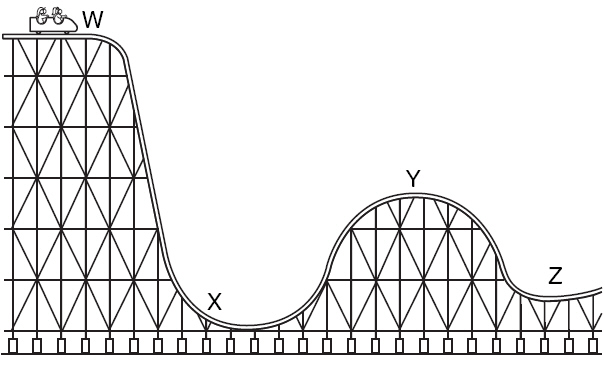

Select the graph that best represents the energy of the skiers in the TOP of the slope.


The picture shows what type of transformation
Electrical to mechanical
light to electric
electrical to light
light to light
what is the two things that need to occur for work to have been done?
force and movement
movement and direction
constant force and power
power and work
what is the unit of work?
Newton
Joule
Watt
meter
In which scenario is work = 0 J ?
Pushing a stationary wall
Pulling a trolley car
Pushing a book across the table
Dropping a set of keys from a height, h.
Two people shove on a wall with 100 N. The wall doesn’t move. How much work is done?
100J
100N
0J
0N
if you push a cart with a force of 60 N for 2 m... how much work have you done
120 J
30 J
120 N
30 N
If 40N of force is applied to Rollo Koster's 10 kg cart over a distance of 50 meters, how much work is done?
8000J
8000N
4000J
2000J


What is the work input of the following simple machine?
50 N
450 J
450 N
50 J
In using scissors to cut paper, the work input is:
the person moving the scissors to cut paper
the paper being cut
located at the fulcrum
located at the load

What is the work out....
10m x 50N = 500J
1m x 500N = 500J
500N x 10m = 5000J
1m x 50N = 50J

What is the work input of the following simple machine?
7680 J
3000 J
9000 J
2560 J
What is the work output of the following simple machine?
7680 J
3000 J
9000 J
2560 J
A simple machine reduces the amount of work needed to accomplish a task.
true
false
The energy output will always be ______________
less than the energy input
more than the energy input
Why can mechanical efficiency never be 100%?
No machine is strong enough.
Machines are too big to allow for 100% efficiency.
It can be 100%.
Some energy is lost in the form of heat/sound due to friction.
What does friction produce that reduces efficiency?
heat
water
energy
work
How much energy is wasted by a machine if the energy consumed (input) is 263 J and the useful energy (output) is 142 J?
405 J
395 J
121 J
1.85 J
_____________ is a measure of how much of the work is changed into useful work
Efficiency
Energy
Joule
Newton

Which bulb is the most efficient?
Filament bulb
LED light
CFL lamp
You solve a problem and find that you have machine with 150% efficiency. Can your answer be correct?
No, efficiency can never be more than 100%
Yes, the answer can be right.
Not enough information to tell.

What type of energy is useful?
Thermal
Electrical
What is wasted energy?
The energy that is lost to heat or other energy types that aren’t useful.
A comparison of how much energy is used to do work versus how much is lost or wasted to the environment.
The energy that you throw away.
The total amount of energy put into a system.

Total energy = 34000J
Useful energy = 340J
Workout the efficiency of this vintage VW Beetle.
efficiency = total energy inuseful energy ×100%
100%
10%
40%
20%
An assembly line machine needs 150 J of input work to do 90 J of output work. What is the efficiency of the machine?
167%
.6%
60%
1.67%

The efficiency of this light bulb is
40 %
60 %
100 %
1.67 %
0.0167 %
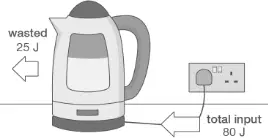
When a kettle is used to boil some water, the total input energy is 80 J. 25 J of the total input energy is wasted by the kettle. The efficiency of the kettle is ____%
69%
50%
75%
80%
A TV uses 200 J of electricity and transforms it into 125 J of sound and light and 75 J of heat. How efficient is it?
62.5%
.625%
37.5%
.375%

What is the efficiency of the ramp?
500J/500J x 100% = 100% J
500J/500J x100% = 100%
50J/5000J x100% = 1%
5000J/50J x100% = 10,000%
What is the efficiency of the following simple machine?
85%
3%
33%
39%
What happens to the overall efficiency of a machine as I add more machines?
For each simple machine you add, the overall efficiency increases because it gets faster.
For each simple machine you add, the overall efficiency decreases.
The overall efficiency is divided in half for every simple machine you add.
There is no connection.

