Wayground logo

Free Printable Worksheets

Font size

S
M
L
XL
Worksheets

Electrical Circuits

Total questions: 41

Worksheet time: 31mins

Name
Class
Date
1.

What is Ohm's Law?

a)

Ohm's Law is F = m * a, where F is force, m is mass, and a is acceleration.

b)

Ohm's Law is P = V * I, where P is power, V is voltage, and I is current.

c)

Ohm's Law is Q = C * V, where Q is charge, C is capacitance, and V is voltage.

d)

Ohm's Law is V = I * R, where V is voltage, I is current, and R is resistance.

2.

What is the symbol for a resistor in a circuit diagram?

a)

zigzag line

b)

straight line

c)

circle

d)

triangle

3.

What is the symbol for a battery in a circuit diagram?

a)

A series of long and short parallel lines

b)

A square with a lightning bolt

c)

A circle with a plus sign inside

d)

A zigzag line

4.

In a series circuit, how does the current flow through the components?

a)

The current flows randomly through each component.

b)

The current flows sequentially through each component.

c)

The current flows in reverse order through each component.

d)

The current flows simultaneously through each component.

5.

What is the symbol for a light bulb in a circuit diagram?

a)

Hexagon with a zigzag line inside

b)

Circle with a cross inside

c)

Square with a line inside

d)

Triangle with a dot inside

6.

What is electric current

a)

flow of protons

b)

flow of neutrons

c)

flow of electrons

d)

flow of atom

7.
What is Resistance?
a)
The flow of electrons
b)
Electric potential difference
c)
A battery
d)
The ability to reduce the flow of electrons
8.
Electricity that flows in a closed path is called a
a)
path
b)
current
c)
circuit
d)
light
9.
If the Voltage is increased and the resistance stays the same, Current will
a)
Increase
b)
Decrease
c)
Stay the same
d)
X
10.
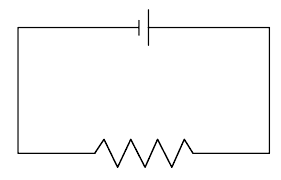
This circuit has a 24 volt battery and the resistor is 8 ohms. How many amps are running through the circuit?
a)
3 Amps
b)
192 Amps
c)
2 Amps
d)
4 Amps
11.
If you decreases the resistance of a circuit, what happens?
a)
Current decreases
b)
Current increases
c)
Electrons disappear
d)
Bulbs get brighter
12.
If you increase the voltage of a circuit, what happens?
a)
Current decreases
b)
Current increases
c)
Electrons disappear
d)
Bulbs get dimmer
13.
What kind of circuit is this?
a)
Series
b)
Consecutive
c)
Parallel
d)
Training
14.
In a parallel circuit if one of the light bulbs burns out the rest _________.
a)
stop the flow of electricity
b)
 can still light up
c)
 will go out
d)
of the light bulbs burn out also
15.
In which of these two circuits is the current the same at all points? 
a)
A
b)
B
16.
What would the voltmeter read
a)
1V
b)
2V
c)
3V
d)
6V
17.
Which Voltmeter will give the lowest reading?
a)
V1
b)
V2
c)
V3
18.

If the current across each light bulb was was 10 amps in this diagram, what would be the total current at the battery?

a)

20 amps

b)

5 amps

c)

10 amps

d)

0 amps

19.
What is a Parallel circuit? 
a)
Has only one path 
b)
Has more than one path 
c)
Allows energy to travel through easily 
d)
Has only one light bulb
20.
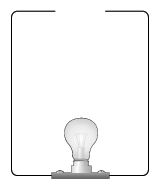
This circuit won't work. What essential part is missing from this circuit?
a)
resistance
b)
source of electric current
c)
conductor
d)
ammeter
21.
What slows down the flow of electricity in a circuit?
a)
resistance
b)
voltage
c)
current
d)
source of electric current
22.
If I add more light bulbs to a series circuit what happens?
a)
The current speeds up and the lights get brighter
b)
The current slows down and the lights dim lower
c)
The current speeds up and the lights dim lower
d)
The current slows down and the lights get brighter
23.

The circuit does not work, what could you do to allow the circuit to work?

a)

Add another light

b)

Add another battery

c)

Open the switch

d)

Remove the wood block and connect the wires

24.

A material that does NOT let electricity pass through it is called ...

a)

electrical conductor

b)

Battery

c)

electrical insulator

d)

light bulb

25.
If you replace the paper clip with a plastic spoon, what happens?
a)
The bulb doesn't light
b)
The bulb is dimmer
c)
The wires get hot
d)
There is no change
26.

What is the unit of measurement for resistance?

a)

Voltage

b)

Ampere

c)

Watts

d)

Ohms

27.

If too much electric current passes through a circuit, the wires can

a)

make batteries

b)

cool down

c)

conductor

d)

overheat

28.
Levi is wanting to light a bulb.  What does he need to get the bulb to light?
a)
A battery and a paper clip
b)
A battery and a wire
c)
A paper clip and a wire
d)
A switch and a wire
29.
Which best describes a simple series circuit?
a)
Electricity flows along one pathway.
b)
The flow of electricity comes from the switch.
c)
Electricity flows along many pathways.
d)
The flow of electricity comes from the light bulb.
30.
In a parallel circuit which of the following is the same value throughout the circuit?
a)
Voltage
b)
Current
c)
Resistance
d)
Charge
31.
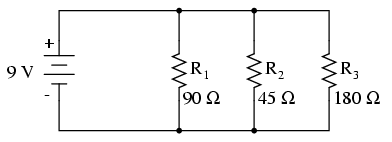
The total current going through the battery of this circuit is
a)
0.35 amps
b)
0.0286 amps
c)
0 amps
d)
9 amps
32.
The picture shows an electrical circuit. This circuit is a series circuit because: 
a)
It has 3 light bulbs.
b)
The same current flows through all three light bulbs.
c)
It uses a single battery.
d)
The electrical current is divided between the three light bulbs.
33.
This is an example of a ______ circuit
a)
Series
b)
Parallel
c)
Open
d)
Dihexihedral
34.
a)
all bulbs are lit equally
b)
the two top bulbs are brighter
c)
the single lower bulb is brighter
d)
the single bulb does not light and the other two are dim
35.

Which of the following correctly states relationship between voltage, resistance, and current in a circuit?

a)

Current is directly related to voltage but inversely related to resistance.

b)

Current is directly related to both voltage and resistance.

c)

Current is inversely related to both voltage and resistance.

d)

Current is directly related to voltage but is not affected by resistance.

36.

An electrical circuit is powered by a 12-volt battery and contains a light bulb. The current flowing in the circuit is 20 amps. What is the resistance of the light bulb? HINT: V = IR

a)

0.6 Ohms

b)

240 Ohms

c)

1.67 Ohms

d)

12 Ohms

37.

If an electrical circuit were analogous to a water circuit at a water park, then the battery voltage would be comparable to ___________________.

a)

the rate at which water flows through the circuit

b)

the speed at which water flows through the circuit

c)

the distance that water flows through the circuit

d)

the water pressure between the top and bottom of the circuit

e)

the hindrance caused by obstacles in the path of the moving water

38.

What will happen if one light bulb is removed from this circuit?

a)

The other bulbs will go out.

b)

The other bulbs will stay on

c)

The other bulbs will get dimmer.

d)

The battery will become stronger.

39.
How should you put in an Ammeter?
a)
In Parallel
b)
In Series
40.

Name the component

a)

battery

b)

switch

c)

wire

d)

variable resistor

41.

Name the component

a)

voltmeter

b)

ammeter

c)

diode

d)

themistor