
 Worksheets
Mock Exam Physics paper 2 practice
Total questions: 123
Worksheet time: 2hrs 9mins
What is the equation that links gravitational field strength, mass and weight?
weight = mass x gravitational field strength
weight = mass ÷ gravitational field strength
weight = gravitational field strength ÷ mass
What is the equation that links distance, force and work done?
work done = force x distance
work done = force ÷ distance
work done = distance ÷ force
What is the equation that links extension, force applied to a spring and spring constant?
force applied to a spring = spring constant x extension
force applied to a spring = spring constant ÷ extension
force applied to a spring = extension ÷ spring constant
What is the equation that links distance, time and velocity?
velocity = time x distance
velocity = distance ÷ time
velocity = time ÷ distance
What is the equation that links acceleration, change in velocity and time?
acceleration = change in velocity x time
acceleration = change in velocity ÷ time
acceleration = time ÷ change in velocity
What is the equation that links acceleration, mass, and resultant force?
resultant force = mass x acceleration
resultant force = mass ÷ acceleration
resultant force = acceleration ÷ mass
What is the equation that links mass, momentum, and velocity?
momentum = mass x velocity
momentum = mass ÷ velocity
momentum = velocity ÷ mass
What is the momentum of a toy car of mass 500 g, travelling at a velocity of 30 m/s?
0.15 kgm/s
15 kgm/s
15 000 kgm/s
15 000 000 kgm/s
What is the unit of work?
Newton
Joule
Watt
meter
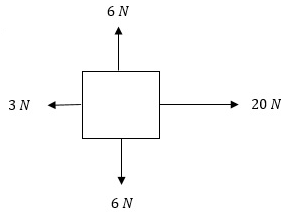
What is the resultant force in this diagram?
17 N, right
17 N, left
23 N, right
12 N, up
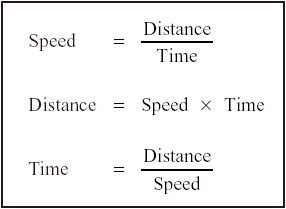
What equation links distance, speed and time?
speed = time ÷ distance
speed = distance ÷ time
speed = distance x time
speed = time x distance
Which of these can be measured in meters per second (m/s)
Distance
Time
Speed
Acceleration
Calculate the average speed (in m/s) if a cheetah runs 180 metres in 10 seconds.
198 m/s
170 m/s
12 m/s
18 m/s
Acceleration is defined as the "change in..."
the time it takes to move from one place to another.
velocity of an object.
distance, divided by the time taken.
velocity, divided by the time taken.


A dog runs with an initial speed of 7.5 m/s on a waxed floor. It slides to a stop in 15 seconds. What is the acceleration?
-7.5 m/s
-7.5 m/s2
-0.5 m/s2
0.5 m/s
A spring has a spring constant of 5 N/cm. What is its extension when loaded with 15 N?
3 cm
5 cm
3 m
5 m
What is the definition of force?
Push
Pull
Push and pull
What is a contact force?
A force that involves objects physically touching
A force that involves objects being very close
A force that involves objects that are not physically touching
What is a non-contact force?
A force that involves objects physically touching
A force that involves objects being very close
A force that involves objects that are not physically touching
Which of the following is not a contact force
Magnetism
Friction
Air resistance
Tension
Which of the following is not non-contact force
Normal
Gravity
Magnetism
Electrostatic
What is a resultant force?
The sum of all forces acting on an object, taking direction into account.
The forward force added to the backwards force.
The backwards force subtracted from the forward force.
What is mass?
The amount of matter an object is made from.
The force of gravity acting on an object.
The strength of the force around an object with mass.
What is weight?
The amount of matter an object is made from.
The force of gravity acting on an object.
The strength of the force around an object with mass.
What is a gravitational field?
The amount of matter an object is made from.
The force of gravity acting on an object.
The area around an object where the force of gravity is experienced.
Which device is used to measure weight?
Scales
Balance
Newton meter
All of the answers are correct
What is the centre of mass?
The point where an object's mass acts.
The middle of an object.
What is work done?
When energy is transferred to move an object.
When a force is applied.
When there is a large momentum.
What is the unit of mass?
g
kg
N/kg
kg m/s
What is the unit for gravitational field strength?
N/kg
N
kN
N/kg/⁰C
What is the unit for work done?
J
N
N/kg
kg m/s
When tension acts on an object, what is elastic deformation?
The object will return to its original size and shape once the force is removed.
The object will not return to its original size and shape once the force is removed.
When tension acts on an object, what is inelastic deformation?
The object will return to its original size and shape once the force is removed.
The object will not return to its original size and shape once the force is removed.
How could we describe the relationship between force and extension for an object that shows elastic deformation?
Directly proportional
Inversely proportional
Positive correlation
No relationship
How could we describe the relationship between force and extension for an object that shows inelastic deformation?
Directly proportional
Inversely proportional
Positive correlation
No relationship
What is the limit of proportionality?
The length a spring can be stretched to before it becomes inelastically deformed.
The length a spring has been stretched to once it becomes inelastically deformed.
The most force a spring can hold.
What is the unit for spring constant?
N/m
Nm
N
m
What is the unit for extension?
m
cm
N
N/m
What is a normal contact force? Choose all correct answers
A force that acts at 90⁰
A force between an object and the surface it rests on
A force caused by objects falling due to gravity
A force caused by the movement of particles
State the equation which links gravitational field strength, mass and weight.
weight = mass x gravitational field strength
gravitational field strength = mass x weight
mass = gravitational field strength x weight
mass = gravitational field strength ÷ weight
Which equation links distance, force and work done?
work done = force x distance
work done = force ÷ distance
force = work done x distance
distance = force ÷ work done
Which equation links extension, force and spring constant?
force = spring constant x extension
force = spring constant ÷ extension
spring constant = force x extension
force = spring constant x extension2
What term describes the distance between two identical points on subsequent waves?
amplitude
frequency
wavelength
velocity
What term is used for the maximum displacement of a wave from its resting position?
wavelength
amplitude
velocity
frequency
Longitudinal waves have:
crests and troughs
crests and compressions
compressions and rarefactions
troughs and rarefactions
Transverse waves have:
crests and troughs
troughs and rarefactions
compressions and contractions
rarefactions and crests
What is described as the number of complete oscillations of a wave in one second?
frequency
amplitude
wavelength
velocity

What is the amplitude of this wave?
3cm
-3cm
6cm
4cm

What is the wavelength of this wave?
3cm
10cm
4cm
8cm
Complete the sentence:
A ray of light passes from one medium to another. In the new medium the light travels slower, at the boundary between the two media light ...
will be bent toward the normal.
will always lies along the normal.
will continue unaffected.
will have been bent away from the normal.

Based on the image, which medium has a greater refractive index?
Medium 1
Medium 2
Both mediums have the same refractive index
Cannot be determined from this image alone
The right hand grip rule will tell us what?
(a)
Solenoids usually have what added through the middle to make them stronger?
(a)

A coil of wire with electricity travelling through it is called a what?
(a)
If a compass points to Earth's magnetic south, what does this tell us about the compass needle tip?
The needle North seeking
The needle is South seeking
The needle is indifferent
Earth's geographical north is magnetic south - True or False?
True
False

Magnetic fields go in the direction?
South to North
North to South
They don't have fields

An induced magnet has what properties?
Can only attract magnet
Can attract and repel magnets
Lose their magnetism when removed from a magnetic field
Are only magnetic when in a magnetic fields
Are made of all metals

Opposite poles on a magnet will
Attract
Repel
A permanent magnet has what properties
Produce their own magnetic fields
Change magnetic field strengths
Can attract and repel other magnets
Can be switched off an d on
Which type of wave as oscillations that are parallel to the direction of energy transfer?
Transverse
Light
Longitudinal
S-Wave
A material has a high optical density. What will this do to the speed of light when it enters?
Speed it up
Slow it down
Stays the same
Which type of radio waves is reflected off the ionosphere?
Long-wave
Short-wave

Which is true about the speed of radio waves compared to light waves? They are...
less energy & frequency, but still the SAME speed as the speed of light (300,000,000 m/s)
less energy & frequency, so LESS than the speed of light (300,000,000 m/s)
smaller wavelength, so LESS than the speed of light (300,000,000 m/s)
more energy & frequency, so MORE than the speed of light (300,000,000 m/s)
To calculate the frequency of an electromagnetic wave, you need to know the speed of the wave and its
wavelength.
intensity.
refraction.
amplitude.
A radio wave has a frequency of 12.0 x 10⁶ Hz. Find its wavelength. (the speed of radtio waves in air is 3.0 x 10⁸ m/s).
(a)
When drawing magnetic field lines, they should have…
arrows pointing south to north
arrows pointing in both directions
no arrows
arrows pointing north to south
An unmagnetised iron nail is passed through a coil of wire attached to a sensitive ammeter.
What happens?
The nail is attracted
The nail is repelled
A current is induced
No current is induced
The region around a magnet where the effect of the magnet can be felt is called the…
magnetic pole
magnetic field
magnetic force
magnetic line
An iron nail that isn't initially magnetic is brought close to a magnet and becomes magnetised.
What is the nail now called?
A constant magnet
A permanent magnet
A temporary magnet
An induced magnet
A magnet is moved past a straight wire and a current is induced.
Which of the following would increase the induced current?
Turning the magnet round
Moving the magnet past in the opposite direction
Making the wire into a coil
Moving the magnet more slowly
The magnetic field around a solenoid is the same shape as the magnetic field…
between two north poles
between two south poles
between two opposite poles
surrounding a bar magnet
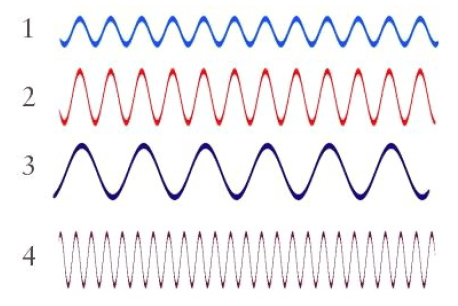
Which wave in the diagram has the highest frequency?
1
2
3
4

Mobile phones use _____________ waves for the signal to link to the mobile network.
Microwaves
Gamma
XRays
Radio

What Unit do we Measure Force in?
Newtons
Joules
Force
Kilograms

These two force arrows are acting on an object. The net force (in N) acting on this object is:
16
12
28
4.0

How Long Does It take For This Object To Travel 10M?
0 S
10 S
15 S
20 S
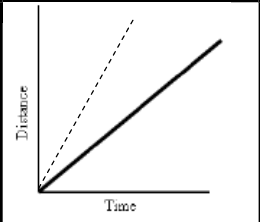
What Does This Graph Represent?
Constant Speed
Acceleration
Not Moving
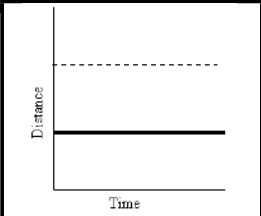
What Does The Graph Represent?
Constant Speed
Acceleration
Not Moving

How Many Time Does This Object STOP Moving
None
Once
Twice
Three Times

Segment C-D The Bus Is _________________.
At Rest
Returning To Original Position
Moving Forward
Segment D-E The Bus Is _________________.
At Rest
Returning To Original Position
Moving Forward
Segment E-F The Bus Is _________________.
At Rest
Returning To Original Position
Moving Forward
In an emergency, the distance travelled by the vehicle after applying brakes is called (a)
If an automobile can be decelerated at 5m/s2 ,Calculate the braking distance travelled in coming to stop from an initial velocity of 36km/h, after a signal is observed.
(a)
Braking distances can also be calculated by plotting the velocity - time graph. In that case the (a) gives the braking distance.
___________ is time it takes a person to process that they need to stop their vehicle.
thinking distance
stopping distance
breaking distance
What is STOPPING distance
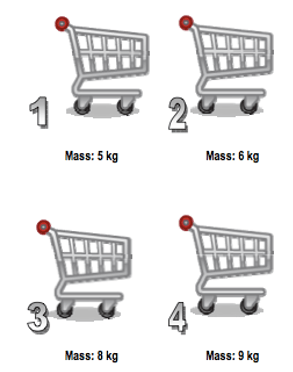
A 25,000 N Car is supported by 4 springs. If each spring is deflected by 0.040 m what is the spring constant? (Think about how much weight each spring holds up!)
160,000 N /m
620,000 N/m
630,000 N/m
120,000 N/m
Mass and weight are different. Mass depends on _____. Weight depends on _____.
gravitational force, the amount of matter
placement, force
force, placement
the amount of matter, gravitational force
What is the formula to calculate Weight from mass(m) and gravity (g) ?
mass (m) / gravity (g) = weight
mass (m) + gravity (g) = weight
mass (m) - gravity (g) = weight
mass (m) x gravity (g) = weight

Calculate the resultant force acting on the parachute.
19 N upwards
19 N downwards
5 N upwards
5 N downwards

Calculate the resultant force acting on the ball.
10 N to the left
10 N to the right
0 N
5 N to the right

What is the resultant force?
17 N, Left
6N, Right
11N , Left
12N, Left

It took 500 Newtons of force to push a car four meters. How much work was done?
2000 J
125 J
0.008 J
500 J

