wayground logo

Free Printable Worksheets

Font size

S
M
L
XL
Worksheets

g7 cells by khayrattee yasser

Total questions: 50

Worksheet time: 3hrs 30mins

Name
Class
Date
1.

has genetic material

a)

cytoplasm

b)

nucleus

c)

wall

d)

cell membrane

2.

gives definite shape to plant cell

a)

cell membrane

b)

cytoplasm

c)

vacuole

d)

cell wall

3.

Which of the following items helps scientists study cells?

a)

Microscope

b)

Telescope

c)

Dissecting tools

d)

Beaker

4.

Which of the following is NOT part of the cell theory?

a)

All living things are made of cells.

b)

The cell is the basic unit of life.

c)

All cells come from other cells.

d)

All cells contain important information for life.

5.
the thick fluid region of a cell located inside the cell membrane or between the cell membrane and nucleus
a)
cytoplasm
b)
cell wall
c)

cell membrane

d)

vacuole

6.
Every living organism is made up of one or more cells
a)
True
b)
False
7.
Which of the following are NOT found in animal cells
a)
chloroplasts and cytoplasm
b)
chloroplasts and cell wall
c)
cell wall and cell membrane
d)
mitochondria and nucleus
8.
The nucleus is like the ____________ of the cell.
a)
foot
b)
hand
c)
stomach
d)
brain
9.
What do vacuoles do? 
a)
They actually do not have an important role
b)
They protect the cell
c)
They are the brain of the cell
d)
storage area for cells; water storage in plants 
10.
If you were some bad guy trying to sneak into an animal cell, who would be there to stop you?
a)
nucleus
b)
mitochondria
c)
cell membrane
d)
cell wall
11.
Which of the following, found ONLY in plant cells, provides structure?
a)
cell wall
b)
chloroplast
c)
mitochondria
d)
vacuole
12.
Chloroplasts in plant cells allow the plant to perform a function that animal cells cannot do.  What is the main function of the chloroplasts found in plant cells?
a)
to absorb light energy and manufacture food
b)
to remove waste materials by active transport
c)
to manufacture chemical energy from food
d)
to control the shape of the cell
13.
The basic unit of structure and function in a living things.
a)
chloroplast
b)
nucleus
c)
cell
d)
cell membrane
14.

There are animal and _______ cells

a)

Plant

b)

Alien

15.

what is the shape of a plant cell?

a)

Circle

b)

Heart

c)

Star

d)

Rectangle

16.

What is the shape of a animal cell?

a)

Circle

b)

Rectangle

c)

Hexagon

d)

Star

17.

Both a plant and animal cells have a cell wall

a)

True

b)

False

18.

What is the large sac that holds food, water, and waste?

a)

Cytoplasm

b)

Vacuole

c)

Nucleus

d)

Mitochondria

19.

Which cell has a cell wall?

a)

Animal Cell

b)

Plant Cell

c)

Both

20.

How many nucleus' are in a plant cell?

a)

1

b)

5

c)

9

d)

3

21.

Which cell has chloroplast?

a)

Plant cell

b)

Animal cell

c)

Both

d)

Neither one of them have chloroplast

22.

Contains chlorophyll (green pigment) and uses the sun to make food

a)

cell membrane

b)

cell wall

c)

chloroplast

d)

cytoplasm

23.

controls movement of materials in and out of the cell, maintains homeostasis

a)

cell membrane

b)

cell wall

c)

chloroplast

d)

cytoplasm

24.

jelly like material that protects cell organelles

a)

cell membrane

b)

cell wall

c)

chloroplast

d)

cytoplasm

25.

fluid-filled sacs that store food

a)

cytoplasm

b)

mitochondrion

c)

nucleus

d)

vacuoles

26.

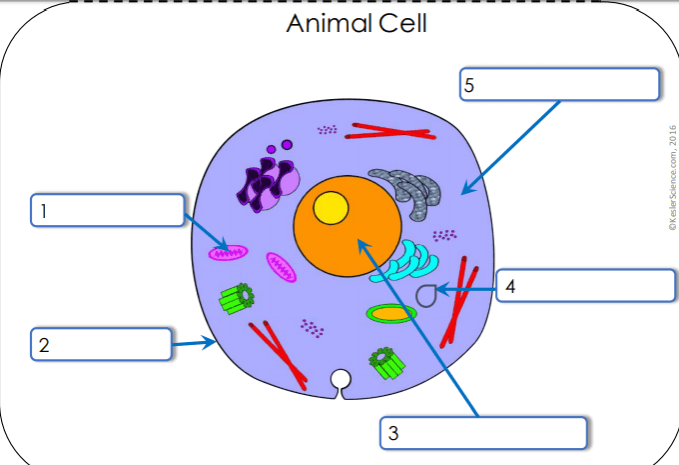
What is #2 in the diagram?

a)

vacuoles

b)

cell membrane

c)

chloroplast

d)

nucleus

27.

What is #3 in the diagram?

a)

vacuoles

b)

cell membrane

c)

chloroplast

d)

nucleus

28.

What kind of cell is this?

a)

plant

b)

animal

29.

Name two parts that are in the plant cell but that are NOT in an animal cell.

a)

cell wall and cell membrane

b)

cell membrane and chloroplasts

c)

cell wall and chloroplasts

d)

cell wall and cytoplasm

30.

What is the part of a plant or animal cell that controls all of the functions?

a)

vacuole

b)

cell membrane

c)

cytoplasm

d)

nucleus

31.
Many cells of the same type form a _____.
a)
Organism
b)
Chloroplast
c)
Tissue
d)
Organ system
32.
Two or more kinds of tissues together form an _____.
a)
Organ
b)
Chloroplast
c)
Cell
d)
Tissue
33.
Organ systems working together form a living _____.
a)
Chloroplast
b)
Tissue
c)
Cell
d)
Organism
34.
Skin is a kind of _____ tissue.
a)
Nervous
b)
Epithelial
c)
Digestive
d)
Muscular
35.
Red blood cells are a kind of _____ tissue.
a)
Nervous
b)
Skeletal
c)
Connective
d)
Muscle
36.
Bone cells (osteocytes) make up _____ tissue.
a)
Skeletal
b)
Nervous
c)
Heart
d)
Skin
37.
The brain is part of the _____ system.
a)
Skeletal
b)
Nervous
c)
Digestive
d)
Respitory
38.
The stomach is part of the _____ system.
a)
Skeletal
b)
Respitory
c)
Digestive
d)
Integumentary
39.
This is the _____ system.
a)
Muscular
b)
Skeletal
c)
Circulatory
d)
Nervous
40.

What is a group of cells that are alike and work together?

a)

a cell team

b)

a tissue

c)

a cell family

41.

A group of tissues that work together is a(n) ______________________.

a)

cell

b)

organ

c)

organ system

42.

Muscle tissue is made of ...

a)

muscle cells

b)

skin tissue

c)

stem cells

43.

What is the correct order of organization?

a)

cells->tissue->organs->organ systems-> organism

b)

tissue->cells->organs->organ systems-> organism

c)

organs->organ systems-> organism->cells->tissue

44.

A plant growing towards a light source is an example of which of the following?

a)

attracting a mate

b)

destroying infectious germs

c)

responding to a stimuli

d)

obtaining moisture from the air

45.

Identify all of the following that are living.

a)

Volcano

b)

Tree

c)

Sun

d)

Fungus

46.

Identify all of the following that are nonliving.

a)

Rock

b)

Oxygen

c)

Bacteria

d)

Battery

47.
What is an organism that consists of more than one cell?
a)
unicellular
b)
multicellular
c)
nucleus
d)
Organelle
48.
This picture is a good example of
a)
Growth
b)
Development
c)
Organelle
d)
Cell
49.

Which one of these is NOT one of the characteristics of living things?

a)

All living things drink water.

b)

All living things are composed of one or more cells.

c)

All living things grow, develop and have life spans.

d)

All living things reproduce.

50.

How many characteristics are there ?

a)

6

b)

5

c)

7

d)

8