
 Worksheets
Test Practice Scientific Method, Graphs, and Bonds
Total questions: 40
Worksheet time: 47mins
Darlene places a bolt in the graduated cylinder to find its volume. Its starting volume is 65mL. After she puts the bolt in the graduated cylinder the water level rose to 110 mL. What is the volume of the bolt? (type the number only)
(a)

The graph shows energy production in the United States in 1967 and 2007 for several sources of energy. Which conclusion is supported by the graph?
In 1967 more energy was produced in oil than in 2007
More energy was produced in 2007 than in 1967 in every category.
In 2007, more energy was produced from renewable energy sources than from fossil fuels.
People in the United States were more concerned about conserving energy in 1967 than they were in 2007.
Jordan has a mixture of two solids that he has to separate. The solids are small granules that are the same size but different colors. She knows that the silver granules are aluminum and the white granules are salt. Which procedures are the Least reliable way to separate the mixture?
Dissolve mixture in a universal solvent and filter. Then evaporate solvent to retrieve the salt.
Dissolve mixture in a universal solvent and filter.
Pass a magnet over the mixture.
Sift the mixture through fine wire mesh.
A mixture of coffee grounds and coffee are being poured through filter paper. Which property of the coffee grounds & filter paper is being used to separate them out from the molecules?
Size of the coffee particles
the polarity of the molecules
Size of pores in the filter
Temperature of the water
Which of the following are NOT true about why we want to test only one independent variable at a time?
Because it is hard to setup a data table with more than one variable
To better identify what is causing the changes
It is what has always been done
It's easier to perform the experiment

Carla needs exactly 100.00 grams of sulfur powder for an experiment. The picture shows the mass on the scale so far. She did not zero the scale before starting. Carla knows that the weighing paper weighs 3.55 grams. How much more sulfur powder does Carla need? type only the number
(a)

A student wanted to test some objects to see if they would sink or float. What conclusion can be made from her investigation?
The marble is less dense than the water and the mineral oil
The mineral oil is less dense than the colored water.
The block is less dense than the water and denser than the mineral oil
The block is more dense than the water and less dense than the mineral oil
Which of the following would be the best method to separate small pieces of wood and small pieces of metal placed in a beaker?
Heat the beaker on a hot plate
Pour the contents into a strainer/filter
Let the contents set for a day to settle out
Add water to the beaker to see which one sinks and which one floats
Students put 2 ice cubes on separate plates. One ice cube had a mass of 20 grams. The other had a mass of 30 grams. Which results would be the same for both ice cubes in this investigation?
The time it took each ice cube to melt completely
The temperature at which each ice cube melted
The amount of liquid produced on each plate
The total volume of each ice cube
Darlene places a bolt in the graduated cylinder to find its volume. Its starting volume is 49.6mL. After she puts the bolt in the graduated cylinder the water level rose to 68.4mL. What is the volume of the bolt? Type only the number
(a)

What is happening at C?
Stationary
Accelerating
Slower steady speed; moving away from the starting position
Steady speed; returning to start position

If your teacher asked you to make quantitative observations about the class’s pet hamster, which group of words might be used?
A mass of 3 kg, 11 cm long, age of 16 months
A mass of 3 kg, 11 cm long, cute
A long hair, white and brown colored, soft
A temperature, length, weight
Jack has a rock. The rock has a mass of 15g and a volume of 5cm3. What is the density of the rock? Type only the number
(a)

Kelsey is measuring her weight in g. She recorded the mass on the scale but realized later that she left her shoes on. She checked and her shoe's weight was 3 g. What is Kelsey's true weight?
(a)

Mr. Lee wants to confirm the metal used in a ring with a mass of 13.8375 g. The volume of the ring is 1.35 cubic centimeters (cm3). What is the metal composition of the ring?
(a)

What was the net loss in glacier ice thickness between the years 1960 and 1990? type only the number
(a)
Convert this number to standard notation: 1.4 x 10⁻⁵
(a)

During an experiment, a student measures the mass of ice and of liquid water and then places the mixture into a freezer for a day. The table shows the data.
What will the student have at the end of the experiment?
100 grams of ice
125 grams of ice
125 grams of liquid water
150 grams of liquid water
Mrs. Norris mixed 100 milliliters (mL) of water with 12 mL of sugar in a bowl. She left the bowl with the sugar and water mixture outdoors. After a week, she noticed crystals and a small amount of liquid at the bottom of the bowl. Which sentence describes what happened in the bowl?
There was one new substance formed.
There were no new substances formed.
There were two new substances formed.
There were many new substances formed.

Mrs. Tamel measured 60 milliliters of hydrogen peroxide into a beaker and measured its temperature. She added yeas to the hydrogen peroxide and stirred the beaker. She measured the temperature at three different times in degrees Celsius. She wrote down her observations in the table.
Which sentence describes her results?
Stirring caused the temperature to increase and fewer bubbles to form.
A physical change cause the temperature to decrease and bubbles to form.
A chemical change caused the temperature to increase and more bubbles to form.
Mixing two substances caused the temperature to decrease and fewer bubbles to form.

Use the graph below to answer this question. What state of matter would the substance be at point F?
(a)


If carbon gained 2 electrons what would its charge be?
Type the charge and then the number
(a)
How many valence electrons does Arsenic have?
(a)
If an atom has 6 protons and 6 electrons what charge will it have?
(a)
Which substance contains bonds that involve a transfer of electrons from one atom to another?
CO2
NH3
RbBr
Cl2
Which element can combine with Be to form a neutral ionic compound? (Type the symbol of one of the possible correct answers)
(a)
Jane is setting up an experiment involving bean plants. She places a bean inside a damp paper towel, then places it inside a Ziploc bag. She takes another bean but places it inside a dry paper towel. She tapes both Ziploc bags to her classroom window next to each other. She checks each day to observe and record the data. Jane is most likely invesitgating which hypothesis:
Beans cannot grow in a paper towel.
Amount of sunlight affects how fast beans grown.
What does a bean look like once it's sprouted?
A dry bean grows quicker than a damp bean.

A scientist studied two species of sea snail and recorded the physical characteristics in the data table. Which conclusion about the data is based on correct reasoning?
If a snail she studied had a brown shell, then it was a red foot snail.
If a snail she studied had a brown shell, then it had a white underside.
If a snail she studied was 175 millimeters long, then it had a white underside.
If a snail she studied was 125 millimeters long, then it was red foot snail.

A scientist studying a species of flower that grows on the side of a mountain measured the height of many of the flowers at different elevations. His results are shown in the graph. Which statement best describes the pattern of growth for the flowers during this experiment?
The flowers cannot grow below elevations of 1,000 meters.
The flowers’ heights increase with higher elevation.
The flowers’ heights are unaffected by elevation.
The flowers grow taller at elevations of around 3,000 meters.

Which question could Julie answer most easily by conducting a scientific experiment?
Does the mass of an ice cube change when it melts?
How long does it take for water to freeze?
What is the temperature of the water?
Does ice melt faster in air or in water?

Chris wanted to determine the effects of a soil pollutant on the growth of a sunflower plant. He designed an experiment and recorded his results in the data table. Where does Chris make a mistake in the design of his experiment?
The amount of water should be the same for each plant.
The amount of sunlight per day should be different.
The amount of pollutant should be the same for each plant.
The experiment should use more types of plants.

Which graph best represents the information in the table?


Name two plant groups that have a combined growth less than that of plant 3.
1 & 2
2 & 7
1 & 7
6 & 7

Which appliance is used twice as many hours on the weekends as it is on weekdays?
(a)
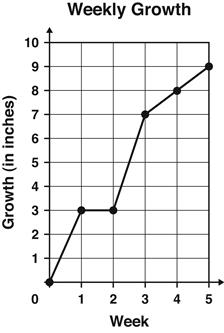
The graph shows the number of inches a plant grew each week.
Between which 2 weeks did the plant grow the MOST?
Week 1 and Week 2
Week 2 and Week 3
Week 3 and Week 4
Week 4 and Week 5
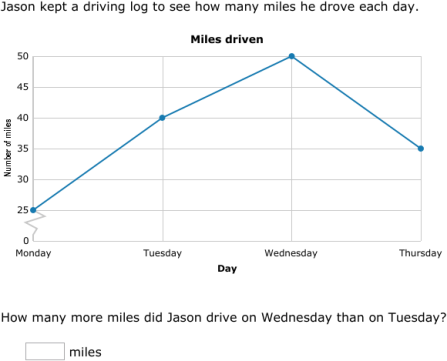
How many more miles did Jason drive on Wednesday than on Tuesday? Type the number only
(a)

