
 Worksheets
Thermo, Equil, Electro
Total questions: 107
Worksheet time: 3hrs 51mins

Specific Heat
the amount of energy it takes to raise one gram of a substance by one degree Celsius
The internal energy of an object
The measure of the kinetic energy of an object's molecules
the amount of energy it takes to change the state of 1g of a substance


What state(s) of matter are present at D-E?
Solid and liquid
Liquid
Liquid and gas
Gas and Solid
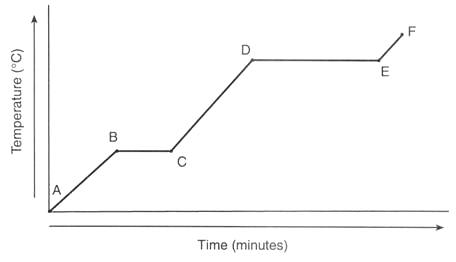
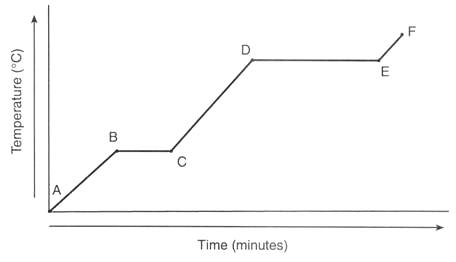


Which equation do you use to solve for segment B-C?
q=mCΔT
q= mLv
q= mLf
PV=nRT

Which equation do you use to solve for the energy of segment D-E?
q= mCΔT
q= mLv
PV=nRT
q= mLf

Which equation do you use to solve for the energy of segment C-D?
q=mCΔT
q= mLv
q= mLf
PV=nRT
Which equation would you use to solve the following: Calculate the heat necessary to change 10 g of ice(s) at 0°C to 10 g of water(l) at 0°C.
q=mCΔT
q= mLv
q= mLf
PV=nRT
Which state of matter has particles that move randomly and freely?
solid
liquid
gas
What happens to the temperature of a gas during boiling?
It goes up
It goes down
It stays the same
The freezing of water (liquid to solid).
endo
exo
Does breaking bonds require energy, release energy, or not involve energy at all?
requires energy to break
releases energy when broken
No energy involved

Energy must be ___ when new bonds are created.
released
absorbed
Heat is _____ if heat is removed from a system
Positive
Negative
Neutral

Is this equation endo- or exo-thermic?
2KNO3 (s) + energy --> 2KNO2 (s) + O2
endothermic
exothermic
When the solids Ba(OH)2 and NH4SCN are mixed, a solution is produced and the temperature drops. Which statement about the energetics of this reaction is correct?
The reaction is endothermic and ΔH is negative
The reaction is endothermic and ΔH is positive
The reaction is exothermic and ΔH is negative
The reaction is exothermic and ΔH is positive
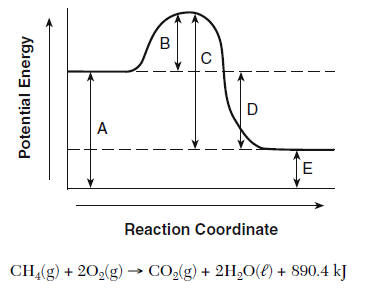
P4 + 6Cl2 --> 4PCl3 + 2439 kJ
Delta S is negative indicates
enthalpy increases
enthalpy decreases
entropy decreases
entropy increases
Delta G is negative indicates
reaction is exothermic
reaction is endothermic
reaction is spontaneous
reaction is not spontaneous
Which of these would ALWAYS indicate a process is spontaneous?
ΔH is + ΔS is +
ΔH is − ΔS is −
ΔH is + ΔS is −
ΔH is − ΔS is +
If the enthalpy of the products > reactants then this reaction is said to be
spontaneous
endothermic
exothermic
unlikely
According to Hess' law, if you reverse a reaction
the sign of delta H must flip
you do not change the delta H sign
you must multiply the delta H value by 2
you must divide the value of delta H by 2
According to Hess' law the reaction pathway's effect on reaction enthalpy is that it
doesn't matter
affects the overall enthalpy change
can only have one step
can't have more steps than reactants
If 25 J are required to change the temperature of 5.0 g of substance A by 2.0°C, what is the specific heat of substance A?
250 J/g °C
10 J/g °C
63 J/g °C
2.5 J/g °C
A reaction has a negative ΔH and a negative ΔS. Which of the following is true?
It will be spontaneous at all temperatures.
It will be nonspontaneous at all temperatures.
It will be spontaneous at low temperatures.
It will be spontaneous at high temperatures.
The thermodynamic quantity that expresses the degree of disorder in a system is _______.
entropy
internal energy
free energy
enthalpy
The entropy will usually increase when________.
a molecule is broken into two or more smaller molecules
a reaction occurs that results in an increase in the number of moles of gas
a solid changes to a liquid
all of these
A given reaction has ΔH =+119kJ and ΔS=+263J/K.mol, at 298 K it is non spontaneous. How can you make it spontaneous?
increase temperature
decrease temperature
it cannot be spontaneous
What information do we need to perform a calculation of Gibbs Free Energy?
Enthalpy of the reaction.
Entropy of the reaction.
The temperature of the reaction in Kelvin.
All of the above are needed.
Which combination of ΔH and ΔS NEVER has a spontaneous reaction?
+ΔH and +ΔS
+ΔH and -ΔS
-ΔH and -ΔS
-ΔH and +ΔS
For the process at 250C : I2(g) →I2(s). What are the signs for ΔG, ΔH and ΔS?
ΔG + ΔH - ΔS -
ΔG - ΔH - ΔS -
ΔG - ΔH + ΔS +
ΔG - ΔH + ΔS +
For the reaction: 2NH3(g) --> N2(g) + 3H2(g)
Entropy is increasing in the forward direction
Entropy is decreasing in the forward direction
Use the Hf values in the table below to answer questions a and b about the following reaction.
CO2(g) + N2(g) ⟶ NO(g) + CO(g) ΔH = ?
Formula kJ/mol
CO(g) -110
CO2(g) -394
NO(g) 90
a) Calculate Hrxn for the reaction.
370kJ/mol
374kJ/mol
333kJ/mol
335KJ/mol
which of the following represent the lattice enthalpy of formation of sodium flouride
2Na(g) + F2(g) → 2NaF(g)
Na(s) + 1/2F2(g) → NaF(s)
2Na(s) + 1/2F2(g) → NaF(g)
2Na(s) + F2(g) → 2NaF(g)
Using the equations:
C(s) + O2(g) → CO2(g) ΔH = -390 kJ
Mn(s) + O2(g) → MnO2(s) ΔH = -520 kJ
what is ΔH for the reaction: MnO2(s) + C(s) → Mn(s) + CO2(g)?
910
130
-130
-910
Approximate values of the average bond enthalpies, in kJ/mol, of three substances are:
H-H = 430, F-F = 155, H-F = 565
What is the enthalpy change in kJ for this reaction: 2HF → H2 + F2
+545
+2
-20
-545
6. The formation ½ A2 + 2 B2 + C --> CAB4 has an enthalpy of formation of -104 kJ and a change in entropy of -60.8 J/K at 30 °C. What is the free energy and spontaneity of the reaction?
-85.6 kJ, spontaneous
-18.3 kJ, not spontaneous
+18.3 kJ, spontaneous
+85.6 kJ, not spontaneous
4NH3 + 5O2 --> 4NO + 6H2O
How many molecules of NO are formed if 6.30g of ammonia react with 1.80g of oxygen?
3.79 x 1024 molecules NO
1.08 x 1024 molecules NO
2.23 x 10²³ molecules NO
2.78 x 10²³ molecules NO
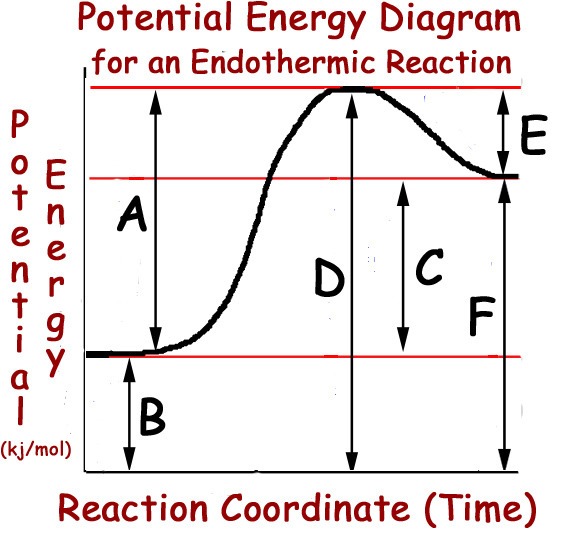
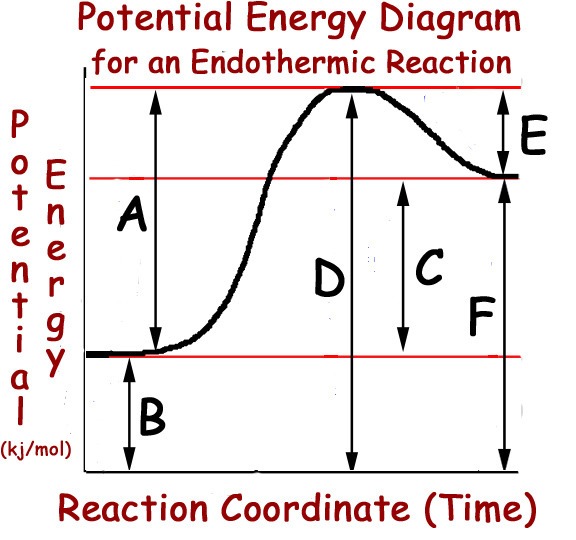


What is the keq for this reaction?
Greater than 1
Less than 1
Exactly 1
Impossible to determine
The equilibrium constant expression for the reaction BrF5(g) —> Br2(g) + F2(g) is
Kc = [Br2] [F2] / [BrF5]
Kc = [BrF5]2 / [Br2][F2]5
Kc = [Br2] [F2]5 / [BrF5]2
Kc = 2[BrF5]2 / ([Br2] × 5[F2]5)
Kc = [Br2] [F2]2 / [BrF5]5
A very high value for K indicates that
reactants are favored.
products are favored.
equilibrium is reached slowly.
equilibrium has been reached
Calculate Kc for the reaction HI(g) —> H2(g) + I2(g) given that the concentrations of each species at equilibrium are as follows: [HI] = 0.85 mol/L, [I2] = 0.60 mol/L, [H2] = 0.27mol/L.
0.19
0.22
4.5
5.25
160
The concentration of OH– in a saturated solution of Mg(OH)2 is 3.6 x 10⁻⁴ M. The Ksp of Mg(OH)2 is
1.3 x 10⁻⁷
4.7 x 10⁻¹¹
3.6 x 10⁻⁴
2.3 x 10⁻¹¹
Which of the following compounds has the lowest molar solubility in mol/L in water at 25°C?
Ag3PO4 Ksp = 1.8 x 10⁻¹⁸
Sn(OH)2 Ksp = 5 x 10–26
CdS Ksp = 3.6 x 10⁻²⁹
Al(OH)3 Ksp = 2 x 10–33
The correct mathematical expression for finding the molar solubility (X) of Sn(OH)2 is:
2(X)3 = Ksp
108(X)5 = Ksp
4(X)3 = Ksp
8(X)3 = Ksp
Barium carbonate has a measured solubility of 4.0 x 10⁻⁵ at 25°C. Determine the Ksp.
5.3 x 10⁻¹⁰
6.1 x 10⁻⁵
9.1 x 10⁻⁷
1.6 x 10⁻⁹
Sodium chloride is added slowly to a solution that is 0.010 M in Cu+, Ag+, and Au+. The Ksp values for the chloride salts are 1.9 x 10⁻⁷, 1,6 x 10⁻¹⁰, and 2.0 x 10⁻¹³, respectively. Which compound will precipitate first?
CuCl(s)
AgCl(s)
AuCl(s)
All will precipitate at the same time.
Will precipitation occur when 3.5 x 10² mL of 3.2 M Pb(NO3)2 and 2.0 x 10² mL of 0.020 M NaCl are added together. Ksp for the lead chloride is 1.6 x 10⁻⁵.
Yes, Qsp is greater than Ksp
No, Qsp is less than Ksp
Maybe, it depends on the temperature.
Maybe, it depends on the limiting reagent
Calculate the solubility of Ca3(PO4)2(s) (Ksp = 1.3 x 10⁻³²) in a 1.0 x 10⁻² M Ca(NO3)2 solution.
5.7 x 10⁻¹⁴ mol/L
6.2 x 10⁻⁷ mol/L
1.6 x 10⁻¹⁴ mol/L
3.16 x 10⁻¹² mol/L
Calculate the solubility of Ag2CrO4 [Ksp = 9.0 x 10⁻¹²] in a 1.0 x 10⁻² M AgNO3 solution.
1.3 x 10⁻⁴ mol/L
2.3 x 10⁻⁸ mol/L
9.0 x 10⁻⁸ mol/L
9.0 x 10⁻¹⁰ mol/L
What is the Ksp for silver phosphate (Ag3PO4) at 25°C? The solubility of silver phosphate at 25°C is 1.6 x 10⁻⁵ mol/L.
7.7 x 10⁻¹⁰
1.8 x 10⁻¹⁸
8.6 x 10⁻¹³
3.3 x 10⁻¹³
2SO2(g) + O2(g) ⇌ 2SO3(g) + Heat
Removing O2(g) will
shift equilibrium right
shift equilibrium left
increase pressure
have no change
2SO2(g)+O2(g) ⇌ 2SO3(g) + Heat
Increasing the temperature will...
shift equilibrium right
shift equilibrium left
increase pressure
have no change
Changes in pressure will only affect substances that are in the ______ state.
solid
gas
liquid
What states of matter are omitted when writing Keq expressions?
solids and liquids
aqueous solutions and gas
solids, liquids, aqueous solutions and gases
aqueous solutions & liquids
A temperature increase causes the particles ......
to slow down
move faster
collide higher
in the right order
cathode is the electrode where
reduction takes place
oxidation takes place
either reduction or oxidation
none of these
Zn/Zn+2 // Ag+1 / Ag
spontaneous
not spontaneous
Zn/Zn+2 // Cu+2/Cu
Mn/Mn(NO3)2 // PBSO4/Pb
Al(s) + Zn(NO3)2(aq) → Al(NO3)3(aq) + Zn(s)
Which of the following statements concerning galvanic cells is/are true?
The two half-cells are connected by a salt bridge.
Electrons flow from the anode to the cathode.
Reduction occurs at the cathode.
All of the above are true.

Given their standard reduction potentials, which of the species is going to be oxidized?
Cu2+/Cu = 0.34V
Zn2+/Zn = -0.76V
Cu
Zn
CuSO4
ZnSO4
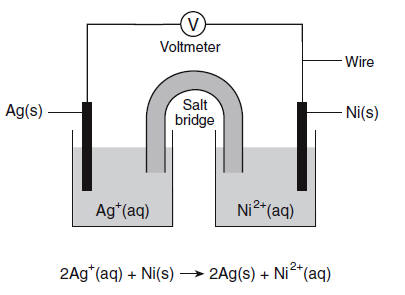
What reaction occurs at the anode?
Ag+/Ag = 0.80V
Ni2+/Ni = -0.25V
Ag+ + e- →Ag
Ag → Ag+ + e-
Ni2+ + 2e- → Ni
Ni → Ni2+ + 2e-

Galvanic cells convert
mechanical energy in to electrical energy
potential energy in to electrical energy
electrical energy in to chemical energy
chemical energy in to electrical energy

When water is electrolyzed, gas collected at cathode, is
sulphur
oxygen
hydrogen
sulphur dioxide
What is oxidation number of Cr in Cr2O72-?
-2
+2
+6
+12


Which of the following statements applies to the change in mass of the electrodes involved in this electrochemical cell?
Electrode A is the anode and it gains mass
since metal ions are being converted to metal
atoms which often adhere to the electrode.
Electrode B is the anode and it gains mass
since metal ions are being converted to metal
atoms which often adhere to the electrode.
Electrode A is the cathode and it gains mass since metal ions are being converted to metal atoms which often adhere to the electrode.
Electrode B is the cathode and it gains mass since metal ions are
being converted to metal atoms which often adhere to the electrode.
If an electrochemical reaction is spontaneous, what will Ecell be?
positive
negative


