wayground logo

Free Printable Worksheets

Font size

S
M
L
XL
Worksheets

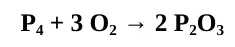
TEST REVIEW: Chapter 6

Total questions: 90

Worksheet time: 1hrs 17mins
Name
Class
Date
1.
How many atoms are present if there is no subscript following the chemical symbol?
a)
1
b)
2
c)
0
d)
4
2.
The REACTANTS are found on which side of a chemical reaction?
a)
Right
b)
Left
3.
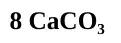
How many total atoms make up the listed compound.
a)
23
b)
5
c)
12
d)
6
e)
1
4.
How many total atoms make up the listed compound.
a)
8
b)
3
c)
5
d)
15
5.
How many total atoms make up the listed compound.
a)
40
b)
32
c)
13
d)
16
6.
What are the needed coefficients to balance the following chemical equation:
a)
1, 1, 1
b)
1, 2, 1
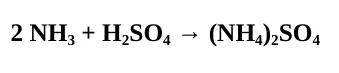
c)
2, 1, 1
d)
2, 1, 2
7.
What are the needed coefficients to balance the following chemical equation:
a)
1, 2, 1
b)
2, 1, 1
c)
2, 2, 1
d)
1, 1, 2
8.
What are the needed coefficients to balance the following chemical equation:
a)
4, 1, 2
b)
2, 1, 1
c)
2, 2, 2
d)
4, 2, 1
9.
What are the needed coefficients to balance the following chemical equation:
a)
1, 1, 1, 1
b)
2, 1, 2, 1
c)
2, 1, 1, 2
d)
1, 2, 2, 1
10.
What are the needed coefficients to balance the following chemical equation:
a)
3, 2, 1, 1
b)
2, 3, 1, 3
c)
2, 3, 1, 1
d)
2, 2, 1, 1
11.
What are the needed coefficients to balance the following chemical equation:
a)
1, 1, 1, 2
b)
1, 2, 1, 1
c)
1, 1, 2, 2
d)
2, 2, 1, 1
12.
What are the needed coefficients to balance the following chemical equation:
a)
2, 3, 1, 6
b)
2, 2, 1, 3
c)
2, 3, 2, 6
d)
1, 3, 2, 1
13.
What are the needed coefficients to balance the following chemical equation:
a)
1, 5, 3, 4
b)
1, 3, 5, 4
c)
2, 3, 3, 1
d)
1, 3, 2, 4
14.
What type of reaction follows this general equation?
a)
Synthesis
b)
Decomposition
c)
Single Replacement
d)
Double Replacement
e)
Combustion
15.
What type of reaction is listed below?
a)
Synthesis
b)
Decomposition
c)
Single Replacement
d)
Double Replacement
e)
Combustion
16.
What type of reaction is listed below?
a)
Synthesis
b)
Decomposition
c)
Single Replacement
d)
Double Replacement
e)
Combustion
17.
What type of reaction is listed below?
a)
Synthesis
b)
Decomposition
c)
Single Replacement
d)
Double Replacement
e)
Combustion
18.
What type of reaction is listed below?
a)
Synthesis
b)
Decomposition
c)
Single Replacement
d)
Double Replacement
e)
Combustion
19.
What type of reaction is listed below?
a)
Synthesis
b)
Decomposition
c)
Single Replacement
d)
Double Replacement
e)
Combustion
20.
What type of reaction is listed below?
a)
Synthesis
b)
Decomposition
c)
Single Replacement
d)
Double Replacement
e)
Combustion
21.
What type of reaction is listed below?
a)
Synthesis
b)
Decomposition
c)
Single Replacement
d)
Double Replacement
e)
Combustion
22.
What type of reaction is listed below?
a)
Synthesis
b)
Decomposition
c)
Single Replacement
d)
Double Replacement
e)
Combustion
23.
What type of reaction is listed below?
a)
Synthesis
b)
Decomposition
c)
Single Replacement
d)
Double Replacement
e)
Combustion
24.
What type of reaction is listed below?
a)
Synthesis
b)
Decomposition
c)
Single Replacement
d)
Double Replacement
e)
Combustion
25.
More frequent collisions correspond to a:
a)
Faster reaction rate.
b)
Slower reaction rate.
c)
Constant reaction rate.
d)
None of the Above.
26.
How is a catalyst different from a reactant?
a)
Catalysts are part of the products generated from the reactants.
b)
A catalyst is an active bystander in the reaction aiding in lowering the activation energy.
c)
Catalysts are reactants, there is not difference.
d)
Catalysts are not reactants, they serve no purpose in a reaction.
27.
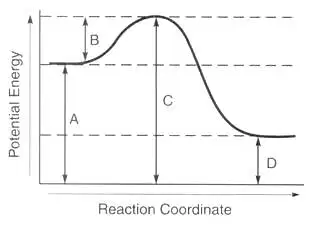
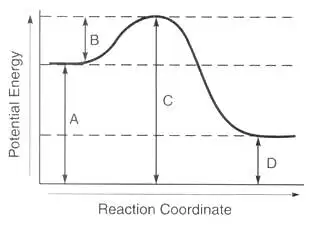
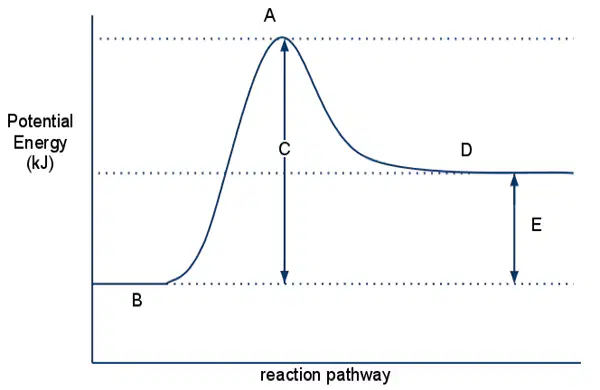
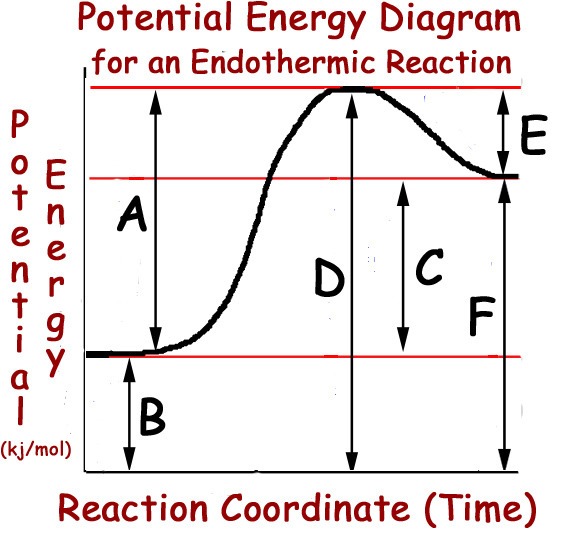
Which letter corresponds to the activation energy of the forward reaction? (Forward reaction means as reactants form products)
a)
A
b)
B
c)
C
d)
D
28.
Which letter corresponds to the energy stored in the bonds of the reactants?
a)
A
b)
B
c)
C
d)
D
29.
Which diagram represents an endothermic reaction?
a)
A
b)
B
c)
Both A and B show an endothermic reaction.
30.
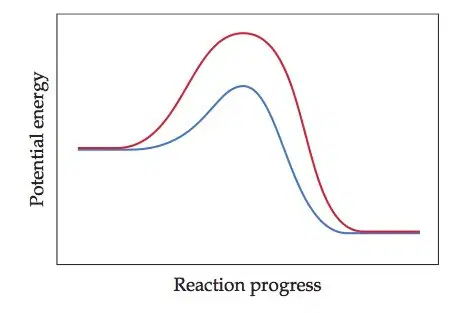
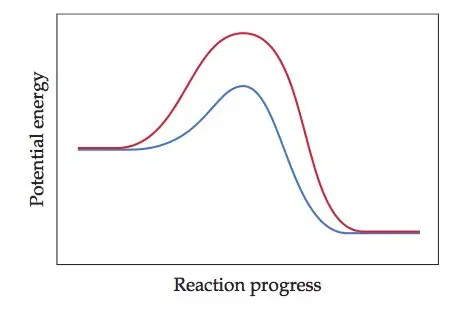
The following graph shows two different reaction pathways for the same overall reaction at the same temperature. Which pathway is slower and why?
a)
Red, because the activation energy is larger.
b)
Blue, because the activation energy is lower.
c)
Both reaction progress at the same rate.
31.
The following graph shows two different reaction pathways for the same overall reaction at the same temperature. Which pathway could represent the pathway using an inhibitor?
a)
Red, because the activation energy is larger.
b)
Blue, because the activation energy is lower.
c)
What is an inhibitor?
32.

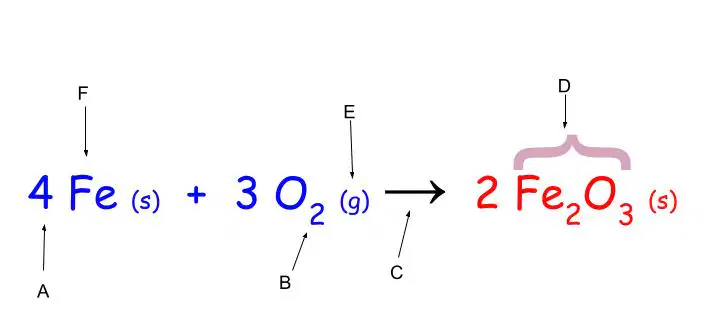
Letter A represents what in the equation listed?

a)

Subscript

b)

Coefficient

c)

State of Matter

d)

Chemical Formula

33.

Letter B represents what in the equation listed?

a)

Subscript

b)

Coefficient

c)

State of Matter

d)

Chemical Formula

34.

Letter D represents what in the equation listed?

a)

Subscript

b)

Coefficient

c)

State of Matter

d)

Chemical Formula

35.

Letter E represents what in the equation listed?

a)

Subscript

b)

Coefficient

c)

State of Matter

d)

Chemical Formula

36.

Letter F represents what in the equation listed?

a)

Subscript

b)

Coefficient

c)

State of Matter

d)

Chemical Symbol

37.

Letter C represents what in the equation listed?

a)

Yields

b)

Coefficient

c)

State of Matter

d)

Chemical Symbol

38.

What does Letter C represent?

a)

Reactants

b)

Products

c)

Activation Energy

39.

What does Letter B represent?

a)

Reactants

b)

Products

c)

Activation Energy

40.

What does Letter D represent?

a)

Reactants

b)

Products

c)

Activation Energy

41.

B represents

a)

Potential Energy of Products

b)

Potential Energy of Reactants

c)

Change in Enthalpy

d)

Activation Energy

42.

A represents

a)

Potential Energy of Products

b)

Potential Energy of Reactants

c)

Change in Enthalpy

d)

Activation Energy

43.

D represents

a)

Potential Energy of Products

b)

Potential Energy of Reactants

c)

Change in Enthalpy

d)

Activation Energy

44.

Is the following reaction endothermic or exothermic

a)

endothermic

b)

exothermic

45.

Is the following reaction endothermic or exothermic

a)

endothermic

b)

exothermic

46.

which factor that affect reaction rate is represented?

a)

Temperature

b)

Catalyst

c)

Surface Area

d)

Concentration

47.

Indicate whether each of the following will: Increase / Decrease / have No effect on the rate of reaction.


                Increasing temperature


a)

Increase

b)

Decrease

c)

No Effect

48.

Indicate whether each of the following will: Increase / Decrease / have No effect on the rate of reaction.


                Decrease Particle Size              

a)

Increase

b)

Decrease

c)

No Effect

49.

Indicate whether each of the following will: Increase / Decrease / have No effect on the rate of reaction.


                Decrease Reactant Concentration             

a)

Increase

b)

Decrease

c)

No Effect

50.

Which energy diagram line represents the catalyzed reaction?

a)

The black line

b)

The red line

c)

It can not be determined

51.
Explosions can happen when there is a large amount of powdered substance because of a large
a)
temperature
b)
surface area
c)
concentration
d)
pressure
52.
Exothermic reactions...
a)
Absorb energy
b)
Release energy
c)
Release Color
d)
Absorb Color
53.
Products will form faster if____________
a)
the particle size of the reactants are larger.
b)
temperature is decreased.
c)
concentration of the reactants are increased.
d)
the reaction is not stirred.
54.
Which of these will NOT speed up the rate of reaction between a strip of magnesium and hydrochloric acid?
a)
tightly coil up the strip of magnesium
b)
cut up the strip of magnesium
c)
increase the concentration of the hydrocholoric acid
d)
increase the temperature of the hydrocholoric acid
55.
Why does a higher concentration increase the rate of reaction?
a)
it increases the amount of reactants
b)
it lowers the activation energy
c)
it increases the energy of particle collisions
d)
it increases the frequency of particle collisions because there are more collision sites
56.
C represents
a)
energy absorbed
b)
energy released
c)
activation energy
57.
In an exothermic reaction the products have
a)
more energy than the reactants
b)
the same energy as the reactants
c)
less energy than the reactants
d)
no energy
58.
In an endothermic reaction the products have 
a)
more energy than the reactants
b)
less energy than the reactants
c)
the same energy as the reactants
d)
no energy
59.
Increasing the concentration of the reactants will slow down the reaction.
a)
false 
b)
true
60.
Exothermic reactions release heat to the surroundings.
a)
true
b)
false
61.
Smaller particle size allows for a _________ surface area to be exposed for the reaction.
a)
larger
b)
smaller
62.
A ______________ is a substance that increases the rate of a reaction without being used up during the reaction. 
a)
catalyst
b)
product
c)
reactant
d)
solute
63.
Which factors increase the rate of a reaction.
a)
increasing temperature
b)
increasing concentration
c)
increasing surface area
d)
all of these
64.
Grinding a seltzer tablet into powder increases the rate of reaction due to increased
a)
concentration
b)
surface area
c)
temperature
d)
reactants
65.
Activation energy is required to start a chemical reaction. What is activation energy?
a)
The energy needed for a reaction to occur
b)
The minimum amount of energy needed for a reaction to potentially occur
c)
The energy added by a catalyst
d)
The energy possessed by the products
66.

Is the following equation balanced?

4Fe + 3O2 ---> 2Fe2O3

a)

YES

b)

NO

67.

Is the following equation balanced?

Al + O2 ---> 2Al2O3

a)

YES

b)

NO

68.

What type of reaction is the following:

2 NH3+ 1 H2SO4 ----> 1 (NH4)2SO4

a)
Synthesis (or combination)
b)
Decomposition
c)
Single displacement
d)
Double displacement
e)

Combustion

69.

What type of reaction is the following:

CaCO3 ----> CaO + CO2

a)
Synthesis (or combination)
b)
Decomposition
c)
Single displacement
d)
Double displacement
e)

Combustion

70.

What type of reaction is the following:

Pb + FeSO4 ----> PbSO4 + Fe

a)
Synthesis (or combination)
b)
Decomposition
c)
Single displacement
d)
Double displacement
e)

Combustion

71.

What type of reaction is the following:

Na3PO4 + 3 KOH ----> 3 NaOH + K3PO4

a)
Synthesis (or combination)
b)
Decomposition
c)
Single displacement
d)
Double displacement
e)

Combustion

72.

What type of reaction is the following:
C11H24+17O2> 11CO2 + 12H2OC_{11}H_{24}+17O_2->\ 11CO_2\ +\ 12H_2O  

a)

Combination

b)

Decomposition

c)

Single Replacement

d)

Double Replacement

e)

Combustion

73.

How many elements are in this chemical formula?

H2SO4H_2SO_4  

a)

1

b)

2

c)

3

d)

4

74.

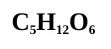
How many atoms of Carbon are in this formula? C6 H12O6C_{6\ }H_{12}O_6  

a)

6

b)

1

c)

12

75.

What is the total number of atoms in this formula? H2O2H_2O_2  

a)

2

b)

4

c)

3

76.

What is the total number of atoms in this chemical formula? C8H3NaBr12C_8H_3NaBr_{12}  

a)

18

b)

12

c)

25

d)

24

77.
How many O's are in Al₂(SO₄)₃
a)
4
b)
12
c)
7
d)
24
78.
How many Sodium (Na) are in 6NaCl?
a)
1
b)
12
c)
6
79.
How many atoms are there TOTAL in:
H2SO4
a)
6
b)
5
c)
7
d)
3
80.
2H2 + O--------> 2H2O What  are the reactants?
a)
----->
b)
2H2O
c)
2H2 +O2
81.
2H2 + O2 ----> 2H2O What is the product?
a)
------>
b)
2H2O
c)
2H2+ O2
82.
How many Oxygen are in H2O?
a)
1
b)
2
c)
0
d)
4
83.
Which side of a chemical equation is the product side?
a)
Left (before the yields sign)
b)
Right (after the yields sign)
84.
What is a coefficient?
a)
The small number on the right of the chemical symbol.
b)
The large number to the left of a formula.
85.
The blue numbers in the image below represent ________
a)
Charges
b)
coefficients
c)
subscripts
d)
none of the answers are correct
86.
What is the arrow in a chemical equation...
H2 + O --> H2O
a)
Reactants
b)
Products 
c)
Yields 
d)
Chemical Equation 
87.
Which side of a chemical equation is the reactant side?
a)
Left (before the arrow sign)
b)
Right (after the arrow sign)
88.

What type of reaction is this?

a)

Endothermic

b)

Exothermic

89.
Grinding a seltzer tablet into powder increases the rate of reaction due to increased
a)
concentration
b)
surface area
c)
temperature
d)
reactants
90.
Why does a higher concentration increase the rate of reaction?
a)
it increases the amount of reactants
b)
it lowers the activation energy
c)
it increases the energy of particle collisions
d)
it increases the frequency of particle collisions because there are more collision sites