
Font size
 Worksheets
Alg2 - NW3 REVIEW QUIZIZZ
Total questions: 71
Worksheet time: 6hrs 10mins
46⋅3
49
72
418
122
6√2 ⋅5√14


Find the sum.
(5-2i) + (-7+8i)
-2+6i
12+6i
-35-16i2
-35 -16i
−3+6i−(−5−3i)−8i
(a)
Simplify: (−2 + 7i)(4 − 2i)
6+ 32i
−6 + 32i
22+32i
6 + 24i
What letter represents an imaginary number?
a
i
j
x
(3i)(5i) (Hint: i2 =-1)
15
-15
15i
-15i
i=−1
True
False

Solve: k2 - 6 = -50
k = ±4i√11
k = ±4√11
k = ±2i√11
k = ±2√11
Solve the following trinomial by factoring:
x=−21, −7
x=21, 7
x=0, 21, 7
x=0, −21, −7
Solve the following trinomial by factoring:
x=72, −1
x=−72, 1
x=27, −1
x=−27, 1
Use the quadratic formula to solve
2x2 + 2x - 12 = 0
-2, 3
2, 3
2, -3
-2, -3

Solve using the quadratic formula.
A
B
C
D
n2 - 2n - 3 = 0
m2 - 16m = -59
Check all of the equations that are in standard form
y=2x+1
y=x2+4x−9
y=4(x−5)2+3
y=x2+9
Select all equations that are in vertex form
y=x2+5x
y=3(x+4)2−1
y=−(x+3)2−2
y=(x+3)(x−2)
If given the equation y = 3(x + 5)2 - 4, what is the vertex of the parabola?
(5,-4)
(-5,-4)
(-15, 4)
(15, -4)
Sketch the graph of the following function


y = x2 - 6x + 11?
f(x) = (x + 7)(x + 5)
f(x)=2x2 + 4x + 6

What is the vertex of the function?
(-3, -16)
(3, 20)
(-6, -7)
(0, -7)
y=−3(x+5)2−4
Convert the equation from vertex form to standard form.
y = 9x2 - 15x + 21
y = -3x2 - 75x - 4
y = 9x2 + 90x + 221
y = -3x2 - 30x - 79
Which equation matches the x-intercepts x=5,-7 ?
(x+5)(x-7)=0
(x-5)(x+7)=0
(x+5)(x+7)=0
(x-5)(x-7)=0
Find the expression equivalent to:
(x−1)(x−9)
x2+9
x2-10x+9
x2-10x-9
x2+10x+9

Write a quadratic equation given the x intercepts and one other point.
Step 2: Find a.
Now that you know that the factors are (x-6) and (x-8), you must find a. Plug the coordinates of the vertex (7, 1) in for x and y and solve for a.
y = a(x-6)(x-8)
What is the value of a?
a = 1
a = -1
a = 7
a = -7
Write a quadratic equation given the x intercepts and one other point.
Put the steps together.
- Find the factors.
- Solve for a by substituting in the extra point.
- Write the equation in factored form.
The roots of the function are (-3, 0) and (5, 0).
The point (4, -3) is also on the graph.
y=4(x+3)(x-5)
y=3/7(x-3)(x+5)
y=-3(x-3)(x+5)
y=3/7(x+3)(x-5)


(8.4 × 10⁶) ÷ (2.1 × 10³)
0.4 × 10⁴
400 × 10-3
4 × 10³
4 × 10²
(x + 2x2) + (4x2 + 7x)
(4n4 - 8n + 4) - (8n2 + 4n4 + 1)
(5x + x2 - 4) - (4x - x2 + 6)
x3(2x2+3x)
-5x6(3x2 - 12x + 30)
-15x8 + 60x7 - 150x6
15x8 - 60x7 - 150x6
8x6 - 17x + 35
-8x6 + 17x - 35x2
(x+4)2
(a)
Multiply:
(x+3)2
**Start by rewriting as (x+3)(x+3)**
x2+6x+9
x2+9
x2+3x+9
x2+6x+6
What method should you use to factor the polynomial?
n³-216
Sum of 2 Cubes
Factor out the GCF
Difference of Squares
Difference of 2 Cubes
Factor Completely. 8x2−200
8(x+5)(x−5)
8(x2−25)
4(2x2−50)
4(2x+25)(2x−25)
Factor: x3 + 512
(x + 8)(x2 - 8x + 64)
(x + 8)(x2 + 8x -64)
(x-8)(x + 2)
(x - 8)(x2 - 8x - 64)
Write 4x3 +2x2-6x in factored form.
2x(2x-3)(x+1)
4x(2x+3)(x-1)
2x(2x+3)(x-1)
4x(2x-3)(x+1)

Factor completely.
x4 - 1
( x2 + 1 ) ( x2 - 1 )
( x + 1 ) ( x + 1 ) ( x + 1 ) ( x - 1 )
( x2 - 1 ) 2
( x2 + 1 ) ( x + 1 ) ( x - 1 )

Factor the difference of a cube.
(x + 3)(x-3)
(x−3)(x2−3x +9)
(x −3)(x2+3x + 9)
none of the above
Factor:
w4 - 625
(w2 + 25) (w2 - 25)
(w2 - 25) (w2 - 25)
(w + 25) (w - 25)
Can't factor using Diff. of Squares
Factor by grouping:
x³ + 7x² - 2x - 14
(x²-2)(x-7)
(x²+2)(x-7)
(x²+2)(x+7)
(x²-2)(x+7)
3x2 - 192 = 0
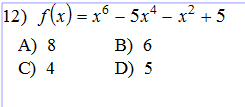
Find all solutions, one factor has been given.
f(x) =x3-3x2-25x+75; (x-5)
5,-3,5
5,5,5
3,-5,5
1,1,1
y = 4x6 - 12x5 - x4 + 2x3 - 6x2 - 5x + 10
The degree of a polynomial tells you how many ___________ the polynomial has
Zeros
Terms
Exponents
Coefficients
(3x - 4x3 + 6x4 + 1) / (x + 3)
f(x) = x4+8x2-9
Which of the following would be the correct factored form with roots 2, 5i, and 6?
(x-6)(x-2)(x+5i)(x-5i)
(x+6)(x+2)(x+5i)
(x-6)(x-2)(x-5i)
(x+6)(x+2)(x-5i)
If a+bi is a root of a polynomial, then _______ is also a root.
i2
a-bi
a+bi
-i2


(x-4)3
(x-4)
(x-1)2
y = -x3 + 6x2 + 7x
as x-> ∞ f(x) -> -∞
as x-> ∞ f(x) -> ∞
as x-> ∞ f(x) -> ∞
as x-> ∞ f(x) -> -∞
y = x6 - 7x5 + 7x - 9
as x-> ∞ f(x) -> -∞
as x-> ∞ f(x) -> ∞
as x-> ∞ f(x) -> ∞
as x-> ∞ f(x) -> -∞

