Wayground logo

Free Printable Worksheets

Font size

S
M
L
XL
Worksheets

Respiratory Quizizz

Total questions: 41

Worksheet time: 41mins
Name
Class
Date
1.
What is the main function of the respiratory system?
a)
to provide oxygen and remove carbon dioxide from the body
b)
to bring oxygen to the body
c)
to break down food and absorb nutrients
d)
to remove oxygen from the body and deliver carbon dioxide
2.
The two main branches from the trachea (one to each lung)
a)
bronchi
b)
alveoli
c)
capillaries
d)
bronchioles
3.
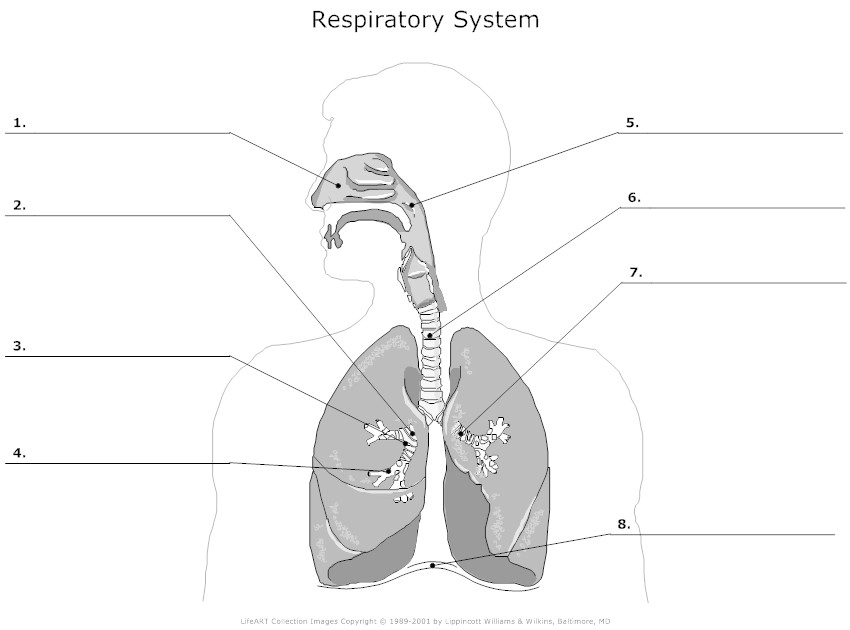
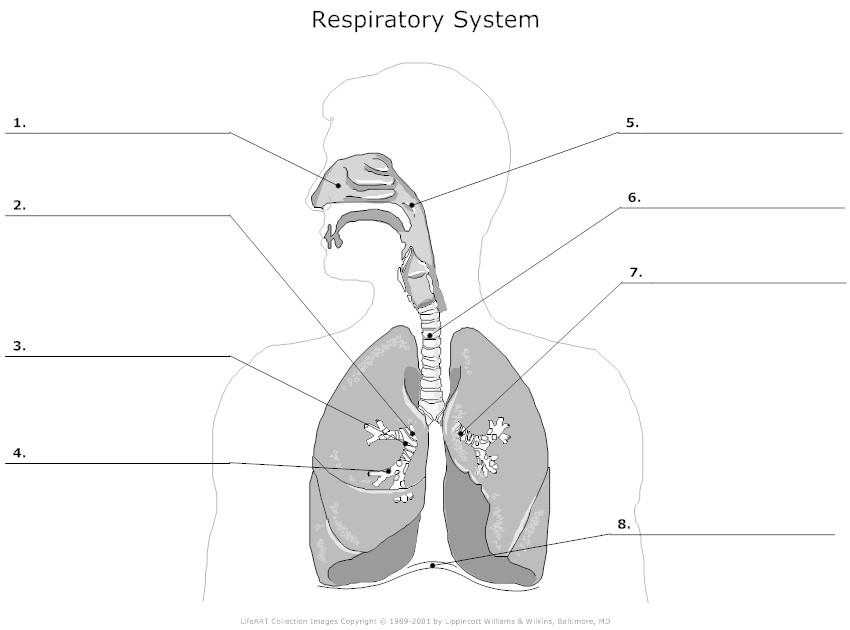
Name the organ label # 6. 
a)
alveoli 
b)
bronchi 
c)
trachea 
d)
lungs 
4.

What is the site of gas exchange?

a)

alveoli

b)

nose

c)

lung

d)

bronchi

5.

The process of diffusing oxygen from the blood, into the interstitial fluid and into the cells.

a)

inspiration

b)

expiration

c)

internal respiration

d)

external respiration

6.

The process of exchanging oxygen and carbon dioxide in the lungs.

a)

inspiration

b)

expiration

c)

internal respiration

d)

external respiration

7.

Which lung has 2 lobes?

a)

Right

b)

Left

8.
Given the following structures:
1. larynx
2. nasal cavity
3. pharynx
4. trachea
Which of the following is the correct order that air would flow during inhalation. 
a)
1,2,3,4
b)
2,3,1,4
c)
2,1,3,4
d)
4,2,3,1 
9.

A small flap of tissue that covers the trachea when swallowing is called the

a)

bronchi

b)

larynx

c)

pharynx

d)

epiglottis

10.

Which part of the Respiratory System collects air from the environment & heats/moistens the air before entering the body?

a)

lungs

b)

nose

c)

heart

d)

mouth

11.
Another name for the throat is called the:
a)
Nasopharynx
b)
Pharynx
c)
Larynx
12.
Name the structure labeled 8 
a)
lungs 
b)
trachea 
c)
diaphragm 
d)
alveoli 
13.
a flap of tissue that closes when we eat so food doesn't not go down the trachea
a)
larynx
b)
pharynx
c)
trachea
d)
epiglottis
14.

NUMBER 2:

a)

Pharynx

b)

Bronchi

c)

Alveoli

d)

Lungs

15.

Gaseous exchange happens because of...

a)

Osmosis

b)

Respiration

c)

Diffusion

d)

Semi-permeable membranes

16.
In the process of breathing, during what stage does the movement of the diaphragm enlarge the thoracic cavity?
a)
Internal respiration
b)
External respiration
c)
Inspiration
d)
Experation
17.
If a person could not produce surfactant, his/her:
a)
Alveoli would collapse
b)
Bronchi would collapse
c)
Vocal chords could not vibrate
d)
Epiglottis would close
18.
Mr. Arnot is a heavy smoker with a chronic cough, bluish tint to his skin, and a barrel chest. He MOST LIKELY suffers from:
a)
Emphysema
b)
Epistaxis
c)
Tuberculosis
d)
Pleurisy
19.

Which of the following happens when you exhale?

a)

chest cavity expands

b)

your lumgs become smaller

c)

your chest cavity becomes smaller

d)

your lungs take in and give off oxygen

20.

What is #4 pointing to?

a)

mouth

b)

pharynx

c)

nasal cavity

d)

trachea

21.

What is #10 pointing to?

a)

right primary bronchus

b)

alveoli

c)

bronchiole

d)

trachea

22.

What is #11 pointing to?

a)

pharynx

b)

alveoli

c)

bronchiole

d)

left primary bronchus

23.

this cleans the air that enters the respiratory system

a)

cilia

b)

mucus

c)

capillaries

24.

In diagram A, the diaphragm is contracted. The volume of the rib cage will ​___ & the pressure will ___causing you to ​ ___ .

a)

increase, decrease, inhale

b)

decrease, increase, inahle

c)

increase, decrease, exhale

d)

decrease, increase, exhale

25.

In diagram B, the diaphragm is relaxed. The volume of the rib cage will ​___ & the pressure will ___causing you to ​ ___ .

a)

increase, decrease, inhale

b)

decrease, increase, inahle

c)

increase, decrease, exhale

d)

decrease, increase, exhale

26.

Oxygen is in ___ concentration in the alveoli & ___ concentration in the blood capillary. This causes oxygen to move by ___.

a)

low, high, active transport

b)

high, low, osmosis

c)

high, low, diffusion

27.

Carbon dioxide is in high concentration in the _____ & low concentration in the ____. This causes carbon dioxide to move by ___.

a)

alveoli, capillary, active transport

b)

capillary, alveoli, osmosis

c)

capillary, alveoli, diffusion

28.
What muscles are used in breathing in and breathing out?
a)
diaphragm and intercostals
b)
diaphragm and lungs
c)
lungs and ribs
d)
lungs and diaphragm
29.
Which of the following lung capacities is the volume of air that can be maximally exhaled after a maximum inhalation?
a)
inspiratory capacity
b)
functional residual capacity
c)
vital capacity
d)
total lung capacity
30.

What is Tidal volume

a)

The volume of air breathed in and out during one breath

b)

The maximal amount of air a person can expel

c)

The amount of blood pumped from the heart

d)

The additional air that can be forcibly inhaled after normal inspiration
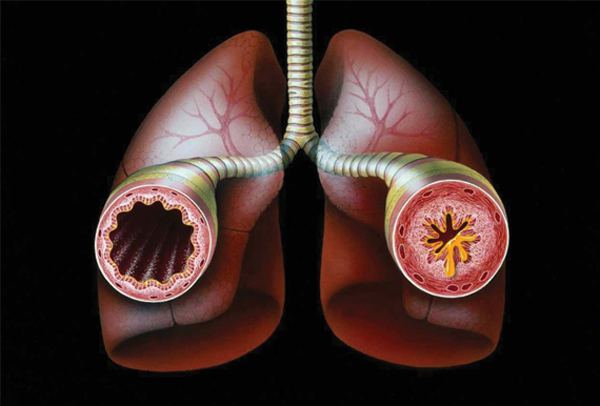
31.
A disorder of the lungs called ____ causes the bronchi to become restricted (get smaller) so air can't get to the lungs.
a)
asthma 
b)
cold
c)
influenza 
d)
bronchitis 
32.
Choose the flowchart with the proper order of airflow into the body. 
a)
nose->pharynx->larynx->trachea->bronchi-> bronchioles->alveoli
b)
nose->larynx->pharynx->trachea->bronchi-> bronchioles->alveoli
c)
nose->pharynx->larynx->trachea->bronchioles-> bronchi->alveoli
d)
nose->bronchi->pharynx->larynx->trachea->bronchioles->alveoli
33.
The patient is having problems breathing. A medical term for this is...
a)
Hemoralgia
b)
Dyspnea
c)
malcarbona
d)
apnea
34.
The root word PNEUMON/O or PULMON/O 
a)
chest
b)
lungs 
c)
ribs 
d)
head
35.
Tachypnea means slow breathing
a)
True
b)
False, fast breathing
36.
blue skin caused by low oxygen in blood
a)
cyanosis
b)
epistaxis
c)
rales
d)
cyanuecstasis
37.

The part of the brain responsible for respiration

a)

Medulla oblongata

b)

Cerebrum

c)

Midbrain

d)

Cerebellum

38.

These move microbes and debris up and out of the airways

a)

pharynx

b)

larynx

c)

Cilia

d)

trachea

39.

BLOOD CLOT IN THE LUNG'S ARTERY

a)

THROMBUS

b)

PULMONARY EMBOLUS

c)

COPD

40.

BACTERIA INFECTION OF THE LUNGS

a)

URI

b)

INFLUENZA

c)

PNEUMONIA

41.

GENETIC RESPIRATORY DISEASE THAT CREATES THICK MUCUS:

a)

ASTHMA

b)

CYSTIC FIBROSIS

c)

EMPHYSEMA