wayground logo

Free Printable Worksheets

Font size

S
M
L
XL
Worksheets

Middle Ages Test Review

Total questions: 77

Worksheet time: 48mins
Name
Class
Date
1.

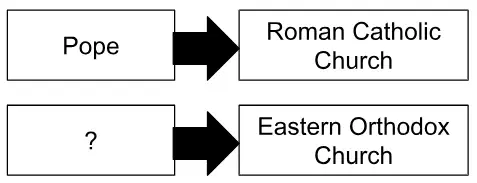
The diagram shows the relationship between religious leaders and their respective churches. The Roman Catholic Church is led by the Pope, while the Eastern Orthodox Church is led by the (a)   .

Choose from the below words
Pope
Patrician
Priest
Patriarch
2.
What is the term given to the parcel of land in the feudal system?
a)
Lord
b)
Vassal
c)
Fief
d)
Serf
3.
The leader depicted above was an unifying figure for which location on the map?
4.
Which of the following was a result of invasions by different tribes during the Middle Ages?
a)
Castles were built for protection
b)
The feudal system by causing a need for protection
c)
Trade was disrupted and towns declined
d)
All of the above
5.
Which of the following monarchs was responsible for the events listed above?
a)
King John
b)
Henry II
c)
William the Conqueror
d)
Hugh Capet
6.
Which group is responsible for spreading the Latin language to Germanic tribes in Western Europe
a)
Monasteries
b)
Parish Priests
c)
Missionaries
d)
Church Councils
7.
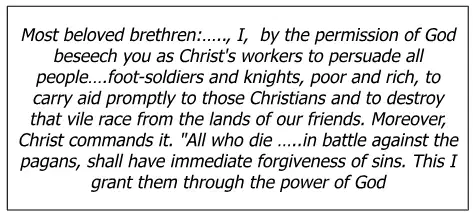
Which of the following men would most likely have have stated the quote above?
a)
King John
b)
Richard the Lionhearted
c)
Pope Urban II
d)
Hugh Capet
8.
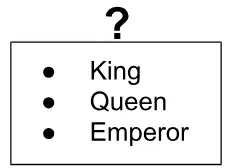
Which of the following terms best describes the list of titles above?
a)
Secular Titles
b)
Non-secular Titles
c)
Clergy Titles
d)
Parish Titles
9.

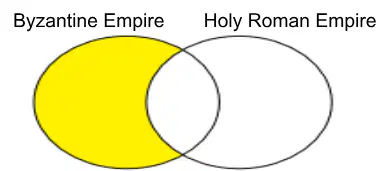
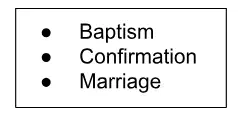
The shaded area of the Venn Diagram above best represents (a)   .
Choose from the below words
Greek Orthodox
Judaism
Roman Catholic
Islam
10.
What tribal group claimed Charlemagne as their king?
a)
Saxons
b)
Angles
c)
Vikings
d)
Franks
11.
Which of the following best replaces the question mark on the diagram above?
a)
Parishes
b)
Feudal Fiefs
c)
Monasteries
d)
Missionaries
12.
What event under Charlemagne allowed the Roman Catholic Church to become involved in the political arena?
a)
Charlemagne became bishop of the church
b)
The Pope crowned Charlemagne Holy Roman Emperor
c)
The Pope excommunicated him
d)
Charlemagne created the Papal States
13.

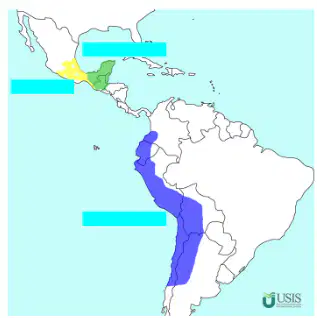
Drag the group to the geographic location the invaded Europe during the Middle Ages.
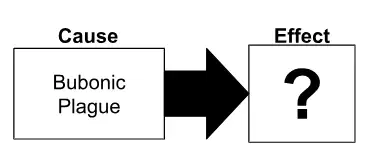
14.
Replace the question mark above to complete the cause/effect chart?
a)
Creation of Roman Catholicism
b)
Freed towns of feudal obligations
c)
Encouraged the use of Arabic numerals
d)
Increased conversion to Catholicism
15.
What did monasteries in Europe laid the foundation for?
a)
Universities
b)
Trade Routes
c)
Parishes
d)
Guilds
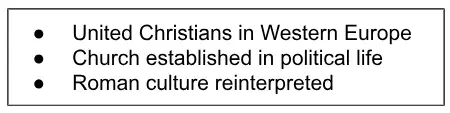
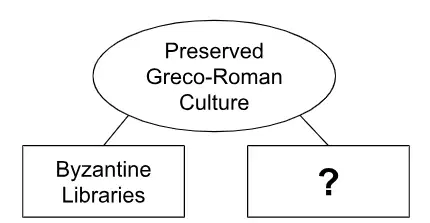
16.
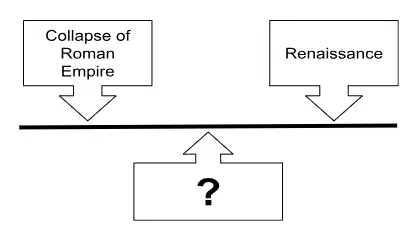
Which of the following choices best replaces the question mark?
a)
Classical Greece
b)
Reformation
c)
Middle Ages
d)
Paleolithic Era
17.
What is the title for someone who is granted land in the feudal system?
a)
Serf
b)
Vassal
c)
Noble
d)
King
18.

Select the number on the map represents the nation-state whose accomplishments are listed.
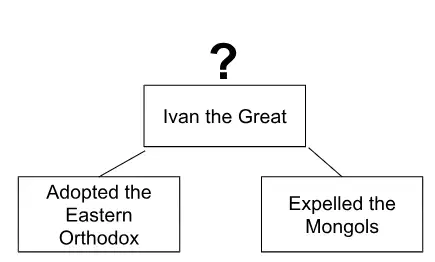
19.
What would be the best title for the diagram above?
a)
The End of the Crusades
b)
The Unification of France
c)
The Destruction of the Mongols
d)
The Unification of Russia
20.
What was the language of the well-educated Roman Catholic scholars in medieval Europe?
a)
Italian
b)
Latin
c)
Greek
d)
Cyrillic
21.
Which of the following people would perform the list of tasks for common people in medieval Europe
a)
Parish Priest
b)
Bishop
c)
Pope
d)
Cardinal
22.

Select the location on the picture above best represents the Lord’s Estate
23.
Which event of the Middle Ages encouraged the use of credit and banking?
a)
The Bubonic Plague
b)
The Crusades
c)
The Hundred Years’ War
d)
Battle of Tours
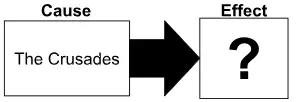
24.
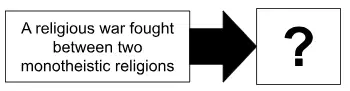
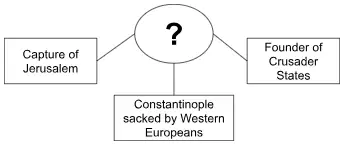
Replace the question mark above to complete the cause/effect diagram.
a)
An increase in religious tolerance
b)
The spread of Islam to Western Europe
c)
A decrease of hostility between the 3 major monotheistic religions
d)
An increase of hostility between the 3 major monotheistic religions
25.
Which of the following re-established Roman culture in Western Europe?
a)
Alliances between Frankish kings and the Church
b)
Alliances between Magyars, Vikings and Anglo-Saxons
c)
Alliances between Byzantines and the Franks
d)
The Byzantines destroyed all the Germanic tribes
26.
What best describes the economic system of feudalism?
a)
A set of rules designed to create a middle class by granting land to lesser vassals
b)
A loosely organized system of rule where vassals pledge service to powerful lords in turn for land
c)
An agreement between artisans and merchants to sell goods at fixed prices
d)
A system of checks and balances where vassals and lords share decision making powers
27.

Select the area that was predominately Eastern Orthodox
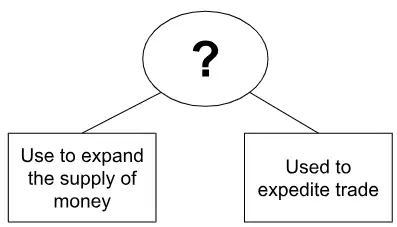
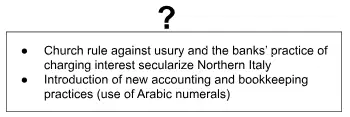
28.
Which of the following best replaces the question on the diagram above?
a)
Centralization of currency
b)
Letters of Credit
c)
The Conversion to Christianity
d)
Introduction of Arabic Numerals
29.
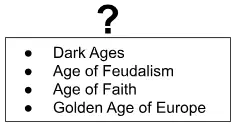
Which of the following time periods is being described in the list above?
a)
Classical Greece
b)
Classical Rome
c)
The Middle Ages
d)
Renaissance Era
30.
Who was most responsible for meeting the spiritual and social needs of the common people?
a)
Parish Priest
b)
Pope
c)
Cardinal
d)
Archbishop
31.
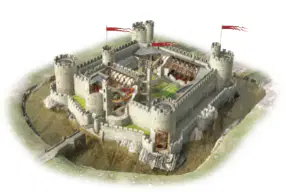
Which of the following reasons best justifies the construction of the building seen above?
a)
Invasion from the Magyars and Saxons
b)
A sign of power by the Catholic Church
c)
Protection from warring missionaries
d)
Protection from dangerous monasteries
32.
Which of the following best replaces the question mark on the diagram?
a)
Decline in population in Asia
b)
Weakening of the Byzantine Empire
c)
Destruction of the Holy Roman Empire
d)
Charlemagne converts the Franks to Christians
33.
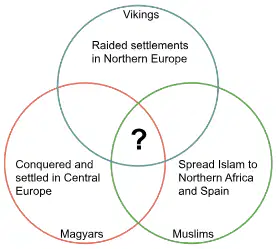
Which of the following best replaces the question mark on the diagram above?
a)
Religions that impact medieval life
b)
Invaders of Europe before the fall of Rome
c)
Invaders of Europe in the Middle East
d)
Religions of the Middle East
34.
Which of the following people would NOT be considered a vassal in medieval Europe?
a)
King
b)
Lord
c)
Knight
d)
Serf
35.
Which of the following would be the best title for the list above?
a)
Economic Effects of the Crusades
b)
Important Economic Concepts
c)
Religious Effects of the Crusades
d)
Important Religious Concepts
36.
Which area on the map did the Magna Carta have the most effect?
37.
Which event signifies the creation of the unified nation-state of Spain?
a)
The Inquisition
b)
Victory in the Hundred Years’ War
c)
The Battle of Tours
d)
The marriage of Ferdinand and Isabella
38.
Which number on the map above marks the location of the Islamic defeat at the Battle of Tours?
39.
Which monarch would have added the shaded area on the map above to their nation-state?
a)
Henry II
b)
Charles V
c)
Ferdinand & Isabella
d)
Hugh Capet
40.
Why did feudalism emerge in Western Europe?
a)
Due to the rise of scholasticism
b)
Due to the lack of protection for the people
c)
In order to provide more opportunities for trade
d)
In order to preserve the power of the Church
41.
Which of the following people accomplished the list of feats in the box above?
a)
Charles Martel
b)
Pope Leo III
c)
Charlemagne
d)
Pope Urban II
42.
What was the main role of serfs in the feudal system?
a)
Soldiers
b)
Explorers
c)
Laborers
d)
Missionaries
43.
What were Romans unable to protect Western European people from after the fall of the Western Roman Empire?
a)
Trade
b)
Disease
c)
Invasions
d)
Feudal system
44.
Which of the following terms best replaces the question mark on the diagram above?
a)
Parliament
b)
Estate General
c)
Absolute Monarchy
d)
Congress
45.
What occurred as a result of The Hundred Years’ War?
a)
Slavery ended
b)
Limitations were placed on taxes
c)
The nation-states of France and England were defined
d)
The King was forced to sign the Magna Carta
46.
In what year did the Ottoman Turks conquer Constantinople?
a)
1543 CE
b)
1453 CE
c)
1354 CE
d)
1435 CE
47.
Replace the question mark above to complete the cause/effect diagram.
a)
Execution
b)
Repentance
c)
Slavery
d)
Excommunication
48.
Which number on the map represents the country described the box above?
49.
What happened to trade after the Crusades?
a)
It decreased because merchants feared for their safety
b)
It decreased due to economic problems caused by the Crusades
c)
It increased because people wanted the products they had encountered during the Crusades
d)
It increased because Muslims forced Europeans to sign trade treaties
50.
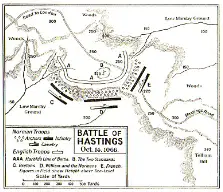
Who was the leader that took over England at the battle depicted above?
a)
Henry II
b)
William the Conqueror
c)
King John
d)
Richard the Lionhearted
51.
Which title best replaces the question mark on the diagram above?
a)
Effects of The Hundred Years’ War
b)
Major Events of the Middle Ages
c)
Events of the Crusades
d)
Effects of the Black Death
52.
Which monarch united most of France and moved the capital to Paris?
a)
Phillip II
b)
Hugh Capet
c)
William the Conqueror
d)
Henry II
53.
Which legal concept was established during the reign of Henry II?
a)
Common Law
b)
Magna Carta
c)
House of Lords
d)
House of Commons
54.
Which area on the map above would be ruled by a czar?
55.

The nation-state king credited with limiting his own power was (a)   .

Choose from the below words
Henry II
William the Conqueror
King John
Hugh Capet
56.
Which monarchy expelled the Moors and Jews from their nation-state?
a)
Henry II
b)
Ivan III
c)
Ferdinand & Isabella
d)
Phillip II
57.
Which empire was weakened as a result of the Crusades?
a)
Roman Empire
b)
Mongolia
c)
Byzantine Empire
d)
Ottoman Empire
58.

Which of the following events marked the end of the Byzantine Empire?

a)

The Treaty of Verdun

b)

The Council of Trent

c)

The Fall of Constantinople

d)

The Battle of Hastings

59.

Which of the following best describes the role of a serf in the feudal system?

a)

A peasant bound to the land

b)

A landowner who grants fiefs

c)

A warrior who serves a lord

d)

A religious leader in a parish

60.

Which of the following was a significant outcome of the Crusades?

a)

The establishment of the Holy Roman Empire

b)

Increased trade between Europe and the Middle East

c)

The unification of the Eastern Orthodox and Catholic Churches

d)

The decline of the Byzantine Empire

61.

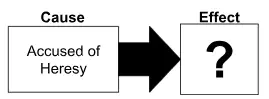
Which vocab. word is the best match for this image?

a)

Feudalism

b)

Reconquista

c)

Heresy

d)

Chivalry

62.

Why did the Church see a need to expand education in the Middle Ages?

a)

They thought it would help more people get to Heaven

b)

They wanted better educated clergy

c)

They wanted people of all classes to be educated

d)

They wanted to construct beautiful gothic universities

63.

What was the official purpose of the Crusades?

a)

To fight the rising Islamic Empire

b)

To reclaim the holy city of Jerusalem

c)

To gain wealth and power for the Church

d)

To conquer new land for European Kings

64.

Which of the following is NOT an effect of invasions by the Germanic Tribes (Angles and Saxons, Magyars, Vikings)?

a)

manors with castles provided protection

b)

trade was disrupted

c)

feudalism weakened

d)

towns declined

65.

The area shaded in white is controlled by what Germanic Tribe?

a)

Franks

b)

Magyars

c)

Angles and Saxons

d)

Vikings

66.

How did Charlemagne encourage the preservation of knowledge during the Middle Ages?

a)

Destroyed schools and churches

b)

Use priests to spread the Jewish faith

c)

He had scholars create illuminated manuscripts

d)

Hired storytellers to spread Roman culture

67.

Vassals who were granted their own fief were expected to pledge an oath of loyalty AND provide-

a)

Slaves to work the lord’s land

b)

Military Support

c)

Entertainment

d)

Farm animals and equipment

68.

Where did Angles and Saxons settle in Europe?

a)

England

b)

Russia

c)

Vikings

d)

Magyar

69.

In medieval times, what were pieces (parcels) of land called which were exchanged for loyalty?

a)

fiefs

b)

vassal

c)

serf

d)

convent

70.

Why do serfs choose to enter into Feudal agreements?

a)

taxes from fiefs

b)

loyalty from their vassals

c)

protection from invasion

d)

voting rights in government

71.

What is the name for peasants who work a noble's land?

a)

fiefs

b)

vassals

c)

serfs

d)

lords

72.

What became the unifying force in Western Europe after the decline of the Roman Empire?

a)

Caste System

b)

Greek Orthodox Church

c)

Roman Catholic Church

d)

Ethnic Groups

73.

Who served the social and religious needs of people during the Middle Ages? (hint: think local)

a)

monks

b)

vassals

c)

parish priests

d)

serfs

74.

In Medieval Europe, a lord who was granted land in exchange for service or loyalty to a greater lord was called a-

a)

fief

b)

vassal

c)

serf

d)

baron

75.

During the Middle Ages, the Manorial System:

a)

had no mutual obligations

b)

provided little class structure

c)

was self-sufficient

d)

was serf controlled

76.

Where did the Vikings settle after leaving Scandinavia?

a)

Russia

b)

England

c)

Hungary

d)

Gaul

77.

What is the BEST title for the Graphic?

a)

The Great Schism

b)

The Manorial System

c)

Age of Charlemagne

d)

Contributions of Justinian