
 Worksheets
BIO201 KELLAR EXAM 3 REVIEW
Total questions: 50
Worksheet time: 28mins
The central nervous system is comprised of...
brain
cranial nerves
spinal nerves
spinal cord
The afferent stimuli is called
Motor
Sensory
Integration
The Peripheral nervous system is regenerative to some extent
True
False
The motor division of the peripheral nervous system is further divided into how many subdivisions?
2
3
5
7
PNS Motor subdivision that is under voluntary control
Autonomic
Somatic
Involuntary control and smooth muscle regulation is what PNS Motor subdivision?
Autonomic
Somatic
"Fight or Flight" refers to what type of response?
(a)
Neurons do not leverage the sodium/potassium pump
True
False
How many glial cells are in the CNS?
(a)
Which glial cell DOES NOT reside in the central nervous system?
Astrocytes
Schwann cells
Microglia
Ependymal cells
Glial cell that produces CSF in the central nervous system:
Oligodendrocytes
Microglia
Ependymal cells
Satellite cells
Any mutations of the glial cells in the CNS can lead to:
(a)
Ganglia refers to a cluster of cell bodies in what nervous system?
CNS
PNS
Receive information and sends signals to the soma
(a)
Where the signal collects and determines if the signal fires or not(the trigger zone)
Soma
Axon Hillock
Dendrites
Synaptic Knob
most common type of neuron, 3 or more processes, small or no axon, most of the brain is multipolar
Unipolar
Bipolar
Multipolar
What is the resting membrane potential?
-50 mV
-55 mV
-70 mV
-75mV
What is threshold's membrane potential?
-55 mV
-50 mV
-75 mV
-70 mV
To pass through the plasma membrane(PM), what gates does sodium need to travel through?
leak channels
ligand-gated
voltage-gated
Do graded(local) potentials propagate all the way down a neuron?
Yes
No
Local potentials can be initiated by:
Energy
Heat
Light
Neurotransmitters
Which of the following is a characteristic of an action potential?
Reversible
All-or-none response
Can dissipate
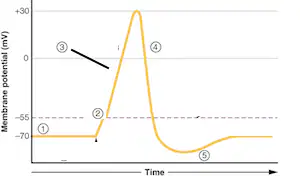
What is occurring at 3 on the graph pictured?
Only the potassium gates are open and are hyperpolarizing the cell
Only sodium gates are open and are repolarizing the cell
Sodium and potassium gates are closed and remain at resting membrane potential
Sodium and potassium gates are open and begin to depolarize the cell
What type of refractory period can fire another action potential if the stimulus is much larger?
Absolute
Relative
Gray matter consists of _______ axons, making action potentials travel ________ than those in white matter.
myelinated, faster
unmyelinated, slower
Which vertebra are most susceptible to injury(i.e. herniated discs?)
L1-L2
T4-T5
L4-L5
C2-C3
What layer of the meninges is the deepest and resides on the surface of the brain?
Dura mater
Arachnoid mater
Subarachnoid space
Pia mater
What neurotransmitter is blocked by the release of Botox?
Dopamine
Serotonin
Acetylcholine
GABA
Structure located in the ventricles are lined with ependymal cells to filter the blood and make/produce the CSF
choroid plexus
gyri plexus
forebrain plexus
ventricular plexus
Is this the correct flow of cerebrospinal fluid(CSF)?
1. Choroid plexus of lateral ventricles produce CSF
2. CSF flows through the interventricular foramina
3. Into the fourth ventricle
4. Through the cerebral aqueduct(aka: mesencephalic aqueduct, aqueduct of Sylvius)
5. Into the third ventricle
6. And into the subarachnoid space between the arachnoid and pia mater
Yes
No
A young infant comes to the emergency room with her head enlarged to three times the normal diameter of an infants head. This can be fixed by shunting the brain to drain the excess or blockage of cerebrospinal fluid. This infant presents with:
dwarfism
hydrocephalus
addison's disease
microcephalus
How do we know what type of meningitis a patient has to determine what route of treatment we take?
labotomy
MRI
spinal tap
epidural
White matter tract that deals with olfaction and long term memory. Connects regions of the brain in the same hemisphere(back to front, top to bottom, left to right)
Commissural tracts
Association tracts
Projection tracts
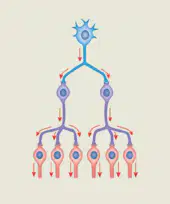
This type of neuronal circuitry can be defined as:
convergent
divergent
conjoined
limbic
Type of aphasia allows for word comprehension but does not allow for word production
Wernicke's aphasia
Broca's aphasia
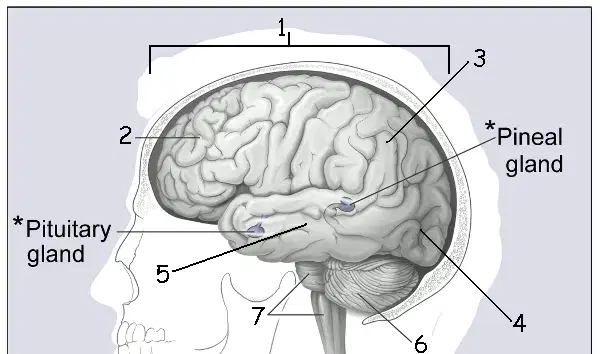
Number 4 of the diagram is what lobe?
temporal
parietal
occipital
frontal
True or false: Whiplash is not the most common injury in a car accident
True
False
The ______ gland is responsible for regulation of our circadian rhythms
pituitary
pineal
thalamus
adrenal
Continuous conduction is faster than saltatory conduction
true
false
Faster conduction down an axon can occur when:
there is no myelination
myelination is present
smaller diameter of myelin sheath
larger diameter of myelin sheath
A right-brained person is considered to be:
logic based
detail oriented
imagination ruled
pattern perceptioned
What connects the two hemispheres of the brain?
thalamus
corpus callosum
the cerebellum
pons
Structure responsible for hunger, thirst, and sex drive
thalamus
hypothalamus
pineal gland
pituitary gland
What makes up the majority of the brain?
Cerebrum
Cerebellum
Forebrain
Brain stem
At Resting Membrane Potential, there is a slightly negative charge in the intracellular fluid
True
False
An EPSP can inhibit a post-synpatic potential from firing an action potential
True
False
Lobe of the brain involved in higher thought, discriminates us from other mammalians; have larger frontal lobes(intelligence, intellect, personality, wittiness)
Occipital
Temporal
Frontal
Parietal
Which of the following IS NOT a part of the limbic system?
Cingulate gyrus
Precentral gyrus
Amygdala
Hippocampus
What bacterium can cause meningitis?
N. meningitdis
E. coli
S. pneumoniae
staphylococcus
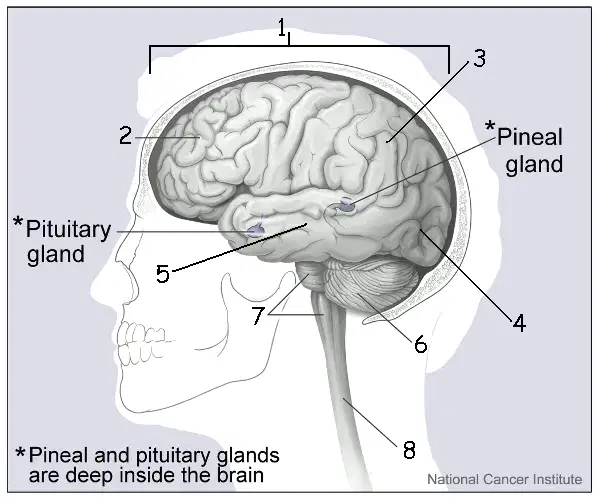
What is pictured at number 6 in this diagram?
Frontal lobe
Cerebellum
Cerebrum
Occipital lobe

