
Font size
 Worksheets
NYS LAB INVESTIGATIONS REVIEW
Total questions: 80
Worksheet time: 2hrs 57mins
Why is weather prediction complex, causing weather forecasts to be probabilistic (based on an educated guess)?
There are many different weather variables that interact and are constantly
changing.
Meteorologists make random guesses
Weather never changes
There are only a few variables that interact so weather predictions are facts
Weather forecasts are more accurate today than in the past due to use of ________________.
satellites
movies

What instrument measures wind speed?
anemometer
wind direction
thermometer

Which weather tool measures air pressure?
thermometer
barometer
anemometer
psychrometer

An instrument used to measure the amount of rainfall =
rain gauge

What instrument measures temperature?
Movement of air masses causes changes in the ______________.
weather
climate
A __________ is the boundary between 2 air masses.
barometer
front
anemometer
Precipitation occurs at _____________.
the center of air masses
fronts
Air traveling from Central Canada is:
continental tropical
continental polar
maritime tropical
maritime polar

The “L” on weather maps refers to ______________________. “H” refers to ___________________________.
low temperature, high temperature
low pressure, high pressure
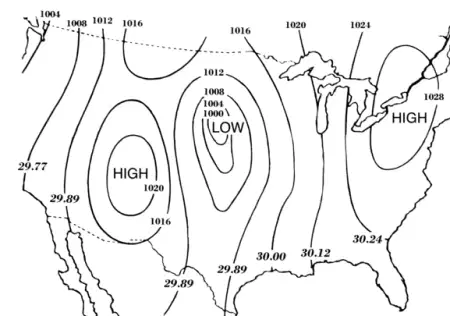
What are isobars?
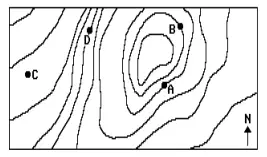
The map below represents a portion of an air-pressure field at the Earth's surface. At which position is the wind speed highest?
D
C
A
B
Weather in the US moves from SW to ________ due to the SW Planetary Wind belt.
SW
NE
NW
SE


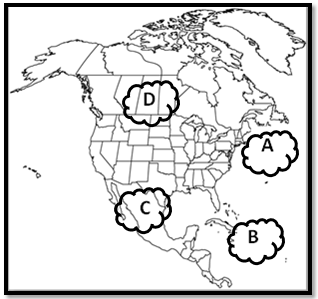
What type of weather is Texas (where the star is) likely experiencing in this image?
Clear skies and cooler weather
High winds and thunderstorms
Hot weather with a warm front
Cloudy skies with high winds
What type of weather is Long Island likely experiencing in this image?
Clear skies and cooler weather
High winds and thunderstorms
Warm and Wet conditions due to the warm front and Low Pressure
Cloudy skies with high winds


Which cities below would be experiencing precipitation?
A and B
B and D
C and B
D and A
Why is there precipitation when a cold air mass and a warm air mass meet?
warm air rises above cold air, expands, cools, and condenses forming clouds and rain.
cold air rises above warm air, expands, cools, and condenses forming clouds and rain.
cold air rises above warm air, compresses, warms, and evaporates
warm air sinks below cold air, compresses, warms, and evaporates
How do clouds form?
warm air rises, expands, cools, condenses = Clouds
warm air sinks, expands, cools, condenses = Clouds
cold air rises, expands, cools, condenses = Clouds
cold air sinks, compresses, warms, evaporates = no cloud
Fronts are associated with _______________
low pressure, slower winds, clouds
high pressure, faster winds, precipitation
low pressure, faster winds, clouds, precipitation
What happens to air at fronts?
warm air rises above cold air
warm air sinks below cold air
____________ air sinks/falls because it is ____________dense = ______ pressure
Cold, More, High
Warm, Less, High
Cold, Less, Low
Warm, More, Low
____________ air rises because it is ____________dense = ______ pressure
Cold, More, High
Warm, Less, High
Cold, Less, Low
Warm, Less, Low
In a high pressure area, the weather will likely be
clear and dry
warm and cloudy
cold and rainy
snowy and clear

As latitude increases, air temperature ________.
decreases
increases
remains the same
Lower latitude =
closer to the equator = warmer temperatures
closer to the equator = colder temperatures
closer to the poles = warmer temperatures
closer to the poles = cooler temperatures
Higher latitude =
closer to the equator = warmer temperatures
closer to the equator = colder temperatures
closer to the poles = warmer temperatures
closer to the poles = cooler temperatures

As elevation increases, air temperature
decreases.
increases.
remains the same.
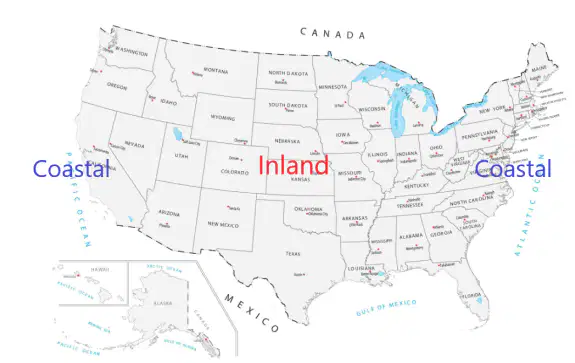
Locations near a large body of water have
moderate climates with a smaller temperature range = warmer winters and cooler summers.
moderate climates with a larger temperature range = cooler winters and warmer summers.
extreme climates with a larger temperature range = cooler winters and warmer summers.
extreme climates with a smaller temperature range = warmer winters and cooler summers.
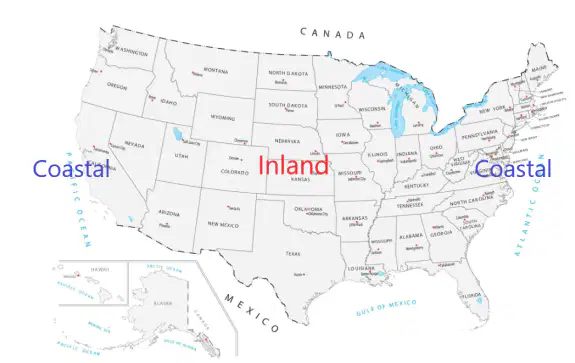
Inland locations =
moderate climates with a smaller temperature range = warmer winters and cooler summers.
moderate climates with a larger temperature range = cooler winters and warmer summers.
extreme climates with a larger temperature range = cooler winters and warmer summers.
extreme climates with a smaller temperature range = warmer winters and cooler summers.
The prevailing southwesterlies wind belt causes most low-pressure weather systems to travel across the United States from the
southwest toward the northeast
northwest toward the southeast
northeast toward the southwest
southeast toward the northwest
The Coriolis Effect is caused by what?
The wind blowing
Earth's gravity pulling things down
The rotation of the Earth
The pull of the Moon
_______ causes the Coriolis Effect
Earth's rotation
gravity
wind
density
What is a measure of the average kinetic energy of the molecules in an object?
heat
volume
kineticism
temperature
When particles in a substance are moving slower, temperature =
hotter
colder
the same

Which of the following statements is true regarding heat energy?
The quicker a molecule moves, the colder it is.
The slower a molecule moves, the warmer it is.
The quicker a molecule moves, the warmer it is.
The faster you dance, the quicker you get tired.


In heat transfer, heat always flows from the _______________ substance to the _______________ substance.
hotter to colder
colder to hotter
hotter to hotter
colder to colder
Heat transfers between two substances until they both reach
different temperatures
the same temperatures

Which number on the diagram is convection
Number 1
Radiation
Number 2
Conduction
Number 3
Convection
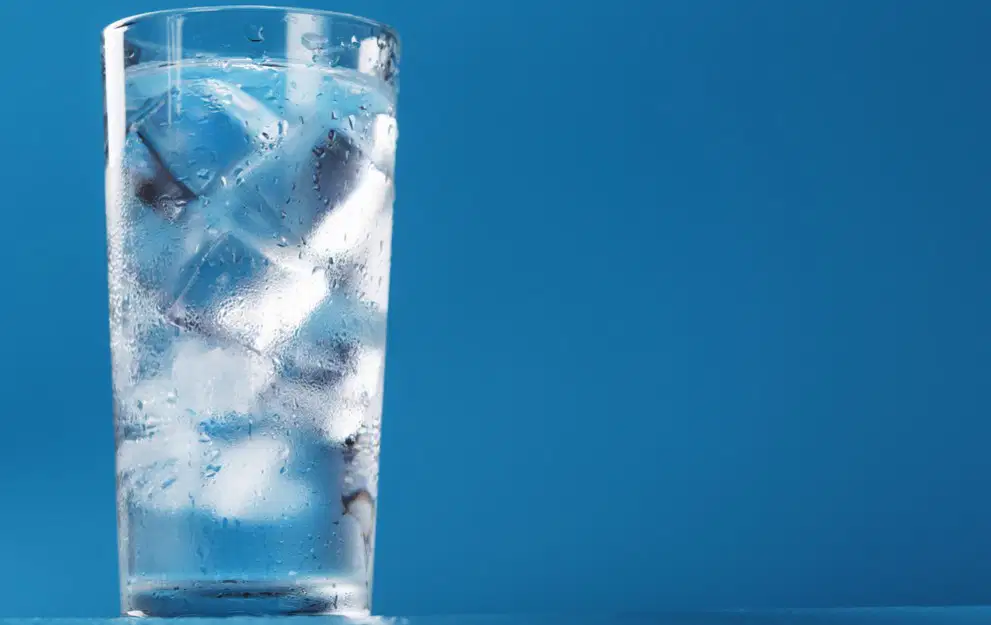
If you added ice (0oC) to a glass of water (25oC) how would the heat move between the ice & water?
from the ice to the water
from the water to the ice

In a closed system, all of the energy lost by the heat source is ___________
gained by the heat sink
released to the outside environment.
lost by the heat sink
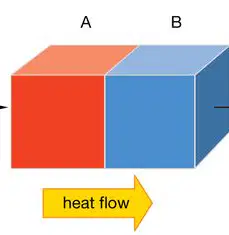
In a closed system, if Block A loses 20 degrees C , Block B will
gain 20 degrees C
lose 20 degrees C
gain 5 degrees C
Specific Heat describes
The energy required to change the state of a material without changing its temperature
The rate at which different materials change temperature
The temperature required to change the a material from solid to liquid
Kinetic Energy

A substance with a high specific heat
requires more energy to change its temperature
requires less energy to change its temperature

A substance with a high specific heat changes temperature more ______
quickly
slowly
A substance with a low specific heat
requires more energy to change its temperature
requires less energy to change its temperature
A substance with a low specific heat changes temperature more ______
quickly
slowly
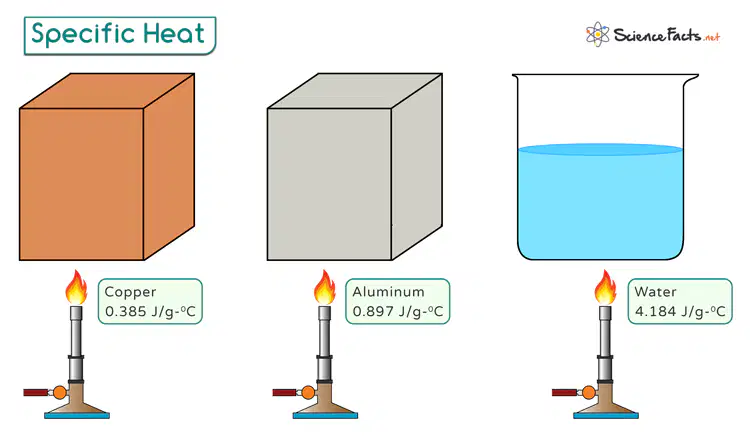
Which substance will heat up the slowest?
copper
liquid water
aluminum
basalt
Which substance will heat up the fastest?
lead
liquid water
aluminum
basalt
A mixtures is a combination of two or more____________ that are ___________ combined.
substances; physically
substances; chemically
compounds; chemically

Mixtures are separated based on their __________properties.
chemical
physical
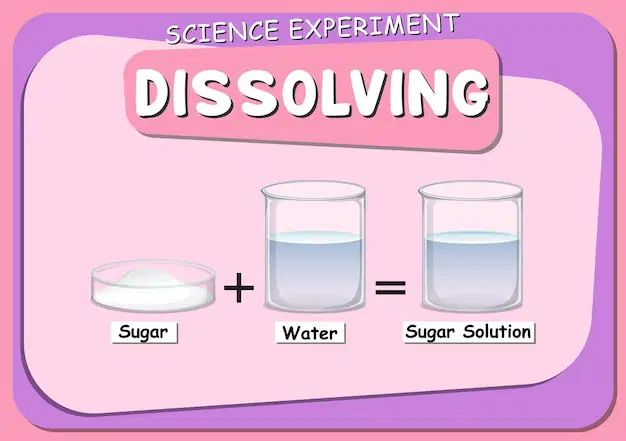
Which of the following dissolve in water? Choose all that apply.
sugar
salt
sand
iron filings
gravel
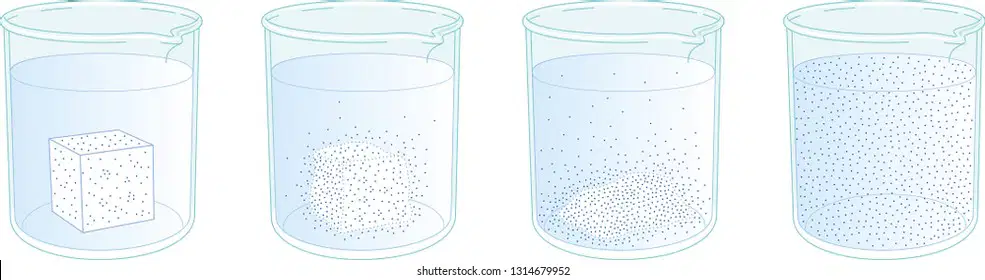
Choose three ways sugar/salt can dissolve faster in water.
heat it
cool it
crush it
stir it

To separate a solution (when one substance is dissolved into a liquid), the liquid can be evaporated to separate the two substances.
True
False

Mixtures can be separated when the materials in it have different densities.
True
False
Sometimes, more than one method of separating a mixture will be needed to separate all the materials in the mixture.
True
False
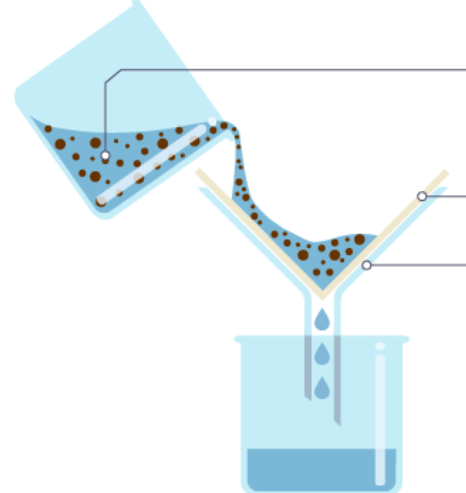
Which separation method is used in this picture?
Filtration
Evaporation
Distillation
Chromatography

During filtration, which substance cannot pass through the filter paper?
the solid
the liquid
What tool can you use to BEST separate a mixture of sand and water?
filter paper
strainer
Which one of the following would you use to separate rocks/gravel from sand?

tweezers

evaporation

Sifting with a sieve or strainer

magnet
Which one of the following would you use to separate salt from water?

Sifting/Straining

Evaporation

By hand

Using a Magnet

Filtration
Which one of the following would you use to separate sand from iron filings?
Sifting/Straining
Evaporating
Tweezer
Magnet
Filtration
Which one of the following would you use to separate sand from saltwater?
Sifting/Straining
Evaporating
Tweezer
Magnet
Filtration

Particles of salt and sand of similar size are mixed together. What would be the best method to extract the sand from the mixture?
Use tweezers to pick out the grains of sand.
Pour water into the mixture to let the salt dissolve and filter out the sand.
Use a sifter to separate the salt and the sand.
There is no way to do this.
How do you remove salt from a salt water solution?
use a sifter/filter
use a magnet
evaporate the water

