

wayground logo

Free Printable Worksheets

Font size

S
M
L
XL
Worksheets

Sound

Total questions: 44

Worksheet time: 57mins

Name
Class
Date
1.
Sound waves are what kind of wave?
a)
Longitudinal
b)
Transverse
c)
Surface
d)
Electromagnetic
2.
If you want to change the pitch of a sound, you have to change the ___
a)
frequency
b)
amplitude
c)
speed
d)
volume
3.
The speed of a sound wave depends on
a)
the frequency
b)
the medium
c)

both, the medium and the temperature of the medium

d)

the temperature of the medium

4.

Bats use ________ to locate mosquitos in the air.

a)
solar
b)
ecology
c)
echolocation
d)
evolution
5.
Which is a tool that is used in medicine to view internal organs and pregnancy.
a)
radar
b)
doppler
c)
ultrasound
d)
sonar
6.
What unit is the intensity of sound measured in?
a)
decibels (dB)
b)
Hertz (Hz)
c)
meters per second (m/s)
d)
meters
7.
A part in a longitudinal wave where the particles are spread apart
a)
compression
b)
rarefaction
c)
crest
d)
trough
8.
The Doppler effect can cause an apparent change in...
a)
loudness
b)
intensity
c)
pitch
d)
reasonance
9.

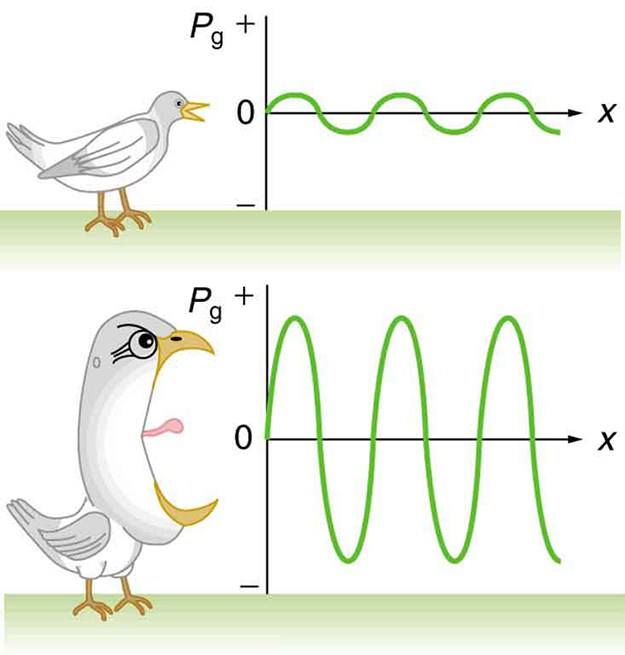
A disturbance that transfers energy from one place to another without transferring significant mass is called_______.

a)
wave
b)
trough
c)
pitch
d)
sound
10.
You and your father inspect an empty house with the hopes of buying it. You walk through the rooms talking to one another, and you notice that your voices and footsteps are echoing in the big, empty house. What causes the echo?
a)
sound waves reflecting off smooth, flat surfaces throughout the house
b)
sound waves moving around the large rooms
c)
sound waves moving slowly through air
d)
sound waves refracting around corners in the empty rooms
11.
After the train passed, the pitch of the train whistle became lower. This change in sound would be represented by what change in the diagram above? 
a)
The distance represented by C would increase. 
b)
The distance represented by C would decrease. 
c)
The distance represented by D would increase. 
d)
The distance represented by D would decrease. 
12.
When a sound is louder what measurement gets bigger?
a)
Frequency 
b)
Amplitude 
c)
Wavelength 
d)
Crest
13.

1 hertz is equal to

a)

1 vibration per minute

b)

10 vibrations per minute

c)

60 vibrations per minute

d)

600 vibrations per minute

14.

________ describes how LOUD a sound is.

a)

Amplitude

b)

Frequency

15.

What is the range of frequencies audible to the human ear

a)

lower than 20 Hz

b)

20 Hz - 20000 Hz

c)

higher than 20000 Hz

d)

0 Hz - infinite Hz

16.

What is ultrasound?

a)

Sound with a frequency higher than 20.000 Hz

b)

Sound with a frequency lower than 20 Hz

c)

Sound with a frequency 20 Hz

d)

sound with a frequency 20000 Hz

17.

The unit for measuring frequency is the ---

a)

Joule

b)

Hertz

c)

Gram

d)

Newton

18.

In a longitudinal wave, the particles move...

a)

In an up and down motion

b)

In the same direction that the wave is moving

19.

Which two materials will absorb sound?

a)

Wooden or tiled floors

b)

Cushions/pillows

c)

Fabric curtains

d)

Glass

20.

Which two materials will reflect sound, creating echoes?

a)

Wooden or tiled floors

b)

Cushions/pillows

c)

Fabric curtains

d)

Bare walls

21.
When comparing the two waves that are shown, how would Wave A (green wave) differ than Wave B (black wave)?
a)
Wave A and B have the same amplitude, but wave B (black) has a lower pitch.
b)
Wave A and B have the same amplitude, but Wave A has a lower pitch. 
c)
Wave A and B have the same pitch, but Wave A is a softer sound. 
d)
Wave A and B have the same pitch, but Wave B is a softer sound. 
22.
A wave that requires a medium through which to travel
a)
mechanical wave
b)
chemical wave
c)
electromagnetic wave
d)
pitch
23.
Which of the following would you hear as a low pitched sound? 
a)
sound wave with a frequency of 50 Hz
b)
sound wave with frequency of 10,000 Hz
c)
sound wave with an intensity of 10 dB
d)
sound wave with an intensity of 100 dB
24.
A tuning fork starts to vibrate when a certain note is played on the piano, This is an example of _______.
a)
resonance
b)
refraction
c)
diffraction
d)
reflection
25.

In the diagram which letters represent the nodes

a)

A B C

b)

A C E

c)

B D

d)

B D E

e)

A C D

26.
What kind of wave is pictured?
a)
Transverse
b)
Longitudinal
c)
surface
d)
none of the above
27.
How is sound produced by these instruments?
a)
Striking the surface
b)
vibrating columns of air
c)
plucking the strings
28.
When two waves combine to form a new wave with a smaller amplitude, it is called 
a)
Refraction
b)
Constructive Interference
c)
Resonance
d)
Destructive Interference
29.

Natural frequency is best described as

a)

the frequency at which an object naturally vibrates at when it is disturbed

b)

a vibration that can be heard in the wild

c)

the radio frequency that astronauts naturally use when travelling into space

d)

the material used to make a swing

30.
As the amplitude of a sound increases, the loudness
a)
increases
b)
decreases
c)
does not change
d)
cancels out
31.
___ is the study of sound.
a)
Acoustics
b)
Reverberation
c)
Echolocation
d)
Infrasound
32.

Sound waves having frequency less than 20 Hz are

a)

Ultrasonic sound waves

b)

Infrasonic sound waves

c)

Supersonic sound waves

d)

Sonic boom

33.

9. The frequency of a wave is measured in (a)   .
Choose from the below words
Hertz
Crest
Trough
Compression
Rarefaction
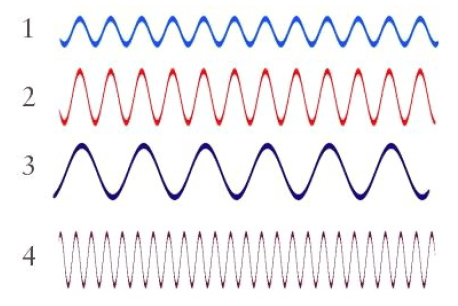
34.
Which wave in the diagram has the greatest frequency?
35.

 A wave has frequency of 50 Hz and a wavelength of 10 m. What is the speed of the wave? (a)  

Choose from the below words
500 m/s
50 m/s
5 m/s
0.5 m/s
36.
 A wave has frequency of 5 Hz and a speed of 25 m/s. What is the wavelength of the wave?
a)
25 m
b)
125 m
c)
5 m
d)
25 m/s
37.

Time taken for one complete oscillation in the density of the medium is called the __________ of the wave.

a)

Frequency

b)

Time Period

c)

Wave length

38.

Higher the Time Period, _____________ the frequency.

a)

Higher

b)

Lower

39.

Which of these is true about the loudness of a sound? (Mark all that apply)

a)

Loudness is relative.

b)

Lower the amplitude, louder the sound.

c)

It depends on the distance from the source of the sound.

d)

Larger the surface area of the vibrating object, louder the sound.

40.

One of these pairs is incorrectly matched. Which one?

a)

< 20 Hz - Infrasonic

b)

> 20,000 Hz - Infrasonic

c)

20 - 20,000 Hz - Human Audible range

41.

__________ is a sound reflection technology applied in ships at sea using the reflection of sound waves to determine the depth of the sea.

a)

Reflection

b)

Echo

c)

Solar

d)

Sonar

42.

2. Which types of materials are good reflectors of sound

a)

Thin

b)

Thick

c)

Hard and flat

43.

Why is the school library covered with carpet?

a)

So everyone can make a lot of noise

b)

because it looks good

c)

to help absorb sounds so it can stay noisy

d)

to help absorb sounds to keep it quiet

44.

What happens to the pitch of the sound when the amplitude increases?

a)

the pitch gets higher

b)

the pitch gets lower

c)

the pitch doesn't change

d)

the pitch gets louder
