
NEW
Font size
 Worksheets
P2 - Thermal physics
Total questions: 72
Worksheet time: 56mins
Which one is a property of a liquid
Takes the shape of its container
Has a fixed volume
Particles vibrate about fixed point
Has a fixed shape
The particles in a solid can...
Move freely
Have no bonds
Vibrate about a fixed point
Melt
Brownian motion is defined as...
The random movement of small particles due to collisions with larger particles
The random movement of particles in a solid due to collisions with smaller surrounding particles
The random movement of particles around us
The random movement of particles in a fluid due to collisions with smaller surrounding particles
When a substance is heated what happens to the particles
They change state
They evaporate
They gain kinetic energy and move more
They melt
During a change of state the temperature of a substance...
Stays the same
Increases
Decreases
Evaporation...
Happens to every molecule in a boiling liquid
Only happens to the particles at the surface
Will increase with a smaller surface area
Is the same as boiling
When a gas changes to a liquid it is called...
Evaporation
Condensation
Boiling
Melting
How does changing the temperature affect gas pressure?
Lower temperature means higher pressure
Higher temperature means higher pressure
Higher temperature means lower pressure
Temperature has no effect
Which substance expands most when heated?
Solid
Liquid
Gas
All the same
To make a thermometer more sensitive you can...
Decrease the length
Decrease the diameter of the tube
Increase the length
Decrease the volume of the bulb
Heat transfer through a solid is called..
Conduction
Convection
Radiation
Melting
When gas is heated it becomes...
More dense
Heavier
Less dense
Lighter
Which energy transfer does not require any particles?
Convection
Conduction
Radiation
None of the above
Which colour absorbs the most heat?
Black
White
Yellow
Silver

A metal rod is heated at end X. Why does end Y of the metal rod become hot?
Energy is transferred from end X of the rod to end Y by vibration of positive ions and by
movement of electrons.
Energy is transferred from end X of the rod to end Y by movement of positive ions only.
Energy is transferred from end X of the rod to end Y by vibration of positive ions only.
Energy is transferred from end X of the rod to end Y by movement of electrons only.
A liquid at room temperature is put on a metal surface which is also at room temperature. A student blows gently across the liquid and its temperature decreases. What causes the liquid to become cooler?
Bubbles of water vapour form in the liquid and go into the air.
The moving air reduces the kinetic energy of all the particles in the liquid.
Thermal energy flows from the liquid into the metal.
The more energetic particles in the liquid escape into the air.
A gas is contained in a sealed container in a laboratory. The temperature of the gas increases. What happens to the average speed and what happens to the total kinetic energy of the gas molecules?
average speed does not change, total kinetic energy does not change
average speed does not change, total kinetic energy increases
average speed increases, total kinetic energy does not change
average speed increases, total kinetic energy increases
The liquid level in a thermometer rises when the thermometer is placed in hot water. What causes this?
The liquid contracts.
The liquid evaporates.
The liquid expands.
The liquid freezes.

The diagram shows a liquid-in-glass thermometer. Which change to the design would result in a more sensitive thermometer?
Increase the density of the liquid.
Increase the diameter of the capillary tube.
Increase the number of scale markings.
Increase the volume of the bulb.
Which statement about boiling and evaporation is correct?
Boiling requires a supply of thermal energy but evaporation does not.
Evaporation takes place at the surface of a liquid but boiling takes place throughout the liquid.
When water boils in a kettle, its temperature decreases.
When water evaporates, its temperature increases.
Why are small gaps left between the metal rails of a railway track?
to allow for expansion of the rails on a hot day
to allow for contraction of the rails on a hot day
to allow for expansion of the rails on a cold day
to allow for contraction of the rails on a cold day
Three students are planning an experiment to test thermal conduction in different materials. The students each propose a hypothesis.
1. I think the copper rod will be a good thermal conductor because it is a metal.
2. I think the glass rod will be a good thermal conductor because it has free electrons that vibrate and transfer energy quickly.
3. I think the wooden rod will be a poor thermal conductor because it can only transfer energy along the rod by vibrating the lattice particles.
Which of their hypotheses are correct?
1 and 2 only
1 and 3 only
2 and 3 only
1, 2 and 3
Which statement about evaporation is correct?
evaporation causes the temperature of the remaining liquid to decrease
evaporation does not occur from a cold liquid near its freezing point
evaporation does not occur from a dense liquid, such as mercury
evaporation occurs from all parts of a liquid
Which causes the random, zig-zag movement (Brownian motion) of smoke particles suspended in air?
air molecules colliding with smoke particles
convection currents as the hot smoke rises
smoke particles colliding with each other
smoke particles reacting with oxygen molecules in the air

A sealed gas cylinder is left outside on a hot, sunny day. What happens to the average speed of the gas molecules and to the pressure of the gas in the cylinder as the temperature of the gas rises?
A
B
C
D
A swimmer feels cold after leaving warm water on a warm, windy day. Why does she feel cold even though the air is warm?
the less energetic water molecules on her skin escape quickly
the more energetic water molecules on her skin do not escape quickly
the water on her skin does not evaporate quickly enough to keep her warm
the water on her skin evaporates quickly and cools her skin
A car tyre has a constant volume. Why does the pressure of the air in the tyre increase when its temperature increases?
the air molecules hit each other less often
the air molecules hit the inside of the tyre less often
the average speed of the air molecules in the tyre is greater
there are more air molecules in the tyre

A solid is heated from room temperature. The graph shows how its temperature changes with time as it is heated constantly. At which time has it just become completely liquid?
A
B
C
D

The diagram shows a vacuum flask used to keep liquid hot. How does thermal energy pass through the vacuum?
conduction only
convection only
radiation only
conduction and convection

The air in a room is heated by a heater. The diagram shows the circulation of the air in the room. Which statement about the air that is heated is correct?
The air contracts and become less dense
The air contracts and becomes more dense
The air expands and becomes less dense
The air expands and becomes more dense

In a refrigerator, the cooling unit can be fitted either at the top or at the bottom. In an oven, the heater can be fitted either at the top or at the bottom. Which row shows the best position for the cooling unit and the best position for the heater?
A
B
C
D

Which row shows the surface that is the better absorber and the surface that is the better emitter of infra-red radiation?
A
B
C
D

The diagram shows electricity cables being put up on a warm day. The cables are left loose between the poles, as shown in the diagram. Why are the cables left loose?
they will contract on cold days
they will contract on very warm days
they will expand on cold days
they will expand on very warm days

The diagram shows four beakers A, B, C and D. The beakers contain different amounts of the same liquid at the same temperature. The beakers are left next to each other on a laboratory bench overnight. The diagrams are all drawn to the same scale.
From which beaker does the largest quantity of liquid evaporate?
A
B
C
D

Which statement about the experiment is correct?
A
B
C
D

Which line in the table shows the relative expansion of the three states of matter from the most expansion to the least expansion?
A
B
C
D

Between which labelled points on the graph is the substance partly solid and partly liquid?
between P and Q
Between Q and R
Between R and S
Between S and T
Temperature is a measure of the...
average kinetic energy of each molecule in a substance
Explain the process of convection and how it relates to heat transfer.
Convection is the process of heat transfer through the movement of fluids, where heated fluid rises and cooler fluid sinks, creating a continuous circulation.
Convection involves the transfer of heat through electromagnetic waves
Convection is the process of heat transfer through solid materials
Convection is only applicable in outer space
Convection transfers heat by the direct contact between objects
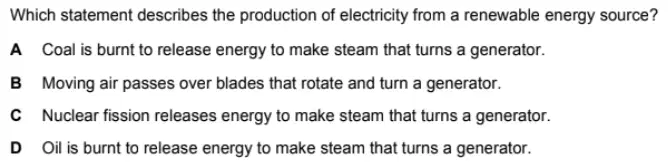
Which statement describes the production of electricity from a renewable energy source?
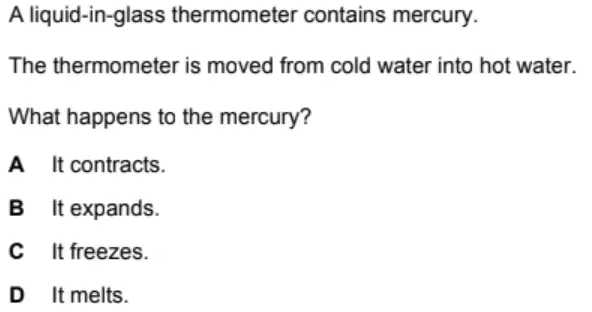
What happens to the mercury?
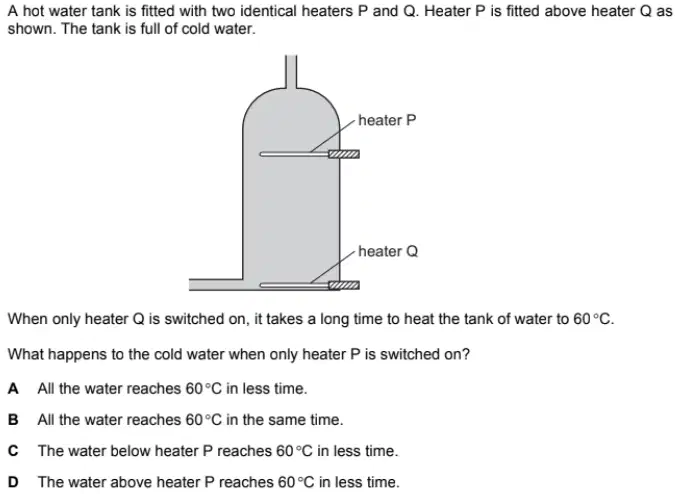
What happens to the cold water when only heater P is switched on?
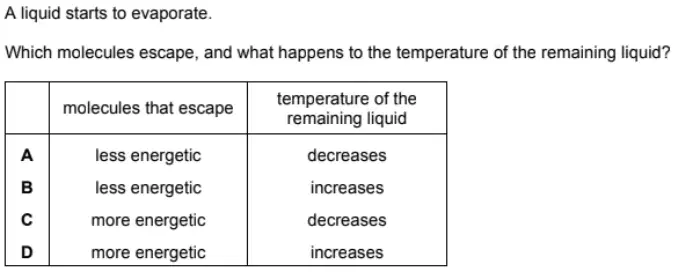
A liquid starts to evaporate.
Which molecules escape, and what happens to the temperature of the remaining liquid?
Which material is a bad thermal conductor?
What is the main method of heat transfer within the water?
What are the main methods by which heat is transferred through the metal pan to the water and throughout the water?
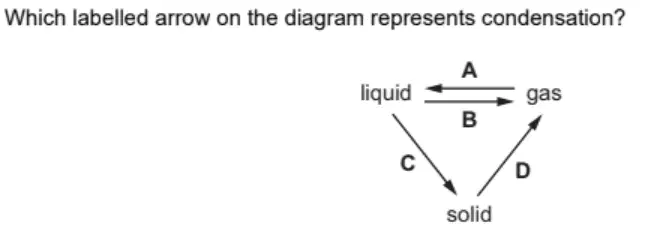
Which labelled arrow on the diagram represents condensation?

What is the temperature of ice as it melts?
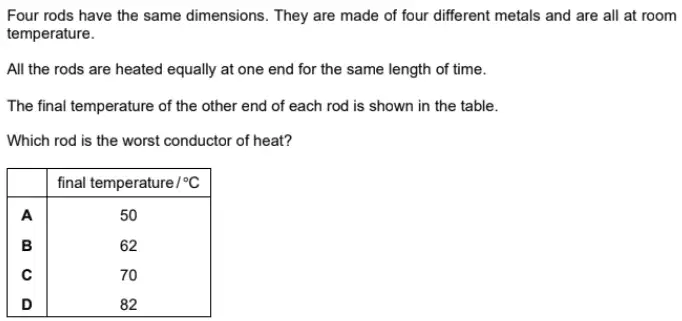
Which rod is the worst conductor of heat?
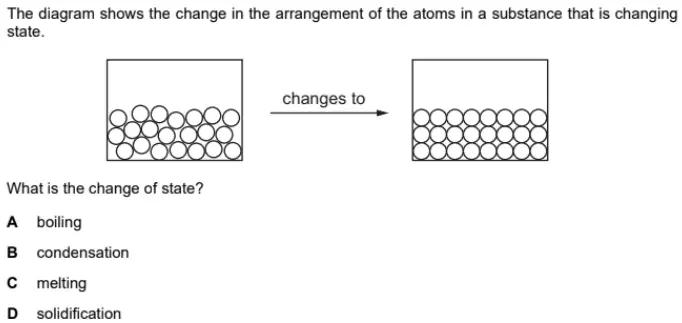
What is the change of state?
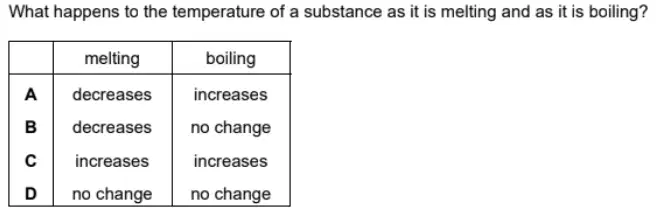
What happens to the temperature of a substance as it is melting and as it is boiling?
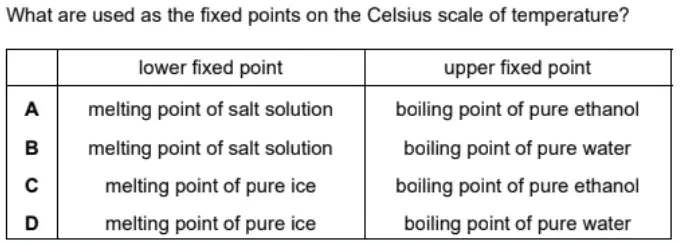
What are used as the fixed points on the Celsius scale of temperature?
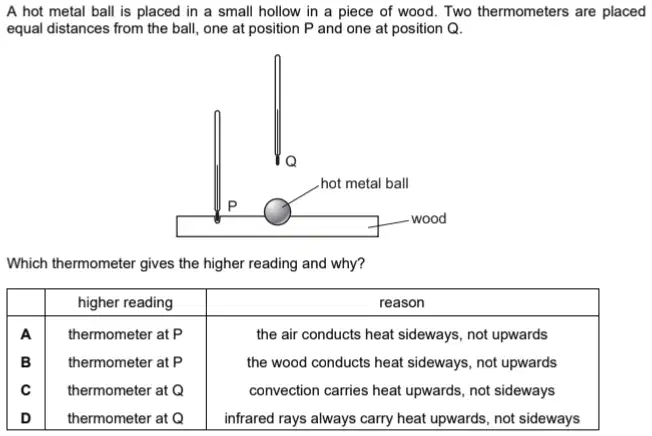
A hot metal ball is placed in a small hollow in a piece of wood.
Two thermometers are placed at equal distances from the ball, one at position P and one at position Q.
Which thermometer gives the higher reading and why?
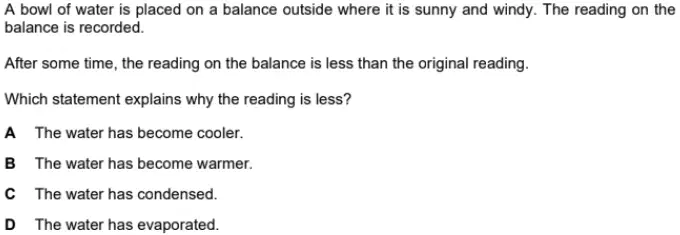
Which statement explains why the reading is less?
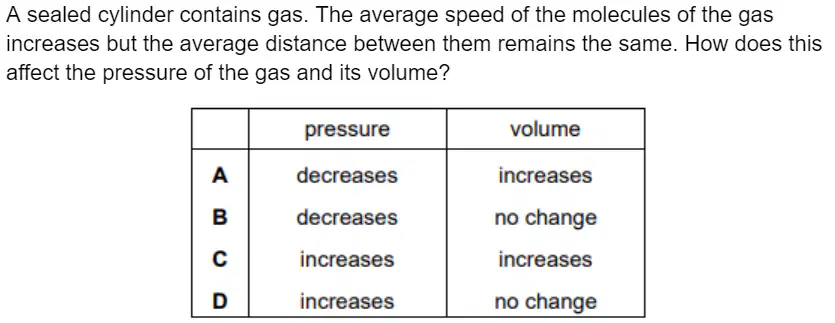
A sealed cylinder contains gas.
The average speed of the molecules of the gas increases but the average distance between them remains the same.
How does this affect the pressure of the gas and its volume?
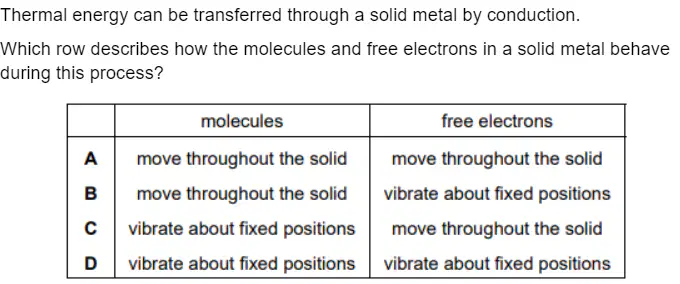
Which row describes how the molecules and free electrons in a solid metal behave during this process?

Which example of thermal conduction involves energy transfer by electrons?
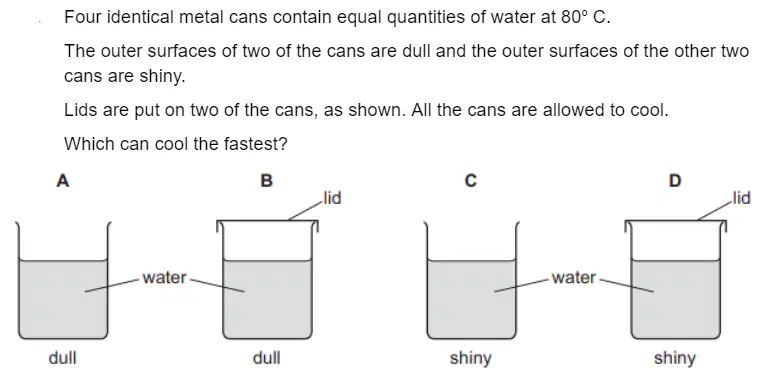
Which can cool the fastest?

A solid metal transfers energy by thermal conduction.
What causes this transfer?
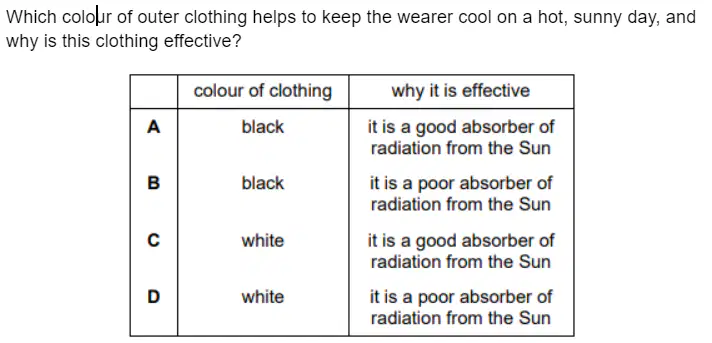
Which color of outer clothing helps to keep the wearer cool on a hot, sunny day, and why is this clothing effective?
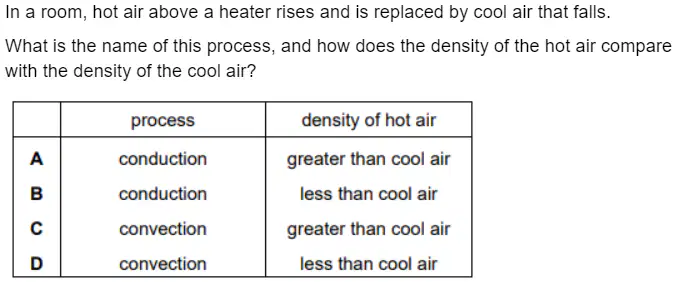
What is the name of this process, and how does the density of the hot air compare with the density of the cool air?

The more energetic molecules of a liquid are escaping from its surface, causing the liquid to cool.
What is happening to the liquid?

Which statement about the evaporation of a liquid is correct?

Which statement describes the conduction of thermal energy through a metal bar?
What is the method that energy transfer by the direct contact between solid objects?
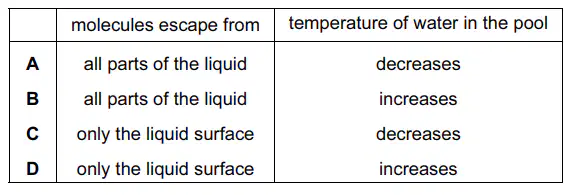
A pool of water evaporates. As molecules escape, the temperature of the water left in the pool changes.
From where do the molecules escape and what is the effect on the temperature of the water in the pool?
A
B
C
D
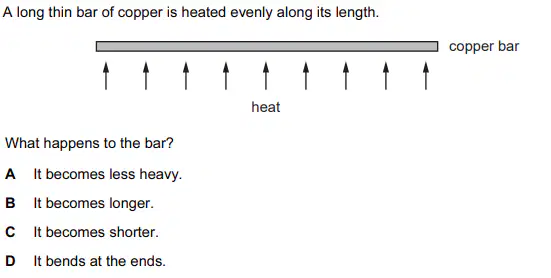
What happens to the bar?
A
B
C
D
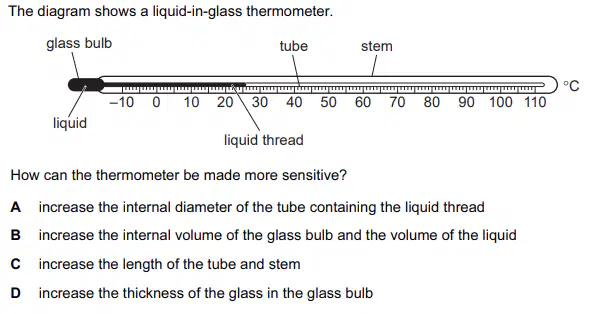
How can the thermometer be made more sensitive?
A
B
C
D
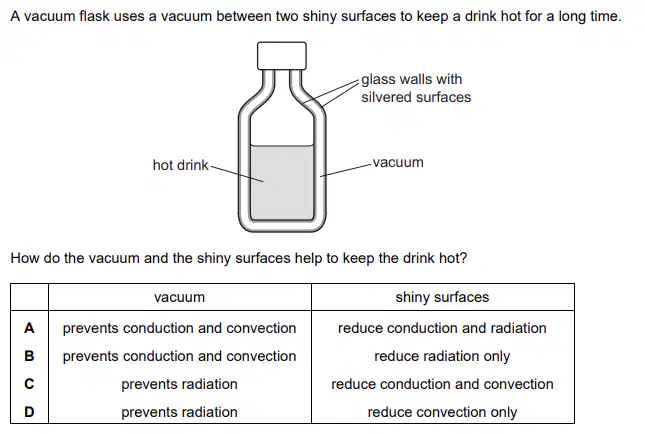
How do the vacuum and the shiny surfaces help to keep the drink hot?
A
B
C
D
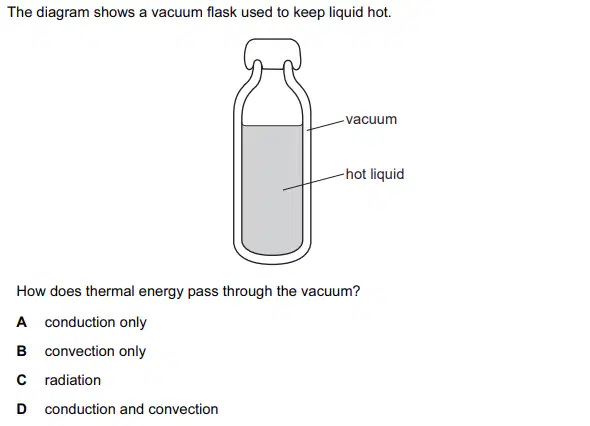
How does thermal energy pass through the vacuum?
A
B
C
D
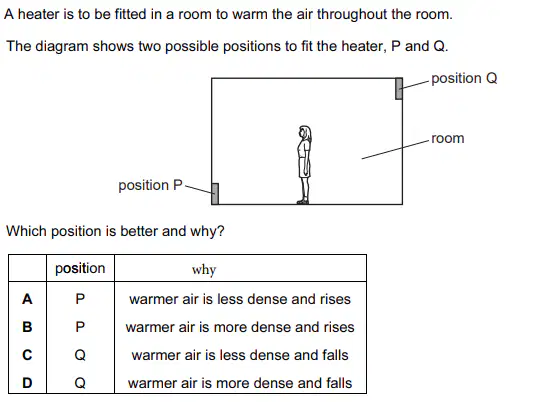
A heater is to be fitted in a room to warm the air throughout the room.
The diagram shows two possible positions to fit the heater, P and Q.
Which position is better and why?
A
B
C
D
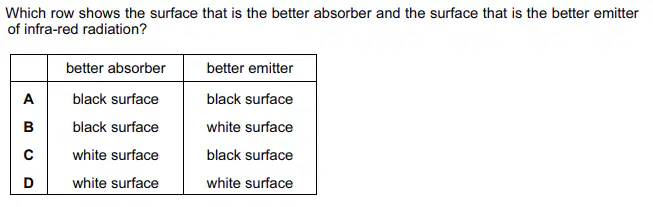
Which row shows the surface that is the better absorber and the surface that is the better emitter of infra-red radiation?
A
B
C
D

