
 Worksheets
DCA 4 - Review
Total questions: 70
Worksheet time: 51mins
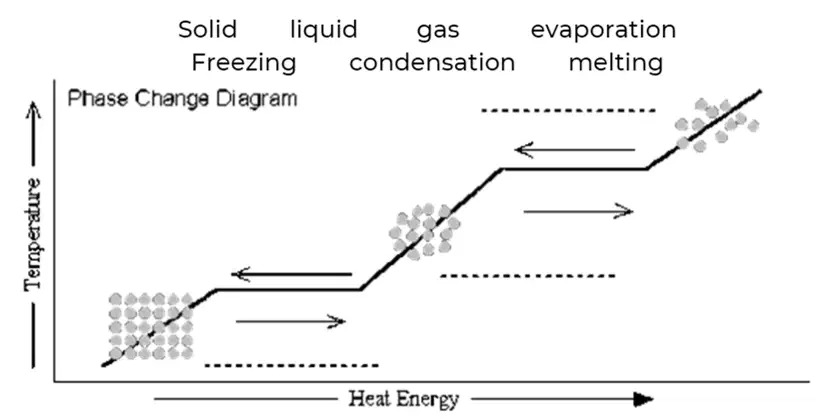
Which phase change in the diagram is represented by the transition from liquid to gas?
Freezing
Melting
Evaporation
Condensation
Which phase change in the diagram is represented by the transition from liquid to solid?
Freezing
Melting
Evaporation
Condensation
Which phase change in the diagram is represented by the transition from solid to liquid?
Freezing
Melting
Evaporation
Condensation
Which phase change in the diagram is represented by the transition from gas to liquid?
Freezing
Melting
Evaporation
Condensation
Which property does NOT change with the size of the sample?
Boiling point
Mass
Volume
Length
Which property does NOT change with the size of the sample?
Shape
Mass
Flammability
Length
Which property does NOT change with the size of the sample?
Shape
Mass
Volume
Melting Point
Which property does NOT change with the size of the sample?
Shape
Density
Volume
Length
Is the odor of a fresh cut lemon a physical or chemical property?
Physical property
Chemical property
Neither physical nor chemical property
Both physical and chemical property
What is the property of magnetism classified as?
Physical property
Chemical property
Neither physical nor chemical property
Both physical and chemical property
What type of change is rusting considered to be?
Physical change
Chemical change
Neither physical nor chemical change
Both physical and chemical change
Is boiling water an example of a physical or chemical change?
Physical change
Chemical change
Neither physical nor chemical change
Both physical and chemical change
What type of change does cutting a banana represent?
Physical change
Chemical change
Neither physical nor chemical change
Both physical and chemical change
Which container would you use to find the volume of an irregular object?
Beaker
Graduated cylinder
Flask
Test tube
If an object has a mass of 27 grams and a volume of 3 cm³, what is its density?
9 g/cm³
30 g/cm³
3 g/cm³
27 g/cm³
What is the density of an object that has a mass of 120 grams and a volume of 24 cm³?
5 g/cm³
120 g/cm³
24 g/cm³
0.2 g/cm³
Which of the following objects will float in water?
Dish soap 1.06 g/cm³
Aluminum 2.71 g/cm³
Styrofoam 0.96 g/cm³
Pony bead 1.02 g/cm³
Based on the density of water (1.0 g/cm³), which of these objects will sink in water?
Dish soap 1.06 g/cm³
Popcorn kernel 1.224 g/cm³
Oil 0.92 g/cm³
Pony bead 1.02 g/cm³
Which of the following is a chemical property?
Color
Boiling point
Ability to rust
Mass

Burning Wood
Physical Property
Chemical Property
Physical Change
Chemical Change

Melting Ice into Water
Physical Property
Chemical Property
Physical Change
Chemical Change

Baking Cookies
Physical Property
Chemical Property
Physical Change
Chemical Change

Boiling Point
Physical Property
Chemical Property
Physical Change
Chemical Change

Folding Origami
Physical Property
Chemical Property
Physical Change
Chemical Change

Malleability
Physical Property
Chemical Property
Physical Change
Chemical Change

Flammable
Physical Property
Chemical Property
Physical Change
Chemical Change

Hardness
Physical Property
Chemical Property
Physical Change
Chemical Change

Changing color
Physical Property
Chemical Property
Physical Change
Chemical Change

Explosion of fireworks.
Physical Property
Chemical Property
Physical Change
Chemical Change

Evaporation of water
Physical Property
Chemical Property
Physical Change
Chemical Change

Getting a haircut
Physical Property
Chemical Property
Physical Change
Chemical Change

Taste
Physical Property
Chemical Property
Physical Change
Chemical Change

Odor
Physical Property
Chemical Property
Physical Change
Chemical Change

A solid forms when two liquids are mixed.
Physical Property
Chemical Property
Physical Change
Chemical Change
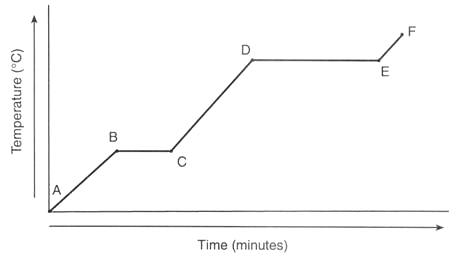
Are the particles moving faster or slower as time goes on?
Faster
Slower
What is happening to the particles in the substance between points A and B?
Melting
Freezing
Speeding Up
Slowing Down
What is happening to the particles in the substance between points D and E?
Melting
Freezing
Vaporizing
Sublimating

The melting point of the sample is
-60 ºC
-100 ºC
60 ºC
100 ºC

Given the heating curve of a solid being heated at a constant rate, what is the boiling point of this substance?
20°C
50°C
110°C
170°C

What term goes on the y-axis? (A)
Heat(Energy)
Temperature
Phase
Type of Matter
What term goes on the x-axis? (B)
Heat(Energy)
Temperature
Phase
Type of Matter
What phase of matter exists in part C of the graph?
Gas
Liquid
Solid
Plasma
What phase of matter exists in part D of the graph?
Gas
Liquid
Solid
Plasma
What phase of matter exists in part E of the graph?
Gas
Liquid
Solid
Plasma
What phase change occurs when you start at D and end at E?
Freezing
Melting
Condensing
Vaporization
What phase change occurs when you start at D and end at C?
Freezing
Melting
Condensing
Vaporization
What phase change occurs when you start at E and end at D?
Freezing
Melting
Condensing
Vaporization
What phase change occurs when you start at C and end at D?
Freezing
Melting
Condensing
Vaporization
On which parts of the graph does the temperature remain the same?
Between C and D
Between D and E
At C, D, or E
On both flat sections
Which of the following is a physical change?
Burning wood
Dissolving salt in water
Corroding iron
Rotting of fruit
What are the 3 States of Matter
Solid, Iron, Gas
Solid, Liquid, Gas
Iron Liquid Gas
Metals, nonmetals, metalloids
The particles of this state of matter are close together
Solid
liquid
Gas
Why does a penny Sink in water
Pennies are less dense than water
Pennies are more dense than water
What does ice float in water?
Ice cubes are less dense than water
Ice cubes are more dense than water
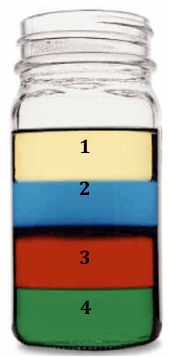
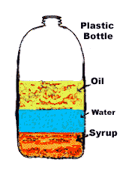


What happens to air molecules when they are heated?
they come together
they seperate
they don't move
they stay the same.
What happens to air molecules when they are cooled?
They spread apart
they become compacted
they stay the same
they move quickly
Warm air is _____ dense than cool air.
more
less
the same

