

wayground logo

Free Printable Worksheets

Font size

S
M
L
XL
Worksheets

Unit 10 IMF and Condensed States

Total questions: 62

Worksheet time: 38mins

Name
Class
Date
1.
What explains the very high melting and boiling point of water
a)
Strong dipole-dipole bonds between water molecules
b)
Strong hydrogen bonds between water molecules
c)
Dispersion forces which are present in all molecules
d)
Asymmetrical shape of the polar bonds.
2.

Which substance would have the weakest intermolecular forces of attraction?

a)

CH4

b)

NaCl

c)

H2O

d)

MgF2

3.

Which substance has the weakest intermolecular forces?

a)

Substance A, boiling point of 75 °C

b)

Substance B, boiling point of 105 °C

c)

Substance C, boiling point of 25 °C

d)

Substance d, boiling point of 45 °C

4.

Intermolecular forces for: CO2

a)

Dispersion Force

b)

Dipole dipole

c)

Hydrogen bonding

5.
Rank these in order of strength:
covalent bond
London forces
hydrogen bond
dipole-dipole attraction
a)
dipole-dipole>covalent bond>hydrogen bond>London
b)
London>dipole-diple>hydrogen bond>covalent bond
c)
covalent bond>hydrogen bond>dipole-dipole>London
d)
hydrogen bond>dipole-dipole>London>covalent bond
6.

Which substance will have the highest vapor pressure

a)

CH3CH2CH2CH2CH2CH3

b)

H2O

c)

CH4

d)

CH3F

7.

What is vapor pressure

a)

the amount of energy required to evaporate

b)

the amount of energy required to boil

c)

the force per unit area exerted by the gaseous layer above a liquid

d)

the force per unit area exerted by a liquid on the gaseous layer above it

8.
Which of these is not an intermolecular force?
a)
covalent bonding
b)
hydrogen bonding
c)
London dispersion forces
d)
dipole-dipole forces
9.
a)
C4H10, because it has more H atoms, resulting in more H-bonding
b)
C4H10, because it has more electrons, resulting in greater polarizability and stronger LDFs
c)
C2H6, because its molecules are smaller and they can get closer to each other, resulting in stronger LDFs
d)
C2H6, because its molecules are more polar, resulting in stronger dipole-dipole attractions
10.
a)
C6H12O6(s)
b)
NaOH(s)
c)
SiO2(s)
d)
Cu(s)
11.
Phase change from a gas to a liquid.
a)
condensation
b)
evaporation
c)
melting
d)
deposition
12.

The water droplets on this glass of water are showing the following phase change

a)

melting

b)

evaporation

c)

freezing

d)

condensation

13.

Which section of the phase change diagram is indicated?

a)

liquid

b)

solid

c)

melting

d)

freezing

14.

Which section of the phase change diagram is indicated?

a)

Gas

b)

Liquid

c)

Vaporization

d)

Condensation

15.

Which section of the phase change diagram is indicated?

a)
Freezing
b)

Melting

c)

Solid

d)

Liquid

16.
What state of matter is Y?
a)
solid 
b)
liquid
c)
gas
d)
supercritical fluid
17.
What state of matter is Z?
a)
solid 
b)
liquid
c)
gas
d)
supercritical fluid
18.
What change occurs from F to E?
a)
sublimation
b)
deposition
c)
melting
d)
condensation
19.
What is point A?
a)
triple point
b)
critical point
c)
equilibrium point
d)
normal melting point
20.

Which is an example of a metallic crystal?

a)

Quartz

b)

NaCl

c)

Ammonia

d)

Iron

21.
Which is an example of an covalent network crystal?
a)
Quartz
b)
NaCl
c)
Ammonia
d)
Iron
22.

Liquids with weak intermolecular forces

a)

contain a lot of kinetic energy

b)

quickly evaporate

c)

cannot diffuse

d)

slowly evaporate

23.

Water has a low vapor pressure because

a)

it has strong london dispersion forces acting between its molecules

b)

it has strong hydrogen bonds acting between its molecules

c)

it has a weaker force of attraction between its molecules

d)

it is very volatile

24.

What is the strongest intermolecular force present in HCl?

a)

dipole dipole

b)

dispersion

c)

H-bond

d)

ionic

25.
Which of the following will take the longest to evaporate?
a)
CH3CH2OH
b)
CH3OH
c)
CH3CH3
26.

Which of the following best describes the type of bonding in a sample of CO2(s)

a)

A lattice of positive and negative ions held together by electrostatic forces

b)

Strong multiple covalent bonds, including pi bonds, with weak intermolecular forces

c)

Strong single covalent bonds with weak intermolecular forces

d)

Macromolecules held together with strong polar bonds

27.

For which of the following would hydrogen bonding occur between molecules?

a)
b)
c)
d)
28.

What phase change occurs if the substance's pressure increases from point A to point B?

a)

melting

b)

freezing

c)

vaporization

d)

condensation

29.

According to the phase diagram given what change occurs at a pressure of 10 atm and a temperature change from -150 to -100?

a)

Freezing

b)

Melting

c)

Evaporation

d)

Condensation

e)

Deposition

30.

At what temperature according to the phase diagram can this substance no longer exist in the liquid phase regardless of pressure?

a)

0 degrees

b)

15 degrees

c)

-90 degrees

d)

-100 degrees

31.

Temporary but instantaneous dipoles created in nonpolar substances are referred to as...

a)

Hydrogen bonding

b)

Dipole-Dipole forces

c)

London Dispersion forces

d)

All of the above

32.

the spontaneous rising of a liquid in a narrow tube

a)

Surface Tension

b)

Capillary Action

c)

Viscosity

d)

None of the above

33.

solids with considerable disorder in their arrangements

a)

Crystalline Solids

b)

Amorphous Solids

c)

Metallic Sollids

d)

None of the above

34.
Which of these is not true for solids?
a)
Particles can move freely
b)
Particles vibrate about a fixed position
c)
Particles are held by strong inter-molecular forces
d)
Particles are regularly arranged
35.
What is happening in section B-C?
a)
A. There is an increase in the kinetic energy of the molecules
b)
B. There is an increase in the electrical potential energy of the molecules
c)
There is a decrease in the electrical potential energy of the molecules
d)
A and B
36.
What is happening in section A-B?
a)
A. There is an increase in the kinetic energy of the molecules
b)
B. There is an increase in the electrical potential energy of the molecules
c)
There is a decrease in the electrical potential energy of the molecules
d)
A and B
37.
What is happening in section E-F?
a)
A. There is an increase in the kinetic energy of the molecules
b)
B. There is an increase in the electrical potential energy of the molecules
c)
There is a decrease in the electrical potential energy of the molecules
d)
A and B
38.

Assuming the graph shown is for water which section(s) show(s) an increase in temperature?

a)

AB

b)

BC

c)

CD

d)

DE

e)

EF

39.

Rain drops are spherical in shape because of

a)

Adhesion

b)

Surface Tension

c)

Viscosity

d)

External forces

40.

Evaporation is what kind of change?

a)

Endothermic

b)

Exothermic

41.

Condensation is an example of what type of process?

a)

Exothermic

b)

Endothermic

42.

What state of matter is Z?

a)

solid

b)

liquid

c)

gas

d)

supercritical fluid

43.

What kind(s) of intermolecular forces are present in CO?

Choose all that apply.

a)

Dispersion forces

b)

Dipole-dipole forces

c)

Hydrogen bonding

d)

Ion-dipole forces

44.

What type of solid is Ar(s)?

a)

Ionic

b)

Molecular

c)

Atomic

45.

Which type of intermolecular forces require molecules to have permanent dipoles? (Select all that apply.)

a)

hydrogen bonding

b)

dipole-dipole interactions

c)

ion-dipole interactions

d)

dispersion forces

46.

Which property is not dependent on intermolecular forces?

a)

viscosity

b)

surface tension

c)

boiling point

d)

melting point

e)

temperature

47.

Metallic solids have which of the following properties?

a)

high melting point

b)

high conductivity

c)

ductile and malleable

d)

shiny

48.

Which of the following statements is/are true about this image of liquid mercury

a)

It forms a concave meniscus

b)

It forms a convex meniscus

c)

There is a greater force of attraction between the molecules towards each other

d)

There is a greater force of attraction between the molecules and the container
49.
20 g of water. specific heat of water is 4.18 J/g°C.  temperature changes from 25° C to 20° Chow much heat energy (Q) moves from the water to the surroundings?
a)
418 Joules
b)
209 J
c)
83 J
d)
4.18 J
50.
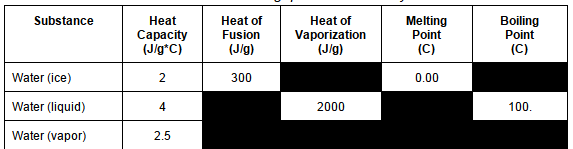
How many Joules of energy are required to change 10 gram of ice at -2 C to water at 20 C?
a)
440 J
b)
880 J
c)
10,140 J
d)
66,000 J
51.
How many Joules of energy are required to make 100 grams of ice at 0 C completely melt?
a)
200 J
b)
400 J
c)
30,000 J
d)
2,000,000 J
52.
When the atmospheric pressure equals the equilibrium vapor pressure ___ occurs.
a)
freezing
b)
melting
c)
boiling
d)
sublimation
53.
If the rate of melting equals the rate of freezing...
a)
there is more liquid
b)
there is more solid
c)
the system is in equilibrium
d)
 the system is working towards equilibrium
54.
A substance can exist as a gas, liquid and solid at the ___
a)
critical point
b)
critical pressure
c)
triple point
d)
critical temperature
55.
During a phase change, the temperature
a)
increases
b)
decreases
c)
fluctuates
d)
stays the same
56.
The strength of intermolecular forces varies between liquids, therefore they will have
a)
different equilibrium vapor pressure
b)
the same equilibrium vapor pressure
c)
different temperatures
d)
the same amount of kinetic energy
57.
Particles can enter the vapor phase if they have enough ___, even if boiling point has not been reached.
a)
space
b)
kinetic energy
c)
attraction to other gas particles
d)
pressure
58.

According to the reference table, what is the boiling point of ethanoic acid at 80 kPa?

a)

28 oC

b)

100oC

c)

111oC

d)

125oC

59.

Which liquid has the highest vapor pressure at 75oC?

a)

ethanoic acid

b)

ethanol

c)

propanone

d)

water

60.

Which model represents a LOWER Vapor Pressure?

a)

A

b)

B

61.

Which model represents STRONGER Intermolecular Forces?

a)

A

b)

B

62.

Imagine A & B represent the same substance. Which model would be at a HIGHER temperature?

a)

A

b)

B
