wayground logo

Free Printable Worksheets

NEW

Font size

S
M
L
XL
Worksheets

Modern Atomic Model Electron Locations

Total questions: 64

Worksheet time: 1hrs 2mins

Name
Class
Date
1.
What atom matches this electron configuration?
1s22s22p63s23p64s23d10
a)
Zinc
b)
Copper
c)
Nickel
d)
Germanium
2.
How many electrons can the first energy level hold?
a)
1
b)
2
c)
8
d)
0
3.
The electron configuration of an atom is 1s22s22p6.  The number of electrons in the atom is 
a)
3
b)
6
c)
8
d)
10
4.
Which electron configuration belongs to Chlorine (Cl)?
a)
1s2s2p3s3p5
b)
1s2s2p3s3p6
c)
1s2s2p3s3p7
5.
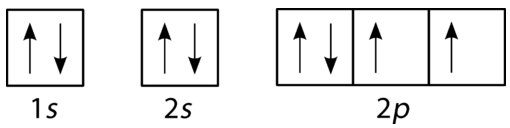
This orbital diagram represents:  
a)
C
b)
B
c)
N
d)
O
6.
This orbital diagram represents:  
a)
C
b)
B
c)
N
d)
O
7.
What is incorrect about this orbital diagram?
a)
Both arrows in the 2p box should be pointing up
b)
There is nothing incorrect with this diagram
c)
In the there should only be 1 orbital in the first 2p box and one in the 2nd 2p box
d)
All the arrows should be pointing up.
8.
Which element is pictured?
a)
neon
b)
fluorine
c)
magnesium
d)
argon
9.
Which is associated with more energy? 
a)
2p
b)
2s
c)
3p
d)
1s
10.
How many electrons can the d sublevel hold?
a)
14
b)
10
c)
2
d)
6
11.
What is the noble gas configuration for beryllium?
a)
[He]1s2
b)
[He]2s2
c)
[Li]2s1
d)
[Li]2s2
12.
What is the noble gas configuration for Sulfur?
a)
[Ar] 3p4
b)
[He] 3s2 3p4
c)
[Ne] 3s2 3p4
d)
[Na] 3s2 3p4
13.
[Ne]3s23p1 is the noble gas configuration for which element?
a)
scandium
b)
boron
c)
nitrogen
d)
aluminum
14.

Which of the following shows a correct Lewis dot structure?

a)
b)
c)
d)
15.

Which element could X represent?

a)

iron

b)

Chlorine

c)

Silicon

d)

Oxygen

16.
How many valence electrons does chlorine (Cl) have?
a)
2
b)
5
c)
6
d)
7
17.
What atom matches this electron configuration?
1s22s22p63s23p64s23d10
a)
Zinc
b)
Copper
c)
Nickel
d)
Germanium
18.

What is the noble gas shorthand electron for Phosphorus atom?

a)

[Ar] 3p4

b)

[He] 3s23p4

c)

[Ne] 3s23p3

d)

[Na] 3s23p4

19.

What is the electron configuration of Ag?

a)

1s2 2s2 2p6 3s2 3p6 4s2 3d10 4p6 5s2 4d9

b)

[Kr] 5s2 4d9

c)

1s2 2s2 2p6 3s2 3p6 4s2 4p6 5s2 4d9

d)

1s2 2s2 2p6 3s2 3p6 3d10 4s2 4d10 4p6 5d10 5s2 4d9

20.
How many d orbitals are there in a given sublevel?
a)
1
b)
3
c)
5
d)
7
21.
Which electron configuration belongs to Copper (Cu)?
a)
1s2 2s2 2p6 3s2 3p6 4s2 3d8
b)
1s2 2s2 2p6 3s2 3p6 4s2 3d9
c)
1s2 2s2 2p6 3s2 3p6 4s2 3d10
22.
Electron arrangement that uses arrows
a)
Electron configuration
b)
Shorthand configuration
c)
Lewis dot structure
d)
Orbital diagram
23.
How can you tell how many valence electrons an atom has? 
a)
APE MAN
b)
By the Group 
c)
By the Period
d)
By the atomic number
24.
How can you tell how many energy levels an atom has? 
a)
APE MAN
b)
By the Group
c)
By the Period
d)
By the atomic mass
25.
How many valence electrons does Calcium have? How many energy levels does Calcium have?
a)
2 valence: 4 energy levels 
b)
20 valence:  4 energy levels 
c)
4 valence: 2 energy levels 
d)
2 valence: 3 energy levels 
26.
According to the octet rule most elements need _______ valence electrons.
a)
2
b)
8
c)
6
d)
18
27.
Which element is depicted from this orbital diagram
a)
Fluorine
b)
Neon
c)
Chlorine
d)
Argon
28.
What comes after 6d?
a)
7s
b)
6f
c)
6s
d)
7p
29.
What comes after 5f?
a)
5d
b)
6d
c)
6p
d)
6s
30.
What comes after 5s?
a)
4d
b)
3d
c)
4p
d)
3f
31.
Noble gas notation for Radium
a)
[Rn] 7s1
b)
[Rn] 7s2
c)
[Uuo] 7s1
d)
[Uuo] 7s2
32.
An atom that has its electrons in the lowest possible energy levels is in the
a)
Ground state
b)
Excited state
c)
State of confusion 
d)
State of Texas
33.
What is incorrect about this orbital diagram?
a)
Both arrows in the 2p box should be pointing up
b)
There is nothing incorrect with this diagram
c)
In the 2p box there should only be 1 electron in the first 2p box and one in the 2nd 2p box
d)
All the arrows should be pointing up.
34.
What is the Pauli Exclusion Principle?
a)
An atomic orbital can only hold a maximum of 2 electrons, each with opposite spins
b)
An atomic orbital can hold a minimum of 6 electrons, each with opposite spins
c)
An atomic orbital can hold a maximum of 6 electrons, each with the same spin
d)
An atomic orbital can hold a minimum of 2 electrons, each with opposite spins
35.
Electrons occupy orbitals of lowest energy first is part of what electron configuration rule?
a)
Hund’s Rule
b)
Aufbau Principle
c)
Pauli Exclusion Principle
36.
Which orbital shows a violation of Hund's Rule?
a)
A
b)
B
c)
C
d)
D
37.
Which orbital shows a violation of the Aufbau Principle?
a)
A
b)
B
c)
C
d)
D
38.
Which orbital shows a violation of the Pauli Exclusion Principle?
a)
A
b)
B
c)
C
d)
D
39.
What is the shape of p orbitals? 
a)
Peanut shaped
b)
Spherical shaped
c)
Flower shaped
d)
Dumbbell shaped
40.
What is the shape of s orbitals?
a)
Dumbbell shaped
b)
Peanut shaped
c)
Spherical shaped
d)
Hybrid structure
41.
What is the maximum number of electrons that can be on the p sublevel?
a)
6
b)
3
c)
2
d)
4
42.
Electrons occupy orbitals of lowest energy first is part of what electron configuration rule?
a)
Hund’s Rule
b)
Aufbau Principle
c)
Pauli Exclusion Principle
43.
Hund’s rule states…
a)
Atomic orbitals have opposite spins and 2 electrons each
b)
Electrons occupy orbitals of highest energy first and energy level changes as you go up
c)
Electrons occupy orbitals of lowest energy first, starting with 1s
d)
Electrons occupy orbitals of equal energy, one electron enters EACH orbital ONE AT A TIME until orbitals of the entire energy level have one electron with the SAME SPIN.
44.
There are 4 different types of sublevels: s,p,d,f
a)
true
b)
false
45.
The Quantum Mechanical Model is the most recent/modern atomic model.
a)
True
b)
False
46.
The quantum number "n" represents:
a)
electron spin
b)
orbital
c)
sublevel
d)
main energy level
47.
Which scientist developed the Quantum Mechanical
a)
E. Schroedinger
b)
W. Heisenberg
c)
J. Dalton
d)
N. Bohr
48.

m indicates the direction or orientation of the magnetic field

a)

principle quantum number

b)

angular momentum quantum number

c)

magnetic quantum number

d)

electron spin quantum number

49.

l= 2 means the orbital is p

a)

Correct

b)

Wrong

c)

I don't know!

50.

When n=4, s can be -1/2, 0, +1/2

a)

Correct

b)

Wrong

51.

When l=2, m can be 0,+1,-1,+2,-2

a)

Correct

b)

Wrong

52.

(4,4,0,+1/2) is exist or not?

a)

exist

b)

not exist

53.

Which quantum number is possible for orbital 5s?

a)

(5,3,0,+1/2)

b)

(5,0,0,+1/2)

c)

(5,1,0,+1/2)

d)

(5,2,1,+1/2)

54.

how many electron can filled in 4p orbital?

a)

2

b)

3

c)

6

55.

Possible quantum number for orbital 7s

a)

(7,0,0,+1/2)

b)

(7,1,0,+1/2)

c)

(7,2,1,+1/2)

56.

Which of the following is NOT a possible pair of quantum numbers?

a)

2p

b)

2d

c)

4p

d)

4f

57.

What does the 1 in "1s" stand for?

a)

energy level

b)

s orbitals

c)

p orbitals

d)

the number of electrons

58.

What is the noble gas configuration for Cobalt?

a)

[Kr] 4s2 3d7

b)

[Kr] 4s2 4d7

c)

[Ar] 4s2 3d7

d)

[Ar] 4s2 4d7

59.

For a p sublevel, "L" equals ____.

a)

0

b)

1

c)

2

d)

3

60.
What is the correct representation for an orbital which has an "n" value of 3 and an "l" value of 1?  
a)
3s
b)
3p
c)
3d
d)
3f
61.

What is the correct representation for an orbital which has an "n" value of 4 and an "L" value of 2?

a)

4d

b)

4s

c)

4f

d)

4p

62.

Which of the following sets of quantum numbers (n, l, ml, and ms) describes the valence electron of Na?

a)

2, 1, 0, -½

b)

2, 0, 0, -½

c)

3, 1, 1, +½

d)

3, 0, 0, +½

63.

Which rule is broken by this electron configuration?

a)

the Aufbau principle

b)

the Pauli exclusion principle

c)

Hund's rule

d)

Conservation of Energy

64.

Which values can (n) be?

a)

only 0

b)

0, 1, 2, 3...

c)

1,2,3,4...

d)

-2 < n < +2