wayground logo

Free Printable Worksheets

Font size

S
M
L
XL
Worksheets

Physical Science - Midterms Review

Total questions: 110

Worksheet time: 4hrs 40mins

Name
Class
Date
1.

What does Ag represent in the periodic table

a)
Gold
b)
Aluminum
c)
Silver
d)
Mercury
2.

Which particle has a positive electrical charge?

a)

proton

b)

neutron

c)

electron

3.

Which particle has a positive electrical charge?

a)

proton

b)

neutron

c)

electron

4.

Which of the three particles has the smallest mass?

a)

proton

b)

neutron

c)

electron

5.

What is a pure substance made of 2 or more elements chemically combined in a specific ratio (Ex. Water)?

a)

Element

b)

Compound

c)

Mixture

d)

Solution

6.

Oxidation numbers are used to indicate the

a)

charge on an ion.

b)

number of atoms or ions in a compound.

c)

type of bond holding particles together in a compound.

d)

distribution of electrons among the bonded particles in a compound.

7.

For each of the following sets of elements, identify the element expected to be most electronegative.

a)

K

b)

Sc

c)

Ca

8.

Identify the type of bond of the following atoms based on their electronegativity difference.


P ------- Si

a)

Ionic

b)

Polar covalent

c)

Non polar covalent

9.

Se (Selenium) would have the same Lewis dot structure as to which molecule below?

a)
b)
c)
d)
10.

What is the chemical formula and name of the molecular structure shown above?

a)

C2H2

b)

C2H4

c)

CH4

11.

What is the molecular geometry of CO2 (carbon dioxide)?

a)

Bent

b)

Linear

c)

Tetrahedral

d)

Trigonal planar

12.

What is the molecular geometry of BF3.

a)

Linear

b)

Bent

c)

Trigonal Pyramidal

d)

Trigonal Planar

13.

Which of the following is an example of an element?

a)

Salt

b)

Water

c)

Iron

d)

Muriatic acid

14.
Which is an example of a lipid
a)
fat
b)
starch
c)
glucose
d)
hemoglobin
15.
Glucose (sugar) is an example of a
a)
Carbohydrate
b)
Lipid
c)
Protein
d)
Nucleic Acid
16.
Which subunits make up the structure of all proteins?
a)
glucose
b)
amino acids
c)
carbohydrates
d)
fatty acids
17.
Carbon, Hydrogen, Oxygen and Nitrogen are elements in what biomolecule?
a)
Carbohydrate
b)
Lipid
c)
Protein
d)
Nucleic acid
18.
The best definition of "organic" in Biology would be:
a)
 to be "fresh"
b)
to be alive
c)
to be chemical-free
d)
to contain Carbon and Hydrogen
19.
Enzymes will make a reaction go _______ and use ______ energy.
a)
faster, less
b)
faster, more
c)
slower, less
d)
slower, more
20.

Which macromolecule has amino acids as monomers?

a)

Carbohydrates

b)

Lipids

c)

Proteins

d)

Nucleic acids

21.
Why are the four biological macromolecules essential for life?
a)
They all provide an organism with oxygen.
b)
They do many important jobs to keep an organism functioning.
c)
They provide an organism with food.
d)
They are all broken down for energy.
22.
DNA and RNA are examples of ___________.
a)
Carbohydrates
b)
Lipids
c)
Proteins
d)
Nucleic Acids
23.
Which type of biological macromolecule are enzymes?
a)
Protein
b)
Carbohydrate
c)
Lipid
d)
Nucleic Acid
24.
Examples of which biological macromolecule include glucose, fructose, starch, and glycogen?
a)
Lipids
b)
Carbohydrates
c)
Nucleic Acids
d)
Proteins
25.
What does POLY- mean?
a)
Two
b)
A name for a parrot
c)
Many
d)
One
26.
Humans get most of their energy from eating what type of food?
a)
protein
b)
carbohydrates
c)
lipids
d)
meat
27.
What are the monomers (building blocks) of CARBOHYDRATES?
a)
Monosaccharides (simple sugars)
b)
Amino Acids
c)
Nucleotides
d)
Glycerol and fatty acids
28.
The protein that transports oxygen in our blood is _________________.
a)
Hemoglobin
b)
Chitin
c)
Cellulose
d)
Phospholipid
29.
What type of eclipse is this?
a)
Solar Eclipse
b)
Lunar Eclipse
30.
What type of eclipse is this?
a)
Solar eclipse
b)
Lunar eclipse
31.
The formation of elements is known as _________.
a)
nucleotides
b)
Synthogenesis
c)
nuclear fission
d)
nucleosynthesis
32.
The first elements were formed in what is known as _________________.
a)
Big Bang Nucleosynthesis
b)
Stellar Nucleosynthesis
c)
Supernova Nucleosynthesis
d)
Genonucleosynthesis
33.
The two elements formed in Big Bang Nucleosynthesis where __________________.
a)
hydrogen and lithium
b)
hydrogen and helium
c)
hydrogen and oxygen
d)
helium and lithium
34.
________ nucleosynthesis happens in the center of stars and is where the elements helium through iron (Fe) are formed. 
a)
Big Bang
b)
Stellar
c)
Supernova
d)
Superdupernova
35.
Which of the following would be classified as the beginning of star formation?
a)
red dwarf
b)
main sequence
c)
protostar
d)
white dwarf
36.

What is nucleosynthesis?

a)

How the sun creates new hydrogen atoms out of dark matter

b)

How helium atoms are broken down by nuclear fission to produce hydrogen

c)

How a nucleus is produced during the big bang

d)

How new elements are created in stars by combining the nuclei of atoms

37.

What is responsible for 85% of the energy from the sun?

a)

the break down of heavy elements by fission

b)

the burning of plasma

c)

hydrogen fusing into helium in the sun's core

d)

the burning of electrons from the outsides of atoms

38.

The light elements that formed in the early universe called the Big Bang Nucleosynthesis

(a)  

39.

Whose model suggested that negative particles were mixed in with positively charged material - like seeds in a watermelon?

a)

J.J. Thomson

b)

Ernest Rutherford

c)

Niels Bohr

d)

Albert Einstein

40.

Who discovered that the atom had an small, dense, positively charged center?

a)

Ernest Rutherford

b)

J.J Thomson

c)

Robert Millikan

d)

John Dalton

41.

Who named the positive center of the atom the "nucleus?"

a)

Democritus

b)

Dalton

c)

Thomson

d)

Rutherford

42.

Which scientists believed an atom was indivisible? (Choose all correct responses.)

a)

Democritus

b)

Dalton

c)

Thomson

d)

Rutherford

43.

In the atomic model nicknamed the "plum pudding" model, what do the plums represent?

a)

the nucleus

b)

the atom

c)

the electrons

d)

the positive material

44.

Which scientist discovered that the atom has parts - which means it can be divided?

a)

Democritus

b)

Dalton

c)

Thomson

d)

Rutherford

45.

Which scientist proposed a new atomic model after discovering the electron in 1897?

a)

Dalton

b)

Thomson

c)

Rutherford

d)

Bohr

46.

Who proposed that electrons move around the nucleus in circular orbits?

a)

Dalton

b)

Thomson

c)

Rutherford

d)

Bohr

47.

Which particle carries no charge?

a)

Neutrons

b)

Electrons

c)

Protons

48.
What is in the nucleus of an atom?
a)
Neutrons and protons 
b)
Protons
c)
Protons and Electrons
d)
Electrons and Nuetrons
49.
The positive particles of an atom are 
a)
electrons 
b)
positrons 
c)
neutrons 
d)
protons 
50.
Ernest Rutherford discovered that atoms were mostly _________________. 
a)
negatively charged
b)
positively charged
c)
electrons
d)
empty space. 
51.
His atomic model included a dense positive core in an atom, surrounded by negatively charged particles
a)
Joseph Thomson
b)
Niels Bohr
c)
Ernest Rutherford
52.

Valence electrons are the number of

a)

protons in the atom

b)

electrons in the atom

c)

protons + neutrons in the nucleus

d)

electrons in the outside shell of the atom

53.
What is an isotope? 
a)
A charged atom
b)
An atom with different amounts of neutrons
c)
An atom with different amounts of protons
d)
A neutral atom
54.

Where are the electrons located in an atom?

a)

Electron shell

b)

Nucleus

c)

Outside

55.

A __________ is a subatomic particle with a negative charge.

a)

proton

b)

neutron

c)

electron

d)

nucleus

56.
Which part of an atom is POSITIVELY charged?
a)
protons
b)
neutrons
c)
electrons
d)
atoms
57.

proton + neutron =

(a)  

58.

atomic number = proton =

(a)  

59.

atomic mass - mass number =

(a)  

60.

In which type of reaction does an unable parent atom lose a few particles to form a stable daughter atom?

a)

chemical

b)

fission

c)

fusion

d)

radioactive decay

61.

In which type of reaction do atoms combine to form a heavier nucleus?

a)

chemical

b)

fission

c)

fusion

d)

radioactive decay

62.

Which type of reaction is initiated by neutron bombardment, resulting in an unstable nucleus that splits apart?

a)

chemical

b)

fission

c)

fusion

d)

radioactive decay

63.
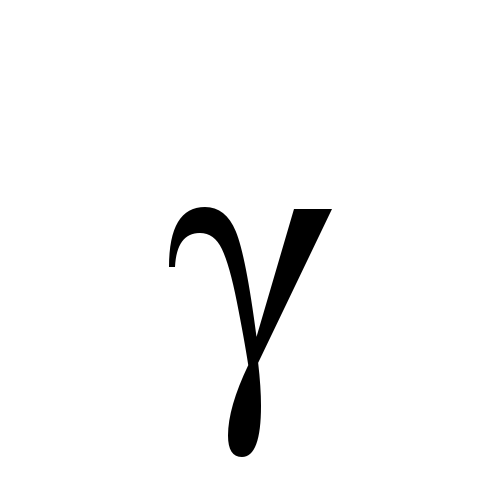
Has the symbol
a)
Alpha
b)
Beta 
c)
Gamma
64.
Has a mass of 0 and a charge of 0
a)
Alpha
b)
Beta
c)
Gamma
65.
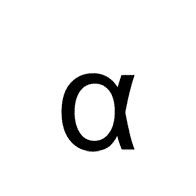
Has the symbol
a)
Alpha
b)
Beta
c)
Gamma
66.
An energized electron resulting from the breaking apart of a neutron in an atom.
a)
Alpha
b)
Beta
c)
Gamma
67.
Has a moderate penetrating power.  It can penetrate 4 mm into body tissue and can be stopped by metal foil.
a)
Alpha
b)
Beta
c)
Gamma
68.
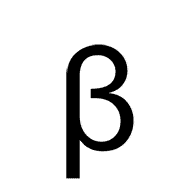
Has the symbol
a)
Alpha
b)
Beta
c)
Gamma
69.
Has a mass of 4 and a charge of +2
a)
Alpha
b)
Beta
c)
Gamma
70.
When an atom loses this particle, the atomic number of the product atom is lower by the two and its mass number is lower by four. 
a)
Alpha 
b)
Beta
c)
Gamma
71.

An alpha particle consists of:

a)

an electron

b)

a proton and an electron

c)

2 protons and 2 neutrons

d)

a photon

72.

True/false: beta decay involves an electron being ejected from the nucleus.

a)

true

b)

false

73.

How is the alpha particle written in a nuclear equation?

a)

42He

b)

24He

c)

0-1e

d)

00γ

74.

Is this molecule polar or non-polar?

a)

Polar

b)

Non-polar

75.
What geometry will this molecular structure have?: PH3
a)
bent
b)
tetrahedral
c)
linear
d)
trigonal pyramidal
76.
What geometry will this molecular structure have?: H2S
a)
bent
b)
tetrahedral
c)
linear
d)
trigonal pyramidal
77.
What geometry will this molecular structure have?: CCl4
a)
bent
b)
tetrahedral
c)
linear
d)
trigonal pyramidal
78.

What is the molecular geometry for this molecule?

a)

Bent

b)

Trigonal pyramidal

c)

Trigonal planar

d)

Linear

79.
Choose the correct shape for this molecule:
a)
Bent
b)
Linear
c)
Tetrahedral
d)
Trigonal pyramidal
80.
Choose the correct shape for this molecule:
a)
Trigonal planar
b)
Trigonal pyramidal
c)
Bent
d)
Linear
81.
Choose the correct shape for this molecule:
a)
linear
b)
Trigonal pyramidal
c)
Bent
d)
Tetrahedral
82.
 A lone pair is defined as
a)
A pair of bonding electrons
b)
One non-bonding electron
c)
A pair of non-bonding electrons
d)
A pair of electrons on the central atom
83.

Is this molecule polar or non-polar?

a)

Non-polar

b)

Polar

84.

Is this molecule polar or non-polar?

a)

Non-polar

b)

Polar

85.

Is this molecule polar or non-polar?

a)

Non-polar

b)

Polar

86.

Classify the above molecule.

a)

Polar

b)

Non polar

87.

Is this molecule polar or non-polar?

a)

Non-polar

b)

Polar

88.
Which of the following is a polar molecule?
a)
CH4
b)
Xe
c)
H2O
d)
CO2
89.
Which phrase correctly describes the distribution of charge and the molecular polarity of ethane?
a)
symmetrical and polar
b)
asymmetrical and polar
c)
asymmetrical and nonpolar
d)
symmetrical and nonpolar
90.
Which formula represents a nonpolar molecule?
a)
HBr
b)
H2S
c)
CBr4
d)
PCl3
91.
A molecule containing polar covalent bonds is always polar.
a)
True
b)
False
92.

The bigger the electronegativity, the more nonpolar the bond is

a)

TRUE

b)

FALSE

93.

To classify compounds using their electronegativity values, we get the electronegativity ________ between molecules.

a)

Difference

b)

Sum

c)

Quotient

d)

Product

94.

From the choices, which element has the highest electronegativity?

a)

Boron

b)

Carbon

c)

Nitrogen

d)

Oxygen

95.

From the choices, which element is least electronegative?

a)

Titanium

b)

Yttrium

c)

Strontium

d)

Cesium

96.

Coumpounds with Carbon-Hydrogen bonds are

a)

Polar

b)

Nonpolar

c)

Ionic

97.

Which of the following does not describe nonpolar molecules?

a)

Monoatomic Particles

b)

Diatomic Particles

c)

Electron Difference of 0-0.4

d)

Contains hydrogen bonds

98.
What information do we look for on the periodic table if we  want to examine intermolecular forces?
a)
atomic mass
b)
atomic number
c)
electronegativity
d)
ionization 
99.
Hydrocarbons will have which type of intermolecular forces?
a)
Dispersion
b)
dipole
c)
hydrogen bonds
100.

What intermolecular force present in a sample of pure HCl?

a)

dipole-dipole attraction

b)

H-bonds

c)

London dispersion forces 

d)

molecule-ion attraction

101.

 Intermolecular forces are the forces that exist

a)

within molecules

b)

between molecules

102.

Which are the strongest intermolecular forces?

a)

hydrogen bonds

b)

London dispersion forces

c)

dipole-dipole forces

d)

molecule-ion attractions

103.

What type of intermolecular force is present in all substances, regardless of polarity?

a)

London dispersion forces

b)

ion-dipole forces

c)

dipole-dipole forces

d)

hydrogen bonding

104.

What explains the very high melting and boiling point of water?

a)

Dipole-dipole forces between water molecules

b)

London dispersion forces between water molecules

c)

Hydrogen bonds between water molecules

d)

Molecule-ion attractions between water molecules

105.

 In general, substances with stronger intermolecular forces have ________ boiling points than those with weaker forces

a)

Higher

b)

The same

c)

Lower

106.

What are intermolecular forces?

a)

forces of attraction or repulsion which act between neighboring particles

b)

forces which keep a molecule together.

107.

What intermolecular forces of attraction does Neon (Ne) exhibit?

a)

Ion-dipole forces

b)

Dispersion forces

c)

Hydrogen bonds

d)

Dipole-dipole forces

108.

What are the intermolecular forces of attraction for nonpolar molecules?

a)

Hydrogen bonds

b)

Dispersion forces

c)

Ion-dipole forces

d)

Dipole-dipole forces

109.

these are attractive forces existing between POLAR molecules

(a)  

110.

attraction between an ion and dipole molecule

(a)