
Font size
 Worksheets
Study Guide Midterm Exam April 2024
Total questions: 65
Worksheet time: 1hrs 26mins
Scarcity is best defined as
the difference between limited wants and limited economic resources.
the difference between the total benefit of an action and the total cost of that action.
the difference between unlimited wants and limited economic resources.
the opportunity cost of pursuing a given course of action.
the difference between the marginal benefit and marginal cost of an action.
Economics is best defined as the study of
how society manages its scarce resources.
how to run a business most profitably.
how to predict inflation, unemployment, and stock prices.
how the government can stop the harm from unchecked self-interest
Protection of property rights exist in
Capitalist economy
command economy
In a command economy...
Public ownership of the means of production
the individual owns the means of production
there is wealth and protection of private property
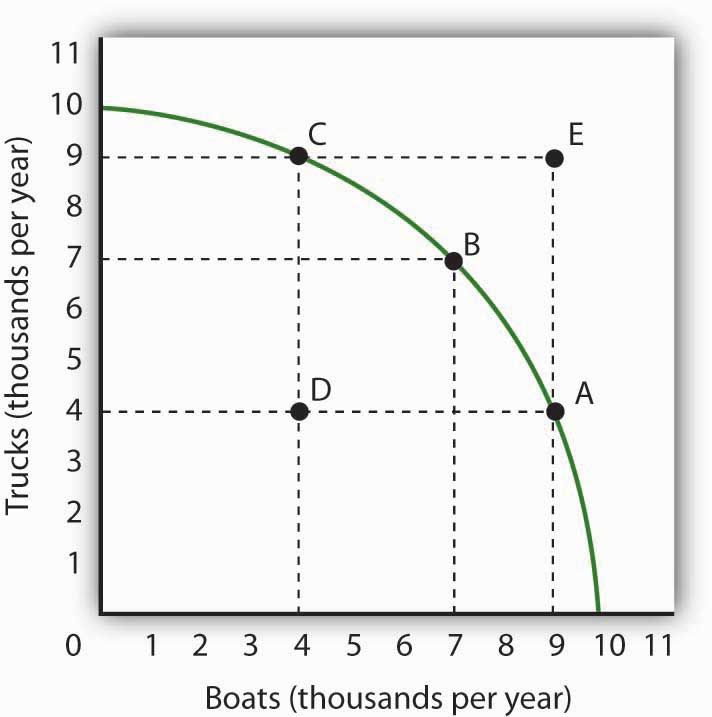

What is the opportunity cost of moving from production from point B to D?
100 units of food
25 units of food
35 units of clothes
50 Units of food
a new technology invention

Points B, D, and C represent ___________ use of resources.
Ineffecient
Efficient
Unfeasible
The producer that can produce the most output OR requires the least amount of inputs (resources)
Comparative Advantage
Trade Offs
Absolute Advantage
Opportunity Cost
Ana takes 30 minutes to wash the dishes and one hour to vacuum the house. Her husband, Joe, takes 15 minutes to wash the dishes and 45 minutes to vacuum. Who has the absolute advantage for vacuuming?
Ana
Joe

Which country has the absolute advantage in producing airplanes?
Josie works part-time at a local convenience store and earns $10 per hour. She wants to spend next Saturday afternoon attending a music concert. The full price of a concert ticket is $75, but Josie was able to get a discounted price of $40 from a friend who purchased the ticket but has become unable to attend. If Karen took 4 hours off from her job to attend the concert, what was her opportunity cost of attending the concert?
$80
$85
$35
$10

Sam often consumes biscuits or cakes.
If the supply of biscuits decreases, which graph will represent Sam's change in demand for cakes?
1
2
3
4

When the price of hot dogs decreases and the demand for hot dog buns increases, this explains the demand of
Complementary goods
Capital Goods
Substitute Goods
Consumer Goods
HyVee increases the price of milk from $2.50 to $3.00. Total revenue from milk increases by $200 each day. The demand for this product would be:
elastic
inelastic
static
dynamic
If a 10 percent increase in the price of good J results in a 20 percent decrease in the quantity of good Y demanded, which of the following is true?
Good J and good Y are complementary goods, and the cross-price elasticity is −2 .
Good J and good Y are substitute goods, and the cross-price elasticity is −2 .
Good J and good Y are complementary goods, and the cross-price elasticity is −0.5 .
A decrease in the demand for antique lanterns, a normal good, would be caused by which of the following?
An increase in the price of antique lanterns
An increase in the price of lamp oil, a complementary good

When the price is P1, consumer surplus is
A
A + B
A + B + C
A + B + D

When the price rises from P1 to P2, consumer surplus
Increases by an amount equal to A
Decreases by an amount equal to B + C
Increases by an amount equal to B + C
Decreases by an amount equal to C

The market is currently in equilibrium. In a competition equilibrium consumer surplus is the area of
UVZ
WYZ
RVUT
XVZY
0YZS

The diagram shows the demand curve for a good. If the price increases from P1 to P2, and quantity consumed decreases from Q2 to Q1, consumer surplus decreases by the area
BDC
P1P2BC
P1P2BD
Q1DCQ2
P2P3B


How much will the country import at a price of Pw?
B-A
C-E
A' - B'
A - B
A - E
If an excise tax is imposed on a product, consumer surplus and producer surplus for this good will most likely change in which of the following ways:
Consumer surplus decreases and producer surplus decreases
Consumer surplus decreases and producer surplus increases
Consumer surplus decreases and producer surplus does not change
Consumer surplus does not change and producer surplus increases
Consumer surplus does not changes and producer surplus does not change
The formula for PES is...
% change Q / % change in Y
% change P / % change Q
% change QS / % change P
% change QD / % change P
The formula for PED is...
% change Q / % change in Y
% change P / % change Q
% change D / % change S
% change Q / % change P
XED is the...
responsiveness to change in price of a related good
responsiveness to change in price
responsiveness to change in demand of a related good
responsiveness to change in demand of supply
Which of the following describes an eventual decline in the productivity of factor inputs as additional units of variable factors are added to fixed resources?
Law of diminishing marginal utility
Law of diminishing marginal returns
Laffer curve
Law of diminishing total product
In the long run...
All inputs are fixed
All input are variable
at least one input is variable and one input is fixes
at most one input is variable and one input is fixed
Fixed cost
long run ATC rises as output increases
long run ATC falls as output rises
costs that do not vary with the quantity of output produced
long run ATC stays the same as the quantity of output changes
Variable cost is
Long run ATC stays the same as the quantity of output changes
Fixed + variable cost
Costs that vary with the output (Q) produced
An explicit cost
Which of the following is the equation for Economic Profit?
Total Revenue - Explicit Costs
Total Revenue + Explicit Costs
Total Revenue - (Explicit Costs + Implicit costs)
Total Revenue - (Explicit Costs - Implicit costs)
Which of the following are the two types of profits?
Accounting Profit
Mathematical Profit
Financial Profit
Economic Profit
If a business makes $85 dollars/day and spends $43 on explicit costs, what is their Accounting Profit?
$43
$85
$128
$42
A woman recently quit her job as a teacher, which earned her $75/day, to become a tailor. She earns $85/day, during that day she spends a total of $25 on materials. What is her Economic Profit ?
$75
$15
-$75
-$15
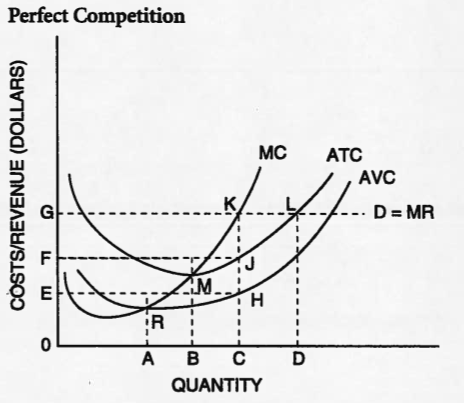

If marginal revenue is equal to P1
Total revenue will equal total costs
Total revenue will be less than total cost
Total revenue will be greater than total costs

What is the profit-maximizing price and quantity?
P1, Q1
P2, Q4
P3, Q3
P4, Q2
P5, Q1
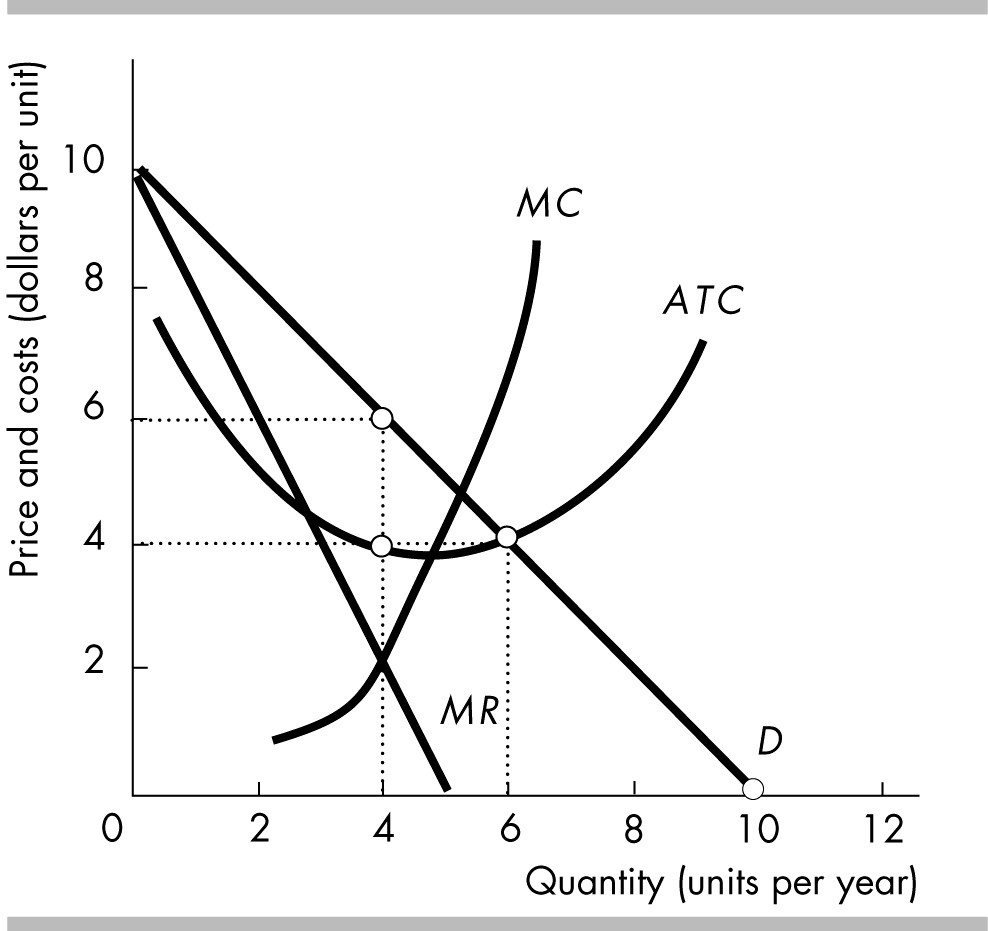
For the unregulated, single-price monopoly shown in the figure above, when its profit is maximized, output will be
4 units per year and the price will be $6.
4 units per year and the price will be $4.
6 units per year and the price will be $4.
None of the above answers is correct.
Perfect Price-Discriminating Monopoly


Price discrimination is defined as a business charging different consumers ... prices for the ... product, whereby the price difference is not due to the differences in the cost of supplying the customers.
different …same
same …same
same...different
different …different
Monopolistically Competitive, Long-Run Equilibrium
Single-Price Monopoly, Economic Loss
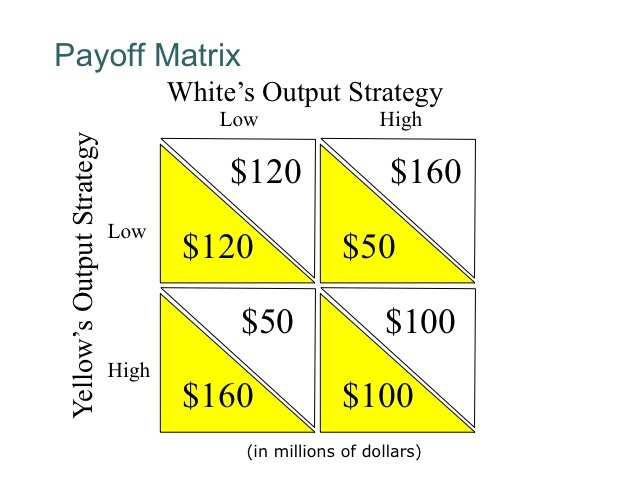
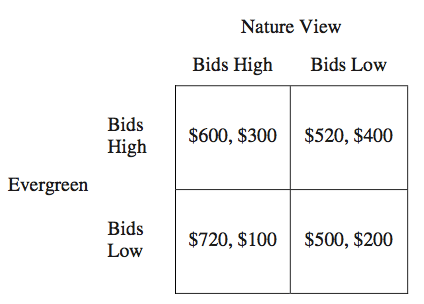
a landscaping contract. The payoff matrix shows what each firm’s total weekly profits from all its operations will be for each combination of bids. The first entry in each cell shows Evergreen’s profit, and the second entry in each cell shows Nature View’s profit. A Nash equilibrium results under which of the following conditions?

Blammo Inc. produces greeting cards in a perfectly competitive market. The table below shows the total number of greeting cards produced using different amounts of labor. The market price for a greeting card is $4.
What is the marginal revenue product of labor (MRPL) of the fifth worker?
$4
$60
$160
$400
$0


The graph above shows the marginal product (MP) and the average product (AP) of labor for a firm that uses labor as the only variable input. At which quantity of labor does marginal cost change from decreasing to increasing?
L1
L2
L3
L5

What does this graph represent?
a perfectly competitive labor market
an imperfectly competitive labor market

Monopsony
Perfect Competition
Oligopsony
All of the above

Which is the competitive labour market wage?
B
A
C


The market should produce the quantity where
marginal social cost equals marginal social benefit.
marginal private cost equals marginal social benefit.
external cost equals external benefit.
private cost is greater than social cost.

When there is a _______ production externality, the free market _________ resources to the production of the good and too ______ of it is produced relative to the social optimum. This is shown by _______and _______ at the point of production, Qm, *
negative; misallocate; little; Qm > Qopt; MSC < MSB
positive; underallocate; much; Qm > Qopt; MSB > MSC
negative; overallocate; much; Qm > Qopt; MSC > MSB
positive; misallocate; much; Qm > Qopt; MSC > MSB

Refer to the image. Given the position of the marginal social cost curve, one can conclude that
production of good X creates a negative externality.
private cost of producing good X exceeds the social cost of production at all levels of output.
market quantity, Q3, is the socially optimal quantity.
free market will produce too little of good X.

According to this graph, which of the following nations is the 'most equal'?
USA
Brazil
Norway
None of the above
According to this graph, which of the following nations is the 'most equal'?
USA
Brazil
Norway
None of the above
laws to control monopoly power and to preserve and promote competition
Clayton Antitrust Act
Sherman Antitrust Act
anti-trust laws
Federal Trade Commission
An example of a public good is...
Firefighters
police officers
parks
all answers are correct
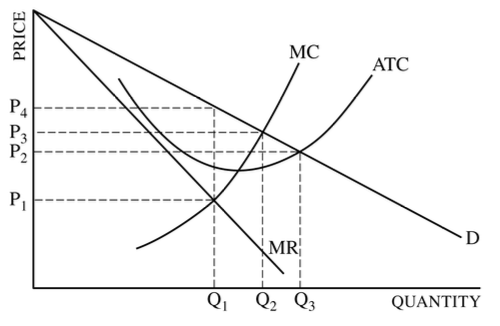
Fair return to Price and Quantity

