
 Worksheets
AP Chem Unit 8
Total questions: 72
Worksheet time: 37mins
Pure water autoionizes as shown in the equation below. Based on this information, which of the following is correct? H2O(l) + H2O(l) ⇌ H3O+(aq) + OH−(aq) Kw = 7.0 × 10^-14 at 55°C
The autoionization equilibrium for pure water favors the formation of reactants at 55°C compared to 25°C.
The autoionization equilibrium for pure water produces the same amount of OH− ions at 55°C and 25°C.
At 55°C, pH = -log(√Kw) for pure water.
At 55°C, pH = -log(Kw) for pure water.
Based on the information below, which of the following is true for a sample of pure water at 25°C? Kw = [H3O+] [OH−] = 1.0 × 10^-14 at 25°C
[H3O+] = 7.0 M
[OH−] = 1.0 × 10^-14 M
pH = 10^7
pOH = 7.00
The endothermic autoionization of pure water is represented by the chemical equation shown below. The pH of pure water is measured to be 7.00 at 25.0°C and 6.02 at 100.0°C. Which of the following statements best explains these observations? 2H2O(l) ⇌ H3O+(aq) + OH−(aq) ΔH° = +56 kJ/mol
At the higher temperature water dissociates less, [H3O+] < [OH−], and the water becomes basic.
At the higher temperature water dissociates less, [H3O+] = [OH−], and the water remains neutral.
At the higher temperature water dissociates more, [H3O+] > [OH−], and the water becomes acidic.
At the higher temperature water dissociates more, [H3O+] = [OH−], and the water remains neutral.
Which of the following gives the best estimate for the pH of a 5×10^-4 M Sr(OH)2(aq) solution at 25°C?
pH ≈ 3.0 because Sr(OH)2 is a strong acid.
pH ≈ 5.0 because Sr(OH)2 is a weak acid.
pH ≈ 9.0 because Sr(OH)2 is a weak base.
pH ≈ 11.0 because Sr(OH)2 is a strong base.
Which of the following gives the best estimate for the pH of a 1 × 10^-5 M HClO4(aq) solution at 25°C?
pH ≈ 1.0 because HClO4 is a strong acid.
pH ≈ 5.0 because HClO4 is a strong acid.
pH ≈ 7.0 because ClO4- is a strong base.
pH ≈ 9.0 because ClO4- is a strong base.
Which of the following is the correct mathematical relationship to use to calculate the pH of a 0.10M aqueous HBr solution?
pH = [H₃O⁺] = 0.10
pH = -log(1.0 × 10^-1)
pH = 7.00 - (0.10)
pH = log(1.0 × 10^-1)
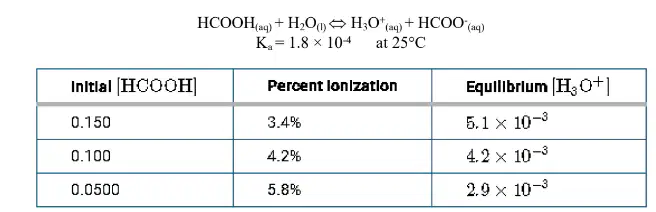
The equilibrium for the acid ionization of HCOOH is represented by the equation in the image and the table gives the percent ionization for HCOOH at different initial concentrations of the weak acid at 25°C. Based on the information, which of the following is true for a 0.125M aqueous solution of HCOOH?
It has a larger percent ionization, a lower [H₃O⁺]eq, and a lower pH than a 0.150M HCOOH solution does.
It has a larger percent ionization, a lower [H₃O⁺]eq, and a higher pH than a 0.150M HCOOH solution does.
It has a lower percent ionization, a larger [H₃O⁺]eq, and a higher pH than a 0.100M HCOOH solution does.
It has a lower percent ionization, a larger [H₃O⁺]eq, and a higher pH than a 0.100M HCOOH solution.
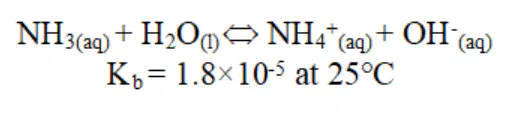
The reaction between NH3 and water is represented in the image. A solution that is initially 0.200M in NH3 has a pH of 11.28. Which of the following correctly predicts the pH of a solution for which [NH3]initial = 0.100M, and why?
The pH will be lower than 11.28 because decreasing the initial concentration of NH3 increases the equilibrium concentration of the conjugate acid NH4+.
The pH will be lower than 11.28 because the equilibrium concentration of OH- ions decreases when the initial concentration of the base decreases.
The pH will be higher than 11.28 because decreasing the initial concentration of NH3 decreases the equilibrium concentration of the conjugate acid NH4+.
The pH will be higher than 11.28 because the equilibrium concentration of OH- ions increases when the initial concentration of the base decreases.
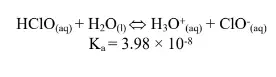
The acid ionization equilibrium for HClO at 25°C is shown below. A 0.100M aqueous solution of this acid has a pH of about 4.2. If a solution with an initial concentration of HClO of 0.200M is allowed to reach equilibrium at the same temperature, which of the following correctly predicts its pH, and why?
The pH will be higher than 4.2 because increasing the concentration of the weak acid decreases the percent ionization.
The pH will be higher than 4.2 because, for weak acid solutions, the pH is directly proportional to the initial concentration of the weak acid.
The pH will be lower than 4.2 because increasing the concentration of the weak acid produces more H3O+ to establish equilibrium.
The pH will be lower than 4.2 because the Kₐ of the weak acid is inversely proportional to the initial concentration of the weak acid.
The weak acid CH3COOH has a pKa of 4.76. A solution is prepared by mixing 500.0 mL of 0.150M CH3COOH(aq) and 0.0200mol of NaOHₐₚ. Which of the following can be used to calculate the pH of the solution?
pH = 4.76 + log(0.0200 / 0.150) = 3.88
pH = 4.76 + log(0.0200 / 0.0200) = 4.19
pH = 4.76 + log(0.0750 / 0.0200) = 4.32
pH = 4.76 + log(0.0950 / 0.0750) = 4.86
Which of the following provides the correct mathematical expression to calculate the pH of a solution made by mixing 10.0ml of 1.00M HCl and 11.0mL of 1.00M NaOH at 25°C?
pH = -log(0.0010) = 3.00
pH = 14.00 + log(0.001) = 11.00
pH = 14.00 + log(0.0010 / 0.0210) = 12.68
pH = 14.00 + log(0.0010 / 0.0110) = 12.96
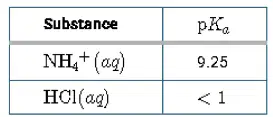
A buffer solution is formed by mixing equal volumes of 0.12M NH3(aq) and 0.10M HCl(aq), which reduces the concentration of both solutions by one half. Based on the pKa data given in the table, which of the following gives the pH of the buffer solution?
pH = -log(0.050) = 1.30
pH = 9.25 + log( 0.010 / 0.050) = 8.55
pH = 9.25 + log( 0.060 / 0.050) = 9.32
pH = 14.00 - (-log(0.010)) = 12.00
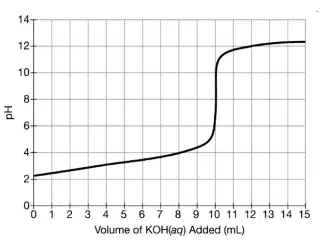
The pH versus volume data for the titration of 0.10M HNO2(aq) with 0.10M KOH(aq) is plotted on the graph below. Based on the data, which of the following species is present in the greatest concentration after 6.0mL of KOH(aq) has been added to the solution of HNO2(aq)?
H+(aq)
HNO2(aq)
NO2-(aq)
OH-(aq)

A 60.0 mL sample of NaOH_(aq) was titrated with 0.10M HCl_(aq). Based on the resulting titration curve shown below, what was the approximate concentration of NaOH in the sample?
0.033M
0.050M
0.10M
0.20M
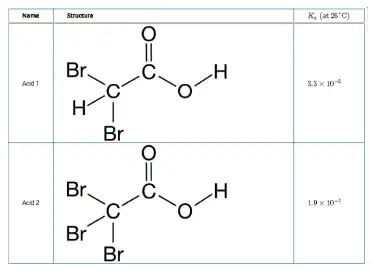
The table below provides information on two weak acids. Which of the following explains the difference in their acid strength?
Acid 1 is a stronger acid because it has more acidic hydrogen atoms than acid 2.
Acid 1 is a stronger acid because it can make more hydrogen bonds than acid 2.
Acid 2 is a stronger acid because it is a larger, more polarizable molecule with stronger intermolecular forces than acid 1.
Acid 2 is a stronger acid because it has a more stable conjugate base than acid 1 due to the greater number of electronegative Br atoms.

A 0.20M solution of the weak acid potassium hydrogen phthalate (KHP) is titrated with 0.10M NaOH(aq). Based on the titration curve shown in the graph below, the pKa of KHP is closest to which of the following?
3.6
5.4
8.8
11.8
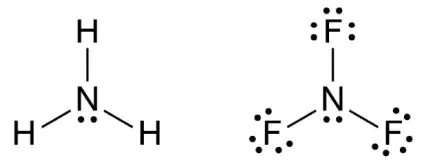
Lewis diagrams of the weak bases NH3 and NF3 are shown below. Based on these diagrams, which of the following predictions of their relative base strength is correct, and why?
NF3 is a stronger base than NH3 because more than one resonance structure exists for its conjugate acid NF3H+, making it more stable than NH4+.
NF3 is a stronger base than NH3 because of the greater electronegativity of F compared with H.
NF3 is a weaker base than NH3 because of the greater electronegativity of F compared with H.
NF3 is a weaker base than NH3 because more than one resonance structure exists for its conjugate acid NF3H+, making it more stable than NH4+.
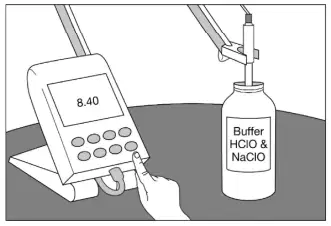
A student measures the pH of a 0.0100M buffer solution made with HClO and NaClO, as shown below. The pKa of HClO is 7.40 at 25°C. Based on this information, which of the following best compares the relative concentrations of ClO- and HClO in the buffer solution?
[ClO-] = [HClO]
[ClO-] > [HClO]
[ClO-] < [HClO]
It is not possible to compare the concentrations without knowing the pKb of ClO-.
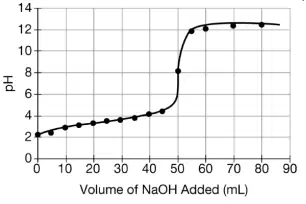
HCNO is a weak acid with a pKa value of 3.5. The graph below shows the results of a titration of an aqueous solution of HCNO with 0.100M NaOH. Based on the results, the concentration of CNO- is greater than the concentration of HCNO at which of the following pH values?
2.0
3.0
3.5
4.0

The weak acid ionization equilibrium for C2H3COOH is represented by the equation below. A student measures the pH of C2H3COOH(aq) using a probe and a pH meter in the experimental setup shown. Based on the information given, which of the following is true?
[C2H3COOH] > [C2H3COO-] since the pKa of the weak acid is less than pH.
[C2H3COOH] > [C2H3COO-] since the pKa of the weak acid is greater than the pH of the solution.
[C2H3COOH] < [C2H3COO-] since the pKa for C2H3COO- is less than pH.
[C2H3COOH] < [C2H3COO-] since the Ka for C2H3COO- is less than the Ka for C2H3COOH.

The acid equilibrium for CH₃CH₂COOH and the base equilibrium for CH₃CH₂COO⁻ are represented below. One liter of a buffer solution with pH = 4.85 is made by mixing 0.100M CH₃CH₂COOH and 0.100M NaCH₃CH₂COO. If 10.0mL of 0.500M NaOH is added to the buffer, which of the following is most likely the resulting pH, and why?
The pH will be much less than 4.85, because the buffer will respond to the addition of NaOH by producing more CH₃CH₂COOH.
The pH will be much greater than 4.85, because there is a large increase in the concentration of the weak base, CH₃CH₂COO⁻.
The pH will be slightly less than 4.85, because the addition of NaOH reduces the autoionization of H₂O.
The pH will be slightly greater than 4.85, because some CH₃CH₂COOH will react with the added bases, resulting in a slight decrease in [H₃O⁺].
A buffer solution that is 0.100M in both HCOOH and HCOOK has a pH = 3.75. A student says that if a very small amount of 0.100M HCl is added to the buffer, the pH will decrease by a very small amount. Which of the following best supports the student's claim?
HCOOH will accept a proton from HCl to produce more HCOOH and H₂O.
HCOO⁻ will accept a proton from HCl to produce more HCOOH and H₂O.
HCOO⁻ will donate a proton to HCl to produce more HCOO⁻ and H₂O.
HCOOH will donate a proton to HCl to produce more HCOO⁻ and H₂O.

The equilibrium representing the acid dissociation of CH₃COOH is shown below. A buffer solution is prepared by adding 0.10mol of NaOH to 1.00L of 0.30M CH₃COOH. Assuming the change in volume is negligible, which of the following expressions will give the pH of the resulting buffer at 25°C?
pH = 4.76 + log(0.10/0.30)
pH = 4.76 + log(0.10/0.20)
pH = 4.76 + log(0.20/0.10)
pH = 4.76 + log(0.20/0.30)
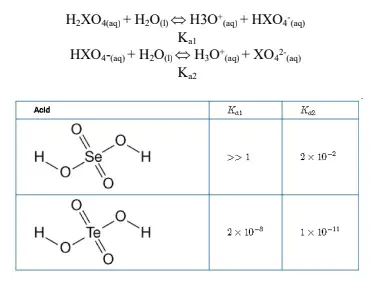
The equilibrium reactions for diprotic oxoacids with a general formula H₂XO₄ are represented by the equations below. The acid ionization constants for H₂SeO₄ and H₂TeO₄ are provided in the table. Which of the following best explains the difference in strength for these two acids?
H₂SeO₄ is weaker because Se has a smaller positive formal charge than Te, resulting in a decrease in its ability to transfer an H⁺ to H₂O.
H₂TeO₄ is weaker because Te has a smaller positive formal charge than Te, resulting in a decrease in its ability to transfer an H⁺ to H₂O.
H₂SeO₄ is weaker because Se is more electronegative than Te, resulting in more stable conjugate bases HSeO₄⁻ and SeO₄²⁻ than those for H₂TeO₄.
H₂TeO₄ is weaker because Te is less electronegative than Se, resulting in less stable conjugate bases HTeO₄⁻ and TeO₄²⁻ than those for H₂SeO₄.
To prepare a buffer solution for an experiment, a student measured out 53.49g of NH₄Cl₄ (molar mass 53.49g/mol) and added it to 1.0L of 1.0M NH₃(aq). However, in the process of adding the NH₄Cl₄ to the NH₃(aq), the student spilled some of the NH₄Cl₄ onto the bench top. As a result, only about 50g of NH₄Cl₄ was actually added to the 1.0M NH₃(aq). Which of the following best describes how the buffer capacity of the solution is affected as a result of the spill?
The solution has a greater buffer capacity for the addition of base than for acid, because [NH₃] < [NH₄⁺].
The solution has a greater buffer capacity for the addition of base than for acid, because [NH₃] > [NH₄⁺].
The solution has a greater buffer capacity for the addition of acid than for base, because [NH₃] < [NH₄⁺].
The solution has a greater buffer capacity for the addition of acid than for base, because [NH₃] > [NH₄⁺].

The acid ionization equilibrium for HC_3H_5O_2 is represented by the equation above. A mixture of 1.00L of 0.100M HC_3H_5O_2 and 0.500L of 0.100M NaOH will produce a buffer solution with a pH = 4.87. If the NaOH solution was mislabeled and was 1.00M instead of 0.100M, which of the following would be true?
The pH of the resulting solution would still be 4.87 because buffer solutions regulate changes in pH regardless of how much NaOH is added.
The pH of the resulting solution would be somewhat higher than 4.87 because adding NaOH that is 10 times more concentrated makes the concentration of the conjugate base 10 times larger.
The pH of the resulting solution would be much higher than 4.87 because the weak acid would be completely neutralized by the larger amount of NaOH added.
The pH of the resulting solution would still be 4.87 because the solution contains a large volume of the weak acid to react with the NaOH and maintain the same pH.
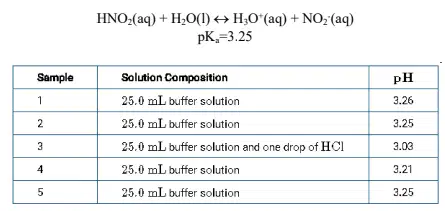
The acid ionization equilibrium for HNO_2 is represented by the equation below. A 250.0mL buffer solution is prepared by mixing 125.0mL of 0.20M HNO_2 and 125.0mL of 0.1M NaOH. To test the buffer capacity, the pH is measured and recorded in the table for four samples of the buffer and one sample of a mixture of the buffer and HCl. Which of the following best helps explain why the pH of sample 4 is lower than the pH of the other samples containing only buffer solution?
Prior to measuring the pH of sample 4, some water evaporated, resulting in an increase in the concentration of HNO_2 in the sample.
After measuring the pH of the more acidic sample 3, the pH probe was not rinsed and wiped, resulting in the neutralization of a very small amount of the conjugate base in sample 4.
Prior to measuring the pH of sample 4, the room temperature dropped suddenly, resulting in an increase in the pK_a for HNO_2.
The volume used to measure the pH of sample 4 was less than 25.0mL, resulting in a decrease in the concentration of NO_2^-.

Which of the following chemical equilibrium equations best shows what happens in the buffer solutions to minimize the change in pH when a small amount of a strong base is added?
H₃O⁺(aq) + OH⁻(aq) ⇌ 2H₂O(l)
HCO₃⁻(aq) + OH⁻(aq) ⇌ CO₃²⁻(aq) + H₂O(l)
CO₃²⁻(aq) + H₂O(l) ⇌ HCO₃⁻(aq) + OH⁻(aq)
CO₃²⁻(aq) + H₂O(l) ⇌ HCO₃⁻(aq) + OH⁻(aq)
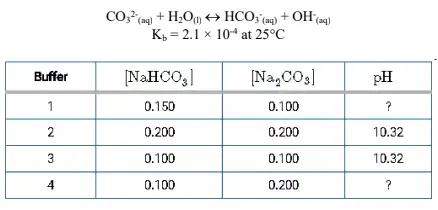
Which of the following mathematical expressions can be used to determine the approximate pH of buffer 1?
pH = -log(2.1 x 10⁻⁴) + log(0.100 / 0.150) = 3.50
pH = -log(2.1 x 10⁻⁴) + log(0.150 / 0.100) = 3.85
pH = [14.00 + log(2.1 x 10⁻⁴)] + log(0.100 / 0.150) = 10.15
pH = [14.00 + log(2.1 x 10⁻⁴)] + log(0.150 / 0.100) = 10.50
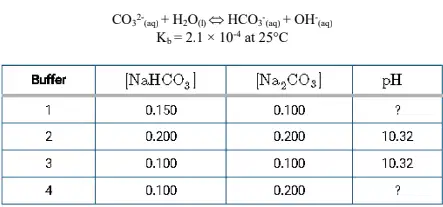
Buffer solutions containing Na2CO3 and NaHCO3 range in pH from 10.0 to 11.0. The chemical equation below represents the equilibrium between CO3^2- and H2O, and the table lists the composition of four different buffer solutions at 25°C. Which mathematical expression can be used to explain why buffer 2 and buffer 3 have the same pH?
log(0.200/0.200) = log(0.100/0.100) = log(1)
log(Kw) - [-log(Kb)] = pKa
0.200M = 2 x (0.100M)
0.200M - 0.200M = 0.100M - 0.100M
Which compound from the following list is the strongest acid?
HOCl
HOBr
NH3
HOI
Which of the following solutions has the highest pH?
1.0 M CuCl2
1.0 M Na2SO4
1.0 M KBr
1.0 M Na2S

In a 0.1 M C₆H₅CH₂COOH solution at 25°C, [C₆H₅CH₂COO⁻] is 2.4 x 10⁻³ M and in a 1.0 M CH₃CH₂COOH solution at 25°C, [H₃O⁺] is 1.1 x 10⁻³ M. Which of the following statements in the image about these acids are true? There may be more than one.
C₆H₅CH₂COOH is a stronger acid than CH₃CH₂COOH.
The Ka value for C₆H₅CH₂COOH is less than the Ka value for CH₃CH₂COOH.
0.1 M C₆H₅CH₂COOH has a lower pH than 0.1 M CH₃CH₂COOH.
Which acid from the following list is the strongest?
HOCl
HClO₂
HClO₃
HClO₄
A 100 mL solution of 0.7 M HCl is mixed with a 100 mL solution of 0.5 M KOH at 25°C. What is the pH of the final solution?
14.0
13.3
13.0
1.0
For HC₇H₅O₂, Ka is 6.3 x 10⁻⁵ and for HC₈H₄O, Ka is 1.3 x 10⁻¹⁰. Suppose you had a 1.0 M NaC₇H₅O₂ and a 1.0 M solution of NaC₈H₄O. Which relationships are true?
[H₃O⁺] in 1.0 M NaC₇H₅O₂ > [H₃O⁺] in 1.0 M NaC₈H₄O
[H₃O⁺] in 1.0 M NaC₇H₅O₂ < [H₃O⁺] in 1.0 M NaC₈H₄O
[H₃O⁺] in 1.0 M NaC₇H₅O₂ > [H₃O⁺] in 1.0 M NaC₈H₄O
Both solutions are acidic
Which of the following reactions will have an equilibrium constant, Kₐ, which is less than 1.0?
HCl(aq) + NaOH(aq) → H₂Oₓ + NaCl(aq)
HBr(aq) + H₂Oₓ → Br⁻(aq) + H₃O⁺(aq)
NaOH(aq) + CH₃COOH(aq) → Na⁺(aq) + CH₃COO⁻(aq) + H₂Oₓ
HCN(aq) + NH₃(aq) → CN⁻(aq) + NH₄⁺(aq)
A student titrated a solution containing a mono-protic acid to determine its concentration. A standardized NaOH solution was used as the titrant. The teacher informed the student that the value he obtained for the concentration was high. Which of the following could account for the enlarged value?
I. The student passed the endpoint of the titration.
II. The student rinsed the buret with distilled water, and then filled it with the NaOH solution.
III. The student did not rinse the side of the Erlenmeyer flask with distilled water during the titration.
I only
II only
I and II only
I and III only
Which compound from the following list is the strongest base?
Ca(OH)₂
AlF₃
NH₃
NaF
A solution of NaF is:
Acidic due to the hydrolysis by the Na⁺ ion
Acidic due to the formation of HF
Neutral at concentrations below 1.0M
Basic due to the hydrolysis by the F⁻ ion
Which compound from the following list is the strongest acid?
HOCl
HClO2
HIO2
HOI
What is the pH of a 1.0 x 10^-3 M solutions of boric acid, H3BO3? The Ka value for boric acid is 6 x 10^-10.
Between 7 and 12
7
Between 7 and 3
3
What volume of 0.100 M HBr is needed to neutralize 50.0 mL of 0.140 M Ba(OH)2?
140 mL
70.0 mL
35.0 mL
28.0 mL
Which of the following are considered to be correct procedures when performing a titration?
I only
II and III only
I and II only
I and III only
Calcium sulfate is least soluble in which of the following solutions?
1.0 M CaCl2
1.0 M Mg(NO3)2
1.0 M Al2(SO4)3
1.0 M Li2SO4
In a laboratory experiment, a student titrated 10.0 mL of an acetic acid, CH3COOH, solution with 0.50 M NaOH. The endpoint was reached when 46.00 mL of 0.50 M NaOH were delivered. What was the concentration of acetic acid in the solution?
23 M
2.3 M
46 M
4.6 M
H2C3H5O4(aq) + 2H2O(l) → 2H3O+(aq) + C3H5O4^2-(aq) K1=1.5 x 10^-3 and K2=2.0 x 10^-6. Malonic acid, H2C3H5O4, is a polyprotic acid. What is the equilibrium constant, Ka, for the reaction written above?
1.5 x 10^-3
2.0 x 10^-6
3.0 x 10^-9
3.0 x 10^-18
Which of the following solutions has the highest pH?
1.0 M Li2SO4
1.0 M CuF2
1.0 M NH4Br
1.0 M K2CO3
Which species from the following list is the strongest base?
Cl-
SO42-
HSO4-
F-
Which of the following solutions has the lowest pH?
1.0 M CuCl2
1.0 M Al(OH)3
1.0 M C6H12O6
1.0 M NaOH
What is the concentration of H3O+ (aq) in a 0.50M HClO solution? (Ka= 3.0 x 10⁻⁸)
6.0 x 10⁻⁸ M
6.0 x 10⁻¹² M
1.2 x 10⁻⁴ M
2.4 x 10⁻⁸ M
During a qualitative analysis, a student is looking for the presence of carbonate ions, CO32- in various
solid samples. Which of the following tests can verify the presence of carbonate ions?
Adding a dilute solution of H2S
Adding a dilute solution of HCl
Adding a dilute solution of NaOH
Adding a dilute solution of AgNO3
Which acid from the following list is the strongest?
HOI
HOBr
HClO2
HClO3
Which solution will produce a buffer with a pH < 6.5?
100 mL of 1.0 M CH3COOH mixed with 100 mL of 1.0 M CH3COONa
100 mL of 1.0 M HBr mixed with 100 mL of 1.0 M KBr
100 mL of 1.0 M HCl mixed with 100 mL of 1.0 M NaOH
100 mL of 1.0 M NH4Cl mixed with 100 mL of 1.0 M NH3
Which solution will produce a buffer with a pH > 7.5?
100 mL of 1.0 M CH3COOH mixed with 100 mL of 1.0 M CH3COONa
100 mL of 1.0 M HBr mixed with 100 mL of 1.0 M KBr
100 mL of 1.0 M HCl mixed with 100 mL of 1.0 M NaOH
100 mL of 1.0 M NH4Cl mixed with 100 mL of 1.0 M NH3
Which solution will have a pH of about 7?
100 mL of 1.0 M CH3COOH mixed with 100 mL of 1.0 M CH3COONa
100 mL of 1.0 M HBr mixed with 100 mL of 1.0 M KBr
100 mL of 1.0 M HCl mixed with 100 mL of 1.0 M NaOH
100 mL of 1.0 M NH4Cl mixed with 100 mL of 1.0 M NH3
Which solution will be the most acidic?
100 mL of 1.0 M CH3COOH mixed with 100 mL of 1.0 M CH3COONa
100 mL of 1.0 M HBr mixed with 100 mL of 1.0 M KBr
100 mL of 1.0 M HI mixed with 100 mL of 1.0 M NaOH
100 mL of 1.0 M NH4Cl mixed with 100 mL of 1.0 M NH3
Which of the following elements react with water to form a strong base?
Na
Cu
Zn
Ne
At 25°C, Ka = 3.0 x 10^-8 for HClO and Ka = 4.9 x 10^-10 for HCN. Which of the following statements about these acids are true? There may be more than one right answer
HClO is a stronger acid than HClO
When comparing separate 2.0 M solutions of each acid, [ClO-] > [CN-]
0.1 M HClO has a higher pH than 0.1 M HCN
Which acid from the following list is the strongest?
HCl
HBr
HBr
HI
A 100 mL solution of 0.4 M HBr is mixed with a 100 mL solution of 0.6 M NaOH at 25°C. What is the pH of the final solution?
14.0
13.3
13.0
0.7
H2PO4-(aq) + H2O(l) ↔ H3O+(aq) + HPO42- (aq)
Which species in the above equilibrium expression act as bases?
H₂PO₄⁻(aq)
H₂O(l)
HPO₄²⁻(aq)
Which of the following statements about the process above are true? HIO(aq) + NH₃(aq) ⇌ IO⁻(aq) + NH₄⁺(aq) K_eq = 4.1 x 10⁻¹⁶
HIO(aq) is a stronger acid than NH₄⁺(aq)
IO⁻(aq) is a stronger base than NH₃(aq)
The conjugate base of HIO(aq) is NH₄⁺(aq)
A solution made by combining equal amounts of 1.0 M HIO and 1.0 M NH₃ will have a pH of 7.
In a qualitative analysis, a student is looking for the presence of ammonium ions, NH₄⁺, in several solutions. Which of the following tests can verify the presence of ammonium?
Adding a dilute solution of H₂S
Adding a dilute solution of HCl
Adding a dilute solution of NaOH
Adding a dilute solution of Na₂SO₄
Which of the following solutions will have the lowest pH?
1.0 M HClO₄
1.0 M HOCl
1.0 M HBrO₃
1.0 M HOBr
How much distilled water must be added to a 20.0 mL of 4.0 M HCl to produce a 0.50 M HCl solution?
100 mL
120 mL
140 mL
160 mL
How much distilled water must be added to 10.0 mL of 1.0 M HCl to create a solution with a pH of 1.0?
10.0 mL
65.0 mL
100.0 mL
90.0 mL
Which solution from the following list will have the highest pH?
1.0 M CuSO₄
1.0 M K₂CO₃
1.0 M NaCl
1.0 M Na₂SO₄
Which of the following solutions will have the highest concentration of H₃O⁺?
The combination of equal volumes of 1.0 M HCl and 1.0 M NaOH
The combination of equal volumes of 1.0 M CH₃COOH and 1.0 M KOH
The combination of equal volumes of 1.0 M HCl and 0.75 M Ca(OH)₂
The combination of equal volumes of 1.0 M HCl and 1.0 M NH₃
What is the acid dissociation reaction of HClO and it’s acid dissociation constant, Kₐ?
HClO ⇌ H⁺ + ClO⁻
Kₐ = 1 / [HClO][H⁺][ClO⁻]
HClO ⇌ H⁺ + ClO⁻
Kₐ = [HClO][H⁺][ClO⁻]
HClO + H₂O ⇌ H₃O⁺ + ClO⁻
Kₐ = [H₃O⁺][ClO⁻] / [HClO][H2O]
HClO + H₂O ⇌ H₃O⁺ + ClO⁻
Kₐ = [H₃O⁺][ClO⁻] / [HClO]
What is the pH of a solution when 25.0mL of 0.50M HCl is mixed with 35.0mL of 0.41M of NaOH?
1.84
2.73
12.16
11.27
A 20.0 mL solution of HCl is titrated with 23.1 mL of 0.200M NaOH. What is the concentration of the HCl solution?
0.231 M
0.200 M
0.173 M
0.189 M

