Wayground logo

Free Printable Worksheets

Font size

S
M
L
XL
Worksheets

23-24 Third Q Science Benchmark Review

Total questions: 72

Worksheet time: 3hrs 30mins

Name
Class
Date
1.

What are the 4 planets farthest from the sun called?

a)

Terrestrial planets

b)

Gas giants

2.

What are the 4 gas giants in order?

a)

Uranus, Saturn, Neptune, Venus

b)

Jupiter, Saturn, Venus, Neptune

c)

Jupiter, Saturn, Uranus, Neptune

d)

Mercury, Venus, Earth, Mars

3.

Select 2 characteristics of gas giants that terrestrial planets do not have

a)

rings

b)

few moons

c)

hard rocky surface

d)

made of hydrogen and helium gases

e)

smaller size

4.
Mercury is the ____ planet from the sun. 
a)
1st
b)
2nd 
c)
3rd
d)
4th
5.
This is the largest planet in the solar system.
a)
Saturn
b)
Jupiter
c)
Uranus
d)
Venus
6.
This is the smallest planet in the solar system
a)
Mercury
b)
Venus
c)
Earth
d)
Mars
7.
The order of the planets is:
a)
Mars,Venus,Earth,
Mercury,Saturn
Jupiter, Uranus, Neptune
b)
Earth,Venus,Mars
Jupiter, Neptune,
Mercury,Saturn,
Uranus
c)
Mercury,Venus,Earth
Mars,Jupiter,
Saturn,Uranus
Neptune
8.

Name the inner planets

a)

Saturn, Jupiter, Earth, Mercury

b)

Mercury, Venus, Earth, Mars

c)

Venus, Earth, Mercury, Saturn

d)

Neptune, Venus, Mercury, Mars

9.
The solar system consists of the sun, smaller objects, and ...
a)
8 planets and their moons
b)
6 planets 
c)
only moons
d)
more than 100 stars
10.
The spinning of an object on its axis is called______
a)
orbit
b)
rotation
c)
revolution
d)
tide
11.
The earth orbits around...
a)
the sun.
b)
the moon
c)
other planets
d)
the Milky Way
12.
The inner planets are also called...
a)
terrestrial planets
b)
gas giants
13.

How many planets are in our solar system?

a)

6

b)

7

c)

8

d)

9

14.
Is this the correct order of the planets from smallest to largest: Mercury, Mars, Venus, Earth, Neptune, Uranus, Saturn, Jupiter?
a)
Yes
b)
No
15.

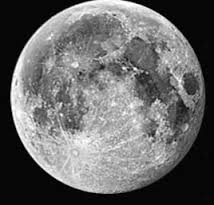
What moon phase is this image?

a)

Full

b)

New

16.

The cycle of the moon lasts about a _.

a)

month

b)

year

c)

week

17.

True or False: The moon produces its own light.

a)

True

b)

False

18.

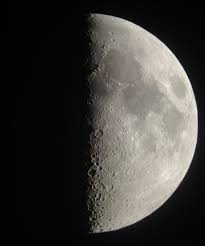
Name the moon phase

a)

First Quarter

b)

Full Moon

c)

New Moon

19.

Tides (marea) are caused by ___________

a)

wind

b)

gravitational pull of moon

c)

rain

20.
Name the moon phase
a)
First Quarter
b)
Last Quarter
c)
New Moon
d)
Full Moon
21.

The Earth makes one complete revolution of the Sun in...

a)

24 hours

b)

365 days

c)

28 days

d)

365.25 days

22.

The movement of the Earth around the Sun is called...

a)

rotation

b)

revolution

23.

These two things cause seasons on Earth are....

a)

the revolution of the Earth around the Sun

&

the Earth's tilt

b)

the rotation of the Earth around the Sun

&

Earth's tilt

c)

the revolution of the Earth around the Sun

&

Earth's rotation

d)

the rotation of the Earth on its axis

&

Earth's tilt

24.

What causes day and night on Earth?

a)

Earth's tilt

b)

Earth's orbit around the Sun

c)

Earth's rotation on its axis

d)

the Moon's orbit of Earth

25.

Which hemisphere is having summer in this diagram?

a)

the Northern Hemisphere

b)

the Southern Hemisphere

26.

One rotation of the Earth takes..

a)

one hour

b)

one year

c)

twenty-four hours

d)

one week

27.

Which hemisphere is tilting towards the sun in this diagram?

a)

Northern

b)

Southern

28.

When the Northern Hemisphere is having winter, the Southern Hemisphere has...

a)

winter

b)

spring

c)

summer

d)

fall

29.
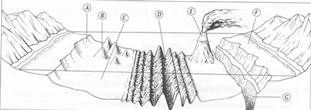
What is letter F pointing to?
a)
Continental Shelf
b)
Continental Slope
c)
Mid-Ocean Ridge
d)
Ocean Basin
30.
What is letter A pointing to?
a)
Continental Shelf
b)
Continental Slope
c)
Mid-Ocean Ridge
d)
Ocean Basin
31.
What is letter G pointing to?
a)
Trench
b)
Continental Slope
c)
Mid-Ocean Ridge
d)
Ocean Basin
32.
This is a mountain range in the middle of the ocean floor.
a)
Ocean Basin
b)
Rift Zone
c)
Mid-Ocean Ridge
d)
Rocky Mountain Ridge
33.
While on vacation at the beach, you can walk out on part of this part of the ocean floor.
a)
Ocean Basin
b)
Continental Slope
c)
Trench
d)
Continental Shelf
34.
Which is deeper, a land valley or an ocean trench?
a)
Trench
b)
Valley
35.
What is letter C?
a)
Mid-Ocean Ridge
b)
Cont. Shelf
c)
Cont. Slope
d)
Abyssal Plain
36.
Scientists use ______ to determine the oceans depth.
a)
Submarines
b)
Sonar
c)
Helicopters
d)
Radiowaves
37.
Which best represents the order of seafloor features as you move from the shoreline to the deep ocean?
a)
 Continental slope – continental shelf- continental rise – mid-ocean ridge
b)
 Continental rise – continental shelf – mid-ocean ridge -  continental slope
c)
 Continental shelf – continental slope – continental rise – mid-ocean ridge
d)
   Mid-ocean ridge – continental rise – continental shelf- continental slope
38.

The Mariana __________ is the deepest known place on Earth

a)

Volcanoe

b)

Seamount

c)

Ridge

d)

Trench

39.

The measure of the amount of salt dissolved in a given amount of liquid.

a)

Sea Mount

b)

Salinity

c)

Saltonomous

d)

Salty McSaltster

40.

A stream of water moving like a river through the ocean is called ___

a)

Wave

b)

Tide

c)

Current

41.

The deeper you go in the ocean, the water gets ________

a)

colder

b)

warmer

42.
 How do conditions change as the depth of the ocean water increases?
a)
temperature decreases and pressure increases
b)
temperature increases and pressure increases
c)
temperature decreases and pressure decreases
d)
temperature increases and pressure decreases
43.

Which pictures shows the correct "Global Conveyor Belt"?

a)
b)
c)
d)
44.

Which best describes the Gulf Stream?

a)

an ocean current which originates in the Gulf of Mexico and causes warm water to travel up the east coast of the United States

b)

an ocean current which originates in the Gulf of Mexico and causes cool water to travel up the east coast of the United States

c)

an ocean current which originates in the Gulf of Mexico and causes warm water to travel down the east coast of Mexico

d)

an ocean current which originates in the Gulf of Mexico and causes cool water to travel down the east coast of Mexico

45.
What layer is 2?
a)
Crust 
b)
Mantel
c)
Outer Core
d)
Inner Core
46.
True or False. The Earth's crust is thick melted rock
a)
True
b)
False
47.
What layer is 1?
a)
Crust
b)
Mantel
c)
Outer Core
d)
Inner Core
48.
Which part of the core is liquid metal?
a)
outer core
b)
inner core
49.
What two metals make up the core?
a)
aluminum and silver
b)
iron and nickel
50.
What Layer is 3?
a)
Crust
b)
Mantle
c)
Outer Core
d)
Inner Core
51.
What layer is 5?
a)
Crust
b)
Mantle
c)
Outer Core
d)
Inner Core
52.

Heat and ____________ can change sedimentary rock into metamorphic rock.

a)

Pressure

b)

Melting

c)

Coolig

53.

Igneous rocks form from the __________ of magma or lava.

a)

Pressure

b)

Cooling

c)

Heat

54.

Which type of rock often contains fossils and how do you think this occurs?

a)

Sedimentary rocks

b)

Metamorphic

c)

Igneous

55.

What Are The Three Main Types Of Rocks?

a)

Igneous, Depository, Metamorphic

b)

Depository, Igneous, Sedimentary

c)

Metamorphic, Igneous, Depository

d)

Igneous, Metamorphic, Sedimentary

56.

How are igneous rocks formed?

a)

Sediment forming together

b)

Heating and pressure

c)

Cooling

d)

Deposition

57.

How are sedimentary rocks formed?

a)

Heating and pressure

b)

Sediment forming together

c)

Weathering

d)

Cooling

58.
Associated with transform boundaries.
a)
Volcanoes
b)
mountains
c)
trenches
d)
earthquakes
59.
A location where two tectonic plates collide is known as a _________ boundary.
a)
Convergent
b)
Divergent
c)
Transform
d)
Spreading
60.

Which layer of Earth flows slowly and causes the crust to move?

a)

Crust

b)

Mantle

c)

Inner Core

d)

Outer core

61.
Name the boundary
a)
convergent
b)
transform
c)
divergent
d)
subduction
62.
What is a tectonic plate?
a)
A piece of the Earth's crust
b)
A piece of Earth's mantle
c)
A piece of Earth's core
d)
A piece of Earth's Moon
63.
Lava that is still deep inside the earth is called ____________________________.
a)
lava
b)
magma
c)
volcano
d)
earthquake
64.

What is a group of organisms of the same species in a specific area?

a)

community

b)

population

c)

ecosystem

65.

What is a community of organisms and their environment?

a)

community

b)

population

c)

ecosystem

66.

What is all the populations of species that live in the same area and interact with each other?

a)

community

b)

population

c)

ecosystem

67.

In an ecosystem, what are the organisms that make their own food?

(a)  

68.

In an ecosystem, what are the organisms that eat other organisms?

(a)  

69.

A place where living and nonliving things interact

a)

population

b)

community

c)

ecosystem

d)

nutrient cycle

70.
The term for the role an organism has in the community.
a)
niche
b)
habitat
c)
tolerances
d)
competition
71.
Bacteria and fungi are known as _________________ because they break down the remains of organisms.
a)
scavengers
b)
herbivores
c)
decomposers
d)
producers
72.

1. All organisms need _______ to survive.

a)

food

b)

water

c)

shelter

d)

all of the above